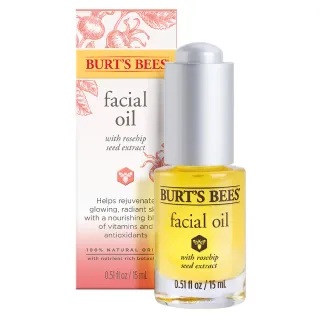
Burt's Bees Complete Nourishment Facial Oil, Anti-Aging Oil
Works for
3 of 3 advertised claims delivered
Anti-agingBakuchiol, Tocopherol + 1 moreStrong evidence
“Reduce the appearance of fine lines and wrinkles with Burt's Bees Complete Nourishment Facial Oil.”
This product can help reduce and prevent fine lines and wrinkles, improve skin elasticity and firmness because it contains bakuchiol.
Keep in mind that it typically takes at least 6 weeks to notice any results because the changes that are needed to improve fine lines and elasticity happen in the deeper layers of the skin. No topical anti-aging product can “erase” wrinkles or fully reverse signs of aging.
Anti-oxidationTocopherol, Bakuchiol + 5 moreStrong evidence
This product contains antioxidants (bakuchiol, tocopherol) that can help neutralize free radicals in skin. By doing so, they can lessen the damage the skin gets from the UV light (sun).
MoisturizingGlycine soja oil, Borago officinalis seed oil + 5 moreGood evidence
“This concentrated blend of Rosehip, Jojoba and Evening Primrose is packed with essential fatty acids, vitamins and antioxidants that help rejuvenate dull skin, as well as provide all day hydration.”
This product can help soften the skin and reduce its moisture loss with emollients and occlusives: helianthus annuus seed oil, simmondsia chinensis seed oil.
Keep in mind that this product does not contain effective ingredients to attract water to the upper layer of the skin. This is why an additional product with humectants like glycerin or hyaluronic acid can be helpful (apply it before this product for the best results).
Evens skin toneNot advertised by the brand · BakuchiolStrong evidence
This product can help reduce hypepigmentation and even out the skin tone because it contains the following effective ingredients: bakuchiol
Keep in mind that you would need to apply any topical skincare targetted at hypigmentation consistently for a couple of months to get a result. No topical skincare product can help get rid of hyperpigmentation (including post-acne marks and age spots) instantly.
Anti-blemishNot advertised by the brand · Bakuchiol, Rosmarinus officinalis leaf extractGood evidence
This product might be able to help reduce blemishes and clogged pores because it contains bakuchiol.
Can it cause trouble?
Irritancy8 strong irritants: Parfum, Rosmarinus officinalis leaf extract + 6 more — patch-test recommendedHigh risk
Comedogenic2 ingredients rated 2 or more on the 0–5 pore-clogging scale2 flagged
User reviews
Be the first — your take helps the next person decide.
Ingredients
Filter by role to see what each ingredient is doing.
Rosa canina seed extract~25–37%
- Irritation risk
- Low
Simmondsia chinensis seed oil~6.5–9.7%
- Irritation risk
- Medium
Softens the upper layer of skin and helps restore the healthy skin barrier. Has shown to help calm down inflammation in skin. It is a stable oil, meaning that it retains its properties even when exposed to air.
More about Simmondsia chinensis seed oilBorago officinalis seed oil~4.9–7.3%
- Irritation risk
- Low
A plant oil that is effective in reducing irritation in skin, restore the barrier function and support its hydration
More about Borago officinalis seed oilCorylus avellana seed oil~3.5–5.3%
- Irritation risk
- Low
Oenothera biennis seed extract~2.6–4%
- Irritation risk
- Medium
A plant extract that might have some anti-oxidant properties but evidence is lacking
More about Oenothera biennis seed extractTriticum vulgare germ oil~2.2–3.3%
- Irritation risk
- Low
- Comedogenicity
- 3/5
A good emoillient. Contains vitamin E which can help neutralise free radicals, however the oil is unstable. Avoid if you have gluten or wheat sensitivity (including food allergies).
More about Triticum vulgare germ oilParfum~1.5–2.3%
- Irritation risk
- High
An aromatic blend of unspecified and possibly irritating ingredients
More about ParfumTocopherol~1.2–1.9%
- Irritation risk
- Low
Pure form of vitamin E. Can help moisturise and protect the skin from free radicals. Often used to help stabilise other ingredients or the formula itself
More about TocopherolHelianthus annuus seed oil~1.3–2%
- Irritation risk
- Low
A great emollient due to its high linoleic acid content. One of the most effective plant oils in helping skin hydration and repairing skin barrier function
More about Helianthus annuus seed oilBakuchiol~1–1.5%
- Irritation risk
- Medium
A plant extract that is, though different in chemical structure, acts similar to retinoids. First studies show that it can help reduce fine lines and wrinkles, improve skin tone, reduce clogged pores and blemishes, and reduce inflammation. There is no conclusive evidence that bakuchiol is as effective as retinol however. The study that directly compared retinol with bakuchiol used bakuchiol applied twice daily compared to once per day for the retinol. According to this study, bakuchiol is less irritating than retinol. Bakuchiol is extracted from seeds of Babchi plant. Other parts of the plant contain coumarins that could cause allergic and irritant reactions. These compounds should be removed in the extraction process when bakuchiol is produced, but it is a good idea to be cautious and stay away from products that include the Babchi plant extracts other than purified bakuchiol to avoid irritation
More about BakuchiolGlycine soja oil~0.85–1.3%
- Irritation risk
- Medium
- Comedogenicity
- 2/5
A good emollient that helps soften the skin and helps repair its barrier function. It can clog pores if used in high concentrations.
More about Glycine soja oilBeta-carotene~0.55–1.3%
Canola oil~0.55–1.3%
- Irritation risk
- Medium
A plant oil that can help soften the upper layer of the skin
More about Canola oilRosmarinus officinalis leaf extract~0.4–0.95%
- Irritation risk
- High
Can be helpful in reducing inflammation in skin, including inflamed acne. It can be irritating
More about Rosmarinus officinalis leaf extractAscorbyl palmitate~0.2–0.75%
- Irritation risk
- Medium
Being a lipid soluble form of vitamin C, it is more stable and can penetrate the skin better than L-Ascorbic acid. It is effective in protecting the skin from free radicals, as well as evening the skin tone, but is less effective in stimulating collagen production compared to L-Ascorbic acid.
More about Ascorbyl palmitateCitronellol~0.15–0.65%
Coumarin~0.1–0.5%
Hexyl cinnamal~0.1–0.4%
Hydroxycitronellal~0.1–0.35%
- Irritation risk
- High
A fragrance. A likely allergen and can be irritating
More about HydroxycitronellalLimonene~0.05–0.25%
- Irritation risk
- High
A common frangrance that can easily irritate skin, especially if exposed to air, light or heat
More about LimoneneLinalool~0.05–0.2%
Ingredient list view
Rosa canina seed extract, Simmondsia chinensis seed oil, Borago officinalis seed oil, Corylus avellana seed oil, Oenothera biennis seed extract, Triticum vulgare germ oil, Parfum, Tocopherol, Helianthus annuus seed oil, Bakuchiol, Glycine soja oil, Beta-carotene, Canola oil, Rosmarinus officinalis leaf extract, Ascorbyl palmitate, Citronellol, Coumarin, Hexyl cinnamal, Hydroxycitronellal, Limonene, Linalool
Compare prices
Retailers ranked by price — lowest first.
Worth comparing, line by line.
Match % combines shared ingredients, the first five ingredients, shared actives and hero ingredients, irritancy (lower counts in the alternative's favour), texture and body area. Only products in the same routine step are compared.
| Burt's BeesComplete Nourishment Facial Oil, Anti-Aging OilYOUR PRODUCT | HerbarThe Face Oil | Kinvara Skin CarePrecious Facial Oil | OmoroviczaMiracle Facial Oil | |
|---|---|---|---|---|
| Match | — | 85% | 84% | 83% |
| Price | $25.00 | — | $23.00−$2.00 | $113.63+$88.63 |
| Shared key ingredients | — | 3 of 8 | 5 of 8 | 5 of 8 |
| Key difference | — | Cannabis Sativa Seed Oil | Squalane | Caprylic/Capric Triglyceride |
| Irritancy | High | Medium | Medium | High |
| Drying alcohol | — | — | Contains drying alcohol | — |
| View product | Shop | Shop | Shop |


Sources cited in this review
Every concentration estimate and effectiveness label is anchored to one of these 16 studies and safety reviews.
- 1
- 2
- 3
- 4Vitamin E in dermatologyncbi.nlm.nih.gov
- 5Vitamin E and Skin Healthlpi.oregonstate.edu
- 6

Affiliate links · As an Amazon Associate, WIMJ earns from qualifying purchases.