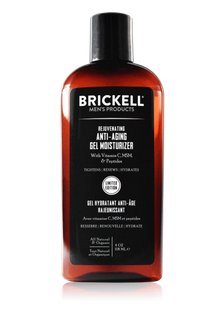
Brickell Men's Products Rejuvenating Anti-Aging Gel Moisturizer for Men
Works for
2 of 2 advertised claims delivered
Anti-aging9 ingredients credited for this claimModerate support
“Rejuvenating Anti-Aging Gel Moisturizer for Men”
This product contains aspartic acid, serine, threonine. These ingredients might be able to help reduce and prevent fine lines and wrinkles, improve skin elasticity and firmness, but there is not enough evidence that it actually works.
Moisturizing20 ingredients credited for this claimGood support
“Rejuvenating Anti-Aging Gel Moisturizer for Men”
This product can help improve hydration of the skin with the two types of ingredients.
The first type is called “humectants”:
these ingredients help attract water.
When humectants are on the surface of the skin, they “pull in” the moisture from the outside environment, or from
within deeper layers of the skin. The following ingredients in this product do the job:
alanine, arginine.
This product also contains ingredients called “occlusives”. They help reduce the speed with which our skin loses moisture to the outside environment. These ingredients also help soften the upper layer of the skin, so it feels less tight and nicer to the touch. The following ingredients in this product do the job: arginine, simmondsia chinensis seed oil.
Anti-oxidationNot advertised by the brand · 6 ingredients credited for this claimModerate support
This product contains antioxidants (sodium ascorbyl phosphate) that might be able to help neutralize free radicals in skin to lessen the damage it gets from the UV light (sun). There is not enough evidence to confirm their effectiveness in skin though.
Can it cause trouble?
Irritancy5 strong irritants: Equisetum arvense extract, Geranium maculatum extract + 3 more — patch-test recommendedHigh risk
ComedogenicClean of flagged comedogenic ingredientsNone flagged
User reviews
Be the first — your take helps the next person decide.
Ingredients
Filter by role to see what each ingredient is doing.
Water~45–55%
Sodium ascorbyl phosphate~6.2–7.6%
- Irritation risk
- Medium
A stable derivative of vitamin C. It is oil-soluble which means it is more likely to penetrate the skin compared to the pure form of vitamin C (which is water-soluble), but it is less bio-available and is way less effective in stimulating collagen and reducing wrinkles compared to the pure form of vitamin C (L-ascorbic acid) and its other derivatives (for example, magnesium ascorbyl phosphate). At the same time, this vitamin C derivative has been shown in studies to be effective in reducing acne, blemishes and clogged pores. It is less irritating then the pure form of vitamin C
More about Sodium ascorbyl phosphateSimmondsia chinensis seed oil~4.4–5.4%
- Irritation risk
- Medium
Softens the upper layer of skin and helps restore the healthy skin barrier. Has shown to help calm down inflammation in skin. It is a stable oil, meaning that it retains its properties even when exposed to air.
More about Simmondsia chinensis seed oilCaesalpinia spinosa gum~3.3–4%
Hyaluronic acid~2.3–2.8%
- Irritation risk
- Low
One of the best moisturizing ingredients. Attracts water into the upper layer of the skin. Naturally present in skin. Typically has large molecule size unless advertised otherwise on the product label. Helps support skin's barrier function and may help to reduce inflammation
More about Hyaluronic acidCucumis sativus fruit water~1.9–2.3%
Cucumis sativus extract~1.6–2%
- Irritation risk
- Medium
Sodium pca~1.4–1.7%
- Irritation risk
- Low
Naturally present in skin and helps to attract water to its upper layer
More about Sodium pcaSodium lactate~1.2–1.4%
- Irritation risk
- Medium
Helps attract water to the upper layer of the skin. Is often used to adjust the pH level of the product
More about Sodium lactateLactic acid~0.95–1.15%
- Irritation risk
- Medium
An exfoliating and moisturizing alpha-hydroxy acid (AHA). Typically causes less irritation than other AHAs, for example, glycolic acid. At high concentrations (about 15%), lactic acid can help reduce lines and wrinkles. Recent studies show that lactic acid can support the "good" bacteria living on skin's surface (healthy skin microbiome)
More about Lactic acidArginine~0.7–1.05%
- Irritation risk
- Low
An amino acid that is naturally present in skin and helps keep it hydrated. When used together with AHAs, it can reduce their irritating effect on the skin
More about ArginineAspartic acid~0.6–0.9%
- Irritation risk
- Low
An amino-acid that helps increase skin hydration and might help to slightly improve skin firmness, potentially reducing lines and wrinkles
More about Aspartic acidGlycine~0.55–0.85%
- Irritation risk
- Low
Helps to attract water to the upper layer of the skin and can help restore the skin barrier function
More about GlycineAlanine~0.5–0.75%
- Irritation risk
- Low
An amino-acid that helps to attract water to the upper layer of the skin and might help to lighten the skin, but solid evidence is lacking
More about AlanineSerine~0.5–0.7%
- Irritation risk
- Low
An amino-acid that helps to attract water to the upper layer of the skin. In combination with other amino-acids, might help to reduce fine lines and wrinkles
More about SerineValine~0.5–0.7%
- Irritation risk
- Low
Isoleucine~0.45–0.7%
- Irritation risk
- Low
An amino acid that can help attract water to the upper layer of the skin and support skin's barrier function
More about IsoleucineProline~0.45–0.7%
Threonine~0.4–0.65%
- Irritation risk
- Low
An amino-acid that helps to attract water to the upper layer of the skin. In combination with other amino-acids, might help to reduce fine lines and wrinkles
More about ThreonineHistidine~0.35–0.65%
Phenylalanine~0.35–0.6%
- Irritation risk
- Low
Aloe barbadensis leaf juice~0.3–0.6%
- Irritation risk
- Medium
Traditionally used to treat sunburns, dermatitis and inflammation, but evidence for its effectiveness is lacking. The extract can contain humectants that help attract water into the skin
More about Aloe barbadensis leaf juiceAloe barbadensis extract~0.3–0.55%
- Irritation risk
- Medium
Traditionally used to treat sunburns, dermatitis and inflammation, but evidence for its effectiveness is lacking. The extract can contain humectants that help attract water into the skin
More about Aloe barbadensis extractDimethyl sulfone~0.3–0.6%
Glycyrrhiza glabra root extract~0.3–0.55%
- Irritation risk
- Medium
A plant extract that can help lighten the skin and calm down inflammation. Might be helpful in neutralizing free radicals
More about Glycyrrhiza glabra root extractVinca major extract~0.3–0.55%
- Irritation risk
- Low
Tocopheryl acetate~0.3–0.55%
- Irritation risk
- Medium
A more stable but less bio-available form of vitamin E compared to Tocopherol. Might help moisturize and protect the skin from free radicals, but mostly used in low concentrations to stabilize other ingredients.
More about Tocopheryl acetateTocopherol~0.3–0.55%
- Irritation risk
- Low
Pure form of vitamin E. Can help moisturise and protect the skin from free radicals. Often used to help stabilise other ingredients or the formula itself
More about TocopherolCentella asiatica extract~0.35–0.65%
- Irritation risk
- Medium
A plant extract that has been shown to be able to reduce inflammation in skin, support restoration of skin barrier function, as well as support collagen production. Contains active compounds called centelloids: asiaticoside, madecasosside, asiatic acid and madecassic acid. Might be helpful in preventing stretch marks. It can be itself be irritating though.
More about Centella asiatica extractEquisetum arvense extract~0.3–0.55%
- Irritation risk
- High
A plant extract that might have anti-oxidant properties. Can be irritating
More about Equisetum arvense extractGeranium maculatum extract~0.2–0.4%
- Irritation risk
- High
Contains an essential oil. Can be irritating
More about Geranium maculatum extractTaraxacum officinale extract~0.2–0.4%
- Irritation risk
- High
A plant extract that might have anti-oxidant and anti-inflammatory properties, but evidence of effectiveness in skin is lacking. Can be an allergen
More about Taraxacum officinale extractAcrylates/c10-30 alkyl acrylate crosspolymer~0.2–0.35%
- Irritation risk
- Medium
Maintains the texture of skincare products. Allows the product to spread evenly. Helps oil and water mix together
More about Acrylates/c10-30 alkyl acrylate crosspolymerSodium hydroxide~0.15–0.3%
Phenoxyethanol~0.1–0.25%
- Irritation risk
- Low
A preservative. It helps prevent bacterial growth in cosmetic products
More about PhenoxyethanolEthylhexylglycerin~0.1–0.2%
Citrus limon peel oil~0.1–0.15%
Citrus aurantifolia oil~0.15–0.25%
- Irritation risk
- High
Zingiber officinale root oil~0.05%
- Irritation risk
- High
An essential oil that is likely to be irritating and can cause photosensitivity
More about Zingiber officinale root oilIngredient list view
Water, Sodium ascorbyl phosphate, Simmondsia chinensis seed oil, Caesalpinia spinosa gum, Hyaluronic acid, Cucumis sativus fruit water, Cucumis sativus extract, Unknown, Sodium pca, Sodium lactate, Lactic acid, Arginine, Aspartic acid, Glycine, Alanine, Serine, Valine, Isoleucine, Proline, Threonine, Histidine, Phenylalanine, Aloe barbadensis leaf juice, Aloe barbadensis extract, Dimethyl sulfone, Glycyrrhiza glabra root extract, Vinca major extract, Tocopheryl acetate, Tocopherol, Centella asiatica extract, Equisetum arvense extract, Geranium maculatum extract, Taraxacum officinale extract, Acrylates/c10-30 alkyl acrylate crosspolymer, Sodium hydroxide, Phenoxyethanol, Ethylhexylglycerin, Citrus limon peel oil, Citrus aurantifolia oil, Zingiber officinale root oil
Compare prices
Retailers ranked by price — lowest first.
Affiliate links · prices updated regularly · As an Amazon Associate, WIMJ earns from qualifying purchases.
Product summary
Based on the ingredients included, "Brickell Men's Products - Rejuvenating Anti-Aging Gel Moisturizer for Men" works well for moisturizing the skin. The formulation is based on a combination of good humectants and emollients. Both are needed to increase the skin hydration level. Humectants in this product (alanine, arginine, aspartic acid, glycine and histidine) help to increase the water content in the upper layer of the skin. (These ingredients do so by "capturing" water molecules from the outside air or from within the deeper layers of the skin). Emollients in this formulation (arginine, simmondsia chinensis seed oil and caesalpinia spinosa gum) help to reduce the moisture loss from the skin. They also soften the skin surface and relieve the feeling of dryness and tightness.
Ingredient callouts
- We love that this moisturizer contains a good concentration of niacinamide 4.10% - 5.00%. Niacinamide is a perfect active in a moistruizer because it helps calm down inflamation in skin and support the skin barrier. More than that, it is helpful for most common skin concerns: it helps regulat oil production, help reduce acne and clogged pores, improve skin tone and prevent pigmentation marks. It also helps fight photodamage.
Irritation risk
There are quite a few common irritants in this product, including ingredients without particular skin benefits. We would not recommend it for sensitive skin. We assess the overall irritancy of this moisturizer to be high. For a detailed overview of all potential irritants: click here
You can see the detailed formula review with the breakdown of all actives in the product and the full ingredient list with estimated concentrations in the tables below.
Sources cited in this review
Every concentration estimate and effectiveness label is anchored to one of these 34 studies and safety reviews.
- 1
- 2Sodium ascorbyl phosphate in topical microemulsionssciencedirect.com
- 3
- 4
- 5
- 6

Affiliate links · As an Amazon Associate, WIMJ earns from qualifying purchases.