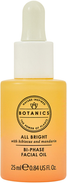
Botanics All Bright Bi-Phase Oil
Works for
1 of 2 advertised claims delivered
MoisturizingCarthamus tinctorius seed oil, Glycerin + 1 moreGood evidence
This product can help improve hydration of the skin with the two types of ingredients.
The first type is called “humectants”:
these ingredients help attract water.
When humectants are on the surface of the skin, they “pull in” the moisture from the outside environment, or from
within deeper layers of the skin. The following ingredients in this product do the job:
glycerin.
This product also contains ingredients called “occlusives”. They help reduce the speed with which our skin loses moisture to the outside environment. These ingredients also help soften the upper layer of the skin, so it feels less tight and nicer to the touch. The following ingredients in this product do the job: carthamus tinctorius seed oil.
Evens skin toneAscorbyl glucosideWeak evidence
“This Botanics All Bright Bi-Phase Facial Oil combines nourishing vitamin E and safflower oil with a water phase of natural AHAs to improve the appearance of uneven skin tone and texture.”
Effective ingredients missing or their concentration is too low
Can it cause trouble?
Irritancy6 strong irritants: Hibiscus sabdariffa flower extract, Limonene + 4 more — patch-test recommendedHigh risk
ComedogenicClean of flagged comedogenic ingredientsNone flagged
User reviews
Be the first — your take helps the next person decide.
Ingredients
Filter by role to see what each ingredient is doing.
Carthamus tinctorius seed oil~23–34%
- Irritation risk
- Low
An emollient that helps soften the skin and might help calm down inflammation
More about Carthamus tinctorius seed oilWater~12–18%
Glycerin~4.3–6.5%
- Irritation risk
- Low
One of the best moisturizing ingredients. Naturally present in skin. It attracts water to the upper layer of the skin working as a humectant
More about GlycerinVaccinium myrtillus fruit/leaf extract~3.5–5.2%
- Irritation risk
- Low
Hibiscus sabdariffa flower extract~2.5–3.7%
- Irritation risk
- High
A plant extract that can be irritating. It might contain a compound anthocyanin that could be helpful in neutralizing free radicals
More about Hibiscus sabdariffa flower extractLimonene~1.7–2.5%
- Irritation risk
- High
A common frangrance that can easily irritate skin, especially if exposed to air, light or heat
More about LimoneneSaccharum officinarum extract~1.4–2.2%
- Irritation risk
- Low
Sugar extract that helps attract water to the upper layer of the skin
More about Saccharum officinarum extractPotassium hydroxide~1.2–1.8%
Phenoxyethanol~0.5–1%
- Irritation risk
- Low
A preservative. It helps prevent bacterial growth in cosmetic products
More about PhenoxyethanolTocopheryl acetate~0.9–1.35%
- Irritation risk
- Medium
A more stable but less bio-available form of vitamin E compared to Tocopherol. Might help moisturize and protect the skin from free radicals, but mostly used in low concentrations to stabilize other ingredients.
More about Tocopheryl acetateCitrus reticulata peel oil~0.5–1.15%
- Irritation risk
- High
An essential oil used for fragrance. Can be an allergen and irritant
More about Citrus reticulata peel oilCitrus limon fruit extract~0.45–1.05%
- Irritation risk
- High
Used as a fragrance. Can be irritating and cause photosensitivity
More about Citrus limon fruit extractCitrus aurantium dulcis fruit extract~0.4–0.9%
- Irritation risk
- High
A plant extract that is used as a fragrance. Can be irritating and lead to photosensitivity
More about Citrus aurantium dulcis fruit extractAscorbyl glucoside~0.35–0.8%
- Irritation risk
- Medium
A vitamin C derivative that is more stable but less potent than pure form of vitamin C. Has a potential to boost collagen production, nutralise free radicals and reduce hyperpigmentation, but the required concentration is likely to be much higher than for the pure form of vitamin C, limiting the ingredient's effectiveness in products
More about Ascorbyl glucosideSodium chloride~0.3–0.75%
- Irritation risk
- Low
Used to stabilize mixtures of oil and water, and create thicker, gel-like product textures
More about Sodium chlorideAcer saccharum extract~0.15–0.65%
- Irritation risk
- Medium
A plant extract that contains small percentage of AHAs. Is unlikely to have any skin benefit due the small concentration of the active compounds
More about Acer saccharum extractSodium benzoate~0.1–0.4%
Tetrasodium edta~0.1–0.3%
Linalool~0.05–0.25%
Benzoic acid~0.05–0.2%
Dehydroacetic acid~0.05–0.25%
Ethylhexylglycerin~0.05–0.2%
Ingredient list view
Carthamus tinctorius seed oil, Water, Glycerin, Vaccinium myrtillus fruit/leaf extract, Hibiscus sabdariffa flower extract, Limonene, Saccharum officinarum extract, Potassium hydroxide, Phenoxyethanol, Tocopheryl acetate, Citrus reticulata peel oil, Citrus limon fruit extract, Citrus aurantium dulcis fruit extract, Ascorbyl glucoside, Sodium chloride, Acer saccharum extract, Sodium benzoate, Tetrasodium edta, Linalool, Benzoic acid, Dehydroacetic acid, Ethylhexylglycerin
Compare prices
Retailers ranked by price — lowest first.
Affiliate links · prices updated regularly · As an Amazon Associate, WIMJ earns from qualifying purchases.
Sources cited in this review
Every concentration estimate and effectiveness label is anchored to one of these 10 studies and safety reviews.
- 1
- 2
- 3Hibiscus sabdariffa L. – A phytochemical and pharmacological reviewsciencedirect.com
- 4
- 5
- 6

Affiliate links · As an Amazon Associate, WIMJ earns from qualifying purchases.