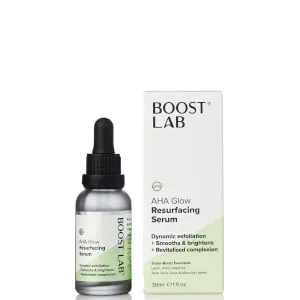
Works for
ExfoliationLactic acidWorks well
“AHA Resurfacing Serum”
This product can help exfoliate the skin. In other words, it helps break down the bonds between dead cells on the surface of the skin and speed up the skin turnover. Skin often appears softer and brighter after exfoliation, but overdoing it can result in disrupted skin barrier. The following ingredient is doing the exfoliating job in this product: lactic acid.
Evens skin toneSide benefit · Lactic acidWorks well
This product can help reduce hypepigmentation and even out the skin tone because it contains the following effective ingredients: lactic acid
Keep in mind that you would need to apply any topical skincare targetted at hypigmentation consistently for a couple of months to get a result. No topical skincare product can help get rid of hyperpigmentation (including post-acne marks and age spots) instantly.
Anti-agingSide benefit · Lactic acid, Aloe barbadensis leaf juiceMay help
This product contains lactic acid. There is some human evidence that this ingredient helps reduce and prevent fine lines and wrinkles and improve skin elasticity and firmness, though it is smaller or less consistent than the evidence for the best anti-aging ingredients.
MoisturizingSide benefit · Lactic acid, Glycerin + 4 moreWorks
This product can help improve hydration of the skin with the two types of ingredients.
The first type is called “humectants”:
these ingredients help attract water.
When humectants are on the surface of the skin, they “pull in” the moisture from the outside environment, or from
within deeper layers of the skin. The following ingredients in this product do the job:
arginine, glycerin.
This product also contains ingredients called “occlusives”. They help reduce the speed with which our skin loses moisture to the outside environment. These ingredients also help soften the upper layer of the skin, so it feels less tight and nicer to the touch. The following ingredients in this product do the job: arginine, mel.
Can it cause trouble?
Irritancy6 flagged ingredientsLow risk
ComedogenicClean of flagged comedogenic ingredientsNone flagged

User reviews
Be the first — your take helps the next person decide.
Ingredients
Filter by role to see what each ingredient is doing.
Water~40–60%
Lactic acid~4.8–7.2%
- Irritation risk
- Medium
An exfoliating and moisturizing alpha-hydroxy acid (AHA). Typically causes less irritation than other AHAs, for example, glycolic acid. At high concentrations (about 15%), lactic acid can help reduce lines and wrinkles. Recent studies show that lactic acid can support the "good" bacteria living on skin's surface (healthy skin microbiome)
More about Lactic acidGlycerin~3.5–5.3%
- Irritation risk
- Low
One of the best moisturizing ingredients. Naturally present in skin. It attracts water to the upper layer of the skin working as a humectant
More about GlycerinPropylene glycol~2.6–3.9%
- Irritation risk
- High
Helps oil and water mix together and can enhance the penetration of other ingredients into the skin. It can be irritating
More about Propylene glycolPeg-40 hydrogenated castor oil~1.9–2.9%
- Irritation risk
- Medium
Helps oil and water mix together
More about Peg-40 hydrogenated castor oilAloe barbadensis leaf juice~1.4–2.1%
- Irritation risk
- Medium
Traditionally used to treat sunburns, dermatitis and inflammation, but evidence for its effectiveness is lacking. The extract can contain humectants that help attract water into the skin
More about Aloe barbadensis leaf juicePolyacrylate crosspolymer-6~1–1.5%
- Irritation risk
- Low
Arginine~0.8–1.25%
- Irritation risk
- Low
An amino acid that is naturally present in skin and helps keep it hydrated. When used together with AHAs, it can reduce their irritating effect on the skin
More about ArginineMel~0.45–1.1%
- Irritation risk
- Low
Helps to soften the upper layer of the skin and attract water to it
More about MelBisabolol~0.1–0.45%
- Irritation risk
- Low
An active component of chamomile plant that historically has been used to calm down irritated skin. A recent study shows that bisabolol indeed can have some anti-inflammatory effect on skin, even though conclusive data is lacking. Bisabolol has a sweet floral scent and can be added to products for its aromatic properties
More about BisabololT-butyl alcohol~0.1–0.35%
- Irritation risk
- Medium
Used to dissolve other ingredients and to improve smell of products. It could be irritating
More about T-butyl alcoholPhenoxyethanol~0.05–0.25%
- Irritation risk
- Low
A preservative. It helps prevent bacterial growth in cosmetic products
More about PhenoxyethanolEthylhexylglycerin~0.05–0.1%
Ingredient list view
Water, Lactic acid, Glycerin, Propylene glycol, Peg-40 hydrogenated castor oil, Aloe barbadensis leaf juice, Polyacrylate crosspolymer-6, Arginine, Mel, Bisabolol, T-butyl alcohol, Phenoxyethanol, Ethylhexylglycerin
Compare prices
Retailers ranked by price — lowest first.

Worth comparing, line by line.
Match % combines shared ingredients, the first five ingredients, shared actives and hero ingredients, irritancy (lower counts in the alternative's favour), texture and body area. Only products in the same routine step are compared.
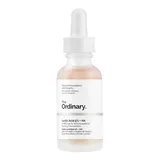
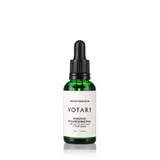
| Boost LabAHA Resurfacing SerumYOUR PRODUCT | ProfkaСыворотка для лица ANTI-ACNE LACTIC SERUM | VotarySensitive Resurfacing Peel | KmartExfoliate Renew Serum - 2% AHA | |
|---|---|---|---|---|
| Match | — | 66% | 64% | 62% |
| Price | — | — | $92.40 | $4.07 |
| Shared key ingredients | — | 3 of 3 | 3 of 3 | 2 of 3 |
| Key difference | — | Soluble Collagen | Salicylic Acid | Sodium Hyaluronate |
| Irritancy | Low | Low | Low | Low |
| Drying alcohol | — | — | — | — |
| View product | Shop | Shop | Shop |

More alternatives: The INKEY List CA Lactic Acid ExfoliantMe Lactic Acid AHA Booster
Product summary
"Boost Lab - AHA Resurfacing Serum" is effective for: Evens skin tone and Exfoliation
This product could be helpful for: Anti-aging and Moisturizing, but its actives are not the most effective or are not well-studied.
Ingredient callouts
- Exfoliating acids (lactic acid 4.30% - 6.50%). In this concentration, they will have a noticeable exfoliating effect. They can also have an anti-aging effect and stimulate collagen production in a long-run. Lactic Acid can also help to attract water to the upper layer (works as a humectant).
- Humectants (lactic acid 4.30% - 6.50%, glycerin 3.50% - 5.30% and arginine 0.90% - 1.35%). These ingredients help attract water to the upper layer of the skin and improve the skin hydration.
Price
The product retails for 29.95A$ in Australia and for 19.95$ in the United States.
For a detailed price comparison: click here.
Sources cited in this review
Every concentration estimate and effectiveness label is anchored to one of these 9 studies and safety reviews.
- 1Epidermal and dermal effects of topical lactic acidncbi.nlm.nih.gov
- 2Dual Effects of Alpha-Hydroxy Acids on the Skinpdfs.semanticscholar.org
- 3
- 4Surfactants and experimental irritant contact dermatitisncbi.nlm.nih.gov
- 5Propylene Glycolpubmed.ncbi.nlm.nih.gov
- 6Skin-sensitizing and irritant properties of propylene glycolonlinelibrary.wiley.com

Affiliate links · As an Amazon Associate, WIMJ earns from qualifying purchases.