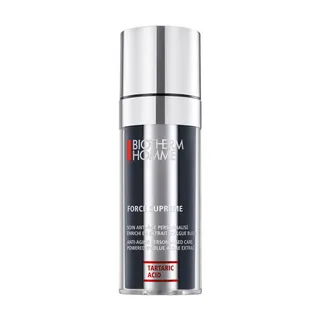
BIOTHERM FORCE SUPREME TARTARIC ACID CARE FOR ACNE SCARS

BIOTHERM FORCE SUPREME TARTARIC ACID CARE FOR ACNE SCARS

Efficacy87/100IrritancyHigh

Works for

Anti-aging
Glycolic acid, Adenosine + 4 more
Works well
What the product description says
“This expert anti-aging serum was specifically designed for men's skin to visibly reduce expression wrinkles, fine lines and lack of firmness in 1 month.”
Source: Biotherm CA

This product can help reduce and prevent fine lines and wrinkles, improve skin elasticity and firmness because it contains adenosine, glycolic acid.

Keep in mind that it typically takes at least 6 weeks to notice any results because the changes that are needed to improve fine lines and elasticity happen in the deeper layers of the skin. No topical anti-aging product can “erase” wrinkles or fully reverse signs of aging.

Glycolic acidKey activeEffect: HighAn alpha-hydroxy acid (AHA) that helps to remove the dead skin cells on the surface of the skin reveling a more even, smoother complexation. It is also able to stimulate collagen production with long-term use. Could help to reduce pore congestion. It can be irritating to the skin. Apply sunscreen daily if using products with glycolic acid~0.25–0.45%
AdenosineKey activeEffect: HighMight help improve cell turnover and reduce inflammation in skin. One study shows that the ingredients might be able to help reduce dynamic wrinkles (for example, in the corners of the eyes or on the forehead)~0.2–0.35%
3-o-ethyl ascorbic acidEffect: LowA vitamin C derivative that is more stable but less potent than pure form of vitamin C. Can help neutralize free radicals and help reduce hyperpigmentation, but the required concentration is likely to be much higher than for the pure form of vitamin C, limiting the ingredient's effectiveness in products~1.2–1.5%
Camellia sinensis leaf extractEffect: LowCan contain potent anti-oxidant compounds (abbreviated ECG, GCG, EGC, and EGCG) that might help protect the skin from free radicals. Can help calm down inflammation and has some anti-bacterial properties. Unfortunately, these antioxidants are unstable and lose their effectiveness very quickly in products. The concentration of the antioxidant compounds in the extract also tends to be low to be effective in topical formulation~0.25–0.45%
TocopherolEffect: Low, below effective dosePure form of vitamin E. Can help moisturise and protect the skin from free radicals. Often used to help stabilise other ingredients or the formula itself~0.25–0.45%
Ascorbyl glucosideUnder-dosedA vitamin C derivative that is more stable but less potent than pure form of vitamin C. Has a potential to boost collagen production, nutralise free radicals and reduce hyperpigmentation, but the required concentration is likely to be much higher than for the pure form of vitamin C, limiting the ingredient's effectiveness in products~0.2–0.4%
Moisturizing
Glycerin, Isocetyl stearate + 22 more
Works
What the product description says
“100% natural, renewable and biodegradable, it contains 35 nutrients that deliver intense regenerating hydration for visibly soothed, soft and luminous skin.”
Source: Biotherm CA

This product can help improve hydration of the skin with the two types of ingredients.

The first type is called “humectants”:
these ingredients help attract water. When humectants are on the surface of the skin, they “pull in” the moisture from the outside environment, or from within deeper layers of the skin. The following ingredients in this product do the job: aphanizomenon flos-aquae extract, glycerin.

This product also contains ingredients called “occlusives”. They help reduce the speed with which our skin loses moisture to the outside environment. These ingredients also help soften the upper layer of the skin, so it feels less tight and nicer to the touch. The following ingredients in this product do the job: isocetyl stearate, cetyl alcohol.

GlycerinKey active· HumectantEffect: HighOne of the best moisturizing ingredients. Naturally present in skin. It attracts water to the upper layer of the skin working as a humectant~4.1–5%
Isocetyl stearateKey active· EmollientEffect: HighAn emollient that helps soften the skin~2.3–2.8%
Hydrogenated starch hydrolysateKey active· HumectantEffect: MediumHelps to attract water to the upper layer of the skin. Can add sweet taste to lip products~1.5–1.8%
Aphanizomenon flos-aquae extractKey active· HumectantEffect: HighAn extract from ablue-green algae. Can help attract water to the upper layer of the skin and might help to neutralize free radicals~0.5–0.75%
Palmaria palmata extractKey activeEffect: HighRed algae extract that helps attract water to the upper layer of the skin~0.35–0.65%
Saccharide isomerateKey active· HumectantEffect: HighHelps attract water to the upper layer of the skin~0.25–0.45%
Sodium hyaluronateKey active· HumectantEffect: HighOne of the best moisturizing ingredients. Attracts water into the upper layer of the skin~0.25–0.45%
Cetyl alcoholKey active· EmollientEffect: MediumA non-drying alcohol that works to soften the skin and stabilize product formulations helping oil and water mix together~0.25–0.5%
Saccharum officinarum extractKey activeEffect: HighSugar extract that helps attract water to the upper layer of the skin~0.2–0.4%
Hydroxypropyl tetrahydropyrantriolKey activeEffect: HighA sugar-derived compound that helps to attract water to the upper layer of the skin and might be able to stimulate synthesis of skin's own moisturizing factors, but solid research is lacking. It could be irritating~0.2–0.35%
Tartaric acidKey activeEffect: MediumAn AHA (alpha-hydroxy acid). It oxidizes quickly which makes it less effective in skincare formulations. It can support skin's barrier and moisture levels~0.2–0.4%
AdenosineKey activeEffect: MediumMight help improve cell turnover and reduce inflammation in skin. One study shows that the ingredients might be able to help reduce dynamic wrinkles (for example, in the corners of the eyes or on the forehead)~0.2–0.35%
Butylene glycol· HumectantEffect: LowUsed to create a nice product texture and help delivery of other ingredients. Might be somewhat helpful in attracting water to the upper layer of the skin~3–3.6%
Dicaprylyl carbonate· EmollientEffect: LowHelps products spread more easily and works as an emollient to soften skin~1.8–2.2%
Isohexadecane· EmollientEffect: LowImproves the texture of the product and helps soften the skin. Helps oil and water mix together and can be used as a cleansing agent~0.3–0.55%
Glyceryl stearate· EmollientEffect: LowAn emollient that softens the skin and forms a protective layer on its surface. Helps water and oil mix together~0.25–0.5%
Palmitic acid· EmollientEffect: LowAn emollient that is naturally present in skin and helps soften it~0.25–0.45%
Caprylyl glycol· Humectant, EmollientEffect: LowHelps preserve products and creates a nice product texture~0.25–0.45%
Camellia sinensis leaf extractEffect: LowCan contain potent anti-oxidant compounds (abbreviated ECG, GCG, EGC, and EGCG) that might help protect the skin from free radicals. Can help calm down inflammation and has some anti-bacterial properties. Unfortunately, these antioxidants are unstable and lose their effectiveness very quickly in products. The concentration of the antioxidant compounds in the extract also tends to be low to be effective in topical formulation~0.25–0.45%
Polyglyceryl-10 stearateEffect: LowHelps water and oil mix together and softens the upper layer of the skin~0.2–0.35%
Propylene glycol· HumectantEffect: LowHelps oil and water mix together and can enhance the penetration of other ingredients into the skin. It can be irritating~0.15–0.3%
Stearic acidEffect: Low, below effective doseHelps oil and water mix together and works as an emollient~0.4–0.65%
TocopherolEffect: Low, below effective dosePure form of vitamin E. Can help moisturise and protect the skin from free radicals. Often used to help stabilise other ingredients or the formula itself~0.25–0.45%
Pyrus malus fruit extractUnder-dosedCan have some moisturizing properties due to its sugar content~0.2–0.4%
Exfoliation
Side benefit · Glycolic acid, Tartaric acid
Works well

This product can help exfoliate the skin. In other words, it helps break down the bonds between dead cells on the surface of the skin and speed up the skin turnover. Skin often appears softer and brighter after exfoliation, but overdoing it can result in disrupted skin barrier. The following ingredient is doing the exfoliating job in this product: glycolic acid.

Glycolic acidKey activeEffect: HighAn alpha-hydroxy acid (AHA) that helps to remove the dead skin cells on the surface of the skin reveling a more even, smoother complexation. It is also able to stimulate collagen production with long-term use. Could help to reduce pore congestion. It can be irritating to the skin. Apply sunscreen daily if using products with glycolic acid~0.25–0.45%
Tartaric acidKey activeEffect: MediumAn AHA (alpha-hydroxy acid). It oxidizes quickly which makes it less effective in skincare formulations. It can support skin's barrier and moisture levels~0.2–0.4%
Evens skin tone
Side benefit the brand mentions · 3-o-ethyl ascorbic acid, Glycolic acid + 2 more
Works well
What the product description says
“FORCE SUPREME TARTARIC ACID CARE FOR ACNE SCARS”
From product name

This product can help reduce hypepigmentation and even out the skin tone because it contains the following effective ingredients: glycolic acid

The following ingredient (ingredients) in this product might be helpful, but there is no evidence to confirm that it actually can help even out the skin tone: 3-o-ethyl ascorbic acid.

Keep in mind that you would need to apply any topical skincare targetted at hypigmentation consistently for a couple of months to get a result. No topical skincare product can help get rid of hyperpigmentation (including post-acne marks and age spots) instantly.

3-o-ethyl ascorbic acidKey activeEffect: MediumA vitamin C derivative that is more stable but less potent than pure form of vitamin C. Can help neutralize free radicals and help reduce hyperpigmentation, but the required concentration is likely to be much higher than for the pure form of vitamin C, limiting the ingredient's effectiveness in products~1.2–1.5%
Glycolic acidKey activeEffect: HighAn alpha-hydroxy acid (AHA) that helps to remove the dead skin cells on the surface of the skin reveling a more even, smoother complexation. It is also able to stimulate collagen production with long-term use. Could help to reduce pore congestion. It can be irritating to the skin. Apply sunscreen daily if using products with glycolic acid~0.25–0.45%
Camellia sinensis leaf extractEffect: LowCan contain potent anti-oxidant compounds (abbreviated ECG, GCG, EGC, and EGCG) that might help protect the skin from free radicals. Can help calm down inflammation and has some anti-bacterial properties. Unfortunately, these antioxidants are unstable and lose their effectiveness very quickly in products. The concentration of the antioxidant compounds in the extract also tends to be low to be effective in topical formulation~0.25–0.45%
Ascorbyl glucosideUnder-dosedA vitamin C derivative that is more stable but less potent than pure form of vitamin C. Has a potential to boost collagen production, nutralise free radicals and reduce hyperpigmentation, but the required concentration is likely to be much higher than for the pure form of vitamin C, limiting the ingredient's effectiveness in products~0.2–0.4%
Anti-oxidation
Side benefit · 3-o-ethyl ascorbic acid, Aphanizomenon flos-aquae extract + 8 more
May help

This product contains antioxidants (3-o-ethyl ascorbic acid, aphanizomenon flos-aquae extract, camellia sinensis leaf extract, tartaric acid) that might be able to help neutralize free radicals in skin to lessen the damage it gets from the UV light (sun). There is not enough evidence to confirm their effectiveness in skin though.

3-o-ethyl ascorbic acidKey activeEffect: MediumA vitamin C derivative that is more stable but less potent than pure form of vitamin C. Can help neutralize free radicals and help reduce hyperpigmentation, but the required concentration is likely to be much higher than for the pure form of vitamin C, limiting the ingredient's effectiveness in products~1.2–1.5%
Aphanizomenon flos-aquae extractKey activeEffect: MediumAn extract from ablue-green algae. Can help attract water to the upper layer of the skin and might help to neutralize free radicals~0.5–0.75%
Camellia sinensis leaf extractKey activeEffect: MediumCan contain potent anti-oxidant compounds (abbreviated ECG, GCG, EGC, and EGCG) that might help protect the skin from free radicals. Can help calm down inflammation and has some anti-bacterial properties. Unfortunately, these antioxidants are unstable and lose their effectiveness very quickly in products. The concentration of the antioxidant compounds in the extract also tends to be low to be effective in topical formulation~0.25–0.45%
Tartaric acidKey activeEffect: MediumAn AHA (alpha-hydroxy acid). It oxidizes quickly which makes it less effective in skincare formulations. It can support skin's barrier and moisture levels~0.2–0.4%
Tocopheryl acetateEffect: LowA more stable but less bio-available form of vitamin E compared to Tocopherol. Might help moisturize and protect the skin from free radicals, but mostly used in low concentrations to stabilize other ingredients.~0.95–1.15%
Palmaria palmata extractEffect: LowRed algae extract that helps attract water to the upper layer of the skin~0.35–0.65%
AdenosineEffect: LowMight help improve cell turnover and reduce inflammation in skin. One study shows that the ingredients might be able to help reduce dynamic wrinkles (for example, in the corners of the eyes or on the forehead)~0.2–0.35%
Pyrus malus fruit extractEffect: Low, below effective doseCan have some moisturizing properties due to its sugar content~0.2–0.4%
TocopherolUnder-dosedPure form of vitamin E. Can help moisturise and protect the skin from free radicals. Often used to help stabilise other ingredients or the formula itself~0.25–0.45%
Ascorbyl glucosideUnder-dosedA vitamin C derivative that is more stable but less potent than pure form of vitamin C. Has a potential to boost collagen production, nutralise free radicals and reduce hyperpigmentation, but the required concentration is likely to be much higher than for the pure form of vitamin C, limiting the ingredient's effectiveness in products~0.2–0.4%

Can it cause trouble?

Irritancy
3 strong irritants: Alcohol denat., Citrus limon fruit extract + 1 more — patch-test recommended
High risk
We flagged 23 ingredients with irritancy potential. Severity depends on your sensitivity threshold; the table lists the worst offenders first.
IngredientFunctionIrritationEst. amount
Alcohol denat.Produces temporary toning effect. Can help dissolve other ingredients or preserve productsHigh~7.4–9%est.
3-o-ethyl ascorbic acidA vitamin C derivative that is more stable but less potent than pure form of vitamin C. Can help neutralize free radicals and help reduce hyperpigmentation, but the required concentration is likely to be much higher than for the pure form of vitamin C, limiting the ingredient's effectiveness in productsHigh~1.2–1.5%est.
Citrus limon fruit extractUsed as a fragrance. Can be irritating and cause photosensitivityHigh~0.3–0.55%est.
Propylene glycolHelps oil and water mix together and can enhance the penetration of other ingredients into the skin. It can be irritatingHigh~0.15–0.3%est.
Hydroxypropyl tetrahydropyrantriolA sugar-derived compound that helps to attract water to the upper layer of the skin and might be able to stimulate synthesis of skin's own moisturizing factors, but solid research is lacking. It could be irritatingHigh~0.2–0.35%est.
ParfumAn aromatic blend of unspecified and possibly irritating ingredientsHigh~0.2–0.4%est.
Glycolic acidAn alpha-hydroxy acid (AHA) that helps to remove the dead skin cells on the surface of the skin reveling a more even, smoother complexation. It is also able to stimulate collagen production with long-term use. Could help to reduce pore congestion. It can be irritating to the skin. Apply sunscreen daily if using products with glycolic acidHigh~0.25–0.45%est.
Tocopheryl acetateA more stable but less bio-available form of vitamin E compared to Tocopherol. Might help moisturize and protect the skin from free radicals, but mostly used in low concentrations to stabilize other ingredients.Medium~0.95–1.15%est.
Pyrus malus fruit extractCan have some moisturizing properties due to its sugar contentMedium~0.3–0.55%est.
Potassium hydroxideUsed to adjust the pH level of productsMedium~0.25–0.45%est.
Sorbitan oleateHelps oil and water mix togetherMedium~0.25–0.45%est.
Sodium citrateHelps to control the skin's pH level. Maintains the skin's natural film of amino-lactic acids and oils. Helps to preserve productsMedium~0.2–0.35%est.
Myristic acidHelps oil and water mix together. Could be comedogenicMedium~0.25–0.45%est.
Citric acidCan work as an exfoliant but is typically used to adjust the product pHMedium~0.2–0.4%est.
Trisodium ethylenediamine disuccinateUsed to improve stability of the formulationMedium~0.2–0.35%est.
Potassium sorbateA preservativeMedium~0.25–0.45%est.
Ascorbyl glucosideA vitamin C derivative that is more stable but less potent than pure form of vitamin C. Has a potential to boost collagen production, nutralise free radicals and reduce hyperpigmentation, but the required concentration is likely to be much higher than for the pure form of vitamin C, limiting the ingredient's effectiveness in productsMedium~0.2–0.4%est.
Caprylyl glycolHelps preserve products and creates a nice product textureMedium~0.25–0.45%est.
Tartaric acidAn AHA (alpha-hydroxy acid). It oxidizes quickly which makes it less effective in skincare formulations. It can support skin's barrier and moisture levelsMedium~0.2–0.4%est.
Polyglyceryl-10 stearateHelps water and oil mix together and softens the upper layer of the skinMedium~0.2–0.35%est.
Sodium dehydroacetateA preservativeMedium~0.15–0.25%est.
Ci 14700A colorantMedium~0.15–0.3%est.
Ci 42090A colorant (dye)Medium~0.1–0.2%est.
Comedogenic
3 ingredients rated 2 or more on the 0–5 pore-clogging scale
3 flagged
These ingredients have a comedogenic rating of 2 or more on a 0–5 scale; the table shows each one's rating. In leave-on products they can clog pores in acne-prone skin.
IngredientFunctionRatingEst. amount
Palmaria palmata extractRed algae extract that helps attract water to the upper layer of the skin3/5~0.35–0.65%est.
Myristic acidHelps oil and water mix together. Could be comedogenic3/5~0.25–0.45%est.
Sorbitan oleateHelps oil and water mix together2/5~0.25–0.45%est.

User reviews

Would you recommend?
No community reviews yet.

Be the first — your take helps the next person decide.

Ingredients

Filter by role to see what each ingredient is doing.

Water~45–55%
Formula
Irritation risk
Low

Plain old water

More about Water
Alcohol denat.~7.4–9%
Irritant · high
Irritation risk
High

Produces temporary toning effect. Can help dissolve other ingredients or preserve products

More about Alcohol denat.
Glycerin~4.1–5%
Key active
Irritation risk
Low
Works for
Moisturizing

One of the best moisturizing ingredients. Naturally present in skin. It attracts water to the upper layer of the skin working as a humectant

More about Glycerin
Butylene glycol~3–3.6%
Formula
Irritation risk
Low
Works for
Moisturizing

Used to create a nice product texture and help delivery of other ingredients. Might be somewhat helpful in attracting water to the upper layer of the skin

More about Butylene glycol
Isocetyl stearate~2.3–2.8%
Key active
Irritation risk
Low
Works for
Moisturizing

An emollient that helps soften the skin

More about Isocetyl stearate
Dicaprylyl carbonate~1.8–2.2%
Formula
Irritation risk
Low
Works for
Moisturizing

Helps products spread more easily and works as an emollient to soften skin

More about Dicaprylyl carbonate
Hydrogenated starch hydrolysate~1.5–1.8%
Key active
Irritation risk
Low
Works for
Moisturizing

Helps to attract water to the upper layer of the skin. Can add sweet taste to lip products

More about Hydrogenated starch hydrolysate
3-o-ethyl ascorbic acid~1.2–1.5%
Key activeIrritant · high
Irritation risk
High
Works for
Anti-oxidationEvens skin toneAnti-aging

A vitamin C derivative that is more stable but less potent than pure form of vitamin C. Can help neutralize free radicals and help reduce hyperpigmentation, but the required concentration is likely to be much higher than for the pure form of vitamin C, limiting the ingredient's effectiveness in products

More about 3-o-ethyl ascorbic acid
Tocopheryl acetate~0.95–1.15%
Irritant · medium
Irritation risk
Medium
Works for
Anti-oxidation

A more stable but less bio-available form of vitamin E compared to Tocopherol. Might help moisturize and protect the skin from free radicals, but mostly used in low concentrations to stabilize other ingredients.

More about Tocopheryl acetate
Acrylamide/sodium acryloyldimethyltaurate copolymer~0.7–1.05%
Formula
Irritation risk
Low

Helps water and oil mix together and create gel-like textures

More about Acrylamide/sodium acryloyldimethyltaurate copolymer
Aphanizomenon flos-aquae extract~0.5–0.75%
Key active
Irritation risk
Low
Works for
MoisturizingAnti-oxidation

An extract from ablue-green algae. Can help attract water to the upper layer of the skin and might help to neutralize free radicals

More about Aphanizomenon flos-aquae extract
Saccharum officinarum extract~0.45–0.65%
Key active
Irritation risk
Low
Works for
Moisturizing

Sugar extract that helps attract water to the upper layer of the skin

More about Saccharum officinarum extract
Camellia sinensis leaf extract~0.45–0.65%
Key active
Irritation risk
Low
Works for
AntibacterialAnti-oxidationAnti-agingAnti-blemishEvens skin toneMoisturizing

Can contain potent anti-oxidant compounds (abbreviated ECG, GCG, EGC, and EGCG) that might help protect the skin from free radicals. Can help calm down inflammation and has some anti-bacterial properties. Unfortunately, these antioxidants are unstable and lose their effectiveness very quickly in products. The concentration of the antioxidant compounds in the extract also tends to be low to be effective in topical formulation

More about Camellia sinensis leaf extract
Palmaria palmata extract~0.35–0.65%
Key activeComedogenic 3/5
Irritation risk
Low
Comedogenicity
3/5
Works for
MoisturizingAnti-oxidation

Red algae extract that helps attract water to the upper layer of the skin

More about Palmaria palmata extract
Citrus limon fruit extract~0.3–0.55%
Irritant · high
Irritation risk
High

Used as a fragrance. Can be irritating and cause photosensitivity

More about Citrus limon fruit extract
Pyrus malus fruit extract~0.3–0.55%
Under-dosedIrritant · medium
Irritation risk
Medium
Works for
MoisturizingAnti-oxidation

Can have some moisturizing properties due to its sugar content

More about Pyrus malus fruit extract
Peg-100 stearate~0.45–0.65%
Formula
Irritation risk
Low
Works for
Cleansing

Helps oil and water mix togehter and creates a nice product texture

More about Peg-100 stearate
Stearic acid~0.4–0.65%
Formula
Irritation risk
Low
Works for
CleansingMoisturizing

Helps oil and water mix together and works as an emollient

More about Stearic acid
Potassium hydroxide~0.25–0.45%
Irritant · medium
Irritation risk
Medium

Used to adjust the pH level of products

More about Potassium hydroxide
Sorbitan oleate~0.25–0.45%
Comedogenic 2/5Irritant · medium
Irritation risk
Medium
Comedogenicity
2/5
Works for
Cleansing

Helps oil and water mix together

More about Sorbitan oleate
Glyceryl stearate~0.25–0.5%
Formula
Irritation risk
Low
Works for
CleansingMoisturizing

An emollient that softens the skin and forms a protective layer on its surface. Helps water and oil mix together

More about Glyceryl stearate
Isohexadecane~0.3–0.55%
Formula
Irritation risk
Low
Works for
CleansingMoisturizing

Improves the texture of the product and helps soften the skin. Helps oil and water mix together and can be used as a cleansing agent

More about Isohexadecane
Sodium citrate~0.2–0.35%
Irritant · medium
Irritation risk
Medium

Helps to control the skin's pH level. Maintains the skin's natural film of amino-lactic acids and oils. Helps to preserve products

More about Sodium citrate
Myristic acid~0.25–0.45%
Comedogenic 3/5Irritant · medium
Irritation risk
Medium
Comedogenicity
3/5
Works for
Cleansing

Helps oil and water mix together. Could be comedogenic

More about Myristic acid
Palmitic acid~0.25–0.45%
Formula
Irritation risk
Low
Works for
CleansingMoisturizing

An emollient that is naturally present in skin and helps soften it

More about Palmitic acid
Adenosine~0.2–0.35%
Key active
Irritation risk
Low
Works for
Anti-agingMoisturizingAnti-oxidation

Might help improve cell turnover and reduce inflammation in skin. One study shows that the ingredients might be able to help reduce dynamic wrinkles (for example, in the corners of the eyes or on the forehead)

More about Adenosine
Propylene glycol~0.15–0.3%
Irritant · high
Irritation risk
High
Works for
Moisturizing

Helps oil and water mix together and can enhance the penetration of other ingredients into the skin. It can be irritating

More about Propylene glycol
Hydroxypropyl tetrahydropyrantriol~0.2–0.35%
Key activeIrritant · high
Irritation risk
High
Works for
Moisturizing

A sugar-derived compound that helps to attract water to the upper layer of the skin and might be able to stimulate synthesis of skin's own moisturizing factors, but solid research is lacking. It could be irritating

More about Hydroxypropyl tetrahydropyrantriol
Vitreoscilla ferment~0.15–0.3%
Formula
Citric acid~0.2–0.4%
Irritant · medium
Irritation risk
Medium

Can work as an exfoliant but is typically used to adjust the product pH

More about Citric acid
Trisodium ethylenediamine disuccinate~0.2–0.35%
Irritant · medium
Irritation risk
Medium

Used to improve stability of the formulation

More about Trisodium ethylenediamine disuccinate
Xanthan gum~0.2–0.4%
Formula
Irritation risk
Low
Works for
Cleansing

Used to create a thicker product consistency

More about Xanthan gum
Polysorbate 80~0.25–0.45%
Formula
Irritation risk
Low
Works for
Cleansing

Helps water and oil mix together

More about Polysorbate 80
Cetyl alcohol~0.25–0.5%
Key active
Irritation risk
Low
Works for
CleansingMoisturizing

A non-drying alcohol that works to soften the skin and stabilize product formulations helping oil and water mix together

More about Cetyl alcohol
Tocopherol~0.25–0.45%
Under-dosed
Irritation risk
Low
Works for
Anti-oxidationAnti-agingMoisturizingAnti-inflammatory

Pure form of vitamin E. Can help moisturise and protect the skin from free radicals. Often used to help stabilise other ingredients or the formula itself

More about Tocopherol
Potassium sorbate~0.25–0.45%
Irritant · medium
Irritation risk
Medium

A preservative

More about Potassium sorbate
Phenoxyethanol~0.25–0.45%
Formula
Irritation risk
Low

A preservative. It helps prevent bacterial growth in cosmetic products

More about Phenoxyethanol
Parfum~0.2–0.4%
Irritant · high
Irritation risk
High

An aromatic blend of unspecified and possibly irritating ingredients

More about Parfum
Water~0.25–0.45%
Formula
Irritation risk
Low

Plain old water

More about Water
Alcohol denat.~0.25–0.45%
Irritant · high
Irritation risk
High

Produces temporary toning effect. Can help dissolve other ingredients or preserve products

More about Alcohol denat.
Glycolic acid~0.25–0.45%
Key activeIrritant · high
Irritation risk
High
Works for
ExfoliationEvens skin toneAnti-agingAnti-blemish

An alpha-hydroxy acid (AHA) that helps to remove the dead skin cells on the surface of the skin reveling a more even, smoother complexation. It is also able to stimulate collagen production with long-term use. Could help to reduce pore congestion. It can be irritating to the skin. Apply sunscreen daily if using products with glycolic acid

More about Glycolic acid
Sodium hydroxide~0.25–0.45%
Formula
Irritation risk
Low

Used to adjust the product's pH

More about Sodium hydroxide
Saccharum officinarum extract~0.2–0.4%
Key active
Irritation risk
Low
Works for
Moisturizing

Sugar extract that helps attract water to the upper layer of the skin

More about Saccharum officinarum extract
Camellia sinensis leaf extract~0.25–0.45%
Key active
Irritation risk
Low
Works for
Anti-oxidationAntibacterialAnti-agingAnti-blemishEvens skin toneMoisturizing

Can contain potent anti-oxidant compounds (abbreviated ECG, GCG, EGC, and EGCG) that might help protect the skin from free radicals. Can help calm down inflammation and has some anti-bacterial properties. Unfortunately, these antioxidants are unstable and lose their effectiveness very quickly in products. The concentration of the antioxidant compounds in the extract also tends to be low to be effective in topical formulation

More about Camellia sinensis leaf extract
Citrus limon fruit extract~0.25–0.4%
Irritant · high
Irritation risk
High

Used as a fragrance. Can be irritating and cause photosensitivity

More about Citrus limon fruit extract
Pyrus malus fruit extract~0.2–0.4%
Under-dosedIrritant · medium
Irritation risk
Medium
Works for
MoisturizingAnti-oxidation

Can have some moisturizing properties due to its sugar content

More about Pyrus malus fruit extract
Saccharide isomerate~0.25–0.45%
Key active
Irritation risk
Low
Works for
Moisturizing

Helps attract water to the upper layer of the skin

More about Saccharide isomerate
Sodium hyaluronate~0.25–0.45%
Key active
Irritation risk
Low
Works for
Moisturizing

One of the best moisturizing ingredients. Attracts water into the upper layer of the skin

More about Sodium hyaluronate
Ascorbyl glucoside~0.2–0.4%
Under-dosedIrritant · medium
Irritation risk
Medium
Works for
Evens skin toneAnti-agingAnti-oxidation

A vitamin C derivative that is more stable but less potent than pure form of vitamin C. Has a potential to boost collagen production, nutralise free radicals and reduce hyperpigmentation, but the required concentration is likely to be much higher than for the pure form of vitamin C, limiting the ingredient's effectiveness in products

More about Ascorbyl glucoside
Charcoal powder~0.35–0.6%
Formula
Irritation risk
Low

Benefits for the skin are not clear

More about Charcoal powder
Caprylyl glycol~0.25–0.45%
Irritant · medium
Irritation risk
Medium
Works for
Moisturizing

Helps preserve products and creates a nice product texture

More about Caprylyl glycol
Citric acid~0.25–0.45%
Irritant · medium
Irritation risk
Medium

Can work as an exfoliant but is typically used to adjust the product pH

More about Citric acid
Trisodium ethylenediamine disuccinate~0.25–0.45%
Irritant · medium
Irritation risk
Medium

Used to improve stability of the formulation

More about Trisodium ethylenediamine disuccinate
Xanthan gum~0.25–0.45%
Formula
Irritation risk
Low
Works for
Cleansing

Used to create a thicker product consistency

More about Xanthan gum
Tartaric acid~0.2–0.4%
Key activeIrritant · medium
Irritation risk
Medium
Works for
MoisturizingAnti-oxidationExfoliation

An AHA (alpha-hydroxy acid). It oxidizes quickly which makes it less effective in skincare formulations. It can support skin's barrier and moisture levels

More about Tartaric acid
Polyglycerin-10~0.25–0.4%
Formula
Polyglyceryl-10 myristate~0.2–0.4%
Formula
Polyglyceryl-10 stearate~0.2–0.35%
Irritant · medium
Irritation risk
Medium
Works for
Moisturizing

Helps water and oil mix together and softens the upper layer of the skin

More about Polyglyceryl-10 stearate
Sodium dehydroacetate~0.15–0.25%
Irritant · medium
Irritation risk
Medium

A preservative

More about Sodium dehydroacetate
Phenoxyethanol~0.15–0.3%
Formula
Irritation risk
Low

A preservative. It helps prevent bacterial growth in cosmetic products

More about Phenoxyethanol
Ci 14700~0.15–0.3%
Irritant · medium
Irritation risk
Medium

A colorant

More about Ci 14700
Ci 42090~0.1–0.2%
Irritant · medium
Irritation risk
Medium

A colorant (dye)

More about Ci 42090
Parfum~0.1–0.15%
Irritant · high
Irritation risk
High

An aromatic blend of unspecified and possibly irritating ingredients

More about Parfum
Ingredient list view

Water, Alcohol denat., Glycerin, Butylene glycol, Isocetyl stearate, Dicaprylyl carbonate, Hydrogenated starch hydrolysate, 3-o-ethyl ascorbic acid, Tocopheryl acetate, Acrylamide/sodium acryloyldimethyltaurate copolymer, Aphanizomenon flos-aquae extract, Saccharum officinarum extract, Camellia sinensis leaf extract, Palmaria palmata extract, Citrus limon fruit extract, Pyrus malus fruit extract, Peg-100 stearate, Stearic acid, Potassium hydroxide, Sorbitan oleate, Glyceryl stearate, Isohexadecane, Sodium citrate, Myristic acid, Palmitic acid, Adenosine, Propylene glycol, Hydroxypropyl tetrahydropyrantriol, Vitreoscilla ferment, Citric acid, Trisodium ethylenediamine disuccinate, Xanthan gum, Polysorbate 80, Cetyl alcohol, Tocopherol, Potassium sorbate, Phenoxyethanol, Parfum, Water, Alcohol denat., Glycolic acid, Sodium hydroxide, Saccharum officinarum extract, Camellia sinensis leaf extract, Citrus limon fruit extract, Pyrus malus fruit extract, Saccharide isomerate, Sodium hyaluronate, Ascorbyl glucoside, Charcoal powder, Caprylyl glycol, Citric acid, Trisodium ethylenediamine disuccinate, Xanthan gum, Tartaric acid, Polyglycerin-10, Polyglyceryl-10 myristate, Polyglyceryl-10 stearate, Sodium dehydroacetate, Phenoxyethanol, Ci 14700, Ci 42090, Parfum

Compare prices

Retailers ranked by price — lowest first.

No pricing data available yet for this product.

Worth comparing, line by line.

Match % combines shared ingredients, the first five ingredients, shared actives and hero ingredients, irritancy (lower counts in the alternative's favour), texture and body area. Only products in the same routine step are compared.

Side-by-side comparison of this product against its closest alternatives
BIOTHERMFORCE SUPREME TARTARIC ACID CARE FOR ACNE SCARSYOUR PRODUCTAnuaVita 10 Porestrix Brightening SerumDr Dennis GrossAdvanced Retinol + Ferulic Texture Renewal SerumJin Jung sungOmega Vegan Vita Serum
Match—51%50%50%
Price—$27.87$20.00$31.40
Shared key ingredients—7 of 155 of 154 of 15
Key difference—Acetyl Hexapeptide-1Salicylic AcidNiacinamide
Irritancy High High Medium Medium
Drying alcohol Contains drying alcohol Contains drying alcohol ——
View product Shop Shop Shop

More alternatives: AMOREPACIFIC Youth Revolution Vitamin C Radiance ConcentratorDERMAFIRM Bio Correcting Ampoule Astasome A4

Cheaper alternatives? Browse formulas in the same category.
We compare ingredient profiles across our catalog — pick the closest match for your budget.
Open dupe finder

Sources cited in this review

Every concentration estimate and effectiveness label is anchored to one of these 27 studies and safety reviews.

  1. 1
  2. 2
  3. 3
  4. 4
  5. 5
  6. 6
BIOTHERM FORCE SUPREME TARTARIC ACID CARE FOR ACNE SCARS
BIOTHERMFORCE SUPREME TARTARIC ACID CARE FOR ACNE SCARS

Affiliate links · As an Amazon Associate, WIMJ earns from qualifying purchases.

As an Amazon Associate, WIMJ earns from qualifying purchases.