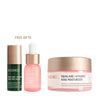
Biossance Squalane + Vitamin C Rose Moisturizer
Works for
1 of 3 advertised claims delivered
MoisturizingCaprylic/capric triglyceride, Glycerin + 4 moreGood evidence
“Squalane + Vitamin C Rose Moisturizer”
This product can help improve hydration of the skin with the two types of ingredients.
The first type is called “humectants”:
these ingredients help attract water.
When humectants are on the surface of the skin, they “pull in” the moisture from the outside environment, or from
within deeper layers of the skin. The following ingredients in this product do the job:
glycerin.
This product also contains ingredients called “occlusives”. They help reduce the speed with which our skin loses moisture to the outside environment. These ingredients also help soften the upper layer of the skin, so it feels less tight and nicer to the touch. The following ingredients in this product do the job: caprylic/capric triglyceride, squalane.
Anti-agingTocopherol, Tetrahexyldecyl ascorbateWeak evidence
“Deeply hydrates, nourishes, and fights signs of aging.”
Effective ingredients missing or their concentration is too low.
Evens skin toneTetrahexyldecyl ascorbateWeak evidence
“Delivers a powerful boost of brightness and evens skin tone.”
Effective ingredients missing or their concentration is too low
Can it cause trouble?
Irritancy2 strong irritants: Rosa damascena flower extract, CitronellolMedium risk
Comedogenic1 ingredient rated 2 or more on the 0–5 pore-clogging scale1 flagged


User reviews
Be the first — your take helps the next person decide.
Ingredients
Filter by role to see what each ingredient is doing.
Water~45–55%
Squalane~6.1–7.4%
- Irritation risk
- Low
An oil naturally present in skin. Works as an emollient to soften the skin and form a protective layer on its surface without a greasy feeling.
More about SqualaneGlycerin~4.3–5.2%
- Irritation risk
- Low
One of the best moisturizing ingredients. Naturally present in skin. It attracts water to the upper layer of the skin working as a humectant
More about GlycerinCaprylic/capric triglyceride~3.3–4.1%
- Irritation risk
- Medium
A good mix of fatty acids that forms a protective layer on the skin. Improves the shelf life of products. Derived from coconut and glycerin
More about Caprylic/capric triglycerideIsoamyl laurate~2.5–3%
- Irritation risk
- Medium
Helps stabilize emulsions and create a nice product texture
More about Isoamyl laurateCetearyl olivate~2–2.5%
Sorbitan olivate~1.7–2.1%
Tetrahexyldecyl ascorbate~1.5–1.8%
- Irritation risk
- Medium
Being a lipid soluble form of vitamin C, it is more stable than ascorbic acid, but still degrades quickly and needs to be stabilized in a formulation with another ingredient. It is claimed to penetrate skin better than pure vitamin C and have the the similar benefits, but solid studies of its effectiveness are lacking. Is likely to require a higher concentration in a product than pure vitamin C to be effective. It might be able to help reduce pore clogging.
More about Tetrahexyldecyl ascorbateLactobacillus/lemon peel ferment extract~1.3–1.5%
- Irritation risk
- Low
Tocopherol~1.1–1.3%
- Irritation risk
- Low
Pure form of vitamin E. Can help moisturise and protect the skin from free radicals. Often used to help stabilise other ingredients or the formula itself
More about TocopherolGlyceryl stearate se~0.8–1.15%
- Irritation risk
- Low
- Comedogenicity
- 2/5
Used to stabilize the product formulations and works as an emollient
More about Glyceryl stearate seRosa damascena flower extract~0.65–0.95%
Hydroxyethyl acrylate/sodium acryloyldimethyl taurate copolymer~0.6–0.9%
- Irritation risk
- Medium
A gelling agent that thickens the product consistency and leaves the skin with a velvety finish
More about Hydroxyethyl acrylate/sodium acryloyldimethyl taurate copolymerLeuconostoc/radish root ferment filtrate~0.55–0.85%
- Irritation risk
- Medium
A preservative that comes from radishes fermented by a bacteria. New research suggests that the preservation properties in the ingredient come from an ammonium salt that is not present naturally in radish root but used in its cultivation. Is problematic because the exact amount of the preservative agents is difficult to determine
More about Leuconostoc/radish root ferment filtrateCetyl alcohol~0.6–0.85%
- Irritation risk
- Low
A non-drying alcohol that works to soften the skin and stabilize product formulations helping oil and water mix together
More about Cetyl alcoholAcacia senegal gum~0.5–0.8%
- Irritation risk
- Medium
Helps mask the small of other ingredients and improve the product texture
More about Acacia senegal gumXanthan gum~0.5–0.75%
- Irritation risk
- Low
Used to create a thicker product consistency
More about Xanthan gumEthylhexylglycerin~0.35–0.65%
Phytic acid~0.3–0.55%
- Irritation risk
- Medium
An alpha-hydroxy acid (AHA), but is mostly used to stabilize product formulations in cosmetics
More about Phytic acidSodium gluconate~0.25–0.5%
Phenoxyethanol~0.25–0.45%
- Irritation risk
- Low
A preservative. It helps prevent bacterial growth in cosmetic products
More about PhenoxyethanolCitric acid~0.2–0.35%
- Irritation risk
- Medium
Can work as an exfoliant but is typically used to adjust the product pH
More about Citric acidSodium hydroxide~0.15–0.3%
Citronellol~0.15–0.25%
Potassium oxide~0.1–0.2%
- Irritation risk
- Low
Ci 77491~0.1–0.15%
- Irritation risk
- Low
A red colorant made of iron oxide. Typically is not irritating
More about Ci 77491Ingredient list view
Water, Squalane, Glycerin, Caprylic/capric triglyceride, Isoamyl laurate, Cetearyl olivate, Sorbitan olivate, Tetrahexyldecyl ascorbate, Lactobacillus/lemon peel ferment extract, Tocopherol, Glyceryl stearate se, Rosa damascena flower extract, Hydroxyethyl acrylate/sodium acryloyldimethyl taurate copolymer, Leuconostoc/radish root ferment filtrate, Cetyl alcohol, Acacia senegal gum, Xanthan gum, Ethylhexylglycerin, Phytic acid, Sodium gluconate, Phenoxyethanol, Citric acid, Sodium hydroxide, Citronellol, Unknown, Potassium oxide, Ci 77491
Compare prices
Retailers ranked by price — lowest first.
Affiliate links · prices updated regularly · As an Amazon Associate, WIMJ earns from qualifying purchases.
Worth comparing, line by line.
Match % combines shared ingredients, the first five ingredients, shared actives and hero ingredients, irritancy (lower counts in the alternative's favour), texture and body area. Only products in the same routine step are compared.
| BiossanceSqualane + Vitamin C Rose MoisturizerYOUR PRODUCT | Dr. IdrissMajor Fade Active Seal Moisturizer | Revision SkincareVitamin C Lotion 15% | Colleen Rothschild BeautyVitamin C Nourishing Cream | |
|---|---|---|---|---|
| Match | — | 60% | 59% | 57% |
| Price | $45.12 | — | $114.00+$68.88 | — |
| Shared key ingredients | — | 5 of 5 | 4 of 5 | 4 of 5 |
| Key difference | — | Hexapeptide-2 | Sodium Polyacrylate | Panthenol |
| Irritancy | Medium | Medium | Low | Medium |
| Drying alcohol | — | — | — | — |
| View product | Shop | Shop | Shop |

Sources cited in this review
Every concentration estimate and effectiveness label is anchored to one of these 7 studies and safety reviews.
- 1
- 2
- 3
- 4Vitamin E in dermatologyncbi.nlm.nih.gov
- 5Vitamin E and Skin Healthlpi.oregonstate.edu
- 6Cosmetic and dermatologic use of alpha hydroxy acidsonlinelibrary.wiley.com

Affiliate links · As an Amazon Associate, WIMJ earns from qualifying purchases.