Works for
2 of 4 advertised claims delivered
Moisturizing19 ingredients credited for this claimStrong support
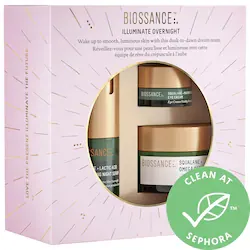
“The Squalane + Lactic Acid Resurfacing Night Serum exfoliates and brightens the look of skin overnight, the Squalane + Omega Repair Cream provides intensive nourishment, and the Squalane + Marine Algae Eye Cream hydrates and visibly lifts the skin around your eyes.”
This product can help improve hydration of the skin with the two types of ingredients.
The first type is called “humectants”:
these ingredients help attract water.
When humectants are on the surface of the skin, they “pull in” the moisture from the outside environment, or from
within deeper layers of the skin. The following ingredients in this product do the job:
glycerin, sodium hyaluronate.
This product also contains ingredients called “occlusives”. They help reduce the speed with which our skin loses moisture to the outside environment. These ingredients also help soften the upper layer of the skin, so it feels less tight and nicer to the touch. The following ingredients in this product do the job: butyrospermum parkii butter, caprylic/capric triglyceride.
The following ingredients in this product are especially good for supporting the skin barrier and helping with the hydration level: ceramide np, linoleic acid, palmitoyl tripeptide-5, panthenol
Anti-aging5 ingredients credited for this claimModerate support
“The Squalane + Lactic Acid Resurfacing Night Serum exfoliates and brightens the look of skin overnight, the Squalane + Omega Repair Cream provides intensive nourishment, and the Squalane + Marine Algae Eye Cream hydrates and visibly lifts the skin around your eyes.”
This product contains astaxanthin, palmitoyl tripeptide-5. These ingredients might be able to help reduce and prevent fine lines and wrinkles, improve skin elasticity and firmness, but there is not enough evidence that it actually works.
Evens skin tone2 ingredients credited for this claimLimited support
“Fine Lines and Wrinkles, Dullness, and Uneven Texture Highlighted Ingredients. . Vegan Lactic Acid 10% (Squalane + Lactic Acid Resurfacing Night Serum).”
This product contains ingredients (ethyl linoleate) that could help reduce hyperpigmentation (for example, post-acne marks or age spots) in theory, but there is not enough evidence that they actually work.
Exfoliation1 ingredient credited for this claimWeak support
“The Squalane + Lactic Acid Resurfacing Night Serum exfoliates and brightens the look of skin overnight, the Squalane + Omega Repair Cream provides intensive nourishment, and the Squalane + Marine Algae Eye Cream hydrates and visibly lifts the skin around your eyes.”
This product does not contain effective exfoliating ingredients. It might be able to deliver physical exfoliation, that is scrub off some of the dead cells on the surface of the skin. We do not recommend physical exfoliation, because it is not uniform (some bits of skin can get exfoliated too much while others not at all). It can also traumatize the skin and aggrevate acne and other skin conditions.
Anti-oxidationNot advertised by the brand · 4 ingredients credited for this claimStrong support
This product contains antioxidants (astaxanthin) that can help neutralize free radicals in skin. By doing so, they can lessen the damage the skin gets from the UV light (sun).
Can it cause trouble?
Irritancy2 strong irritants: Lavandula angustifolia oil, LinaloolMedium risk
Comedogenic4 ingredients rated 2 or more on the 0–5 pore-clogging scale4 flagged
User reviews
Be the first — your take helps the next person decide.
Ingredients
Filter by role to see what each ingredient is doing.
Water~45–55%
Squalane~5.2–6.3%
- Irritation risk
- Low
An oil naturally present in skin. Works as an emollient to soften the skin and form a protective layer on its surface without a greasy feeling.
More about SqualaneGlycerin~4.2–5.2%
- Irritation risk
- Low
One of the best moisturizing ingredients. Naturally present in skin. It attracts water to the upper layer of the skin working as a humectant
More about GlycerinCaprylic/capric triglyceride~3.3–4%
- Irritation risk
- Medium
A good mix of fatty acids that forms a protective layer on the skin. Improves the shelf life of products. Derived from coconut and glycerin
More about Caprylic/capric triglycerideIsoamyl laurate~2.4–3%
- Irritation risk
- Medium
Helps stabilize emulsions and create a nice product texture
More about Isoamyl laurateButyrospermum parkii butter~2.1–2.5%
- Irritation risk
- Low
- Comedogenicity
- 3/5
A great moisturising ingredient that softens the skin and reduces water loss from its upper layer. It also can be helpful in protecting skin from free radicals
More about Butyrospermum parkii butterSorbitan olivate~1.7–2.1%
Cetearyl olivate~1.5–1.8%
Ceramide np~1.3–1.6%
- Irritation risk
- Low
A type of lipid similar to ceramides naturally present in skin. Helps to soften the upper layer of the skin and supports the skin barrier function to keep it hydrated. Can help to prevent inflammation in skin
More about Ceramide npJojoba esters~1.1–1.3%
- Irritation risk
- Medium
An emollient made of jojoba oil. Helps soften the skin and support its barrier function
More about Jojoba estersSodium hyaluronate~0.75–1.1%
- Irritation risk
- Low
One of the best moisturizing ingredients. Attracts water into the upper layer of the skin
More about Sodium hyaluronateEuterpe oleracea sterols~0.6–0.95%
- Irritation risk
- Low
Linoleic acid~0.7–1.05%
- Irritation risk
- Low
An excellent emollient. Helps soften the skin, restore its barrier function, and can help to calm down inflammation. It can be helpful to prevent blemishes and clogged pores
More about Linoleic acidOleic acid~0.6–0.9%
- Irritation risk
- Medium
Helps soften the upper layer of the skin. At the same time, it can weaken the skin's barrier enhancing penetration of other ingredients and increasing the risk of skin dryness
More about Oleic acidLinolenic acid~0.6–0.9%
- Irritation risk
- Medium
An emollient that helps soften the skin and calm down inflammation
More about Linolenic acidEthyl linoleate~0.55–0.85%
- Irritation risk
- Medium
Helps reduce acne and blemishes. Helps to soften the upper layer of the skin and reduce inflammation. Might be helpful in reducing hyperpigmentation and evening out the skin tone, but evidence of effectiveness in skin are lacking
More about Ethyl linoleateTocopherol~0.55–0.8%
- Irritation risk
- Low
Pure form of vitamin E. Can help moisturise and protect the skin from free radicals. Often used to help stabilise other ingredients or the formula itself
More about TocopherolIsoamyl cocoate~0.5–0.8%
- Irritation risk
- Medium
Helps oil and water mix together and works as a cleansing agent
More about Isoamyl cocoateCetyl palmitate~0.5–0.75%
- Irritation risk
- Low
An emollient that helps soften the skin and is used to improve product texture and stability
More about Cetyl palmitateSorbitan palmitate~0.45–0.7%
- Irritation risk
- Medium
Helps water and oil mix together and stabilize the product formulation
More about Sorbitan palmitateCetearyl alcohol~0.5–0.7%
- Irritation risk
- Low
- Comedogenicity
- 2/5
A non-drying alcohol. Works as an emollient. Helps water and oil mix together and creates a nice product texture
More about Cetearyl alcoholEthylhexylglycerin~0.4–0.65%
Carbomer~0.4–0.6%
- Irritation risk
- Low
Helps create a thicker or gel-like product texture. It is not a surfactant but can be used in gentle cleansing formulations
More about CarbomerSodium hydroxide~0.4–0.6%
Phenoxyethanol~0.4–0.65%
- Irritation risk
- Low
A preservative. It helps prevent bacterial growth in cosmetic products
More about PhenoxyethanolSodium gluconate~0.35–0.6%
Water~0.4–0.6%
Caprylic/capric triglyceride~0.45–0.7%
- Irritation risk
- Medium
A good mix of fatty acids that forms a protective layer on the skin. Improves the shelf life of products. Derived from coconut and glycerin
More about Caprylic/capric triglycerideLactic acid~0.35–0.65%
- Irritation risk
- Medium
An exfoliating and moisturizing alpha-hydroxy acid (AHA). Typically causes less irritation than other AHAs, for example, glycolic acid. At high concentrations (about 15%), lactic acid can help reduce lines and wrinkles. Recent studies show that lactic acid can support the "good" bacteria living on skin's surface (healthy skin microbiome)
More about Lactic acidSqualane~0.45–0.7%
- Irritation risk
- Low
An oil naturally present in skin. Works as an emollient to soften the skin and form a protective layer on its surface without a greasy feeling.
More about SqualaneGlycerin~0.45–0.65%
- Irritation risk
- Low
One of the best moisturizing ingredients. Naturally present in skin. It attracts water to the upper layer of the skin working as a humectant
More about GlycerinSodium hydroxide~0.4–0.6%
Cetearyl olivate~0.4–0.65%
Propanediol~0.4–0.65%
- Irritation risk
- Low
Acts as a solvent for other ingredients. Speeds up the absorption of other ingredients into the skin
More about PropanediolSorbitan olivate~0.4–0.65%
Cetearyl alcohol~0.45–0.7%
- Irritation risk
- Low
- Comedogenicity
- 2/5
A non-drying alcohol. Works as an emollient. Helps water and oil mix together and creates a nice product texture
More about Cetearyl alcoholLespedeza capitata leaf/stem extract~0.35–0.65%
- Irritation risk
- Low
Polyacrylate crosspolymer-6~0.4–0.6%
- Irritation risk
- Low
Acacia senegal gum~0.4–0.65%
- Irritation risk
- Medium
Helps mask the small of other ingredients and improve the product texture
More about Acacia senegal gumSodium gluconate~0.35–0.6%
Xanthan gum~0.4–0.6%
- Irritation risk
- Low
Used to create a thicker product consistency
More about Xanthan gumPhenoxyethanol~0.4–0.6%
- Irritation risk
- Low
A preservative. It helps prevent bacterial growth in cosmetic products
More about PhenoxyethanolEthylhexylglycerin~0.4–0.6%
Lavandula angustifolia oil~0.35–0.65%
- Irritation risk
- High
An essential oil. Potential allergen and can be irritating. It has some anti-bacterial properties
More about Lavandula angustifolia oilLinalool~0.35–0.6%
Water~0.4–0.6%
Caprylic/capric triglyceride~0.45–0.7%
- Irritation risk
- Medium
A good mix of fatty acids that forms a protective layer on the skin. Improves the shelf life of products. Derived from coconut and glycerin
More about Caprylic/capric triglycerideSqualane~0.45–0.7%
- Irritation risk
- Low
An oil naturally present in skin. Works as an emollient to soften the skin and form a protective layer on its surface without a greasy feeling.
More about SqualaneGlycerin~0.45–0.65%
- Irritation risk
- Low
One of the best moisturizing ingredients. Naturally present in skin. It attracts water to the upper layer of the skin working as a humectant
More about GlycerinSorbitan olivate~0.4–0.6%
Cetearyl olivate~0.4–0.6%
Jojoba esters~0.45–0.65%
- Irritation risk
- Medium
An emollient made of jojoba oil. Helps soften the skin and support its barrier function
More about Jojoba estersGlyceryl stearate se~0.4–0.6%
- Irritation risk
- Low
- Comedogenicity
- 2/5
Used to stabilize the product formulations and works as an emollient
More about Glyceryl stearate sePanthenol~0.35–0.6%
- Irritation risk
- Low
Helps attract water to the upper layer of the skin and can help improve skin barrier function
More about PanthenolHydroxyethyl acrylate/sodium acryloyldimethyl taurate copolymer~0.3–0.6%
- Irritation risk
- Medium
A gelling agent that thickens the product consistency and leaves the skin with a velvety finish
More about Hydroxyethyl acrylate/sodium acryloyldimethyl taurate copolymerCetyl palmitate~0.35–0.65%
- Irritation risk
- Low
An emollient that helps soften the skin and is used to improve product texture and stability
More about Cetyl palmitateSpilanthes acmella flower extract~0.3–0.55%
- Irritation risk
- High
Plant extract that might hep calm down inflammation in skin
More about Spilanthes acmella flower extractPalmitoyl tripeptide-5~0.3–0.5%
- Irritation risk
- Low
A type of peptide. Peptides are excellent moisturizers and might be able support collagen production reducing fine lines and wrinkles
More about Palmitoyl tripeptide-5Sorbitan palmitate~0.3–0.5%
- Irritation risk
- Medium
Helps water and oil mix together and stabilize the product formulation
More about Sorbitan palmitateDunaliella salina extract~0.25–0.45%
- Irritation risk
- Low
A green micro-algae extract that might help neutralize free radicals in skin, but solid evidence is lacking. It helps to soften the upper layer of the skin
More about Dunaliella salina extractAstaxanthin~0.2–0.35%
- Irritation risk
- Medium
Helps neutralize free radicals in skin and might help to calm down inflammation
More about AstaxanthinSodium hyaluronate~0.15–0.3%
- Irritation risk
- Low
One of the best moisturizing ingredients. Attracts water into the upper layer of the skin
More about Sodium hyaluronatePhenoxyethanol~0.2–0.35%
- Irritation risk
- Low
A preservative. It helps prevent bacterial growth in cosmetic products
More about PhenoxyethanolEthylhexylglycerin~0.15–0.3%
Tocopherol~0.1–0.2%
- Irritation risk
- Low
Pure form of vitamin E. Can help moisturise and protect the skin from free radicals. Often used to help stabilise other ingredients or the formula itself
More about TocopherolCitric acid~0.1–0.15%
- Irritation risk
- Medium
Can work as an exfoliant but is typically used to adjust the product pH
More about Citric acidIngredient list view
Water, Squalane, Glycerin, Caprylic/capric triglyceride, Isoamyl laurate, Butyrospermum parkii butter, Sorbitan olivate, Cetearyl olivate, Ceramide np, Jojoba esters, Sodium hyaluronate, Euterpe oleracea sterols, Linoleic acid, Oleic acid, Linolenic acid, Ethyl linoleate, Tocopherol, Isoamyl cocoate, Cetyl palmitate, Sorbitan palmitate, Cetearyl alcohol, Ethylhexylglycerin, Carbomer, Sodium hydroxide, Phenoxyethanol, Sodium gluconate, Water, Caprylic/capric triglyceride, Lactic acid, Squalane, Glycerin, Sodium hydroxide, Cetearyl olivate, Propanediol, Sorbitan olivate, Cetearyl alcohol, Lespedeza capitata leaf/stem extract, Polyacrylate crosspolymer-6, Acacia senegal gum, Sodium gluconate, Xanthan gum, Phenoxyethanol, Ethylhexylglycerin, Lavandula angustifolia oil, Linalool, Water, Caprylic/capric triglyceride, Squalane, Glycerin, Sorbitan olivate, Cetearyl olivate, Jojoba esters, Glyceryl stearate se, Panthenol, Hydroxyethyl acrylate/sodium acryloyldimethyl taurate copolymer, Cetyl palmitate, Spilanthes acmella flower extract, Palmitoyl tripeptide-5, Sorbitan palmitate, Dunaliella salina extract, Astaxanthin, Sodium hyaluronate, Phenoxyethanol, Ethylhexylglycerin, Tocopherol, Citric acid
Compare prices
Retailers ranked by price — lowest first.
Affiliate links · prices updated regularly · As an Amazon Associate, WIMJ earns from qualifying purchases.
Sources cited in this review
Every concentration estimate and effectiveness label is anchored to one of these 23 studies and safety reviews.
- 1
- 2
- 3
- 4Hyaluronic acid: A key molecule in skin agingncbi.nlm.nih.gov
- 5
- 6

Affiliate links · As an Amazon Associate, WIMJ earns from qualifying purchases.