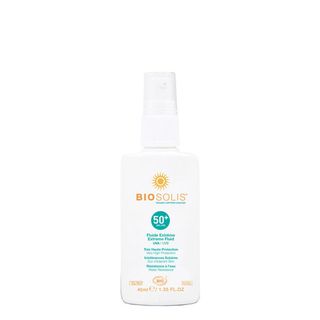
BIOSOLIS Extreme Fluid For Face SPF50
Works for
3 of 3 advertised claims delivered
Sun protectionSPF 50 · 2 UV filtersBroad spectrum
This product offers a good level of protection against both UVB and UVA rays.
It is a mineral sunscreen. In other words, it contains non-organic UV filters. It will probably not sting your eyes but might leave a white cast.
This product can be considered "reef safe" because it does not contain the UV filters (oxybenzone and octinoxate) that can be harmful to coral reefs when present in the water in high concentrations.
Evens skin tone1 ingredient credited for this claimStrong support
“Biosolis Extreme Fluid for Face SPF50 helps to prevents sun intolerance and sun allergies such as heat rash and aids in the prevention of Melasma and sun-induced pigmentation spots.”
This product offers broad spectrum sun protection. It means that it can prevent hyperpigmentation and help keep the skin tone even (sun damage is the main factor causing age spots, darkening of post-acne marks and other discolorations).
Anti-aging3 ingredients credited for this claimStrong support
“Protects from premature cutaneous ageing and long-term cell damage.”
This product can help prevent early signs of skin aging because it offers a good level of broad spectrum sun protection. Sun damage is the main cause of premature skin aging, and protecting your skin from the sun is the best anti-aging strategy.
MoisturizingNot advertised by the brand · 11 ingredients credited for this claimGood support
This product can help soften the skin and reduce its moisture loss with emollients and occlusives: helianthus annuus seed oil, coco-caprylate/caprate.
Keep in mind that this product does not contain effective ingredients to attract water to the upper layer of the skin. This is why an additional product with humectants like glycerin or hyaluronic acid can be helpful (apply it before this product for the best results).
Can it cause trouble?
Irritancy1 strong irritant: ParfumMedium risk
Comedogenic2 ingredients rated 2 or more on the 0–5 pore-clogging scale2 flagged
User reviews
Be the first — your take helps the next person decide.
Ingredients
Filter by role to see what each ingredient is doing.
Dicaprylyl carbonate~22–33%
- Irritation risk
- Low
Helps products spread more easily and works as an emollient to soften skin
More about Dicaprylyl carbonateAloe barbadensis leaf juice~5.7–8.5%
- Irritation risk
- Medium
Traditionally used to treat sunburns, dermatitis and inflammation, but evidence for its effectiveness is lacking. The extract can contain humectants that help attract water into the skin
More about Aloe barbadensis leaf juiceTitanium dioxide~4.8–7.2%
- Irritation risk
- Low
Works as a UV filter when used in high concentrations. It is photostable and is effective mostly against the UVB light, with some protection in the UVA range. In small concentrations, used for its ability to improve the color of cosmetic products. Is usually well tolerated by the skin
More about Titanium dioxideZinc oxide~4.3–6.5%
- Irritation risk
- Low
A broad spectrum sunblock (protects from both UVA and UVB rays). Is suitable for most sensitive skins. In small concentrations, can be used as a colorant
More about Zinc oxideCoconut alkanes~3.1–4.6%
- Irritation risk
- Medium
- Comedogenicity
- 2/5
An emollient that helps soften the skin
More about Coconut alkanesPolyglyceryl-2 dipolyhydroxystearate~2.3–3.5%
- Irritation risk
- Low
Helps to soften the upper layer of the skin
More about Polyglyceryl-2 dipolyhydroxystearatePropanediol~1.8–2.8%
- Irritation risk
- Low
Acts as a solvent for other ingredients. Speeds up the absorption of other ingredients into the skin
More about PropanediolPongamia glabra seed oil~1.4–2.2%
- Irritation risk
- Low
A plant oil that helps soften the upper layer of the skin
More about Pongamia glabra seed oilPolyglyceryl-3 diisostearate~1.1–1.6%
- Irritation risk
- Medium
- Comedogenicity
- 3/5
Helps oil and water mix together
More about Polyglyceryl-3 diisostearatePolyhydroxystearic acid~1–1.5%
- Irritation risk
- Medium
Used to create a thicker product consistency and stabilize the formulation
More about Polyhydroxystearic acidStearic acid~1–1.5%
- Irritation risk
- Low
Helps oil and water mix together and works as an emollient
More about Stearic acidAluminum hydroxide~0.95–1.4%
- Irritation risk
- Low
Is used to add opaque (non-transparent) appearance to formulations. Can be used to coat other ingredients for even dispersion. This is a different ingredient compared to the ones used in antipersperants (aluminium chloride and aluminium chlorohydrate)
More about Aluminum hydroxideSodium chloride~0.6–1.4%
- Irritation risk
- Low
Used to stabilize mixtures of oil and water, and create thicker, gel-like product textures
More about Sodium chlorideBrassica campestris seed oil~0.55–1.25%
- Irritation risk
- Low
Helps soften the upper layer of the skin
More about Brassica campestris seed oilDaucus carota sativa extract~0.45–1.05%
- Irritation risk
- Medium
Helianthus annuus seed oil~0.45–1.1%
- Irritation risk
- Low
A great emollient due to its high linoleic acid content. One of the most effective plant oils in helping skin hydration and repairing skin barrier function
More about Helianthus annuus seed oilCoco-caprylate/caprate~0.5–1.1%
- Irritation risk
- Low
Helps to soften the upper layer of the skin without creating a greasy texture
More about Coco-caprylate/caprateAlumina~0.5–1.1%
- Irritation risk
- Low
The same compound that is used safely in dental implants and bone cements. In cosmetics, it is used to improve the consistency of products
More about AluminaPotassium sorbate~0.3–0.6%
Sodium benzoate~0.25–0.5%
Parfum~0.15–0.6%
- Irritation risk
- High
An aromatic blend of unspecified and possibly irritating ingredients
More about ParfumLactic acid~0.15–0.55%
- Irritation risk
- Medium
An exfoliating and moisturizing alpha-hydroxy acid (AHA). Typically causes less irritation than other AHAs, for example, glycolic acid. At high concentrations (about 15%), lactic acid can help reduce lines and wrinkles. Recent studies show that lactic acid can support the "good" bacteria living on skin's surface (healthy skin microbiome)
More about Lactic acidTocopherol~0.1–0.3%
- Irritation risk
- Low
Pure form of vitamin E. Can help moisturise and protect the skin from free radicals. Often used to help stabilise other ingredients or the formula itself
More about TocopherolIngredient list view
Dicaprylyl carbonate, Aloe barbadensis leaf juice, Titanium dioxide, Zinc oxide, Coconut alkanes, Polyglyceryl-2 dipolyhydroxystearate, Propanediol, Pongamia glabra seed oil, Polyglyceryl-3 diisostearate, Polyhydroxystearic acid, Stearic acid, Aluminum hydroxide, Sodium chloride, Brassica campestris seed oil, Daucus carota sativa extract, Helianthus annuus seed oil, Coco-caprylate/caprate, Alumina, Potassium sorbate, Sodium benzoate, Parfum, Lactic acid, Tocopherol
Compare prices
Retailers ranked by price — lowest first.
Product summary
We believe that "BIOSOLIS - Extreme Fluid For Face SPF50" can provide reliable sun protection based on the ingredients listed. It can protect from both UVA and UVB rays. This is great news because not all sunscreens with SPF ratings give UVA protection. (UVA rays do not cause sunburn, but still damage our skin and lead to early aging).
Its formula is also hydrating, so you might not need an additional moistruizer during the day. Like all broad-spectrum sunscreens, this product helps prevent early signs of aging.
Sunscreen filters
This moisturizer is a mineral sunscreen. It uses titanium dioxide and zinc oxide for sun protection. Both titanium dioxide and zinc oxide almost never irritate even the most sensitive skin and eyes, but can leave a white cast.
Irritation risk
This formulation includes some common irritants, including ingredients that do not provide a benefit for the skin. We assess the overall irritancy of this moisturizer to be medium. For a detailed overview of all potential irritants: click here
You can see the detailed formula review with the breakdown of all actives in the product and the full ingredient list with estimated concentrations in the tables below.
Price
The product retails for 16.60£ in the United Kingdom.
For a detailed price comparison: click here.
Sources cited in this review
Every concentration estimate and effectiveness label is anchored to one of these 16 studies and safety reviews.
- 1A review of inorganic UV filters zinc oxide and titanium dioxideonlinelibrary.wiley.com
- 2
- 3
- 4
- 5
- 6

Affiliate links · As an Amazon Associate, WIMJ earns from qualifying purchases.