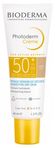
Bioderma Photoderm Cream SPF50+ Tinted
Works for
1 of 1 advertised claim delivered
Sun protectionSPF 50 · 6 UV filtersBroad spectrum
This product offers a good level of protection against both UVB and UVA rays.
This sunscreen uses organic (so-called "chemical") sunscreen filters. Organic, or "chemical" filters usually provide reliable sun protection and rarely leave a white cast. Sunscreens with organic filters can sting eyes.
This product can be considered "reef safe" because it does not contain the UV filters (oxybenzone and octinoxate) that can be harmful to coral reefs when present in the water in high concentrations.
Evens skin toneNot advertised by the brand · No ingredient credited for this claimStrong support
This product offers broad spectrum sun protection. It means that it can prevent hyperpigmentation and help keep the skin tone even (sun damage is the main factor causing age spots, darkening of post-acne marks and other discolorations).
Anti-agingNot advertised by the brand · 1 ingredient credited for this claimStrong support
This product can help prevent early signs of skin aging because it offers a good level of broad spectrum sun protection. Sun damage is the main cause of premature skin aging, and protecting your skin from the sun is the best anti-aging strategy.
MoisturizingNot advertised by the brand · 13 ingredients credited for this claimGood support
This product contains good ingredients to attract water to the upper layer of the skin. These ingredients are called "humectants": fructooligosaccharides, glycerin.
When humectants are on the surface of the skin, they “pull in” the moisture from the outside environment, or from within deeper layers of the skin. If the air is dry, humectants can speed up the moisture loss from the skin. This is why it is a good idea to use another product on top of this one to help "seal in" the moisture (look for ingredients like dimethicone, squalane, oils and butters).
Can it cause trouble?
Irritancy11 flagged ingredientsLow risk
Comedogenic1 ingredient rated 2 or more on the 0–5 pore-clogging scale1 flagged
User reviews
Be the first — your take helps the next person decide.
Ingredients
Filter by role to see what each ingredient is doing.
Water~45–55%
Diethylamino hydroxybenzoyl hexyl benzoate~6.6–8.1%
- Irritation risk
- Medium
Uvinul A Plus. A new generation broad spectrum sunscreen that offers an effective protection especially in the UVA range. It is stable in formulations. Unfortunately, is not approved by the FDA (US) yet
More about Diethylamino hydroxybenzoyl hexyl benzoateHomosalate~4.5–5.5%
- Irritation risk
- Medium
A weak sunscreen that offers some protection against the sun rays that cause sunburn (UVB), but does not offer meaningful protection against protect against the most aging sun rays (UVA). It loses its effectiveness quickly when exposed to sunlight. It is an organic, or so called "chemical" sunscreen. When used in low concentrations, helps to stabilize the product formulation
More about HomosalateDiisopropyl sebacate~3.2–3.9%
- Irritation risk
- Low
Helps soften the upper layer of the skin without creatng a greasy finish
More about Diisopropyl sebacateBis-ethylhexyloxyphenol methoxyphenyl triazine~3.1–3.8%
- Irritation risk
- Medium
Tinosorb S. One of the most effective broad spectrum sunscreen ingredients. Protects from both UVA and UVB rays. It is photostable. Unfortunately, not approved by FDA (US) yet.
More about Bis-ethylhexyloxyphenol methoxyphenyl triazineDibutyl adipate~2–2.5%
- Irritation risk
- Low
Helps soften the upper layer of the skin and create a nice product consistency
More about Dibutyl adipatePropanediol~1.7–2%
- Irritation risk
- Low
Acts as a solvent for other ingredients. Speeds up the absorption of other ingredients into the skin
More about PropanediolEthylhexyl salicylate~2–2.5%
- Irritation risk
- Low
Octisalate. A UV filter. It offers some protection against the sun rays that cause sunburn (UVB), but does not protect against the most aging sun rays (UVA). It loses its effectiveness quickly when exposed to sunlight. It is an organic, or so called "chemical" sunscreen
More about Ethylhexyl salicylateEthylhexyl triazone~1.7–2.1%
- Irritation risk
- Medium
Uvinul T. A UV filter. Effective against UVB rays. It is photostable. Can increase water resistance properties of the sunscreen. Unfortunately, not approved by the FDA (US) yet
More about Ethylhexyl triazoneSilica~1.2–1.5%
Glycerin~0.7–1.05%
- Irritation risk
- Low
One of the best moisturizing ingredients. Naturally present in skin. It attracts water to the upper layer of the skin working as a humectant
More about GlycerinTitanium dioxide~0.75–1.1%
- Irritation risk
- Low
Works as a UV filter when used in high concentrations. It is photostable and is effective mostly against the UVB light, with some protection in the UVA range. In small concentrations, used for its ability to improve the color of cosmetic products. Is usually well tolerated by the skin
More about Titanium dioxidePropylene glycol~0.45–0.65%
- Irritation risk
- High
Helps oil and water mix together and can enhance the penetration of other ingredients into the skin. It can be irritating
More about Propylene glycolSucrose stearate~0.45–0.7%
Glyceryl stearate~0.45–0.65%
- Irritation risk
- Low
An emollient that softens the skin and forms a protective layer on its surface. Helps water and oil mix together
More about Glyceryl stearatePeg-100 stearate~0.45–0.7%
- Irritation risk
- Low
Helps oil and water mix togehter and creates a nice product texture
More about Peg-100 stearateCi 77492~0.3–0.6%
Pentylene glycol~0.35–0.6%
- Irritation risk
- Medium
Used to preserve products, dissolve other ingredients and create a nice product texture
More about Pentylene glycol1,2-hexanediol~0.25–0.5%
Sodium citrate~0.25–0.45%
- Irritation risk
- Medium
Helps to control the skin's pH level. Maintains the skin's natural film of amino-lactic acids and oils. Helps to preserve products
More about Sodium citrateXanthan gum~0.25–0.45%
- Irritation risk
- Low
Used to create a thicker product consistency
More about Xanthan gumCi 77491~0.2–0.4%
- Irritation risk
- Low
A red colorant made of iron oxide. Typically is not irritating
More about Ci 77491Caprylyl glycol~0.2–0.4%
- Irritation risk
- Medium
Helps preserve products and creates a nice product texture
More about Caprylyl glycolPolyacrylate crosspolymer-6~0.2–0.4%
- Irritation risk
- Low
Citric acid~0.2–0.35%
- Irritation risk
- Medium
Can work as an exfoliant but is typically used to adjust the product pH
More about Citric acidCi 77499~0.2–0.35%
Ectoin~0.2–0.35%
- Irritation risk
- Low
Softens the upper layer of the skin and can support skin barrier function
More about EctoinMannitol~0.15–0.3%
- Irritation risk
- Low
Helps to attract water to the upper layer of the skin
More about MannitolXylitol~0.15–0.3%
- Irritation risk
- Low
Helps attract water to the upper layer of the skin and repair the skin barrier function
More about XylitolRhamnose~0.15–0.25%
- Irritation risk
- Low
Helps oil and water mix together. It also helps attract water to the upper layer of the skin
More about RhamnoseFructooligosaccharides~0.1–0.25%
- Irritation risk
- Low
Help attract water to the upper layer of the skin
More about FructooligosaccharidesCaprylic/capric triglyceride~0.15–0.3%
- Irritation risk
- Medium
A good mix of fatty acids that forms a protective layer on the skin. Improves the shelf life of products. Derived from coconut and glycerin
More about Caprylic/capric triglycerideLaminaria ochroleuca extract~0.1–0.15%
- Irritation risk
- Low
- Comedogenicity
- 3/5
Helps attract water to the upper layer of the skin
More about Laminaria ochroleuca extractIngredient list view
Water, Diethylamino hydroxybenzoyl hexyl benzoate, Homosalate, Diisopropyl sebacate, Bis-ethylhexyloxyphenol methoxyphenyl triazine, Dibutyl adipate, Propanediol, Ethylhexyl salicylate, Ethylhexyl triazone, Silica, Glycerin, Titanium dioxide, Propylene glycol, Sucrose stearate, Glyceryl stearate, Peg-100 stearate, Ci 77492, Pentylene glycol, 1,2-hexanediol, Sodium citrate, Xanthan gum, Ci 77491, Caprylyl glycol, Polyacrylate crosspolymer-6, Citric acid, Ci 77499, Ectoin, Mannitol, Xylitol, Rhamnose, Fructooligosaccharides, Caprylic/capric triglyceride, Laminaria ochroleuca extract
Compare prices
Retailers ranked by price — lowest first.

Product summary
Based on the ingredient list, we assess that "Bioderma - Photoderm Cream SPF50+ Tinted" can provide reliable sun protection. We love that it can protect from both UVA and UVB rays (not all sunscreens with SPF ratings give UVA protection. UVA rays do not cause sunburn, but still damage our skin and lead to early aging).
Its formula is also hydrating, so you might not need an additional moistruizer during the day. Like all broad-spectrum sunscreens, this product helps prevent early signs of aging.
Sunscreen filters
This sunscreen uses so-called "chemical", or organic UV filters (organic simply means that their molecules contain atoms of carbon). These filters typically give good sun protection and rarely leave a white cast, but they can be irritating for sensitive skin. The UV filters in this sunscreen are: tinosorb s 3.10% - 3.80%, uvinul a plus 6.60% - 8.00%, octisalate 2.00% - 2.50%, uvinul t 1.70% - 2.10% and homosalate 4.50% - 5.50%.
Irritation risk
There are some common irritants in this product, including ingredients that do not have benefits for the skin. We assess the overall irritancy of this moisturizer to be low. For a detailed overview of all potential irritants: click here
You can see the detailed formula review with the breakdown of all actives in the product and the full ingredient list with estimated concentrations in the tables below.
Price
The product retails from 10.25£ up to 14.32£ in the United Kingdom.
For a detailed price comparison: click here.
Sources cited in this review
Every concentration estimate and effectiveness label is anchored to one of these 7 studies and safety reviews.
- 1
- 2
- 3Surfactants and experimental irritant contact dermatitisncbi.nlm.nih.gov
- 4Propylene Glycolpubmed.ncbi.nlm.nih.gov
- 5Skin-sensitizing and irritant properties of propylene glycolonlinelibrary.wiley.com
- 6

Affiliate links · As an Amazon Associate, WIMJ earns from qualifying purchases.