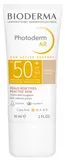
Bioderma Photoderm AR Anti-Redness SPF50+
Works for
Sun protectionSPF 50 · 6 UV filtersBroad spectrum
This product offers a good level of protection against both UVB and UVA rays.
This sunscreen uses organic (so-called "chemical") sunscreen filters. Organic, or "chemical" filters usually provide reliable sun protection and rarely leave a white cast. Sunscreens with organic filters can sting eyes.
This product can be considered "reef safe" because it does not contain the UV filters (oxybenzone and octinoxate) that can be harmful to coral reefs when present in the water in high concentrations.
Anti-agingRhamnoseWorks well
“Bioderma Photoderm Anti-redness SPF 50+ offers a high protection against the effects of UV rays and preserves the skin's natural defences. anti-redness and unifying.”
This product can help prevent early signs of skin aging because it offers a good level of broad spectrum sun protection. Sun damage is the main cause of premature skin aging, and protecting your skin from the sun is the best anti-aging strategy.
Evens skin toneSide benefit · Stearyl glycyrrhetinateWorks well
This product offers broad spectrum sun protection. It means that it can prevent hyperpigmentation and help keep the skin tone even (sun damage is the main factor causing age spots, darkening of post-acne marks and other discolorations).
MoisturizingSide benefit the brand mentions · Diisopropyl sebacate, Glycerin + 12 moreWorks
“The unifying natural shade is suitable for fair skin.Its moisturising and melting texture leaves the skin comfortable.”
This product contains good ingredients to attract water to the upper layer of the skin. These ingredients are called "humectants": fructooligosaccharides, glycerin.
When humectants are on the surface of the skin, they “pull in” the moisture from the outside environment, or from within deeper layers of the skin. If the air is dry, humectants can speed up the moisture loss from the skin. This is why it is a good idea to use another product on top of this one to help "seal in" the moisture (look for ingredients like dimethicone, squalane, oils and butters).
Anti-oxidationSide benefit · Ginkgo biloba leaf extract, Tocopheryl acetateMay help
This product contains antioxidants (ginkgo biloba leaf extract) that might be able to help neutralize free radicals in skin to lessen the damage it gets from the UV light (sun). There is not enough evidence to confirm their effectiveness in skin though.
Can it cause trouble?
Irritancy12 flagged ingredientsLow risk
Comedogenic1 ingredient rated 2 or more on the 0–5 pore-clogging scale1 flagged
User reviews
Be the first — your take helps the next person decide.
Ingredients
Filter by role to see what each ingredient is doing.
Water~45–55%
Diethylamino hydroxybenzoyl hexyl benzoate~5.8–7.1%
- Irritation risk
- Medium
Uvinul A Plus. A new generation broad spectrum sunscreen that offers an effective protection especially in the UVA range. It is stable in formulations. Unfortunately, is not approved by the FDA (US) yet
More about Diethylamino hydroxybenzoyl hexyl benzoateHomosalate~4.5–5.5%
- Irritation risk
- Medium
A weak sunscreen that offers some protection against the sun rays that cause sunburn (UVB), but does not offer meaningful protection against protect against the most aging sun rays (UVA). It loses its effectiveness quickly when exposed to sunlight. It is an organic, or so called "chemical" sunscreen. When used in low concentrations, helps to stabilize the product formulation
More about HomosalateDiisopropyl sebacate~3.2–3.9%
- Irritation risk
- Low
Helps soften the upper layer of the skin without creatng a greasy finish
More about Diisopropyl sebacateBis-ethylhexyloxyphenol methoxyphenyl triazine~3.1–3.8%
- Irritation risk
- Medium
Tinosorb S. One of the most effective broad spectrum sunscreen ingredients. Protects from both UVA and UVB rays. It is photostable. Approved by the US FDA in 2026 (listed as bemotrizinol on US labels).
More about Bis-ethylhexyloxyphenol methoxyphenyl triazineDibutyl adipate~2–2.5%
- Irritation risk
- Low
Helps soften the upper layer of the skin and create a nice product consistency
More about Dibutyl adipatePropanediol~1.6–2%
- Irritation risk
- Low
Acts as a solvent for other ingredients. Speeds up the absorption of other ingredients into the skin
More about PropanediolEthylhexyl salicylate~2–2.4%
- Irritation risk
- Low
Octisalate. A UV filter. It offers some protection against the sun rays that cause sunburn (UVB), but does not protect against the most aging sun rays (UVA). It loses its effectiveness quickly when exposed to sunlight. It is an organic, or so called "chemical" sunscreen
More about Ethylhexyl salicylateEthylhexyl triazone~1.7–2%
- Irritation risk
- Medium
Uvinul T. A UV filter. Effective against UVB rays. It is photostable. Can increase water resistance properties of the sunscreen. Unfortunately, not approved by the FDA (US) yet
More about Ethylhexyl triazoneGlycerin~1–1.2%
- Irritation risk
- Low
One of the best moisturizing ingredients. Naturally present in skin. It attracts water to the upper layer of the skin working as a humectant
More about GlycerinSilica~1–1.3%
Potassium cetyl phosphate~0.55–0.85%
- Irritation risk
- Medium
Helps oil and water mix together
More about Potassium cetyl phosphateGlyceryl stearate~0.5–0.75%
- Irritation risk
- Low
An emollient that softens the skin and forms a protective layer on its surface. Helps water and oil mix together
More about Glyceryl stearatePeg-100 stearate~0.5–0.75%
- Irritation risk
- Low
Helps oil and water mix togehter and creates a nice product texture
More about Peg-100 stearatePropylene glycol~0.3–0.6%
- Irritation risk
- High
Helps oil and water mix together and can enhance the penetration of other ingredients into the skin. It can be irritating
More about Propylene glycolPolyacrylate crosspolymer-6~0.35–0.65%
- Irritation risk
- Low
Stearyl glycyrrhetinate~0.3–0.55%
- Irritation risk
- Medium
A fatty acid derived from licorice. Works as an emollient and can help calm down inflammation
More about Stearyl glycyrrhetinateTocopheryl acetate~0.3–0.55%
- Irritation risk
- Medium
A more stable but less bio-available form of vitamin E compared to Tocopherol. Might help moisturize and protect the skin from free radicals, but mostly used in low concentrations to stabilize other ingredients.
More about Tocopheryl acetateTitanium dioxide~0.35–0.65%
- Irritation risk
- Low
Works as a UV filter when used in high concentrations. It is photostable and is effective mostly against the UVB light, with some protection in the UVA range. In small concentrations, used for its ability to improve the color of cosmetic products. Is usually well tolerated by the skin
More about Titanium dioxideCi 77891~0.25–0.5%
- Irritation risk
- Low
Capryloyl glycine~0.3–0.5%
- Irritation risk
- Low
Helps oil and water mix together, preserve cosmetic products, and attract water to the upper layer of the skin
More about Capryloyl glycineSodium citrate~0.2–0.35%
- Irritation risk
- Medium
Helps to control the skin's pH level. Maintains the skin's natural film of amino-lactic acids and oils. Helps to preserve products
More about Sodium citrateXanthan gum~0.2–0.35%
- Irritation risk
- Low
Used to create a thicker product consistency
More about Xanthan gumGlycine soja germ extract~0.2–0.35%
- Irritation risk
- Low
Ectoin~0.15–0.3%
- Irritation risk
- Low
Softens the upper layer of the skin and can support skin barrier function
More about EctoinMannitol~0.15–0.3%
- Irritation risk
- Low
Helps to attract water to the upper layer of the skin
More about MannitolXylitol~0.15–0.3%
- Irritation risk
- Low
Helps attract water to the upper layer of the skin and repair the skin barrier function
More about XylitolCitric acid~0.15–0.3%
- Irritation risk
- Medium
Can work as an exfoliant but is typically used to adjust the product pH
More about Citric acidGinkgo biloba leaf extract~0.2–0.35%
- Irritation risk
- High
A plant extract that might help neutralize free radicals and reduce inflammation in skin. It can be irritating
More about Ginkgo biloba leaf extractSodium hydroxide~0.2–0.35%
Iron oxides~0.2–0.35%
- Irritation risk
- Low
An umbrella term for the following three colorants: CI 77491, CI 77492, CI 77499. They might be able to offer some protection against visible light, but the degree of the protection is not clear
More about Iron oxidesCi 77492~0.2–0.35%
Rhamnose~0.2–0.35%
- Irritation risk
- Low
Helps oil and water mix together. It also helps attract water to the upper layer of the skin
More about RhamnoseIron oxides~0.2–0.35%
- Irritation risk
- Low
An umbrella term for the following three colorants: CI 77491, CI 77492, CI 77499. They might be able to offer some protection against visible light, but the degree of the protection is not clear
More about Iron oxidesCi 77491~0.2–0.35%
- Irritation risk
- Low
A red colorant made of iron oxide. Typically is not irritating
More about Ci 77491Iron oxides~0.2–0.35%
- Irritation risk
- Low
An umbrella term for the following three colorants: CI 77491, CI 77492, CI 77499. They might be able to offer some protection against visible light, but the degree of the protection is not clear
More about Iron oxidesCi 77499~0.2–0.35%
Hydrogenated lecithin~0.2–0.35%
- Irritation risk
- Low
Helps to retain moisture by creating a protective barrier on the skin. Rich in fatty acids. Improves product texture and helps with the penetration of other ingredients.
More about Hydrogenated lecithinLauroyl lysine~0.15–0.3%
- Irritation risk
- Low
Helps soften the upper layer of the skin and creates a nice product texture
More about Lauroyl lysineFructooligosaccharides~0.15–0.3%
- Irritation risk
- Low
Help attract water to the upper layer of the skin
More about FructooligosaccharidesCaprylic/capric triglyceride~0.2–0.4%
- Irritation risk
- Medium
A good mix of fatty acids that forms a protective layer on the skin. Improves the shelf life of products. Derived from coconut and glycerin
More about Caprylic/capric triglycerideLaminaria ochroleuca extract~0.1–0.2%
- Irritation risk
- Low
- Comedogenicity
- 3/5
Helps attract water to the upper layer of the skin
More about Laminaria ochroleuca extractIngredient list view
Water, Diethylamino hydroxybenzoyl hexyl benzoate, Homosalate, Diisopropyl sebacate, Bis-ethylhexyloxyphenol methoxyphenyl triazine, Dibutyl adipate, Propanediol, Ethylhexyl salicylate, Ethylhexyl triazone, Glycerin, Silica, Potassium cetyl phosphate, Glyceryl stearate, Peg-100 stearate, Propylene glycol, Polyacrylate crosspolymer-6, Stearyl glycyrrhetinate, Tocopheryl acetate, Titanium dioxide, Ci 77891, Capryloyl glycine, Sodium citrate, Xanthan gum, Glycine soja germ extract, Ectoin, Mannitol, Xylitol, Citric acid, Ginkgo biloba leaf extract, Sodium hydroxide, Iron oxides, Ci 77492, Rhamnose, Iron oxides, Ci 77491, Iron oxides, Ci 77499, Hydrogenated lecithin, Lauroyl lysine, Fructooligosaccharides, Caprylic/capric triglyceride, Laminaria ochroleuca extract
Compare prices
Retailers ranked by price — lowest first.


Worth comparing, line by line.
Match % combines shared ingredients, the first five ingredients, shared actives and hero ingredients, irritancy (lower counts in the alternative's favour), texture and body area. Only products in the same routine step are compared.
| BiodermaPhotoderm AR Anti-Redness SPF50+YOUR PRODUCT | EUBOSCool & Calm - Redness Relieving CC Cream SPF 50 | GarnierAmbre Solaire Kids Sensitive Advanced Sun Cream Lotion SPF50+ | Ambre SolaireKids Sensitive Sand Resistant Sun Cream SPF50+ | |
|---|---|---|---|---|
| Match | — | 32% | 30% | 30% |
| Price | — | — | $6.69 | — |
| Shared key ingredients | — | 6 of 13 | 6 of 13 | 6 of 13 |
| Key difference | — | Panthenol | Avobenzone | Avobenzone |
| Irritancy | Low | Low | Low | Low |
| SPF | SPF 50 | SPF 50 | SPF 50 | SPF 50 |
| Drying alcohol | — | — | Contains drying alcohol | Contains drying alcohol |
| View product | Shop | Shop | Shop |


More alternatives: Eveline Cosmetics Photoderm MAX Tinted Cream SPF50+ Sensitive Skin #Golden ColourAcnemy Zitcontrol spf 50
Product summary
We believe that "Bioderma - Photoderm AR Anti-Redness SPF50+" can provide reliable sun protection based on the ingredients listed. It can protect from both UVA and UVB rays. This is great news because not all sunscreens with SPF ratings give UVA protection. (UVA rays do not cause sunburn, but still damage our skin and lead to early aging).
It also works as a moisturizer, so you do not have to use an additional hydrating product. Like all broad-spectrum sunscreens, this product helps prevent early signs of aging.
Sunscreen filters
This is a so-called "chemical" sunscreen. It means that it uses organic UV filters. They typically offer good sun protection and rarely leave a white cast, but they can be irritating for some people with sensitive skin. The UV filters in this sunscreen are: tinosorb s 3.10% - 3.80%, uvinul a plus 5.80% - 7.10%, octisalate 2.00% - 2.40%, uvinul t 1.70% - 2.00% and homosalate 4.50% - 5.50%.
Irritation risk
There are some common irritants in this product, including ingredients that do not have benefits for the skin. We assess the overall irritancy of this product to be low. For a detailed overview of all potential irritants: click here
You can see the detailed formula review with the breakdown of all actives in the product and the full ingredient list with estimated concentrations in the tables below.
Price
The product retails from 11.11£ up to 18.00£ in the United Kingdom.
For a detailed price comparison: click here.
Sources cited in this review
Every concentration estimate and effectiveness label is anchored to one of these 8 studies and safety reviews.
- 1
- 2
- 3Surfactants and experimental irritant contact dermatitisncbi.nlm.nih.gov
- 4Propylene Glycolpubmed.ncbi.nlm.nih.gov
- 5Skin-sensitizing and irritant properties of propylene glycolonlinelibrary.wiley.com
- 6

Affiliate links · As an Amazon Associate, WIMJ earns from qualifying purchases.