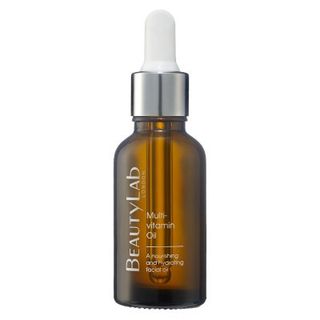
BeautyLab BeautyLabreg; Multi-Vitamin Oil
Works for
1 of 2 advertised claims delivered
Moisturizing9 ingredients credited for this claimGood support
“• Nourishes, softens and helps to repair dry skin • Intensely hydrates and improves moisture retention • Boosts skin suppleness and plumpness • Soothes and comforts, and helps to restore skin balance • Provides high antioxidant protection to help prevent damage to skin cells Main Actives.”
This product can help soften the skin and reduce its moisture loss with emollients and occlusives: caprylic/capric triglyceride, helianthus annuus seed oil.
Keep in mind that this product does not contain effective ingredients to attract water to the upper layer of the skin. This is why an additional product with humectants like glycerin or hyaluronic acid can be helpful (apply it before this product for the best results).
Anti-aging4 ingredients credited for this claimWeak support
“For best results, follow with BeautyLab® Anti-Ageing Skin Perfecting Moisture Cream (morning) or BeautyLab® Anti-Ageing Overnight Repair Beauty Cream (evening).”
Effective ingredients missing or their concentration is too low.
Can it cause trouble?
Irritancy9 strong irritants: Passiflora incarnata seed oil, Retinyl palmitate + 7 more — patch-test recommendedHigh risk
Comedogenic1 ingredient rated 2 or more on the 0–5 pore-clogging scale1 flagged
User reviews
Be the first — your take helps the next person decide.
Ingredients
Filter by role to see what each ingredient is doing.
Caprylic/capric triglyceride~23–34%
- Irritation risk
- Medium
A good mix of fatty acids that forms a protective layer on the skin. Improves the shelf life of products. Derived from coconut and glycerin
More about Caprylic/capric triglycerideHelianthus annuus seed oil~6.6–9.9%
- Irritation risk
- Low
A great emollient due to its high linoleic acid content. One of the most effective plant oils in helping skin hydration and repairing skin barrier function
More about Helianthus annuus seed oilIsopropyl palmitate~4.9–7.4%
- Irritation risk
- Medium
- Comedogenicity
- 3/5
Helps soften the upper layer of the skin and create a thicker product consistency
More about Isopropyl palmitateSimmondsia chinensis seed oil~3.9–5.9%
- Irritation risk
- Medium
Softens the upper layer of skin and helps restore the healthy skin barrier. Has shown to help calm down inflammation in skin. It is a stable oil, meaning that it retains its properties even when exposed to air.
More about Simmondsia chinensis seed oilTocopheryl acetate~2.5–3.7%
- Irritation risk
- Medium
A more stable but less bio-available form of vitamin E compared to Tocopherol. Might help moisturize and protect the skin from free radicals, but mostly used in low concentrations to stabilize other ingredients.
More about Tocopheryl acetatePassiflora incarnata seed oil~1.9–2.8%
- Irritation risk
- High
A plant oil that can help soften the upper layer of the skin. Contains essential oil that can be irritating
More about Passiflora incarnata seed oilPrunus amygdalus dulcis oil~1.6–2.4%
- Irritation risk
- Low
An emollient that softens the skin
More about Prunus amygdalus dulcis oilCarotenoids~1.1–1.6%
- Irritation risk
- Low
Tocopherol~0.9–1.35%
- Irritation risk
- Low
Pure form of vitamin E. Can help moisturise and protect the skin from free radicals. Often used to help stabilise other ingredients or the formula itself
More about TocopherolAscorbyl palmitate~0.8–1.2%
- Irritation risk
- Medium
Being a lipid soluble form of vitamin C, it is more stable and can penetrate the skin better than L-Ascorbic acid. It is effective in protecting the skin from free radicals, as well as evening the skin tone, but is less effective in stimulating collagen production compared to L-Ascorbic acid.
More about Ascorbyl palmitateArgania spinosa kernel oil~0.6–1.4%
- Irritation risk
- Medium
An emollient that helps soften the upper layer of the skin. Might have some weak anti-oxidant properties
More about Argania spinosa kernel oilMauritia flexuosa fruit oil~0.45–1.05%
- Irritation risk
- Medium
Helps soften the upper layer of the skin
More about Mauritia flexuosa fruit oilRetinyl palmitate~0.35–0.75%
- Irritation risk
- High
Three steps removed from the active form of vitamin A - retinoic acid. To have an effect in the skin, it first needs to be converted twice to become the retinoic acid. This means it is less potent than retinol, but could also be less irritating. Once converted to the retinoic acid in the skin, it helps against all signs of aging, improves skin cell turnover and helps fight blemishes and clogged pores. However, in many cosmetic formulations, it is used in a concentration that is too low to have the full effect
More about Retinyl palmitateLavandula angustifolia oil~0.3–0.7%
- Irritation risk
- High
An essential oil. Potential allergen and can be irritating. It has some anti-bacterial properties
More about Lavandula angustifolia oilMelissa officinalis leaf oil~0.15–0.65%
- Irritation risk
- High
Bht~0.15–0.5%
Eugenol~0.1–0.4%
Geraniol~0.1–0.3%
Linalool~0.05–0.3%
Citronellol~0.1–0.35%
Limonene~0.1–0.35%
- Irritation risk
- High
A common frangrance that can easily irritate skin, especially if exposed to air, light or heat
More about LimoneneIngredient list view
Caprylic/capric triglyceride, Helianthus annuus seed oil, Isopropyl palmitate, Simmondsia chinensis seed oil, Tocopheryl acetate, Passiflora incarnata seed oil, Prunus amygdalus dulcis oil, Carotenoids, Tocopherol, Ascorbyl palmitate, Argania spinosa kernel oil, Mauritia flexuosa fruit oil, Retinyl palmitate, Lavandula angustifolia oil, Melissa officinalis leaf oil, Bht, Eugenol, Geraniol, Linalool, Citronellol, Limonene
Compare prices
Retailers ranked by price — lowest first.
Affiliate links · prices updated regularly
Sources cited in this review
Every concentration estimate and effectiveness label is anchored to one of these 11 studies and safety reviews.
- 1
- 2
- 3Effect of topically applied lipids on surfactant-irritated skinonlinelibrary.wiley.com
- 4
- 5Final Report on the Safety Assessment of Isopropyl Isostearatejournals.sagepub.com
- 6

Affiliate links · As an Amazon Associate, WIMJ earns from qualifying purchases.