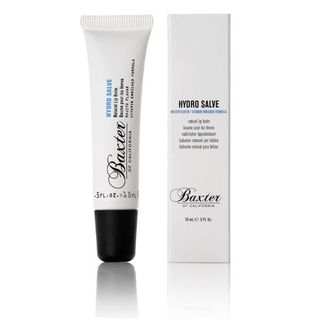
Baxter of California Hydro Salve Lip Balm
Works for
1 of 1 advertised claim delivered
MoisturizingPanthenol, Simmondsia chinensis seed oil + 10 moreStrong evidence
“Hydro Salve Lip Balm”
This product can help improve hydration of the skin with the two types of ingredients.
The first type is called “humectants”:
these ingredients help attract water.
When humectants are on the surface of the skin, they “pull in” the moisture from the outside environment, or from
within deeper layers of the skin. The following ingredients in this product do the job:
panthenol, aloe barbadensis extract.
This product also contains ingredients called “occlusives”. They help reduce the speed with which our skin loses moisture to the outside environment. These ingredients also help soften the upper layer of the skin, so it feels less tight and nicer to the touch. The following ingredients in this product do the job: beeswax, caprylic/capric triglyceride.
The following ingredients in this product are especially good for supporting the skin barrier and helping with the hydration level: panthenol
Anti-agingNot advertised by the brand · Retinyl palmitate, Tocopherol + 2 moreModerate evidence
This product contains retinyl palmitate. This ingredient might be able to help reduce and prevent fine lines and wrinkles, improve skin elasticity and firmness, but there is not enough evidence that it actually works.
Can it cause trouble?
Irritancy6 strong irritants: Retinyl palmitate, Rosa damascena extract + 4 more — patch-test recommendedHigh risk
Comedogenic1 ingredient rated 2 or more on the 0–5 pore-clogging scale1 flagged

User reviews
Be the first — your take helps the next person decide.
Ingredients
Filter by role to see what each ingredient is doing.
Isododecane~23–34%
- Irritation risk
- Low
An emollient that helps soften the skin and can decrease moisture loss. Helps create a nice product texture
More about IsododecaneCaprylic/capric triglyceride~5.7–8.6%
- Irritation risk
- Medium
A good mix of fatty acids that forms a protective layer on the skin. Improves the shelf life of products. Derived from coconut and glycerin
More about Caprylic/capric triglycerideC12-15 alkyl benzoate~5.1–7.7%
- Irritation risk
- Low
Enhances the product texture and makes it more spreadable. Helps reduce water loss from the outer layer of skin. Extands the shelf life by preventing bacteria growth
More about C12-15 alkyl benzoateVitis vinifera seed oil~4.2–6.4%
- Irritation risk
- Medium
A great emollient that can also have anti-oxidant properties
More about Vitis vinifera seed oilSimmondsia chinensis seed oil~3.4–5.2%
- Irritation risk
- Medium
Softens the upper layer of skin and helps restore the healthy skin barrier. Has shown to help calm down inflammation in skin. It is a stable oil, meaning that it retains its properties even when exposed to air.
More about Simmondsia chinensis seed oilRuscus aculeatus root extract~2.2–3.3%
- Irritation risk
- Low
Retinyl palmitate~1.9–2.8%
- Irritation risk
- High
Three steps removed from the active form of vitamin A - retinoic acid. To have an effect in the skin, it first needs to be converted twice to become the retinoic acid. This means it is less potent than retinol, but could also be less irritating. Once converted to the retinoic acid in the skin, it helps against all signs of aging, improves skin cell turnover and helps fight blemishes and clogged pores. However, in many cosmetic formulations, it is used in a concentration that is too low to have the full effect
More about Retinyl palmitatePropylene glycol~1.4–2.1%
- Irritation risk
- High
Helps oil and water mix together and can enhance the penetration of other ingredients into the skin. It can be irritating
More about Propylene glycolPanthenol~1.2–1.7%
- Irritation risk
- Low
Helps attract water to the upper layer of the skin and can help improve skin barrier function
More about PanthenolMacadamia ternifolia seed oil~1–1.5%
- Irritation risk
- Medium
Plant oil from nuts that helps soften the upper layer of the skin. Contains a high concentration of oleic acid that can weaken skin's barrier function and increase water-loss while enhancing penetration of other ingredients
More about Macadamia ternifolia seed oilHydrolyzed yeast protein~0.6–1.4%
- Irritation risk
- Low
Glycyrrhiza glabra root extract~0.4–1%
- Irritation risk
- Medium
A plant extract that can help lighten the skin and calm down inflammation. Might be helpful in neutralizing free radicals
More about Glycyrrhiza glabra root extractRosa damascena extract~0.5–1.1%
- Irritation risk
- High
Oil of a very fragrant pink rose used as fragrance in cosmetics. Extensive research has shown it has mixed benefits. In the pro column, inhaling this flower’s scent seems to have relaxing properties and the plant’s petals contain skin-soothing and antioxidant compounds that can benefit skin. On the flipside, the numerous chemicals that create this rose’s distinctive fragrance pose a risk of causing skin aggravation.
More about Rosa damascena extractCocos nucifera oil~0.45–1.05%
- Irritation risk
- Low
- Comedogenicity
- 3/5
An emollient. Found to be as effective as a moisturizer for dry skin as mineral oil. Could be comedogenic
More about Cocos nucifera oilCentella asiatica extract~0.45–1.05%
- Irritation risk
- Medium
A plant extract that has been shown to be able to reduce inflammation in skin, support restoration of skin barrier function, as well as support collagen production. Contains active compounds called centelloids: asiaticoside, madecasosside, asiatic acid and madecassic acid. Might be helpful in preventing stretch marks. It can be itself be irritating though.
More about Centella asiatica extractCalendula officinalis flower extract~0.4–0.9%
- Irritation risk
- High
A plant extract that has some anti-oxidant and anti-bacterial properties. Can be irritating
More about Calendula officinalis flower extractButyrospermum parkii nut extract~0.45–1.05%
- Irritation risk
- Low
Beeswax~0.45–1%
- Irritation risk
- Low
Forms a protective barrier that holds water and keeps dry skin hydrated. Keeps an emulsion from separating into its oil and liquid components, and increases the thickness of a product. Can be an allergen
More about BeeswaxAscorbyl palmitate~0.3–0.75%
- Irritation risk
- Medium
Being a lipid soluble form of vitamin C, it is more stable and can penetrate the skin better than L-Ascorbic acid. It is effective in protecting the skin from free radicals, as well as evening the skin tone, but is less effective in stimulating collagen production compared to L-Ascorbic acid.
More about Ascorbyl palmitateElaeis guineensis extract~0.35–0.8%
- Irritation risk
- Low
Aloe barbadensis extract~0.3–0.7%
- Irritation risk
- Medium
Traditionally used to treat sunburns, dermatitis and inflammation, but evidence for its effectiveness is lacking. The extract can contain humectants that help attract water into the skin
More about Aloe barbadensis extractAloe vera leaf extract~0.15–0.55%
- Irritation risk
- Low
Aesculus hippocastanum extract~0.2–0.8%
- Irritation risk
- High
A plant extract. Benefits of topical application are not confirmed
More about Aesculus hippocastanum extractCitrus aurantifolia oil~0.15–0.65%
- Irritation risk
- High
Tocopheryl acetate~0.1–0.45%
- Irritation risk
- Medium
A more stable but less bio-available form of vitamin E compared to Tocopherol. Might help moisturize and protect the skin from free radicals, but mostly used in low concentrations to stabilize other ingredients.
More about Tocopheryl acetateTocopherol~0.1–0.4%
- Irritation risk
- Low
Pure form of vitamin E. Can help moisturise and protect the skin from free radicals. Often used to help stabilise other ingredients or the formula itself
More about TocopherolMentha piperita oil~0.05–0.3%
Citrus limon peel oil~0.05–0.2%
Ingredient list view
Isododecane, Caprylic/capric triglyceride, C12-15 alkyl benzoate, Vitis vinifera seed oil, Simmondsia chinensis seed oil, Ruscus aculeatus root extract, Retinyl palmitate, Propylene glycol, Panthenol, Macadamia ternifolia seed oil, Hydrolyzed yeast protein, Glycyrrhiza glabra root extract, Rosa damascena extract, Cocos nucifera oil, Centella asiatica extract, Calendula officinalis flower extract, Butyrospermum parkii nut extract, Beeswax, Ascorbyl palmitate, Elaeis guineensis extract, Aloe barbadensis extract, Aloe vera leaf extract, Aesculus hippocastanum extract, Citrus aurantifolia oil, Tocopheryl acetate, Tocopherol, Mentha piperita oil, Citrus limon peel oil
Compare prices
Retailers ranked by price — lowest first.
Affiliate links · prices updated regularly · As an Amazon Associate, WIMJ earns from qualifying purchases.
Worth comparing, line by line.
Match % combines shared ingredients, the first five ingredients, shared actives and hero ingredients, irritancy (lower counts in the alternative's favour), texture and body area. Only products in the same routine step are compared.
| Baxter of CaliforniaHydro Salve Lip BalmYOUR PRODUCT | Banila CoMiss Flower & Mr. Honey Lip Balm | |
|---|---|---|
| Match | — | 51% |
| Price | — | — |
| Shared key ingredients | — | 4 of 8 |
| Key difference | — | Madecassoside |
| Irritancy | High | Medium |
| Drying alcohol | — | — |
| View product | Shop |

Product summary
"Baxter of California - Hydro Salve Lip Balm" is a well-rounded moisturizing product. The formulation is based on a combination of good humectants and emollients. Both are needed to increase the skin hydration level. Humectants in this product (panthenol and aloe barbadensis extract) help to increase the water content in the upper layer of the skin. (These ingredients do so by "capturing" water molecules from the outside air or from within the deeper layers of the skin). Vitis vinifera seed oil, beeswax, caprylic/capric triglyceride, cocos nucifera oil and simmondsia chinensis seed oil in this product help decrease the water evoporation from the skin, so that it stays hydrated for longer. These ingredients also soften the skin and take away the feeling of tightness and dryness.
Ingredient callouts
- it includes a form of retinoids (vitamin A) - retinyl palmitate 1.90% - 2.80%, but this type of vitamin A is not very effective. It could in theory help with fine lines and wrinkles, but the effect is most likely minimal.
- This formulation also uses an effective concentration of panthenol (pro-vitamin B5) - about 1.20% - 1.70%. Panthenol helps strengthen the skin barrier, improve hydration and reduce inflammation in skin.
Irritation risk
There are quite a few common irritants in this product, including ingredients without particular skin benefits. We would not recommend it for sensitive skin. We assess the overall irritancy of it to be high. For a detailed overview of all potential irritants: click here
You can see the detailed formula review with the breakdown of all actives in the product and the full ingredient list with estimated concentrations in the tables below.
Price
The product retails for 25.00A$ in Australia and for 10.00$ in the United States.
For a detailed price comparison: click here.
Sources cited in this review
Every concentration estimate and effectiveness label is anchored to one of these 20 studies and safety reviews.
- 1Surfactants and experimental irritant contact dermatitisncbi.nlm.nih.gov
- 2Propylene Glycolpubmed.ncbi.nlm.nih.gov
- 3Skin-sensitizing and irritant properties of propylene glycolonlinelibrary.wiley.com
- 4Skin moisturizing effects of panthenol-based formulationspdfs.semanticscholar.org
- 5
- 6

Affiliate links · As an Amazon Associate, WIMJ earns from qualifying purchases.