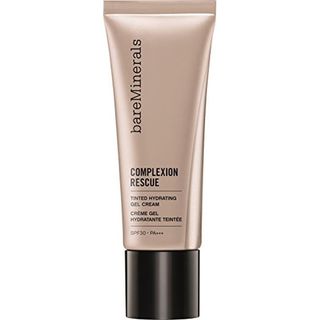
bareMinerals Complexion Rescue Hydrating Tinted Cream Gel SPF30 07 - Tan
Works for
0 of 1 advertised claim delivered
Sun protectionSPF 30 · 1 UV filter · Partial spectrumWeak protection
This product does not offer good protection against UVA rays.
This product can be considered "reef safe" because it does not contain the UV filters (oxybenzone and octinoxate) that can be harmful to coral reefs when present in the water in high concentrations.
MoisturizingNot advertised by the brand · 11 ingredients credited for this claimGood support
This product can help improve hydration of the skin with the two types of ingredients.
The first type is called “humectants”:
these ingredients help attract water.
When humectants are on the surface of the skin, they “pull in” the moisture from the outside environment, or from
within deeper layers of the skin. The following ingredients in this product do the job:
glycerin, sodium hyaluronate.
This product also contains ingredients called “occlusives”. They help reduce the speed with which our skin loses moisture to the outside environment. These ingredients also help soften the upper layer of the skin, so it feels less tight and nicer to the touch. The following ingredients in this product do the job: squalane, coco-caprylate/caprate.
Can it cause trouble?
Irritancy1 strong irritant: Melilotus officinalis extractMedium risk
Comedogenic1 ingredient rated 2 or more on the 0–5 pore-clogging scale1 flagged
User reviews
Be the first — your take helps the next person decide.
Ingredients
Filter by role to see what each ingredient is doing.
Water~45–55%
Coconut alkanes~7.2–8.8%
- Irritation risk
- Medium
- Comedogenicity
- 2/5
An emollient that helps soften the skin
More about Coconut alkanesPropanediol~4.5–5.5%
- Irritation risk
- Low
Acts as a solvent for other ingredients. Speeds up the absorption of other ingredients into the skin
More about PropanediolSqualane~3.4–4.1%
- Irritation risk
- Low
An oil naturally present in skin. Works as an emollient to soften the skin and form a protective layer on its surface without a greasy feeling.
More about SqualaneTrehalose~2.3–2.8%
- Irritation risk
- Low
A sugar that attracts water to the upper layer of the skin
More about TrehaloseIsostearic acid~2–2.4%
- Irritation risk
- Low
Used to create a nice product texture
More about Isostearic acidGlycerin~1.6–2%
- Irritation risk
- Low
One of the best moisturizing ingredients. Naturally present in skin. It attracts water to the upper layer of the skin working as a humectant
More about GlycerinSilica~1.5–1.9%
Agar~1.1–1.3%
- Irritation risk
- Medium
Polysaccharide derived from seaweed. Used to create a thicker product consistency and might help attract water to the upper layer of the skin
More about AgarCaprylic/capric triglyceride~0.95–1.15%
- Irritation risk
- Medium
A good mix of fatty acids that forms a protective layer on the skin. Improves the shelf life of products. Derived from coconut and glycerin
More about Caprylic/capric triglycerideGlobularia cordifolia callus culture extract~0.6–0.9%
- Irritation risk
- Low
An extract from plant stem cells that might help calm down inflammation in skin
More about Globularia cordifolia callus culture extractSalicornia herbacea extract~0.5–0.75%
- Irritation risk
- Low
Melilotus officinalis extract~0.4–0.6%
- Irritation risk
- High
A plant extract that might have some anti-oxidant properties. Can be used as a fragrance and can be irritating
More about Melilotus officinalis extractCoco-caprylate/caprate~0.4–0.65%
- Irritation risk
- Low
Helps to soften the upper layer of the skin without creating a greasy texture
More about Coco-caprylate/caprateButylene glycol~0.3–0.6%
- Irritation risk
- Low
Used to create a nice product texture and help delivery of other ingredients. Might be somewhat helpful in attracting water to the upper layer of the skin
More about Butylene glycolLauroyl lysine~0.3–0.6%
- Irritation risk
- Low
Helps soften the upper layer of the skin and creates a nice product texture
More about Lauroyl lysineSodium hyaluronate~0.3–0.55%
- Irritation risk
- Low
One of the best moisturizing ingredients. Attracts water into the upper layer of the skin
More about Sodium hyaluronateSuccinoglycan~0.3–0.5%
Polysorbate 60~0.25–0.5%
Cellulose gum~0.25–0.45%
- Irritation risk
- Low
Used to create thicker product consistency and stabilize emulsions
More about Cellulose gumPolyglyceryl-4 laurate/succinate~0.25–0.4%
Sorbitan sesquiisostearate~0.2–0.4%
Magnesium stearate~0.2–0.35%
Magnesium hydroxide~0.2–0.35%
- Irritation risk
- Low
Magnesium chloride~0.15–0.3%
Potassium chloride~0.15–0.25%
- Irritation risk
- Low
Calcium chloride~0.1–0.2%
- Irritation risk
- Medium
Helps create a thicker product consistency. Might be irritating
More about Calcium chloridePotassium sorbate~0.1–0.15%
Phenoxyethanol~0.1–0.2%
- Irritation risk
- Low
A preservative. It helps prevent bacterial growth in cosmetic products
More about PhenoxyethanolTitanium dioxide6.2%
- Irritation risk
- Low
Works as a UV filter when used in high concentrations. It is photostable and is effective mostly against the UVB light, with some protection in the UVA range. In small concentrations, used for its ability to improve the color of cosmetic products. Is usually well tolerated by the skin
More about Titanium dioxideIron oxides~0.05–0.15%
- Irritation risk
- Low
An umbrella term for the following three colorants: CI 77491, CI 77492, CI 77499. They might be able to offer some protection against visible light, but the degree of the protection is not clear
More about Iron oxidesIngredient list view
Water, Coconut alkanes, Propanediol, Squalane, Trehalose, Isostearic acid, Glycerin, Silica, Agar, Caprylic/capric triglyceride, Globularia cordifolia callus culture extract, Salicornia herbacea extract, Melilotus officinalis extract, Coco-caprylate/caprate, Butylene glycol, Lauroyl lysine, Sodium hyaluronate, Succinoglycan, Polysorbate 60, Cellulose gum, Polyglyceryl-4 laurate/succinate, Sorbitan sesquiisostearate, Magnesium stearate, Magnesium hydroxide, Magnesium chloride, Potassium chloride, Calcium chloride, Potassium sorbate, Phenoxyethanol, Titanium dioxide, Iron oxides
Compare prices
Retailers ranked by price — lowest first.

Affiliate links · prices updated regularly
Product summary
We do not recommend "bareMinerals - Complexion Rescue Hydrating Tinted Cream Gel SPF30 07 - Tan" because it does not provide good UVA protection. UVA sun rays don't burn the skin, but they still lead to photoaging and hyperpigmentation.
It contains good moisturizing ingredients and can double as a hydrating day cream.
Sunscreen filters
This moisturizer is a mineral sunscreen. It uses titanium dioxide for sun protection. Titanium dioxide almost never irritates the skin or stings eyes, but it can leave a white cast.
Irritation risk
This moisturizer contains some common irritants, including those without a benefit for the skin. We assess the overall irritancy of this moisturizer to be medium. For a detailed overview of all potential irritants: click here
You can see the detailed formula review with the breakdown of all actives in the product and the full ingredient list with estimated concentrations in the tables below.
About the brand
According to Cruelty-Free Kitty "bareMinerals" is cruelty free, but its parent company is not.
Price
The product retails for 92.43A$ in Australia, from 27.24$ up to 30.00$ in the United States and for 17.50£ in the United Kingdom.
For a detailed price comparison: click here.
Sources cited in this review
Every concentration estimate and effectiveness label is anchored to one of these 4 studies and safety reviews.
- 1
- 2Safety Assessment of Alkyl Esters as Used in Cosmeticscir-safety.org
- 3Hyaluronic acid: A key molecule in skin agingncbi.nlm.nih.gov
- 4

Affiliate links · As an Amazon Associate, WIMJ earns from qualifying purchases.