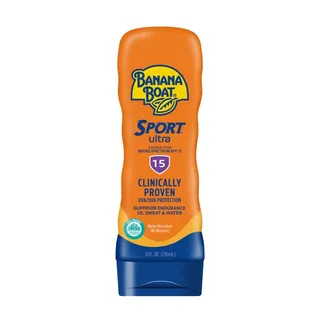
Banana Boat Ultra Sport Sunscreen Lotion SPF 15
Works for
Sun protectionSPF 15 · 5 UV filters · Broad spectrumWeak protectionSPF under 30
This product offers broad spectrum sun protection, but it is weak. We recommend to use a broad spectrum sunscreen with at least SPF 30.
Anti-agingNot advertised by the brand · Retinyl palmitate, Aloe barbadensis leaf juiceMay help
This product contains retinyl palmitate. This ingredient might be able to help reduce and prevent fine lines and wrinkles, improve skin elasticity and firmness, but there is not enough evidence that it actually works. The biggest anti-aging effect in this product comes from sun protection. Sun damage is the main factor causing early signs of skin aging. We, however, do not recommend using this product as a sunscreen because the protection it offers is not strong enough).
Evens skin toneNot advertised by the brand · Retinyl palmitateMay help
The following ingredient (ingredients) in this product might be helpful, but there is no evidence to confirm that it actually works: retinyl palmitate.
The biggest effect for evening out skin tone in this product comes from sun protection. Sun damage is the main factor causing age spots, darkening of post-acne marks and other discolorations. This is why sun protection is the best strategy for maintaining an even skin tone. We, however, do not recommend using this product as a sunscreen because the protection it offers is not strong enough).
MoisturizingNot advertised by the brand · Cetyl dimethicone, Cetearyl alcohol + 9 moreWorks
This product can help improve hydration of the skin with the two types of ingredients.
The first type is called “humectants”:
these ingredients help attract water.
When humectants are on the surface of the skin, they “pull in” the moisture from the outside environment, or from
within deeper layers of the skin. The following ingredients in this product do the job:
glycerin, caprylyl glycol.
This product also contains ingredients called “occlusives”. They help reduce the speed with which our skin loses moisture to the outside environment. These ingredients also help soften the upper layer of the skin, so it feels less tight and nicer to the touch. The following ingredients in this product do the job: cetyl dimethicone, cetearyl alcohol.
Can it cause trouble?
Irritancy5 strong irritants: Parfum, Benzophenone-3 + 3 more — patch-test recommendedHigh risk
Comedogenic1 ingredient rated 2 or more on the 0–5 pore-clogging scale1 flagged
User reviews
Be the first — your take helps the next person decide.
Ingredients
Filter by role to see what each ingredient is doing.
Ethylhexyl salicylate~22–33%
- Irritation risk
- Low
Octisalate. A UV filter. It offers some protection against the sun rays that cause sunburn (UVB), but does not protect against the most aging sun rays (UVA). It loses its effectiveness quickly when exposed to sunlight. It is an organic, or so called "chemical" sunscreen
More about Ethylhexyl salicylateWater~10–16%
Glyceryl stearate~3.5–5.2%
- Irritation risk
- Low
An emollient that softens the skin and forms a protective layer on its surface. Helps water and oil mix together
More about Glyceryl stearatePeg-100 stearate~3.7–5.5%
- Irritation risk
- Low
Helps oil and water mix togehter and creates a nice product texture
More about Peg-100 stearateCetyl alcohol~2.5–3.8%
- Irritation risk
- Low
A non-drying alcohol that works to soften the skin and stabilize product formulations helping oil and water mix together
More about Cetyl alcoholCetyl dimethicone~1.9–2.8%
- Irritation risk
- Low
A type of silicone. Helps soften the upper layer of the skin and creates a nice, light product texture
More about Cetyl dimethiconePropylene glycol~1.4–2.2%
- Irritation risk
- High
Helps oil and water mix together and can enhance the penetration of other ingredients into the skin. It can be irritating
More about Propylene glycolPhenoxyethanol~0.5–1%
- Irritation risk
- Low
A preservative. It helps prevent bacterial growth in cosmetic products
More about PhenoxyethanolCaprylyl glycol~1.1–1.7%
- Irritation risk
- Medium
Helps preserve products and creates a nice product texture
More about Caprylyl glycolVp/eicosene copolymer~0.95–1.4%
- Irritation risk
- Medium
Used to improve the product adherence to the skin, for example, to pro-long the protective effect of sunscreens. Can be irritating to very sensitive skin
More about Vp/eicosene copolymerAcrylates/c12-22 alkyl methacrylate copolymer~0.8–1.2%
- Irritation risk
- Low
Behenyl alcohol~0.5–1.2%
- Irritation risk
- Low
Non-drying alcohol that helps water and oil mix together. Also serves as an emollient
More about Behenyl alcoholSodium polyacrylate~0.5–1.1%
- Irritation risk
- Low
Used to create a gel-like product texture, as well as to stabilize emulsions
More about Sodium polyacrylateChlorphenesin~0.16–0.32%
Xanthan gum~0.35–0.85%
- Irritation risk
- Low
Used to create a thicker product consistency
More about Xanthan gumDisodium edta~0.35–0.85%
Parfum~0.35–0.8%
- Irritation risk
- High
An aromatic blend of unspecified and possibly irritating ingredients
More about ParfumTocopheryl acetate~0.35–0.8%
- Irritation risk
- Medium
A more stable but less bio-available form of vitamin E compared to Tocopherol. Might help moisturize and protect the skin from free radicals, but mostly used in low concentrations to stabilize other ingredients.
More about Tocopheryl acetateAloe barbadensis leaf juice~0.3–0.7%
- Irritation risk
- Medium
Traditionally used to treat sunburns, dermatitis and inflammation, but evidence for its effectiveness is lacking. The extract can contain humectants that help attract water into the skin
More about Aloe barbadensis leaf juiceButyl methoxydibenzoylmethane1%
- Irritation risk
- Medium
Avobenzone. An organic, or so-called "chemical" UV filter. Protects against both UVA and UVB rays. Needs to be combined with other filters in a formulation to be stable.
More about Butyl methoxydibenzoylmethaneHomosalate6%
- Irritation risk
- Medium
A weak sunscreen that offers some protection against the sun rays that cause sunburn (UVB), but does not offer meaningful protection against protect against the most aging sun rays (UVA). It loses its effectiveness quickly when exposed to sunlight. It is an organic, or so called "chemical" sunscreen. When used in low concentrations, helps to stabilize the product formulation
More about HomosalateOctocrylene0.8%
- Irritation risk
- Medium
A weak sunscreen that protects against the sun rays that cause sunburn (UVB) and is somewhat effective against the UVA rays. It is quite stable and can help stabilize other, more vulnerable, sunscreen ingredients like Avobenzone. It is an organic, or so called "chemical" sunscreen
More about OctocryleneBenzophenone-32%
- Irritation risk
- High
Same as oxybenzone. Protects in the UVB and short UVA range. In small concentrations, used to stabilize product formulation. Can be irritating. Is shown to be harmful to coral reefs - consider avoiding bathing in coral reef areas when wearing a product with this ingredient. It can penetrate the skin and get absorbed into bloodstream faster than other popular filters available in the US. The study that produced this finding did not address any potential health effects of the absorption
More about Benzophenone-3Water~0.2–0.8%
Stearyl alcohol~0.3–0.75%
- Irritation risk
- Low
An emollient that helps soften the skin
More about Stearyl alcoholGlycerin~0.2–0.8%
- Irritation risk
- Low
One of the best moisturizing ingredients. Naturally present in skin. It attracts water to the upper layer of the skin working as a humectant
More about GlycerinCaprylyl glycol~0.2–0.7%
- Irritation risk
- Medium
Helps preserve products and creates a nice product texture
More about Caprylyl glycolHydrogenated dimer dilinoleyl/dimethylcarbonate copolymer~0.15–0.65%
- Irritation risk
- Low
Cetyl alcohol~0.2–0.8%
- Irritation risk
- Low
A non-drying alcohol that works to soften the skin and stabilize product formulations helping oil and water mix together
More about Cetyl alcoholTriethanolamine~0.15–0.7%
- Irritation risk
- Medium
Used to adjust pH of the product and can help improve the product's smell
More about TriethanolamineCarbomer~0.15–0.65%
- Irritation risk
- Low
Helps create a thicker or gel-like product texture. It is not a surfactant but can be used in gentle cleansing formulations
More about CarbomerGlyceryl stearate~0.2–0.8%
- Irritation risk
- Low
An emollient that softens the skin and forms a protective layer on its surface. Helps water and oil mix together
More about Glyceryl stearateBehenyl alcohol~0.2–0.75%
- Irritation risk
- Low
Non-drying alcohol that helps water and oil mix together. Also serves as an emollient
More about Behenyl alcoholXanthan gum~0.15–0.6%
- Irritation risk
- Low
Used to create a thicker product consistency
More about Xanthan gumSodium lauroyl sarcosinate~0.9–1.3%
- Irritation risk
- Medium
Helps oil and water mix together and works as a cleansing agent
More about Sodium lauroyl sarcosinateDisodium edta~0.15–0.6%
Dipropylene glycol~0.15–0.5%
- Irritation risk
- Low
Helps to dissolve other ingredients in a formulation. Slows down the rate of product drying
More about Dipropylene glycolBht~0.15–0.6%
Disodium ethylene dicocamide peg-15 disulfate~0.2–0.8%
- Irritation risk
- Medium
Helps oil and water mix together
More about Disodium ethylene dicocamide peg-15 disulfateGlyceryl stearate citrate~0.2–0.75%
- Irritation risk
- Low
Helps oil and water mix together while softening the upper layer of the skin
More about Glyceryl stearate citrateCetearyl alcohol~0.3–0.7%
- Irritation risk
- Low
- Comedogenicity
- 2/5
A non-drying alcohol. Works as an emollient. Helps water and oil mix together and creates a nice product texture
More about Cetearyl alcoholSodium lauroyl lactylate~0.15–0.6%
- Irritation risk
- Medium
Helps water and oil mix together
More about Sodium lauroyl lactylateRetinyl palmitate~0.1–0.5%
- Irritation risk
- High
Three steps removed from the active form of vitamin A - retinoic acid. To have an effect in the skin, it first needs to be converted twice to become the retinoic acid. This means it is less potent than retinol, but could also be less irritating. Once converted to the retinoic acid in the skin, it helps against all signs of aging, improves skin cell turnover and helps fight blemishes and clogged pores. However, in many cosmetic formulations, it is used in a concentration that is too low to have the full effect
More about Retinyl palmitateTocopheryl acetate~0.15–0.55%
- Irritation risk
- Medium
A more stable but less bio-available form of vitamin E compared to Tocopherol. Might help moisturize and protect the skin from free radicals, but mostly used in low concentrations to stabilize other ingredients.
More about Tocopheryl acetateLecithin~0.15–0.6%
- Irritation risk
- Low
Used mostly for creating emulsions - helping oil and water mix together. Helps soften the upper layer of the skin
More about LecithinAloe barbadensis leaf juice~0.1–0.35%
- Irritation risk
- Medium
Traditionally used to treat sunburns, dermatitis and inflammation, but evidence for its effectiveness is lacking. The extract can contain humectants that help attract water into the skin
More about Aloe barbadensis leaf juicePhenoxyethanol~0.1–0.4%
- Irritation risk
- Low
A preservative. It helps prevent bacterial growth in cosmetic products
More about PhenoxyethanolMethyldibromo glutaronitrile~0.1–0.35%
- Irritation risk
- Low
Methylisothiazolinone~0.00075–0.0015%
Methylchloroisothiazolinone~0.00075–0.0015%
- Irritation risk
- High
A preservative. Is a frequent allergen in cosmetics
More about MethylchloroisothiazolinoneIngredient list view
Ethylhexyl salicylate, Water, Glyceryl stearate, Peg-100 stearate, Cetyl alcohol, Cetyl dimethicone, Propylene glycol, Phenoxyethanol, Caprylyl glycol, Vp/eicosene copolymer, Acrylates/c12-22 alkyl methacrylate copolymer, Behenyl alcohol, Sodium polyacrylate, Chlorphenesin, Xanthan gum, Disodium edta, Parfum, Tocopheryl acetate, Aloe barbadensis leaf juice, Butyl methoxydibenzoylmethane, Homosalate, Octocrylene, Benzophenone-3, Water, Stearyl alcohol, Glycerin, Caprylyl glycol, Hydrogenated dimer dilinoleyl/dimethylcarbonate copolymer, Cetyl alcohol, Triethanolamine, Carbomer, Glyceryl stearate, Behenyl alcohol, Xanthan gum, Sodium lauroyl sarcosinate, Disodium edta, Dipropylene glycol, Bht, Disodium ethylene dicocamide peg-15 disulfate, Glyceryl stearate citrate, Cetearyl alcohol, Sodium lauroyl lactylate, Retinyl palmitate, Tocopheryl acetate, Lecithin, Aloe barbadensis leaf juice, Phenoxyethanol, Methyldibromo glutaronitrile, Methylisothiazolinone, Methylchloroisothiazolinone
Compare prices
Retailers ranked by price — lowest first.
Affiliate links · As an Amazon Associate, WIMJ earns from qualifying purchases.
Worth comparing, line by line.
Match % combines shared ingredients, the first five ingredients, shared actives and hero ingredients, irritancy (lower counts in the alternative's favour), texture and body area. Only products in the same routine step are compared.
| Banana BoatUltra Sport Sunscreen Lotion SPF 15YOUR PRODUCT | NeutrogenaUltra Sheer Dry-Touch Sunscreen Broad Spectrum SPF 30 | MesoesteticMesoprotech Sun Protective Body Lotion SPF 30 | VichyCapital Soleil Soft Sheer Face and Body Sunscreen Lotion SPF 60 | |
|---|---|---|---|---|
| Match | — | 41% | 40% | 40% |
| Price | $18.99 | $8.24−$10.75 | $75.75+$56.76 | — |
| Shared key ingredients | — | 5 of 8 | 3 of 8 | 5 of 8 |
| Key difference | — | Beeswax | Beta-Sitosterol | Butyloctyl Salicylate |
| Irritancy | High | Medium | Medium | Medium |
| SPF | SPF 15 | SPF 30 | SPF 30 | SPF 60 |
| Drying alcohol | — | — | — | — |
| View product | Shop | Shop | Shop |


More alternatives: Paula's choice Extra Care Non-Greasy Sunscreen SPF 50Daylogic Kids Sunscreen Lotion, SPF 50
Product summary
"Banana Boat - Ultra Sport Sunscreen Lotion SPF 15" "is a broad spectrum sunscreen meaning that it protects both from UVB rays (" burning "- they cause sunburn) and UVA rays (" aging "- they don't cause sunburn but lead to premature aging and pigmentation issues). However, it does not offer enough sun protection. We recommend to use a sunscreen with at least SPF 30 daily.
It also works as a moisturizer, so you do not have to use an additional hydrating product.
Sunscreen filters
This is a so-called" chemical "sunscreen. It means that it uses organic UV filters. They typically offer good sun protection and rarely leave a white cast, but they can be irritating for some people with sensitive skin. These are the sun protection ingredients in this sunscreen: oxybenzone 2.00% (declared), avobenzone 1.00% (declared), octisalate 22.00% - 33.00%, homosalate 6.00% (declared) and octocrylene 0.80% (declared).
Irritation risk
We assess the overall irritancy of this product to be high. For a detailed overview of all potential irritants: click here
You can see the detailed formula review with the breakdown of all actives in the product and the full ingredient list with estimated concentrations in the tables below.
Price
The product retails from 12.44$ up to 14.99$ in the United States.
For a detailed price comparison: click here.
Sources cited in this review
Every concentration estimate and effectiveness label is anchored to one of these 10 studies and safety reviews.
- 1Surfactants and experimental irritant contact dermatitisncbi.nlm.nih.gov
- 2Propylene Glycolpubmed.ncbi.nlm.nih.gov
- 3Skin-sensitizing and irritant properties of propylene glycolonlinelibrary.wiley.com
- 4
- 5
- 6

Affiliate links · As an Amazon Associate, WIMJ earns from qualifying purchases.