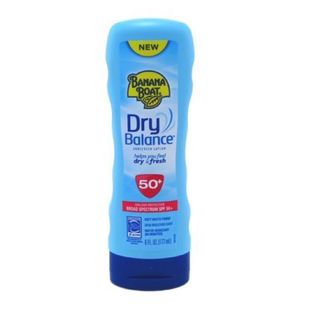
Banana Boat Dry Balance Sunscreen Lotion SPF 50+
Works for
2 of 2 advertised claims delivered
Sun protectionSPF 50 · 4 UV filtersBroad spectrum
This product offers a good level of protection against both UVB and UVA rays.
This sunscreen uses organic (so-called "chemical") sunscreen filters. Organic, or "chemical" filters usually provide reliable sun protection and rarely leave a white cast. Sunscreens with organic filters can sting eyes.
This product can be considered "reef safe" because it does not contain the UV filters (oxybenzone and octinoxate) that can be harmful to coral reefs when present in the water in high concentrations.
MoisturizingPanthenol, Glycerin + 5 moreStrong evidence
“Dry Balance Sunscreen Lotion SPF 50+”
This product contains good ingredients to attract water to the upper layer of the skin. These ingredients are called "humectants": glycerin, caprylyl glycol.
When humectants are on the surface of the skin, they “pull in” the moisture from the outside environment, or from within deeper layers of the skin. If the air is dry, humectants can speed up the moisture loss from the skin. This is why it is a good idea to use another product on top of this one to help "seal in" the moisture (look for ingredients like dimethicone, squalane, oils and butters).
The following ingredients in this product are especially good for supporting the skin barrier and helping with the hydration level: panthenol
Anti-agingNot advertised by the brand · Sodium ascorbyl phosphate, Aloe barbadensis leaf juiceStrong evidence
This product can help prevent early signs of skin aging because it offers a good level of broad spectrum sun protection. Sun damage is the main cause of premature skin aging, and protecting your skin from the sun is the best anti-aging strategy.
Evens skin toneNot advertised by the brand · No ingredient credited for this claimStrong evidence
This product offers broad spectrum sun protection. It means that it can prevent hyperpigmentation and help keep the skin tone even (sun damage is the main factor causing age spots, darkening of post-acne marks and other discolorations).
Can it cause trouble?
Irritancy1 strong irritant: ParfumMedium risk
Comedogenic2 ingredients rated 2 or more on the 0–5 pore-clogging scale2 flagged

User reviews
Ingredients
Filter by role to see what each ingredient is doing.
Disodium edta~0.5–1%
Polymethylsilsesquioxane~3.3–5%
- Irritation risk
- Low
A silicone that improves product texture and helps dissolve other ingredients. Can form a non-greasy film on the skin to prevent moisture loss
More about PolymethylsilsesquioxaneTocopheryl acetate~4.3–6.5%
- Irritation risk
- Medium
A more stable but less bio-available form of vitamin E compared to Tocopherol. Might help moisturize and protect the skin from free radicals, but mostly used in low concentrations to stabilize other ingredients.
More about Tocopheryl acetateMethylparaben~0.15–0.3%
Phenoxyethanol~0.5–1%
- Irritation risk
- Low
A preservative. It helps prevent bacterial growth in cosmetic products
More about PhenoxyethanolDiisopropyl adipate~2.2–3.3%
- Irritation risk
- Low
Helps soften the upper layer of the skin
More about Diisopropyl adipateTapioca starch~1.6–2.3%
Propylparaben~0.2–0.4%
Parfum~1.1–1.6%
- Irritation risk
- High
An aromatic blend of unspecified and possibly irritating ingredients
More about ParfumSilica~1.2–1.8%
Acrylates/c10-30 alkyl acrylate crosspolymer~0.9–1.35%
- Irritation risk
- Medium
Maintains the texture of skincare products. Allows the product to spread evenly. Helps oil and water mix together
More about Acrylates/c10-30 alkyl acrylate crosspolymerCoco-glucoside~0.6–1.35%
- Irritation risk
- High
Used as a cleansing agent (surfactant) in cleansers. Helps water and oil mix together in lotions. Can be irritating
More about Coco-glucosideCeteth-10 phosphate~0.55–1.3%
Cetearyl alcohol~0.8–1.2%
- Irritation risk
- Low
- Comedogenicity
- 2/5
A non-drying alcohol. Works as an emollient. Helps water and oil mix together and creates a nice product texture
More about Cetearyl alcoholSodium hydroxide~0.45–1.1%
Aloe barbadensis leaf juice~0.45–1.05%
- Irritation risk
- Medium
Traditionally used to treat sunburns, dermatitis and inflammation, but evidence for its effectiveness is lacking. The extract can contain humectants that help attract water into the skin
More about Aloe barbadensis leaf juiceXanthan gum~0.45–1.05%
- Irritation risk
- Low
Used to create a thicker product consistency
More about Xanthan gumPanthenol~0.4–0.95%
- Irritation risk
- Low
Helps attract water to the upper layer of the skin and can help improve skin barrier function
More about PanthenolWater~0.4–0.9%
Sodium ascorbyl phosphate~0.45–1%
- Irritation risk
- Medium
A stable derivative of vitamin C. It is oil-soluble which means it is more likely to penetrate the skin compared to the pure form of vitamin C (which is water-soluble), but it is less bio-available and is way less effective in stimulating collagen and reducing wrinkles compared to the pure form of vitamin C (L-ascorbic acid) and its other derivatives (for example, magnesium ascorbyl phosphate). At the same time, this vitamin C derivative has been shown in studies to be effective in reducing acne, blemishes and clogged pores. It is less irritating then the pure form of vitamin C
More about Sodium ascorbyl phosphateDicetyl phosphate~0.35–0.85%
Glycerin~0.35–0.85%
- Irritation risk
- Low
One of the best moisturizing ingredients. Naturally present in skin. It attracts water to the upper layer of the skin working as a humectant
More about GlycerinAcrylates/c12-22 alkyl methacrylate copolymer~0.4–0.95%
- Irritation risk
- Low
Caprylyl glycol~0.35–0.85%
- Irritation risk
- Medium
Helps preserve products and creates a nice product texture
More about Caprylyl glycolButyl methoxydibenzoylmethane3%
- Irritation risk
- Medium
Avobenzone. An organic, or so-called "chemical" UV filter. Protects against both UVA and UVB rays. Needs to be combined with other filters in a formulation to be stable.
More about Butyl methoxydibenzoylmethaneHomosalate9%
- Irritation risk
- Medium
A weak sunscreen that offers some protection against the sun rays that cause sunburn (UVB), but does not offer meaningful protection against protect against the most aging sun rays (UVA). It loses its effectiveness quickly when exposed to sunlight. It is an organic, or so called "chemical" sunscreen. When used in low concentrations, helps to stabilize the product formulation
More about HomosalateEthylhexyl salicylate4%
- Irritation risk
- Low
Octisalate. A UV filter. It offers some protection against the sun rays that cause sunburn (UVB), but does not protect against the most aging sun rays (UVA). It loses its effectiveness quickly when exposed to sunlight. It is an organic, or so called "chemical" sunscreen
More about Ethylhexyl salicylateOctocrylene5%
- Irritation risk
- Medium
A weak sunscreen that protects against the sun rays that cause sunburn (UVB) and is somewhat effective against the UVA rays. It is quite stable and can help stabilize other, more vulnerable, sunscreen ingredients like Avobenzone. It is an organic, or so called "chemical" sunscreen
More about OctocryleneWater~0.35–0.75%
Diisopropyl adipate~0.4–0.9%
- Irritation risk
- Low
Helps soften the upper layer of the skin
More about Diisopropyl adipateSilica~0.4–0.95%
Cetearyl alcohol~0.4–0.9%
- Irritation risk
- Low
- Comedogenicity
- 2/5
A non-drying alcohol. Works as an emollient. Helps water and oil mix together and creates a nice product texture
More about Cetearyl alcoholGlycerin~0.35–0.8%
- Irritation risk
- Low
One of the best moisturizing ingredients. Naturally present in skin. It attracts water to the upper layer of the skin working as a humectant
More about GlycerinPhenoxyethanol~0.35–0.8%
- Irritation risk
- Low
A preservative. It helps prevent bacterial growth in cosmetic products
More about PhenoxyethanolTapioca starch~0.3–0.75%
Acrylates/c12-22 alkyl methacrylate copolymer~0.35–0.85%
- Irritation risk
- Low
Caprylyl glycol~0.2–0.75%
- Irritation risk
- Medium
Helps preserve products and creates a nice product texture
More about Caprylyl glycolAcrylates/c10-30 alkyl acrylate crosspolymer~0.3–0.75%
- Irritation risk
- Medium
Maintains the texture of skincare products. Allows the product to spread evenly. Helps oil and water mix together
More about Acrylates/c10-30 alkyl acrylate crosspolymerCeteth-10 phosphate~0.2–0.75%
Dicetyl phosphate~0.15–0.65%
Coco-glucoside~0.35–0.8%
- Irritation risk
- High
Used as a cleansing agent (surfactant) in cleansers. Helps water and oil mix together in lotions. Can be irritating
More about Coco-glucosideMethylparaben~0.15–0.3%
Parfum~0.15–0.55%
- Irritation risk
- High
An aromatic blend of unspecified and possibly irritating ingredients
More about ParfumXanthan gum~0.15–0.6%
- Irritation risk
- Low
Used to create a thicker product consistency
More about Xanthan gumPropylparaben~0.2–0.4%
Sodium hydroxide~0.1–0.45%
Disodium edta~0.1–0.35%
Polymethylsilsesquioxane~0.1–0.5%
- Irritation risk
- Low
A silicone that improves product texture and helps dissolve other ingredients. Can form a non-greasy film on the skin to prevent moisture loss
More about PolymethylsilsesquioxaneSodium ascorbyl phosphate~0.1–0.4%
- Irritation risk
- Medium
A stable derivative of vitamin C. It is oil-soluble which means it is more likely to penetrate the skin compared to the pure form of vitamin C (which is water-soluble), but it is less bio-available and is way less effective in stimulating collagen and reducing wrinkles compared to the pure form of vitamin C (L-ascorbic acid) and its other derivatives (for example, magnesium ascorbyl phosphate). At the same time, this vitamin C derivative has been shown in studies to be effective in reducing acne, blemishes and clogged pores. It is less irritating then the pure form of vitamin C
More about Sodium ascorbyl phosphateTocopheryl acetate~0.1–0.4%
- Irritation risk
- Medium
A more stable but less bio-available form of vitamin E compared to Tocopherol. Might help moisturize and protect the skin from free radicals, but mostly used in low concentrations to stabilize other ingredients.
More about Tocopheryl acetatePanthenol~0.05–0.2%
- Irritation risk
- Low
Helps attract water to the upper layer of the skin and can help improve skin barrier function
More about PanthenolAloe barbadensis leaf juice~0.05–0.2%
- Irritation risk
- Medium
Traditionally used to treat sunburns, dermatitis and inflammation, but evidence for its effectiveness is lacking. The extract can contain humectants that help attract water into the skin
More about Aloe barbadensis leaf juiceIngredient list view
Disodium edta, Polymethylsilsesquioxane, Tocopheryl acetate, Methylparaben, Phenoxyethanol, Diisopropyl adipate, Tapioca starch, Propylparaben, Parfum, Silica, Acrylates/c10-30 alkyl acrylate crosspolymer, Coco-glucoside, Ceteth-10 phosphate, Cetearyl alcohol, Sodium hydroxide, Aloe barbadensis leaf juice, Xanthan gum, Panthenol, Water, Sodium ascorbyl phosphate, Dicetyl phosphate, Glycerin, Acrylates/c12-22 alkyl methacrylate copolymer, Caprylyl glycol, Butyl methoxydibenzoylmethane, Homosalate, Ethylhexyl salicylate, Octocrylene, Water, Diisopropyl adipate, Silica, Cetearyl alcohol, Glycerin, Phenoxyethanol, Tapioca starch, Acrylates/c12-22 alkyl methacrylate copolymer, Caprylyl glycol, Acrylates/c10-30 alkyl acrylate crosspolymer, Ceteth-10 phosphate, Dicetyl phosphate, Coco-glucoside, Methylparaben, Parfum, Xanthan gum, Propylparaben, Sodium hydroxide, Disodium edta, Polymethylsilsesquioxane, Sodium ascorbyl phosphate, Tocopheryl acetate, Panthenol, Aloe barbadensis leaf juice
Compare prices
Retailers ranked by price — lowest first.

Worth comparing, line by line.
Match % combines shared ingredients, the first five ingredients, shared actives and hero ingredients, irritancy (lower counts in the alternative's favour), texture and body area. Only products in the same routine step are compared.
| Banana BoatDry Balance Sunscreen Lotion SPF 50+YOUR PRODUCT | innisfreeHyaluron Moist Sunscreen Mini | ManyoHyaluron Hydrating Sunscreen | the Torriden StoreDive-In Low Molecular Hyaluronic Watery Sun Serum PA++++ SPF50+ | |
|---|---|---|---|---|
| Match | — | 52% | 52% | 51% |
| Price | $8.92 | $12.98+$4.06 | $14.01+$5.09 | $23.39+$14.47 |
| Shared key ingredients | — | 3 of 6 | 3 of 6 | 3 of 6 |
| Key difference | — | Madecassoside | Niacinamide | Niacinamide |
| Irritancy | Medium | Medium | Medium | Low |
| SPF | SPF 50 | SPF 50 | SPF 50 | SPF 50 |
| Drying alcohol | — | — | — | — |
| View product | Shop | Shop | Shop |


Product summary
The ingredient list suggests that "Banana Boat - Dry Balance Sunscreen Lotion SPF 50+" can provide reliable sun protection. It can protect from both UVA and UVB rays. This is great news because not all sunscreens with SPF ratings give UVA protection. (UVA rays do not cause sunburn, but still damage our skin and lead to early aging).
This moisturizer should also be hydrating enough to use without an additional moisturizer during the day. Like all broad-spectrum sunscreens, this product has an anti-aging benefit.
Sunscreen filters
This is a so-called "chemical" sunscreen. It means that it uses organic UV filters. They typically offer good sun protection and rarely leave a white cast, but they can be irritating for some people with sensitive skin. These are the sun protection ingredients in this sunscreen: avobenzone 3.00% (declared), octisalate 4.00% (declared), homosalate 9.00% (declared) and octocrylene 5.00% (declared).
Irritation risk
This moisturizer contains some common irritants, including those without a benefit for the skin. We assess the overall irritancy of this moisturizer to be medium. For a detailed overview of all potential irritants: click here
You can see the detailed formula review with the breakdown of all actives in the product and the full ingredient list with estimated concentrations in the tables below.
What our users say
Based on 1 review 100% recommend this product- When it comes to comedogenicity, the reviewer found that it does not clog pores.
- As for the white cast, the reviewer reported a noticeable whitish residue.
Price
The product retails from 8.92$ up to 25.81$ in the United States and for 44.00£ in the United Kingdom.
For a detailed price comparison: click here.
Sources cited in this review
Every concentration estimate and effectiveness label is anchored to one of these 13 studies and safety reviews.
- 1
- 2Allergen of the Year—Alkyl Glucosidepracticeupdate.com
- 3Skin moisturizing effects of panthenol-based formulationspdfs.semanticscholar.org
- 4
- 5
- 6Sodium ascorbyl phosphate in topical microemulsionssciencedirect.com

Affiliate links · As an Amazon Associate, WIMJ earns from qualifying purchases.