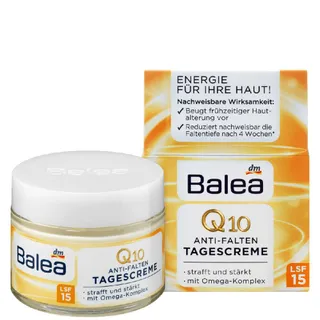
Works for
Anti-agingUbiquinone, Ascorbyl tetraisopalmitateMay help
“Q10 Anti-Age Day Cream”
This product contains ubiquinone. This ingredient help neutralize free radicals in skin. By doing so, they might be able to prevent early signs of aging (like fine lines and wrinkles), at least to some extent. These ingredients will not be able to "reverse" signs of aging.
MoisturizingGlycerin, C12-15 alkyl benzoate + 10 moreWorks
“Q10 Anti-Age Day Cream”
This product can help improve hydration of the skin with the two types of ingredients.
The first type is called “humectants”:
these ingredients help attract water.
When humectants are on the surface of the skin, they “pull in” the moisture from the outside environment, or from
within deeper layers of the skin. The following ingredients in this product do the job:
glycerin, caprylyl glycol.
This product also contains ingredients called “occlusives”. They help reduce the speed with which our skin loses moisture to the outside environment. These ingredients also help soften the upper layer of the skin, so it feels less tight and nicer to the touch. The following ingredients in this product do the job: carthamus tinctorius seed oil, c12-15 alkyl benzoate.
Anti-oxidationSide benefit · Ubiquinone, Carthamus tinctorius seed oil + 2 moreWorks well
This product contains antioxidants (ubiquinone) that can help neutralize free radicals in skin. By doing so, they can lessen the damage the skin gets from the UV light (sun).
Can it cause trouble?
Irritancy2 strong irritants: Isoamyl p-methoxycinnamate, ParfumMedium risk
Comedogenic1 ingredient rated 2 or more on the 0–5 pore-clogging scale1 flagged


User reviews
Be the first — your take helps the next person decide.
Ingredients
Filter by role to see what each ingredient is doing.
Water~40–60%
Glycerin~4.1–6.1%
- Irritation risk
- Low
One of the best moisturizing ingredients. Naturally present in skin. It attracts water to the upper layer of the skin working as a humectant
More about GlycerinC12-15 alkyl benzoate~3.6–5.5%
- Irritation risk
- Low
Enhances the product texture and makes it more spreadable. Helps reduce water loss from the outer layer of skin. Extands the shelf life by preventing bacteria growth
More about C12-15 alkyl benzoateEthylhexyl salicylate~3.1–4.6%
- Irritation risk
- Low
Octisalate. A UV filter. It offers some protection against the sun rays that cause sunburn (UVB), but does not protect against the most aging sun rays (UVA). It loses its effectiveness quickly when exposed to sunlight. It is an organic, or so called "chemical" sunscreen
More about Ethylhexyl salicylateButyl methoxydibenzoylmethane~2.7–4.1%
- Irritation risk
- Medium
Avobenzone. An organic, or so-called "chemical" UV filter. Protects against both UVA and UVB rays. Needs to be combined with other filters in a formulation to be stable.
More about Butyl methoxydibenzoylmethaneCetearyl alcohol~1.7–2.6%
- Irritation risk
- Low
- Comedogenicity
- 2/5
A non-drying alcohol. Works as an emollient. Helps water and oil mix together and creates a nice product texture
More about Cetearyl alcoholDibutyl adipate~1.5–2.2%
- Irritation risk
- Low
Helps soften the upper layer of the skin and create a nice product consistency
More about Dibutyl adipateIsoamyl p-methoxycinnamate~1.8–2.7%
- Irritation risk
- High
Amiloxate or Neo Heliopan E1000. A UV filter. It is effective against UVB and UVA II rays. Not available in the US. It can be irritating
More about Isoamyl p-methoxycinnamateEthylhexyl triazone~1.5–2.2%
- Irritation risk
- Medium
Uvinul T. A UV filter. Effective against UVB rays. It is photostable. Can increase water resistance properties of the sunscreen. Unfortunately, not approved by the FDA (US) yet
More about Ethylhexyl triazoneMyristyl alcohol~0.85–1.25%
- Irritation risk
- High
Helps to stabilize the product formulation while softening the upper layer of the skin. Can be irritating
More about Myristyl alcoholBis-ethylhexyloxyphenol methoxyphenyl triazine~0.95–1.45%
- Irritation risk
- Medium
Tinosorb S. One of the most effective broad spectrum sunscreen ingredients. Protects from both UVA and UVB rays. It is photostable. Unfortunately, not approved by FDA (US) yet.
More about Bis-ethylhexyloxyphenol methoxyphenyl triazineCarthamus tinctorius seed oil~0.4–1%
- Irritation risk
- Low
An emollient that helps soften the skin and might help calm down inflammation
More about Carthamus tinctorius seed oilCetearyl glucoside~0.35–0.85%
- Irritation risk
- Medium
Helps water and oil in the product mix well together and improves product texture
More about Cetearyl glucosideCetyl alcohol~0.4–0.9%
- Irritation risk
- Low
A non-drying alcohol that works to soften the skin and stabilize product formulations helping oil and water mix together
More about Cetyl alcoholStearic acid~0.35–0.85%
- Irritation risk
- Low
Helps oil and water mix together and works as an emollient
More about Stearic acidStearyl alcohol~0.3–0.7%
- Irritation risk
- Low
An emollient that helps soften the skin
More about Stearyl alcoholTocopheryl acetate~0.15–0.6%
- Irritation risk
- Medium
A more stable but less bio-available form of vitamin E compared to Tocopherol. Might help moisturize and protect the skin from free radicals, but mostly used in low concentrations to stabilize other ingredients.
More about Tocopheryl acetateUbiquinone~0.15–0.55%
- Irritation risk
- Low
Coenzyme Q10. It helps neutralize free radicals in skin, improves skin hydration and might be helpful agains fine lines and wrinkles. It can be an allergen
More about UbiquinoneAscorbyl tetraisopalmitate~0.15–0.6%
- Irritation risk
- Medium
A vitamin C derivative. Studies show that is might be effective in reducing hyperpigmentation, but there are no studies confirming that it is effectively converted into the bioavailable form of Vitamin C in skin. It is not clear how this derivative compares in effectiveness to the topical application of bioavailable form of vitamin C (L-ascorbic acid)
More about Ascorbyl tetraisopalmitatePanthenol~0.1–0.45%
- Irritation risk
- Low
Helps attract water to the upper layer of the skin and can help improve skin barrier function
More about PanthenolCaprylyl glycol~0.1–0.45%
- Irritation risk
- Medium
Helps preserve products and creates a nice product texture
More about Caprylyl glycolMyristyl glucoside~0.15–0.5%
- Irritation risk
- Low
Parfum~0.05–0.25%
- Irritation risk
- High
An aromatic blend of unspecified and possibly irritating ingredients
More about ParfumXanthan gum~0.05–0.25%
- Irritation risk
- Low
Used to create a thicker product consistency
More about Xanthan gumPhenoxyethanol~0.05–0.25%
- Irritation risk
- Low
A preservative. It helps prevent bacterial growth in cosmetic products
More about PhenoxyethanolDisodium edta~0.01–0.1%
Ingredient list view
Water, Glycerin, C12-15 alkyl benzoate, Ethylhexyl salicylate, Butyl methoxydibenzoylmethane, Cetearyl alcohol, Dibutyl adipate, Isoamyl p-methoxycinnamate, Ethylhexyl triazone, Myristyl alcohol, Bis-ethylhexyloxyphenol methoxyphenyl triazine, Carthamus tinctorius seed oil, Cetearyl glucoside, Cetyl alcohol, Stearic acid, Stearyl alcohol, Tocopheryl acetate, Ubiquinone, Ascorbyl tetraisopalmitate, Panthenol, Caprylyl glycol, Myristyl glucoside, Parfum, Xanthan gum, Phenoxyethanol, Disodium edta
Compare prices
Retailers ranked by price — lowest first.
Worth comparing, line by line.
Match % combines shared ingredients, the first five ingredients, shared actives and hero ingredients, irritancy (lower counts in the alternative's favour), texture and body area. Only products in the same routine step are compared.
| BaleaQ10 Anti-Age Day CreamYOUR PRODUCT | AveenoCalm + Restore Redness Relief Moisturizing Cream | OARS + ALPSMen's Daily All | EpicurenHydro Plus Moisturizer | |
|---|---|---|---|---|
| Match | — | 59% | 58% | 58% |
| Price | — | $19.97 | $15.00 | $67.10 |
| Shared key ingredients | — | 2 of 8 | 3 of 8 | 3 of 8 |
| Key difference | — | Ceramide Np | Caprylic/Capric Triglyceride | Anhydroxylitol |
| Irritancy | Medium | Low | Low | Low |
| Drying alcohol | — | — | — | — |
| View product | Shop | Shop | Shop |

More alternatives: Real Barrier Intense Moisture Hyaluronic CreamNivea Q10 Sensitive Anti-Wrinkle Night Cream
Sources cited in this review
Every concentration estimate and effectiveness label is anchored to one of these 11 studies and safety reviews.
- 1
- 2
- 3Cosmetic allergy from myristyl alcoholncbi.nlm.nih.gov
- 4
- 5Patch testing with myristyl alcoholresearchgate.net
- 6

Affiliate links · As an Amazon Associate, WIMJ earns from qualifying purchases.