Works for
ExfoliationGlycolic acid, Lactic acidWorks well
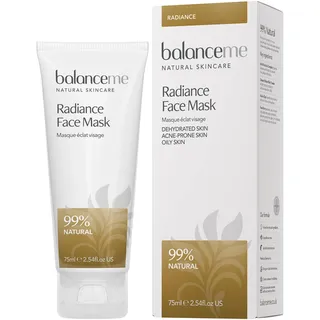
“Synergising Ground Walnut Spheres and a Fruit Acid Complex, the 99% natural mask delivers a gently exfoliating action to buff away dead skin cells and eliminate impurities, revealing a smoother, more refined complexion with enhanced luminosity.”
This product can help exfoliate the skin. In other words, it helps break down the bonds between dead cells on the surface of the skin and speed up the skin turnover. Skin often appears softer and brighter after exfoliation, but overdoing it can result in disrupted skin barrier. The following ingredient is doing the exfoliating job in this product: glycolic acid.
MoisturizingGlycerin, Caprylic/capric triglyceride + 9 moreWorks
“Treat dull complexions to the Balance Me Radiance Face Mask; a multi-beneficial, five-minute formula that works to replenish moisture and restore a radiant glow.”
This product can help improve hydration of the skin with the two types of ingredients.
The first type is called “humectants”:
these ingredients help attract water.
When humectants are on the surface of the skin, they “pull in” the moisture from the outside environment, or from
within deeper layers of the skin. The following ingredients in this product do the job:
glycerin, sodium lactate.
This product also contains ingredients called “occlusives”. They help reduce the speed with which our skin loses moisture to the outside environment. These ingredients also help soften the upper layer of the skin, so it feels less tight and nicer to the touch. The following ingredients in this product do the job: caprylic/capric triglyceride, cetearyl alcohol.
Anti-blemishGlycolic acid, KaolinNot delivered
“Kaolin Clay effectively clears pores, whilst Rosemary and Lavender Oils leave skin rejuvenated, revitalised and deeply refreshed. 99% natural.”
This product contains ingredients (glycolic acid) that could help reduce blemishes and clogged pores in theory, but there is not enough evidence that they actually work.
Evens skin toneNot advertised by the brand · Glycolic acid, Lactic acidWorks well
This product can help reduce hypepigmentation and even out the skin tone because it contains the following effective ingredients: glycolic acid
Keep in mind that you would need to apply any topical skincare targetted at hypigmentation consistently for a couple of months to get a result. No topical skincare product can help get rid of hyperpigmentation (including post-acne marks and age spots) instantly.
Anti-agingNot advertised by the brand · Glycolic acid, Tocopherol + 1 moreWorks well
This product can help reduce and prevent fine lines and wrinkles, improve skin elasticity and firmness because it contains glycolic acid.
Keep in mind that it typically takes at least 6 weeks to notice any results because the changes that are needed to improve fine lines and elasticity happen in the deeper layers of the skin. No topical anti-aging product can “erase” wrinkles or fully reverse signs of aging.
Can it cause trouble?
Irritancy11 strong irritants: Juglans regia shell powder, Cymbopogon martini oil + 9 more — patch-test recommendedHigh risk
Comedogenic3 ingredients rated 2 or more on the 0–5 pore-clogging scale3 flagged


User reviews
Be the first — your take helps the next person decide.
Ingredients
Filter by role to see what each ingredient is doing.
Water~45–55%
Kaolin~4.8–5.9%
- Irritation risk
- Low
A type of clay that consists mainly of aluminum silicate. Helps absorb oil and creates a thicker product consistency. Can be used to add a white color
More about KaolinGlycerin~4–4.9%
- Irritation risk
- Low
One of the best moisturizing ingredients. Naturally present in skin. It attracts water to the upper layer of the skin working as a humectant
More about GlycerinCaprylic/capric triglyceride~3.2–3.9%
- Irritation risk
- Medium
A good mix of fatty acids that forms a protective layer on the skin. Improves the shelf life of products. Derived from coconut and glycerin
More about Caprylic/capric triglyceridePrunus amygdalus dulcis seed~2.3–2.8%
- Irritation risk
- Low
Helps soften the upper layer of the skin
More about Prunus amygdalus dulcis seedCetearyl alcohol~2–2.4%
- Irritation risk
- Low
- Comedogenicity
- 2/5
A non-drying alcohol. Works as an emollient. Helps water and oil mix together and creates a nice product texture
More about Cetearyl alcoholGlyceryl stearate~1.7–2%
- Irritation risk
- Low
An emollient that softens the skin and forms a protective layer on its surface. Helps water and oil mix together
More about Glyceryl stearateCetearyl glucoside~1.4–1.7%
- Irritation risk
- Medium
Helps water and oil in the product mix well together and improves product texture
More about Cetearyl glucosideJuglans regia shell powder~1.3–1.6%
- Irritation risk
- High
Tocopherol~0.95–1.15%
- Irritation risk
- Low
Pure form of vitamin E. Can help moisturise and protect the skin from free radicals. Often used to help stabilise other ingredients or the formula itself
More about TocopherolAloe barbadensis leaf extract~0.75–1.1%
- Irritation risk
- Medium
Traditionally used to treat sunburns, dermatitis and inflammation, but evidence for its effectiveness is lacking. The extract can contain humectants that help attract water into the skin
More about Aloe barbadensis leaf extractCymbopogon martini oil~0.55–0.8%
- Irritation risk
- High
Aromatic plant oil used in cosmetics as a fragrance. A likely irritant
More about Cymbopogon martini oilLavandula angustifolia flower oil~0.5–0.75%
- Irritation risk
- High
A fragrant plant oil, can be irritating
More about Lavandula angustifolia flower oilPelargonium graveolens flower oil~0.45–0.7%
- Irritation risk
- High
An essential oil. Can be irritating. Can become an allergen with oxidation
More about Pelargonium graveolens flower oilCitrus aurantium amara leaf/twig oil~0.45–0.65%
- Irritation risk
- High
Angelica archangelica root oil~0.35–0.6%
- Irritation risk
- Low
Anthemis nobilis flower oil~0.3–0.6%
- Irritation risk
- High
An essential oil that is used as a fragrance and can be irritating. It might have some anti-oxidant effect in skin
More about Anthemis nobilis flower oilRosmarinus officinalis leaf oil~0.3–0.6%
- Irritation risk
- High
A plant oil with high content of volatile compounds that can irritate the skin. Can be used as a fragrance. Has anti-bacterial properties and might help neutralize free radicals on the surface of the skin
More about Rosmarinus officinalis leaf oilCananga odorata flower oil~0.3–0.5%
Sodium lactate~0.3–0.5%
- Irritation risk
- Medium
Helps attract water to the upper layer of the skin. Is often used to adjust the pH level of the product
More about Sodium lactateSodium pca~0.25–0.5%
- Irritation risk
- Low
Naturally present in skin and helps to attract water to its upper layer
More about Sodium pcaSodium glycolate~0.25–0.45%
- Irritation risk
- Low
Sodium citrate~0.25–0.45%
- Irritation risk
- Medium
Helps to control the skin's pH level. Maintains the skin's natural film of amino-lactic acids and oils. Helps to preserve products
More about Sodium citrateSodium malate~0.25–0.4%
- Irritation risk
- Low
Lactic acid~0.2–0.4%
- Irritation risk
- Medium
An exfoliating and moisturizing alpha-hydroxy acid (AHA). Typically causes less irritation than other AHAs, for example, glycolic acid. At high concentrations (about 15%), lactic acid can help reduce lines and wrinkles. Recent studies show that lactic acid can support the "good" bacteria living on skin's surface (healthy skin microbiome)
More about Lactic acidGlycolic acid~0.25–0.45%
- Irritation risk
- High
An alpha-hydroxy acid (AHA) that helps to remove the dead skin cells on the surface of the skin reveling a more even, smoother complexation. It is also able to stimulate collagen production with long-term use. Could help to reduce pore congestion. It can be irritating to the skin. Apply sunscreen daily if using products with glycolic acid
More about Glycolic acidMalic acid~0.2–0.4%
Sodium stearoyl lactylate~0.25–0.45%
- Irritation risk
- Medium
Helps oil and water mix together
More about Sodium stearoyl lactylateChondrus crispus~0.2–0.4%
- Irritation risk
- Low
- Comedogenicity
- 3/5
Red algae extract that helps attract water to the upper layer of the skin and create a nicer product consistency
More about Chondrus crispusCarrageenan~0.25–0.4%
- Irritation risk
- Medium
- Comedogenicity
- 3/5
Helps thicken the product formula and create a nice product formulation
More about CarrageenanTetrasodium pyrophosphate~0.2–0.35%
Benzyl alcohol~0.15–0.25%
- Irritation risk
- High
A preservative. Can be used to mask unpleasant smell. Can be irritating
More about Benzyl alcoholDehydroacetic acid~0.15–0.25%
Citric acid~0.15–0.25%
- Irritation risk
- Medium
Can work as an exfoliant but is typically used to adjust the product pH
More about Citric acidLimonene~0.1–0.2%
- Irritation risk
- High
A common frangrance that can easily irritate skin, especially if exposed to air, light or heat
More about LimoneneLinalool~0.1–0.2%
Geraniol~0.05–0.15%
Citronellol~0.05–0.1%
Ingredient list view
Water, Kaolin, Glycerin, Caprylic/capric triglyceride, Prunus amygdalus dulcis seed, Cetearyl alcohol, Glyceryl stearate, Cetearyl glucoside, Juglans regia shell powder, Tocopherol, Aloe barbadensis leaf extract, Cymbopogon martini oil, Lavandula angustifolia flower oil, Pelargonium graveolens flower oil, Citrus aurantium amara leaf/twig oil, Angelica archangelica root oil, Anthemis nobilis flower oil, Rosmarinus officinalis leaf oil, Cananga odorata flower oil, Sodium lactate, Sodium pca, Sodium glycolate, Sodium citrate, Sodium malate, Lactic acid, Glycolic acid, Malic acid, Sodium stearoyl lactylate, Chondrus crispus, Carrageenan, Tetrasodium pyrophosphate, Benzyl alcohol, Dehydroacetic acid, Citric acid, Limonene, Linalool, Geraniol, Citronellol, Unknown
Compare prices
Retailers ranked by price — lowest first.
Affiliate links · As an Amazon Associate, WIMJ earns from qualifying purchases.
Worth comparing, line by line.
Match % combines shared ingredients, the first five ingredients, shared actives and hero ingredients, irritancy (lower counts in the alternative's favour), texture and body area. Only products in the same routine step are compared.
| Balance MeRadiance Face MaskYOUR PRODUCT | SOBEL SKIN Rx11% Triple Acid Mineral Mask | Elizabeth GrantWonder Effect Detoxifying Mask | Herbal EssentialsIlluminating Mask With Papain and Honey | |
|---|---|---|---|---|
| Match | — | 61% | 61% | 61% |
| Price | $35.00 | — | — | $10.69−$24.31 |
| Shared key ingredients | — | 5 of 9 | 4 of 9 | 5 of 9 |
| Key difference | — | Salicylic Acid | Palmitoyl Tetrapeptide-7 | Cera Alba |
| Irritancy | High | Medium | Medium | Medium |
| Drying alcohol | — | — | — | — |
| View product | Shop | Shop | Shop |


More alternatives: Functionalab Glycolic Acid 5 % MaskM. Skin Care Sensitive Skin Clay Mask
Product summary
"Balance Me - Radiance Face Mask" is effective for: Exfoliation, Evens skin tone and Anti-aging
This product could be helpful for: Moisturizing, but its actives are not the most effective or are not well-studied.
Ingredient callouts
- Humectants (sodium pca 0.25% - 0.50%, sodium lactate 0.30% - 0.50% and glycerin 4.00% - 4.90%). These ingredients help attract water to the upper layer of the skin and improve the skin hydration.
Price
The product retails for 24.00$ in the United States.
For a detailed price comparison: click here.
Sources cited in this review
Every concentration estimate and effectiveness label is anchored to one of these 19 studies and safety reviews.
- 1
- 2Vitamin E in dermatologyncbi.nlm.nih.gov
- 3Vitamin E and Skin Healthlpi.oregonstate.edu
- 4
- 5Safety Assessment of Anthemis nobilis– Derived Ingredients as Used in Cosmeticsjournals.sagepub.com
- 6

Affiliate links · As an Amazon Associate, WIMJ earns from qualifying purchases.