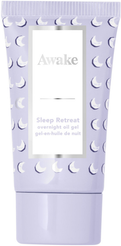
Awake Beauty Sleep Retreat Overnight Oil Gel
Works for
1 of 1 advertised claim delivered
Moisturizing14 ingredients credited for this claimGood support
“oil gel texture boosts skin's moisture barrier nourishing botanical complex packed with 20+ ingredients like jojoba, sunflower, rice bran & apple hydrate, soothe and soften green tea & cucumber extracts set the mood for maximum relaxation Ingredients.”
This product can help improve hydration of the skin with the two types of ingredients.
The first type is called “humectants”:
these ingredients help attract water.
When humectants are on the surface of the skin, they “pull in” the moisture from the outside environment, or from
within deeper layers of the skin. The following ingredients in this product do the job:
glycerin.
This product also contains ingredients called “occlusives”. They help reduce the speed with which our skin loses moisture to the outside environment. These ingredients also help soften the upper layer of the skin, so it feels less tight and nicer to the touch. The following ingredients in this product do the job: caprylic/capric triglyceride, cocos nucifera oil.
Anti-oxidationNot advertised by the brand · 10 ingredients credited for this claimModerate support
This product contains antioxidants (squalene) that might be able to help neutralize free radicals in skin to lessen the damage it gets from the UV light (sun). There is not enough evidence to confirm their effectiveness in skin though.
Can it cause trouble?
Irritancy9 strong irritants: Rosmarinus officinalis leaf extract, Lavandula angustifolia flower/leaf/stem extract + 7 more — patch-test recommendedHigh risk
Comedogenic2 ingredients rated 2 or more on the 0–5 pore-clogging scale2 flagged
User reviews
Be the first — your take helps the next person decide.
Ingredients
Filter by role to see what each ingredient is doing.
Caprylic/capric triglyceride~23–34%
- Irritation risk
- Medium
A good mix of fatty acids that forms a protective layer on the skin. Improves the shelf life of products. Derived from coconut and glycerin
More about Caprylic/capric triglycerideGlycerin~3.5–5.3%
- Irritation risk
- Low
One of the best moisturizing ingredients. Naturally present in skin. It attracts water to the upper layer of the skin working as a humectant
More about GlycerinOlea europaea fruit oil~4.4–6.6%
- Irritation risk
- Medium
An emollient that helps soften the skin but is not effective for restoring its barrier function. Might be helpful to calm down inflammation
More about Olea europaea fruit oilOryza sativa bran oil~3.7–5.6%
- Irritation risk
- Low
Helps soften the upper layer of the skin and might have some anti-oxidant properties
More about Oryza sativa bran oilHydrogenated polyisobutene~2.9–4.4%
- Irritation risk
- Low
Used to improve the product consistency and soften the upper layer of the skin
More about Hydrogenated polyisobuteneSesamum indicum seed oil~2.1–3.1%
- Irritation risk
- Low
A good moisturizing plant oil. Due to the high linoleic acid content, it helps soften the upper layer of the skin, reduce water loss and support skin barrier function
More about Sesamum indicum seed oilDimethicone~1.7–2.6%
- Irritation risk
- Low
A silicone that helps to reduce water loss from the surface of the skin. Can temporarily "fill in" lines and wrinkles, absorb oil, and create a nice product finish
More about DimethiconeSimmondsia chinensis seed oil~1.5–2.3%
- Irritation risk
- Medium
Softens the upper layer of skin and helps restore the healthy skin barrier. Has shown to help calm down inflammation in skin. It is a stable oil, meaning that it retains its properties even when exposed to air.
More about Simmondsia chinensis seed oilPhenoxyethanol~0.5–1%
- Irritation risk
- Low
A preservative. It helps prevent bacterial growth in cosmetic products
More about PhenoxyethanolOryza sativa bran extract~0.85–1.3%
Sodium surfactin~0.6–1.35%
Triethyl citrate~0.4–1%
Tocopherol~0.4–0.95%
- Irritation risk
- Low
Pure form of vitamin E. Can help moisturise and protect the skin from free radicals. Often used to help stabilise other ingredients or the formula itself
More about TocopherolHelianthus annuus extract~0.4–1%
- Irritation risk
- Low
Helps soften the upper layer of the skin
More about Helianthus annuus extractTetrahexyldecyl ascorbate~0.35–0.8%
- Irritation risk
- Medium
Being a lipid soluble form of vitamin C, it is more stable than ascorbic acid, but still degrades quickly and needs to be stabilized in a formulation with another ingredient. It is claimed to penetrate skin better than pure vitamin C and have the the similar benefits, but solid studies of its effectiveness are lacking. Is likely to require a higher concentration in a product than pure vitamin C to be effective. It might be able to help reduce pore clogging.
More about Tetrahexyldecyl ascorbateSqualene~0.4–0.95%
- Irritation risk
- Low
- Comedogenicity
- 2/5
An oil that is naturally part of skin sebum that helps to soften its upper layer, reduce water loss and neutralize free radicals. It might be comedogenic. Avoid applying large concentrations (or pure oil) before sun exposure as oxidized squalene can clog pores and lead to skin irritation. Today squalene is mostly derived from vegetable oils or synthetized by yeast
More about SqualeneRosmarinus officinalis leaf extract~0.3–0.75%
- Irritation risk
- High
Can be helpful in reducing inflammation in skin, including inflamed acne. It can be irritating
More about Rosmarinus officinalis leaf extractLavandula angustifolia flower/leaf/stem extract~0.3–0.75%
Linalool~0.2–0.7%
Cocos nucifera oil~0.2–0.75%
- Irritation risk
- Low
- Comedogenicity
- 3/5
An emollient. Found to be as effective as a moisturizer for dry skin as mineral oil. Could be comedogenic
More about Cocos nucifera oilMedicago sativa extract~0.15–0.65%
- Irritation risk
- Medium
A plant extract that might help neutralize free radicals in skin
More about Medicago sativa extractCamellia sinensis leaf extract~0.15–0.65%
- Irritation risk
- Low
Can contain potent anti-oxidant compounds (abbreviated ECG, GCG, EGC, and EGCG) that might help protect the skin from free radicals. Can help calm down inflammation and has some anti-bacterial properties. Unfortunately, these antioxidants are unstable and lose their effectiveness very quickly in products. The concentration of the antioxidant compounds in the extract also tends to be low to be effective in topical formulation
More about Camellia sinensis leaf extractElettaria cardamomum seed extract~0.15–0.5%
Pyrus malus fruit extract~0.15–0.6%
- Irritation risk
- Medium
Can have some moisturizing properties due to its sugar content
More about Pyrus malus fruit extractRubus idaeus fruit extract~0.15–0.6%
- Irritation risk
- Medium
A fruit extract that might have some anti-oxidant properties but evidence of effectiveness in skin is lacking
More about Rubus idaeus fruit extractHydroxycitronellal~0.1–0.5%
- Irritation risk
- High
A fragrance. A likely allergen and can be irritating
More about HydroxycitronellalAmyl cinnamal~0.1–0.4%
- Irritation risk
- High
Cananga odorata flower extract~0.1–0.4%
Citrus aurantium amara flower extract~0.1–0.45%
- Irritation risk
- High
Used as a fragrance for its citrus smell. Can be irritating
More about Citrus aurantium amara flower extractCitrus aurantium bergamia fruit extract~0.1–0.35%
- Irritation risk
- High
Coffea arabica seed extract~0.1–0.35%
- Irritation risk
- Low
Might be helpful in neutralizing free radicals in skin
More about Coffea arabica seed extractCucumis melo fruit extract~0.1–0.35%
- Irritation risk
- Medium
A fruit extract that might have some anti-oxidant properties
More about Cucumis melo fruit extractIngredient list view
Caprylic/capric triglyceride, Glycerin, Olea europaea fruit oil, Oryza sativa bran oil, Hydrogenated polyisobutene, Sesamum indicum seed oil, Dimethicone, Simmondsia chinensis seed oil, Phenoxyethanol, Oryza sativa bran extract, Sodium surfactin, Triethyl citrate, Tocopherol, Helianthus annuus extract, Tetrahexyldecyl ascorbate, Squalene, Rosmarinus officinalis leaf extract, Lavandula angustifolia flower/leaf/stem extract, Linalool, Cocos nucifera oil, Medicago sativa extract, Camellia sinensis leaf extract, Elettaria cardamomum seed extract, Pyrus malus fruit extract, Rubus idaeus fruit extract, Hydroxycitronellal, Amyl cinnamal, Cananga odorata flower extract, Citrus aurantium amara flower extract, Citrus aurantium bergamia fruit extract, Coffea arabica seed extract, Cucumis melo fruit extract
Compare prices
Retailers ranked by price — lowest first.
Sources cited in this review
Every concentration estimate and effectiveness label is anchored to one of these 24 studies and safety reviews.
- 1
- 2Use of “natural” oils for moisturization: Review of olive, coconut, and sunflower seed oilonlinelibrary.wiley.com
- 3
- 4
- 5
- 6Triglyceride composition of Sesamum indicum seed oilonlinelibrary.wiley.com

Affiliate links · As an Amazon Associate, WIMJ earns from qualifying purchases.