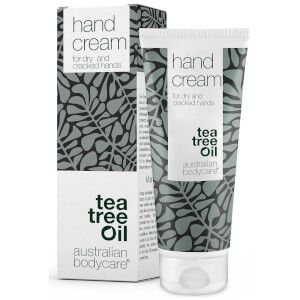
Australian Bodycare Hand Cream
Works for
1 of 1 advertised claim delivered
MoisturizingLinoleic acid, Panthenol + 14 moreStrong evidence
“Replenish cracked, dry skin with the Australian Bodycare Hand Cream.”
This product can help improve hydration of the skin with the two types of ingredients.
The first type is called “humectants”:
these ingredients help attract water.
When humectants are on the surface of the skin, they “pull in” the moisture from the outside environment, or from
within deeper layers of the skin. The following ingredients in this product do the job:
glycerin, saccharide isomerate.
This product also contains ingredients called “occlusives”. They help reduce the speed with which our skin loses moisture to the outside environment. These ingredients also help soften the upper layer of the skin, so it feels less tight and nicer to the touch. The following ingredients in this product do the job: butyrospermum parkii butter, ricinus communis seed oil.
The following ingredients in this product are especially good for supporting the skin barrier and helping with the hydration level: linoleic acid, panthenol
Can it cause trouble?
Irritancy1 strong irritant: Melaleuca alternifolia leaf oilMedium risk
Comedogenic3 ingredients rated 2 or more on the 0–5 pore-clogging scale3 flagged
User reviews
Be the first — your take helps the next person decide.
Ingredients
Filter by role to see what each ingredient is doing.
Water~45–55%
Isopropyl myristate~6.3–7.7%
- Irritation risk
- Low
- Comedogenicity
- 3/5
An emollient that helps soften the skin. Could be comedogenic
More about Isopropyl myristateButyrospermum parkii butter~4.8–5.8%
- Irritation risk
- Low
- Comedogenicity
- 3/5
A great moisturising ingredient that softens the skin and reduces water loss from its upper layer. It also can be helpful in protecting skin from free radicals
More about Butyrospermum parkii butterGlycerin~3.3–4%
- Irritation risk
- Low
One of the best moisturizing ingredients. Naturally present in skin. It attracts water to the upper layer of the skin working as a humectant
More about GlycerinTribehenin peg-20 esters~2.5–3.1%
- Irritation risk
- Medium
Helps oil and water mix together
More about Tribehenin peg-20 estersOryza sativa cera~2.1–2.5%
- Irritation risk
- Low
Shea butter ethyl esters~1.8–2.2%
- Irritation risk
- Low
Helps soften the upper layer of the skin
More about Shea butter ethyl estersRicinus communis seed oil~1.7–2%
- Irritation risk
- Medium
A plant oil that can help soften the skin. It might be helpful in calming down inflammation, but solid research is lacking. Is often used in lip products to create the needed product consistency
More about Ricinus communis seed oilGlyceryl stearate~1.4–1.7%
- Irritation risk
- Low
An emollient that softens the skin and forms a protective layer on its surface. Helps water and oil mix together
More about Glyceryl stearatePeg-100 stearate~1.1–1.4%
- Irritation risk
- Low
Helps oil and water mix togehter and creates a nice product texture
More about Peg-100 stearateCetearyl alcohol~0.95–1.15%
- Irritation risk
- Low
- Comedogenicity
- 2/5
A non-drying alcohol. Works as an emollient. Helps water and oil mix together and creates a nice product texture
More about Cetearyl alcoholPentaerythrityl distearate~0.65–1%
4-terpineol~0.55–0.85%
- Irritation risk
- Low
Distarch phosphate~0.55–0.8%
- Irritation risk
- Low
Limnanthes alba seed oil~0.55–0.8%
- Irritation risk
- Low
This oil's cmposition is closest to rapeseed oil. It is a very stable oil and serves as an emoillient
More about Limnanthes alba seed oilPhenoxyethanol~0.5–0.75%
- Irritation risk
- Low
A preservative. It helps prevent bacterial growth in cosmetic products
More about PhenoxyethanolPrunus amygdalus dulcis oil~0.5–0.75%
- Irritation risk
- Low
An emollient that softens the skin
More about Prunus amygdalus dulcis oilRhus verniciflua peel cera~0.45–0.7%
- Irritation risk
- Low
Rhus succedanea fruit cera~0.45–0.65%
- Irritation risk
- Low
Glycine soja sterols~0.4–0.65%
- Irritation risk
- Low
An emollient that helps soften the skin
More about Glycine soja sterolsPanthenol~0.3–0.6%
- Irritation risk
- Low
Helps attract water to the upper layer of the skin and can help improve skin barrier function
More about PanthenolLinoleic acid~0.45–0.7%
- Irritation risk
- Low
An excellent emollient. Helps soften the skin, restore its barrier function, and can help to calm down inflammation. It can be helpful to prevent blemishes and clogged pores
More about Linoleic acidSaccharide isomerate~0.3–0.55%
- Irritation risk
- Low
Helps attract water to the upper layer of the skin
More about Saccharide isomerateLactic acid~0.3–0.55%
- Irritation risk
- Medium
An exfoliating and moisturizing alpha-hydroxy acid (AHA). Typically causes less irritation than other AHAs, for example, glycolic acid. At high concentrations (about 15%), lactic acid can help reduce lines and wrinkles. Recent studies show that lactic acid can support the "good" bacteria living on skin's surface (healthy skin microbiome)
More about Lactic acidSodium benzoate~0.25–0.5%
Carbomer~0.3–0.55%
- Irritation risk
- Low
Helps create a thicker or gel-like product texture. It is not a surfactant but can be used in gentle cleansing formulations
More about CarbomerSodium hydroxide~0.3–0.5%
Tocopherol~0.25–0.5%
- Irritation risk
- Low
Pure form of vitamin E. Can help moisturise and protect the skin from free radicals. Often used to help stabilise other ingredients or the formula itself
More about TocopherolEthylhexylglycerin~0.25–0.5%
Tetrasodium iminodisuccinate~0.25–0.45%
- Irritation risk
- Low
Melaleuca alternifolia leaf oil~0.2–0.4%
- Irritation risk
- High
An essential oil that can be irritating. Has some anti-bacterial properties
More about Melaleuca alternifolia leaf oilAscorbyl palmitate~0.2–0.35%
- Irritation risk
- Medium
Being a lipid soluble form of vitamin C, it is more stable and can penetrate the skin better than L-Ascorbic acid. It is effective in protecting the skin from free radicals, as well as evening the skin tone, but is less effective in stimulating collagen production compared to L-Ascorbic acid.
More about Ascorbyl palmitateSodium gluconate~0.2–0.35%
Citric acid~0.15–0.25%
- Irritation risk
- Medium
Can work as an exfoliant but is typically used to adjust the product pH
More about Citric acidSodium citrate~0.1–0.2%
- Irritation risk
- Medium
Helps to control the skin's pH level. Maintains the skin's natural film of amino-lactic acids and oils. Helps to preserve products
More about Sodium citrateLinolenic acid~0.2–0.4%
- Irritation risk
- Medium
An emollient that helps soften the skin and calm down inflammation
More about Linolenic acidIngredient list view
Water, Isopropyl myristate, Butyrospermum parkii butter, Glycerin, Tribehenin peg-20 esters, Oryza sativa cera, Shea butter ethyl esters, Ricinus communis seed oil, Glyceryl stearate, Peg-100 stearate, Cetearyl alcohol, Pentaerythrityl distearate, 4-terpineol, Distarch phosphate, Limnanthes alba seed oil, Phenoxyethanol, Prunus amygdalus dulcis oil, Rhus verniciflua peel cera, Rhus succedanea fruit cera, Glycine soja sterols, Panthenol, Linoleic acid, Saccharide isomerate, Lactic acid, Sodium benzoate, Carbomer, Sodium hydroxide, Tocopherol, Ethylhexylglycerin, Tetrasodium iminodisuccinate, Melaleuca alternifolia leaf oil, Ascorbyl palmitate, Sodium gluconate, Citric acid, Sodium citrate, Linolenic acid
Compare prices
Retailers ranked by price — lowest first.

.png)
Product summary
Based on the ingredients included, "Australian Bodycare - Hand Cream" works well for moisturizing the skin. This moisturizer uses a good combo of humectants and emollients. These both types of ingredients are essentials for improving the skin hydration and keeping the skin barrier healthy. Humectants in this product (panthenol, glycerin and saccharide isomerate) help to increase the water content in the upper layer of the skin. (These ingredients do so by "capturing" water molecules from the outside air or from within the deeper layers of the skin). Emollients in this formulation (glycine soja sterols, isopropyl myristate, limnanthes alba seed oil, linolenic acid and butyrospermum parkii butter) help to reduce the moisture loss from the skin. They also soften the skin surface and relieve the feeling of dryness and tightness.
Irritation risk
This moisturizer contains some common irritants, including those without a benefit for the skin. We assess the overall irritancy of this moisturizer to be medium. For a detailed overview of all potential irritants: click here
You can see the detailed formula review with the breakdown of all actives in the product and the full ingredient list with estimated concentrations in the tables below.
Price
The product retails from 13.49$ up to 19.95$ in the United States, from 7.99£ up to 13.49£ in the United Kingdom and for 14.00CA$ in Canada.
For a detailed price comparison: click here.
Sources cited in this review
Every concentration estimate and effectiveness label is anchored to one of these 13 studies and safety reviews.
- 1
- 2
- 3
- 4
- 5
- 6Skin moisturizing effects of panthenol-based formulationspdfs.semanticscholar.org

Affiliate links · As an Amazon Associate, WIMJ earns from qualifying purchases.