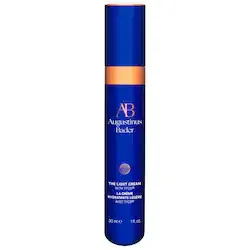
Augustinus Bader The Light Cream
Works for
2 of 3 advertised claims delivered
Anti-aging3 ingredients credited for this claimModerate support
“Reduced appearance of wrinkles by 45%”
This product contains alanyl glutamine, epigallocatechin gallatyl glucoside. These ingredients might be able to help reduce and prevent fine lines and wrinkles, improve skin elasticity and firmness, but there is not enough evidence that it actually works.
Moisturizing13 ingredients credited for this claimGood support
“What it is: A light, mattifying moisturizer that hydrates, balances, visibly renews, and protects while improving the complexion's appearance and preventing unwanted shine.”
This product can help improve hydration of the skin with the two types of ingredients.
The first type is called “humectants”:
these ingredients help attract water.
When humectants are on the surface of the skin, they “pull in” the moisture from the outside environment, or from
within deeper layers of the skin. The following ingredients in this product do the job:
alanyl glutamine, arginine.
This product also contains ingredients called “occlusives”. They help reduce the speed with which our skin loses moisture to the outside environment. These ingredients also help soften the upper layer of the skin, so it feels less tight and nicer to the touch. The following ingredients in this product do the job: arginine, squalane.
Evens skin tone1 ingredient credited for this claimWeak support
“Combats the signs of aging, while improving elasticity, tone, and texture.”
Effective ingredients missing or their concentration is too low
Anti-oxidationNot advertised by the brand · 6 ingredients credited for this claimStrong support
This product contains antioxidants (epigallocatechin gallatyl glucoside) that can help neutralize free radicals in skin. By doing so, they can lessen the damage the skin gets from the UV light (sun).
Can it cause trouble?
Irritancy1 strong irritant: Backhousia citriodora leaf extractMedium risk
Comedogenic1 ingredient rated 2 or more on the 0–5 pore-clogging scale1 flagged
User reviews
Be the first — your take helps the next person decide.
Ingredients
Filter by role to see what each ingredient is doing.
Water~40–60%
Glycerin~4–6.1%
- Irritation risk
- Low
One of the best moisturizing ingredients. Naturally present in skin. It attracts water to the upper layer of the skin working as a humectant
More about GlycerinMaris aqua~3.2–4.8%
Sodium acrylates copolymer~2.4–3.7%
- Irritation risk
- Medium
Used to create a thicker product consistency
More about Sodium acrylates copolymer1,2-hexanediol~1–1.45%
Cellulose~1.6–2.4%
- Irritation risk
- Low
Can be used to help absorb oil as well as add volume and imporve texture of products.
More about CelluloseMicrocrystalline cellulose~1.4–2.1%
Propanediol~1.2–1.8%
- Irritation risk
- Low
Acts as a solvent for other ingredients. Speeds up the absorption of other ingredients into the skin
More about PropanediolGlyceryl glucoside~0.95–1.4%
- Irritation risk
- Low
Can help to restore skin barrier function and soften its upper layer
More about Glyceryl glucosideEthylhexyl polyhydroxystearate~0.55–1.25%
- Irritation risk
- Low
Oryza sativa bran oil~0.4–0.95%
- Irritation risk
- Low
Helps soften the upper layer of the skin and might have some anti-oxidant properties
More about Oryza sativa bran oilSqualane~0.35–0.8%
- Irritation risk
- Low
An oil naturally present in skin. Works as an emollient to soften the skin and form a protective layer on its surface without a greasy feeling.
More about SqualaneLecithin~0.15–0.6%
- Irritation risk
- Low
Used mostly for creating emulsions - helping oil and water mix together. Helps soften the upper layer of the skin
More about LecithinSodium phytate~0.1–0.45%
Citric acid~0.1–0.4%
- Irritation risk
- Medium
Can work as an exfoliant but is typically used to adjust the product pH
More about Citric acidSodium hyaluronate~0.1–0.4%
- Irritation risk
- Low
One of the best moisturizing ingredients. Attracts water into the upper layer of the skin
More about Sodium hyaluronateO-cymen-5-ol~0.05–0.1%
Hydrolyzed rice protein~0.1–0.4%
- Irritation risk
- Low
Helps attract water to the upper layer of the skin. Might have some anti-oxidant properties
More about Hydrolyzed rice proteinMaltodextrin~0.1–0.45%
- Irritation risk
- Low
Used to stabilize the product formulation and can help absorb oil
More about MaltodextrinSodium citrate~0.1–0.35%
- Irritation risk
- Medium
Helps to control the skin's pH level. Maintains the skin's natural film of amino-lactic acids and oils. Helps to preserve products
More about Sodium citrateSodium hydroxide~0.1–0.35%
Hydrolyzed adansonia digitata extract~0.1–0.4%
- Irritation risk
- Low
Porphyridium cruentum extract~0.05–0.25%
- Irritation risk
- Low
- Comedogenicity
- 3/5
A red algae extract. Can help attract water to the upper layer of the skin and might have an antioxidant effect
More about Porphyridium cruentum extractPhragmites communis extract~0.05–0.25%
- Irritation risk
- Low
Poria cocos extract~0.05–0.25%
- Irritation risk
- Low
Backhousia citriodora leaf extract~0.05–0.25%
- Irritation risk
- High
A plant extract used mostly as a fragrance. Can have some anti-microbial and anti-oxidant properties
More about Backhousia citriodora leaf extractSodium benzoate~0.05–0.3%
Aloe barbadensis leaf juice powder~0.05–0.2%
- Irritation risk
- Medium
Traditionally used to treat sunburns, dermatitis and inflammation, but evidence for its effectiveness is lacking. The extract can contain humectants that help attract water into the skin
More about Aloe barbadensis leaf juice powderCamellia sinensis leaf extract~0.05–0.25%
- Irritation risk
- Low
Can contain potent anti-oxidant compounds (abbreviated ECG, GCG, EGC, and EGCG) that might help protect the skin from free radicals. Can help calm down inflammation and has some anti-bacterial properties. Unfortunately, these antioxidants are unstable and lose their effectiveness very quickly in products. The concentration of the antioxidant compounds in the extract also tends to be low to be effective in topical formulation
More about Camellia sinensis leaf extractHydrogenated lecithin~0.05–0.25%
- Irritation risk
- Low
Helps to retain moisture by creating a protective barrier on the skin. Rich in fatty acids. Improves product texture and helps with the penetration of other ingredients.
More about Hydrogenated lecithinTocopheryl acetate~0.05–0.25%
- Irritation risk
- Medium
A more stable but less bio-available form of vitamin E compared to Tocopherol. Might help moisturize and protect the skin from free radicals, but mostly used in low concentrations to stabilize other ingredients.
More about Tocopheryl acetateXanthan gum~0.1–0.3%
- Irritation risk
- Low
Used to create a thicker product consistency
More about Xanthan gumAlanyl glutamine~0.1–0.3%
- Irritation risk
- Low
A type of peptide. Peptides are excellent moisturizers and might be able support collagen production reducing fine lines and wrinkles
More about Alanyl glutamineArginine~0.05–0.25%
- Irritation risk
- Low
An amino acid that is naturally present in skin and helps keep it hydrated. When used together with AHAs, it can reduce their irritating effect on the skin
More about ArginineOligopeptide-177~0.05–0.25%
- Irritation risk
- Low
Phenylalanine~0.05–0.25%
- Irritation risk
- Low
Potassium sorbate~0.05–0.2%
Sisymbrium irio seed oil~0.05–0.1%
- Irritation risk
- Low
A plant oil that helps soften the upper layer of the skin. Could help reduce inflammation due to high content of linolenic acid
More about Sisymbrium irio seed oilSodium chloride~0.01–0.1%
- Irritation risk
- Low
Used to stabilize mixtures of oil and water, and create thicker, gel-like product textures
More about Sodium chlorideEpigallocatechin gallatyl glucoside~0.01–0.05%
- Irritation risk
- Low
A synthetic version of green tea polyphenol that helps neutralize free radicals in skin
More about Epigallocatechin gallatyl glucosideIngredient list view
Water, Glycerin, Maris aqua, Sodium acrylates copolymer, 1,2-hexanediol, Cellulose, Microcrystalline cellulose, Propanediol, Glyceryl glucoside, Ethylhexyl polyhydroxystearate, Oryza sativa bran oil, Squalane, Lecithin, Sodium phytate, Citric acid, Sodium hyaluronate, O-cymen-5-ol, Hydrolyzed rice protein, Maltodextrin, Sodium citrate, Sodium hydroxide, Hydrolyzed adansonia digitata extract, Porphyridium cruentum extract, Phragmites communis extract, Poria cocos extract, Backhousia citriodora leaf extract, Sodium benzoate, Aloe barbadensis leaf juice powder, Camellia sinensis leaf extract, Hydrogenated lecithin, Tocopheryl acetate, Xanthan gum, Alanyl glutamine, Arginine, Oligopeptide-177, Phenylalanine, Potassium sorbate, Sisymbrium irio seed oil, Sodium chloride, Epigallocatechin gallatyl glucoside
Compare prices
Retailers ranked by price — lowest first.


Sources cited in this review
Every concentration estimate and effectiveness label is anchored to one of these 15 studies and safety reviews.
- 1
- 2
- 3
- 4
- 5
- 6

Affiliate links · As an Amazon Associate, WIMJ earns from qualifying purchases.