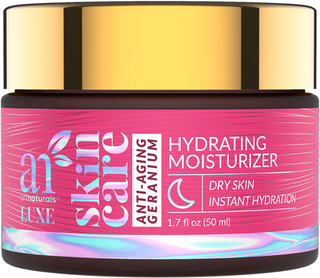
ArtNaturals LUXE Hydrating Moisturizer
Works for
2 of 3 advertised claims delivered
MoisturizingUrea, Xylitylglucoside + 14 moreStrong evidence
“Hydrating Moisturizer”
This product contains good ingredients to attract water to the upper layer of the skin. These ingredients are called "humectants": anhydroxylitol, glycerin.
When humectants are on the surface of the skin, they “pull in” the moisture from the outside environment, or from within deeper layers of the skin. If the air is dry, humectants can speed up the moisture loss from the skin. This is why it is a good idea to use another product on top of this one to help "seal in" the moisture (look for ingredients like dimethicone, squalane, oils and butters).
The following ingredients in this product are especially good for supporting the skin barrier and helping with the hydration level: urea
Anti-agingSerine, Camellia sinensis leaf extract + 1 moreModerate evidence
“Benefits Smooth and soften skin Enhance skin elasticity Even skin tone Stimulate cell renewal Reduce hyperpigmentation Shield skin from UV damage Key Ingredients Anti-Aging Geranium Hydrating Glycerin”
This product contains serine. This ingredient might be able to help reduce and prevent fine lines and wrinkles, improve skin elasticity and firmness, but there is not enough evidence that it actually works.
Evens skin toneCamellia sinensis leaf extract, Lactic acidWeak evidence
“Benefits Smooth and soften skin Enhance skin elasticity Even skin tone Stimulate cell renewal Reduce hyperpigmentation Shield skin from UV damage Key Ingredients Anti-Aging Geranium Hydrating Glycerin”
Effective ingredients missing or their concentration is too low
Can it cause trouble?
Irritancy1 strong irritant: Geranium maculatum oilMedium risk
Comedogenic1 ingredient rated 2 or more on the 0–5 pore-clogging scale1 flagged


User reviews
Be the first — your take helps the next person decide.
Ingredients
Filter by role to see what each ingredient is doing.
Water~45–55%
Cetyl ethylhexanoate~5.8–7.1%
- Irritation risk
- Medium
An emollient that helps soften the skin and creates a thicker product texture
More about Cetyl ethylhexanoateGlycerin~4.2–5.1%
- Irritation risk
- Low
One of the best moisturizing ingredients. Naturally present in skin. It attracts water to the upper layer of the skin working as a humectant
More about GlycerinPropanediol~3.1–3.8%
- Irritation risk
- Low
Acts as a solvent for other ingredients. Speeds up the absorption of other ingredients into the skin
More about PropanediolDiheptyl succinate~2.4–2.9%
- Irritation risk
- Low
Helps to soften the upper layer of the skin and creates a nice product finish on the skin
More about Diheptyl succinateCapryloyl glycerin~2.2–2.7%
- Irritation risk
- Low
Sebacic acid~1.7–2%
- Irritation risk
- Low
Xylitylglucoside~1.4–1.7%
- Irritation risk
- Low
Helps attract water to the upper layer of the skin and repair the skin barrier function
More about XylitylglucosideAnhydroxylitol~1.2–1.4%
- Irritation risk
- Low
Helps attract water to the upper layer of the skin and repair the skin barrir function
More about AnhydroxylitolXylitol~0.9–1.1%
- Irritation risk
- Low
Helps attract water to the upper layer of the skin and repair the skin barrier function
More about XylitolGlyceryl stearate~0.7–1.1%
- Irritation risk
- Low
An emollient that softens the skin and forms a protective layer on its surface. Helps water and oil mix together
More about Glyceryl stearateCetearyl olivate~0.6–0.85%
Sorbitan olivate~0.5–0.8%
Cetearyl alcohol~0.55–0.85%
- Irritation risk
- Low
- Comedogenicity
- 2/5
A non-drying alcohol. Works as an emollient. Helps water and oil mix together and creates a nice product texture
More about Cetearyl alcoholPentylene glycol~0.5–0.7%
- Irritation risk
- Medium
Used to preserve products, dissolve other ingredients and create a nice product texture
More about Pentylene glycolSodium lactate~0.45–0.65%
- Irritation risk
- Medium
Helps attract water to the upper layer of the skin. Is often used to adjust the pH level of the product
More about Sodium lactateLactic acid~0.35–0.65%
- Irritation risk
- Medium
An exfoliating and moisturizing alpha-hydroxy acid (AHA). Typically causes less irritation than other AHAs, for example, glycolic acid. At high concentrations (about 15%), lactic acid can help reduce lines and wrinkles. Recent studies show that lactic acid can support the "good" bacteria living on skin's surface (healthy skin microbiome)
More about Lactic acidSerine~0.3–0.6%
- Irritation risk
- Low
An amino-acid that helps to attract water to the upper layer of the skin. In combination with other amino-acids, might help to reduce fine lines and wrinkles
More about SerineUrea~0.3–0.55%
- Irritation risk
- Low
Naturally present in skin (urea makes up about 7% of natural moisturizing factors in skin). Attracts water to the upper layer of the skin. Also has a positive effect on the skin barrier beyond the humectant action. Can enhance penetration of other ingredients. Is an exfoliating ingredient when used in high concentrations
More about UreaSorbitol~0.25–0.45%
- Irritation risk
- Low
Helps attract water to the upper layer of the skin and improves the product texture
More about SorbitolSodium chloride~0.25–0.5%
- Irritation risk
- Low
Used to stabilize mixtures of oil and water, and create thicker, gel-like product textures
More about Sodium chlorideAllantoin~0.2–0.35%
- Irritation risk
- Low
Helps calm down inflammation in skin and can help reduce itching. Helps to repair the skin barrier and keep skin hydrated
More about AllantoinPhenoxyethanol~0.2–0.35%
- Irritation risk
- Low
A preservative. It helps prevent bacterial growth in cosmetic products
More about PhenoxyethanolEthylhexylglycerin~0.15–0.3%
Cetyl alcohol~0.2–0.4%
- Irritation risk
- Low
A non-drying alcohol that works to soften the skin and stabilize product formulations helping oil and water mix together
More about Cetyl alcoholXanthan gum~0.15–0.25%
- Irritation risk
- Low
Used to create a thicker product consistency
More about Xanthan gumSodium phytate~0.1–0.2%
Camellia sinensis leaf extract~0.1–0.15%
- Irritation risk
- Low
Can contain potent anti-oxidant compounds (abbreviated ECG, GCG, EGC, and EGCG) that might help protect the skin from free radicals. Can help calm down inflammation and has some anti-bacterial properties. Unfortunately, these antioxidants are unstable and lose their effectiveness very quickly in products. The concentration of the antioxidant compounds in the extract also tends to be low to be effective in topical formulation
More about Camellia sinensis leaf extractGeranium maculatum oil~0.05–0.1%
Ingredient list view
Unknown, Water, Cetyl ethylhexanoate, Glycerin, Propanediol, Diheptyl succinate, Capryloyl glycerin, Sebacic acid, Unknown, Xylitylglucoside, Anhydroxylitol, Xylitol, Glyceryl stearate, Cetearyl olivate, Sorbitan olivate, Cetearyl alcohol, Pentylene glycol, Sodium lactate, Lactic acid, Serine, Urea, Sorbitol, Sodium chloride, Allantoin, Phenoxyethanol, Ethylhexylglycerin, Cetyl alcohol, Xanthan gum, Sodium phytate, Camellia sinensis leaf extract, Geranium maculatum oil
Compare prices
Retailers ranked by price — lowest first.
Worth comparing, line by line.
Match % combines shared ingredients, the first five ingredients, shared actives and hero ingredients, irritancy (lower counts in the alternative's favour), texture and body area. Only products in the same routine step are compared.
| ArtNaturals LUXEHydrating MoisturizerYOUR PRODUCT | CetaphilRestoring Water Gel | MarcelleHydractive 24H Day & Night Moisturizing Gel Cream - Dry Skin | |
|---|---|---|---|
| Match | — | 51% | 50% |
| Price | $9.50 | $19.79+$10.29 | $34.31+$24.81 |
| Shared key ingredients | — | 6 of 9 | 6 of 9 |
| Key difference | — | Niacinamide | Glycine Soja Oil |
| Irritancy | Medium | Low | Low |
| Drying alcohol | — | — | — |
| View product | Shop | Shop |
Product summary
Based on the ingredients included, "ArtNaturals LUXE - Hydrating Moisturizer" works well for moisturizing the skin. To work well, any moisturizer needs to include a combination of water-binding and emollient ingredients. ArtNaturals LUXE - Hydrating Moisturizer ticks this box. Humectants in this product (urea, anhydroxylitol, glycerin, sodium lactate and xylitylglucoside) help to increase the water content in the upper layer of the skin. (These ingredients do so by "capturing" water molecules from the outside air or from within the deeper layers of the skin). Emollients in this formulation (cetearyl alcohol, cetyl alcohol, diheptyl succinate, cetyl ethylhexanoate and glyceryl stearate) help to reduce the moisture loss from the skin. They also soften the skin surface and relieve the feeling of dryness and tightness.
Irritation risk
This formulation includes some common irritants, including ingredients that do not provide a benefit for the skin. We assess the overall irritancy of this moisturizer to be medium. For a detailed overview of all potential irritants: click here
You can see the detailed formula review with the breakdown of all actives in the product and the full ingredient list with estimated concentrations in the tables below.
Price
The product retails for 18.90$ in the United States.
For a detailed price comparison: click here.
Sources cited in this review
Every concentration estimate and effectiveness label is anchored to one of these 6 studies and safety reviews.
- 1
- 2Epidermal and dermal effects of topical lactic acidncbi.nlm.nih.gov
- 3Dual Effects of Alpha-Hydroxy Acids on the Skinpdfs.semanticscholar.org
- 4Topical palmitoyl pentapeptide provides improvement in photoaged human facial skinonlinelibrary.wiley.com
- 5Topical urea in skincare: A reviewpubmed.ncbi.nlm.nih.gov
- 6

Affiliate links · As an Amazon Associate, WIMJ earns from qualifying purchases.