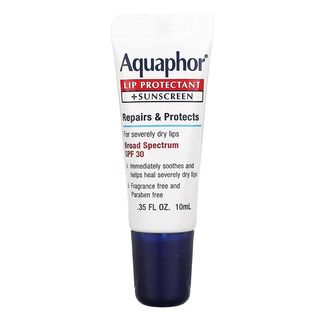
Works for
1 of 1 advertised claim delivered
Moisturizing9 ingredients credited for this claimStrong support
“The unique formula relieves and soothes chapped, cracked lips and provides effective, long-lasting moisture, so lips look and feel healthier.”
This product can help improve hydration of the skin with the two types of ingredients.
The first type is called “humectants”:
these ingredients help attract water.
When humectants are on the surface of the skin, they “pull in” the moisture from the outside environment, or from
within deeper layers of the skin. The following ingredients in this product do the job:
glycerin.
This product also contains ingredients called “occlusives”. They help reduce the speed with which our skin loses moisture to the outside environment. These ingredients also help soften the upper layer of the skin, so it feels less tight and nicer to the touch. The following ingredients in this product do the job: beeswax, butyrospermum parkii butter.
The following ingredients in this product are especially good for supporting the skin barrier and helping with the hydration level: panthenol, petrolatum
Can it cause trouble?
Irritancy1 strong irritant: Benzophenone-3Medium risk
Comedogenic2 ingredients rated 2 or more on the 0–5 pore-clogging scale2 flagged
User reviews
Be the first — your take helps the next person decide.
Ingredients
Filter by role to see what each ingredient is doing.
Petrolatum31%
- Irritation risk
- Low
One of the most effective and the most studied occlusive ingredients that creates a protective layer on top of the skin preventing moisture loss
More about PetrolatumButyl methoxydibenzoylmethane3%
- Irritation risk
- Medium
Avobenzone. An organic, or so-called "chemical" UV filter. Protects against both UVA and UVB rays. Needs to be combined with other filters in a formulation to be stable.
More about Butyl methoxydibenzoylmethaneEthylhexyl methoxycinnamate6.75%
- Irritation risk
- High
Octinoxate. When used in higher concentrations, works as a sunscreen protecting the skin from UVB rays. When used in lower concentration, helps to preserve the product formulation. Is shown to be harmful to coral reefs - consider avoiding bathing in coral reef areas when wearing a product with this ingredient. It can be irritating
More about Ethylhexyl methoxycinnamateEthylhexyl salicylate4.5%
- Irritation risk
- Low
Octisalate. A UV filter. It offers some protection against the sun rays that cause sunburn (UVB), but does not protect against the most aging sun rays (UVA). It loses its effectiveness quickly when exposed to sunlight. It is an organic, or so called "chemical" sunscreen
More about Ethylhexyl salicylateOctocrylene2%
- Irritation risk
- Medium
A weak sunscreen that protects against the sun rays that cause sunburn (UVB) and is somewhat effective against the UVA rays. It is quite stable and can help stabilize other, more vulnerable, sunscreen ingredients like Avobenzone. It is an organic, or so called "chemical" sunscreen
More about OctocryleneBenzophenone-35.4%
- Irritation risk
- High
Same as oxybenzone. Protects in the UVB and short UVA range. In small concentrations, used to stabilize product formulation. Can be irritating. Is shown to be harmful to coral reefs - consider avoiding bathing in coral reef areas when wearing a product with this ingredient. It can penetrate the skin and get absorbed into bloodstream faster than other popular filters available in the US. The study that produced this finding did not address any potential health effects of the absorption
More about Benzophenone-3C18-38 alkyl hydroxystearoyl stearate~22–33%
- Irritation risk
- Low
Octyldodecanol~5.1–7.7%
- Irritation risk
- Low
An emollient that helps to soften the skin and create a pleasant product texture and stabilize the formulation
More about OctyldodecanolGlycerin~4.5–6.7%
- Irritation risk
- Low
One of the best moisturizing ingredients. Naturally present in skin. It attracts water to the upper layer of the skin working as a humectant
More about GlycerinRicinus communis seed oil~3.9–5.9%
- Irritation risk
- Medium
A plant oil that can help soften the skin. It might be helpful in calming down inflammation, but solid research is lacking. Is often used in lip products to create the needed product consistency
More about Ricinus communis seed oilCaprylic/capric triglyceride~2.9–4.4%
- Irritation risk
- Medium
A good mix of fatty acids that forms a protective layer on the skin. Improves the shelf life of products. Derived from coconut and glycerin
More about Caprylic/capric triglyceridePanthenol~1.8–2.7%
- Irritation risk
- Low
Helps attract water to the upper layer of the skin and can help improve skin barrier function
More about PanthenolWater~1.3–1.9%
Polyglyceryl-3 diisostearate~1.1–1.6%
- Irritation risk
- Medium
- Comedogenicity
- 3/5
Helps oil and water mix together
More about Polyglyceryl-3 diisostearateButyrospermum parkii butter~1.2–1.8%
- Irritation risk
- Low
- Comedogenicity
- 3/5
A great moisturising ingredient that softens the skin and reduces water loss from its upper layer. It also can be helpful in protecting skin from free radicals
More about Butyrospermum parkii butterTocopheryl acetate~0.5–1.15%
- Irritation risk
- Medium
A more stable but less bio-available form of vitamin E compared to Tocopherol. Might help moisturize and protect the skin from free radicals, but mostly used in low concentrations to stabilize other ingredients.
More about Tocopheryl acetateHydrogenated castor oil~0.5–1.2%
- Irritation risk
- Medium
A plant oil that can help soften the skin. It might be helpful in calming down inflammation, but solid research is lacking. Is often used in lip products to create the needed product consistency
More about Hydrogenated castor oilBeeswax~0.4–0.95%
- Irritation risk
- Low
Forms a protective barrier that holds water and keeps dry skin hydrated. Keeps an emulsion from separating into its oil and liquid components, and increases the thickness of a product. Can be an allergen
More about BeeswaxC20-40 alkyl stearate~0.15–0.5%
- Irritation risk
- Low
Magnesium sulfate~0.1–0.35%
Magnesium stearate~0.05–0.2%
Bht~0.05–0.1%
Ingredient list view
Petrolatum, Butyl methoxydibenzoylmethane, Ethylhexyl methoxycinnamate, Ethylhexyl salicylate, Octocrylene, Benzophenone-3, C18-38 alkyl hydroxystearoyl stearate, Octyldodecanol, Glycerin, Ricinus communis seed oil, Caprylic/capric triglyceride, Panthenol, Water, Polyglyceryl-3 diisostearate, Butyrospermum parkii butter, Tocopheryl acetate, Hydrogenated castor oil, Beeswax, C20-40 alkyl stearate, Magnesium sulfate, Magnesium stearate, Bht
Compare prices
Retailers ranked by price — lowest first.
Affiliate links · prices updated regularly · As an Amazon Associate, WIMJ earns from qualifying purchases.
Product summary
"Aquaphor - Lip Protectant + Sunscreen" is a well-rounded moisturizing product. The formulation is based on a combination of good humectants and emollients. Both are needed to increase the skin hydration level. Panthenol and glycerin in this product (humectants) attract water molecules to the upper layer of the skin (the water comes from the outside air or from the deeper layers of the skin if the air is dry). Emollients in this formulation (petrolatum, beeswax, butyrospermum parkii butter, caprylic/capric triglyceride and ricinus communis seed oil) help to reduce the moisture loss from the skin. They also soften the skin surface and relieve the feeling of dryness and tightness.
Ingredient callouts
- Panthenol (pro-vitamin B5) at about 1.80% - 2.70% concentration. In this concentration, Panthenol works effectively to improve the skin barrier and reduce inflammation.
Irritation risk
This moisturizer contains actives that can be irritating. We assess the overall irritancy of this moisturizer to be medium. For a detailed overview of all potential irritants: click here
You can see the detailed formula review with the breakdown of all actives in the product and the full ingredient list with estimated concentrations in the tables below.
Price
The product retails for 12.50A$ in Australia.
For a detailed price comparison: click here.
Sources cited in this review
Every concentration estimate and effectiveness label is anchored to one of these 10 studies and safety reviews.
- 1
- 2
- 3On Photostability of Oxybenzonecore.ac.uk
- 4
- 5
- 6

Affiliate links · As an Amazon Associate, WIMJ earns from qualifying purchases.