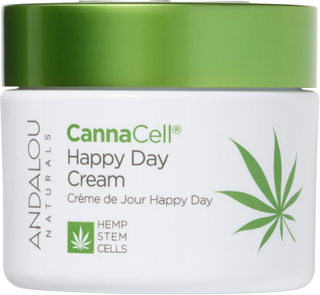
Andalou Naturals CannaCell Happy Day Cream
Works for
2 of 2 advertised claims delivered
Anti-oxidation4 ingredients credited for this claimStrong support
This product contains antioxidants (resveratrol, tocopherol) that can help neutralize free radicals in skin. By doing so, they can lessen the damage the skin gets from the UV light (sun).
Moisturizing13 ingredients credited for this claimStrong support
“Amplify your pure, natural beauty with our nourishing botanical Happy Day Cream!”
This product can help improve hydration of the skin with the two types of ingredients.
The first type is called “humectants”:
these ingredients help attract water.
When humectants are on the surface of the skin, they “pull in” the moisture from the outside environment, or from
within deeper layers of the skin. The following ingredients in this product do the job:
glycerin, aloe barbadensis leaf juice.
This product also contains ingredients called “occlusives”. They help reduce the speed with which our skin loses moisture to the outside environment. These ingredients also help soften the upper layer of the skin, so it feels less tight and nicer to the touch. The following ingredients in this product do the job: myristyl myristate, simmondsia chinensis seed oil.
The following ingredients in this product are especially good for supporting the skin barrier and helping with the hydration level: panthenol
Anti-agingNot advertised by the brand · 4 ingredients credited for this claimModerate support
This product contains resveratrol. This ingredient might be able to help reduce and prevent fine lines and wrinkles, improve skin elasticity and firmness, but there is not enough evidence that it actually works.
Can it cause trouble?
Irritancy4 strong irritants: Citrus tangerina peel oil, Citrus aurantium amara flower oil + 2 more — patch-test recommendedHigh risk
Comedogenic1 ingredient rated 2 or more on the 0–5 pore-clogging scale1 flagged


User reviews
Be the first — your take helps the next person decide.
Ingredients
Filter by role to see what each ingredient is doing.
Aloe barbadensis leaf juice~23–34%
- Irritation risk
- Medium
Traditionally used to treat sunburns, dermatitis and inflammation, but evidence for its effectiveness is lacking. The extract can contain humectants that help attract water into the skin
More about Aloe barbadensis leaf juiceWater~11–17%
Glycerin~4.8–7.1%
- Irritation risk
- Low
One of the best moisturizing ingredients. Naturally present in skin. It attracts water to the upper layer of the skin working as a humectant
More about GlycerinDicaprylyl carbonate~3.8–5.7%
- Irritation risk
- Low
Helps products spread more easily and works as an emollient to soften skin
More about Dicaprylyl carbonateCetyl alcohol~2.7–4.1%
- Irritation risk
- Low
A non-drying alcohol that works to soften the skin and stabilize product formulations helping oil and water mix together
More about Cetyl alcoholTocopherol~1.8–2.7%
- Irritation risk
- Low
Pure form of vitamin E. Can help moisturise and protect the skin from free radicals. Often used to help stabilise other ingredients or the formula itself
More about TocopherolGlyceryl stearate citrate~1.5–2.3%
- Irritation risk
- Low
Helps oil and water mix together while softening the upper layer of the skin
More about Glyceryl stearate citrateTapioca starch~1.2–1.8%
Myristyl myristate~1.4–2.1%
- Irritation risk
- Medium
- Comedogenicity
- 3/5
An emollient. Is not recommended for acne-prone skin as it can be comedogenic
More about Myristyl myristateStearic acid~1–1.5%
- Irritation risk
- Low
Helps oil and water mix together and works as an emollient
More about Stearic acidCannabis sativa seed oil~0.85–1.25%
- Irritation risk
- Medium
A plant oil that due to its high linoleic acid content can help strengthen skin's barrier function and soften its upper layer
More about Cannabis sativa seed oilMagnesium ascorbyl phosphate~0.5–1.15%
- Irritation risk
- Medium
A derivative of vitamin C that is more stable, but less bioavailable than the pure form of vitamin C. It does not penetrate the skin well, but has been shown to convert to pure vitamin C once in skin. It can be helpful in stimulating collagen production and lightening the skin tone, but the required concentration is likely to be very high
More about Magnesium ascorbyl phosphateCannabis sativa callus culture lysate extract~0.5–1.15%
- Irritation risk
- Low
Resveratrol~0.45–1%
- Irritation risk
- Medium
Helps neutralize free radicals in skin and might help reduce fine lines and wrinkles, as well as even out the skin tone
More about ResveratrolSimmondsia chinensis seed oil~0.45–1.05%
- Irritation risk
- Medium
Softens the upper layer of skin and helps restore the healthy skin barrier. Has shown to help calm down inflammation in skin. It is a stable oil, meaning that it retains its properties even when exposed to air.
More about Simmondsia chinensis seed oilSqualane~0.45–1%
- Irritation risk
- Low
An oil naturally present in skin. Works as an emollient to soften the skin and form a protective layer on its surface without a greasy feeling.
More about SqualaneAllantoin~0.3–0.7%
- Irritation risk
- Low
Helps calm down inflammation in skin and can help reduce itching. Helps to repair the skin barrier and keep skin hydrated
More about AllantoinPanthenol~0.2–0.75%
- Irritation risk
- Low
Helps attract water to the upper layer of the skin and can help improve skin barrier function
More about PanthenolPhenoxyethanol~0.15–0.7%
- Irritation risk
- Low
A preservative. It helps prevent bacterial growth in cosmetic products
More about PhenoxyethanolEthylhexylglycerin~0.15–0.65%
Citrus tangerina peel oil~0.15–0.5%
- Irritation risk
- High
Essential oil that can be irritating. Can lead to photosensitivity
More about Citrus tangerina peel oilCitrus aurantium amara flower oil~0.1–0.45%
- Irritation risk
- High
Used as a fragrance. Can be irritating
More about Citrus aurantium amara flower oilAnthemis nobilis flower oil~0.1–0.4%
- Irritation risk
- High
An essential oil that is used as a fragrance and can be irritating. It might have some anti-oxidant effect in skin
More about Anthemis nobilis flower oilLimonene~0.1–0.3%
- Irritation risk
- High
A common frangrance that can easily irritate skin, especially if exposed to air, light or heat
More about LimoneneLinalool~0.05–0.3%
Ingredient list view
Aloe barbadensis leaf juice, Water, Glycerin, Dicaprylyl carbonate, Cetyl alcohol, Tocopherol, Glyceryl stearate citrate, Tapioca starch, Myristyl myristate, Stearic acid, Cannabis sativa seed oil, Magnesium ascorbyl phosphate, Cannabis sativa callus culture lysate extract, Resveratrol, Simmondsia chinensis seed oil, Squalane, Allantoin, Panthenol, Phenoxyethanol, Ethylhexylglycerin, Citrus tangerina peel oil, Citrus aurantium amara flower oil, Anthemis nobilis flower oil, Limonene, Linalool
Compare prices
Retailers ranked by price — lowest first.
Affiliate links · prices updated regularly · As an Amazon Associate, WIMJ earns from qualifying purchases.
Worth comparing, line by line.
Match % combines shared ingredients, the first five ingredients, shared actives and hero ingredients, irritancy (lower counts in the alternative's favour), texture and body area. Only products in the same routine step are compared.
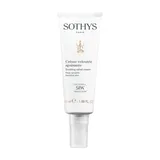
| Andalou NaturalsCannaCell Happy Day CreamYOUR PRODUCT | Indie LeeSqualane Facial Cream | endota spaBlue Light Defence Hydro Cream | SothysSoothing Velvet Cream | |
|---|---|---|---|---|
| Match | — | 61% | 61% | 61% |
| Price | $15.39 | $49.00+$33.61 | $134.85+$119.46 | $59.50+$44.11 |
| Shared key ingredients | — | 6 of 9 | 5 of 9 | 5 of 9 |
| Key difference | — | Sunflower Seed Oil | Urea | Butyrospermum Parkii Butter |
| Irritancy | High | Medium | Medium | Medium |
| Drying alcohol | — | — | — | — |
| View product | Shop | Shop | Shop |


Product summary
Based on the ingredients included, "Andalou Naturals - CannaCell Happy Day Cream" works well for moisturizing the skin. The formulation is based on a combination of good humectants and emollients. Both are needed to increase the skin hydration level. Panthenol, glycerin and aloe barbadensis leaf juice in this product (humectants) attract water molecules to the upper layer of the skin (the water comes from the outside air or from the deeper layers of the skin if the air is dry). Cannabis sativa seed oil, myristyl myristate, squalane, cetyl alcohol and dicaprylyl carbonate in this product help decrease the water evoporation from the skin, so that it stays hydrated for longer. These ingredients also soften the skin and take away the feeling of tightness and dryness.
Ingredient callouts
- This formulation also uses an effective concentration of panthenol (pro-vitamin B5) - about 0.45% - 1.05%. Panthenol helps strengthen the skin barrier, improve hydration and reduce inflammation in skin.
Irritation risk
This moisturizer contains a bunch of common irritants, including ingredients that do not provide any known benefit for the skin. It might not be the best choice if your skin is sensitive. We assess the overall irritancy of this moisturizer to be high. For a detailed overview of all potential irritants: click here
You can see the detailed formula review with the breakdown of all actives in the product and the full ingredient list with estimated concentrations in the tables below.
About the brand
According to Cruelty-Free Kitty "Andalou Naturals" is cruelty free and so is its parent company.
Price
The product retails from 20.99$ up to 21.99$ in the United States, for 33.14A$ in Australia and for 15.94£ in the United Kingdom.
For a detailed price comparison: click here.
Sources cited in this review
Every concentration estimate and effectiveness label is anchored to one of these 18 studies and safety reviews.
- 1
- 2Vitamin E in dermatologyncbi.nlm.nih.gov
- 3Vitamin E and Skin Healthlpi.oregonstate.edu
- 4
- 5Hemp (Cannabis sativa L.) as a Resource for Green Cosmeticstandfonline.com
- 6

Affiliate links · As an Amazon Associate, WIMJ earns from qualifying purchases.