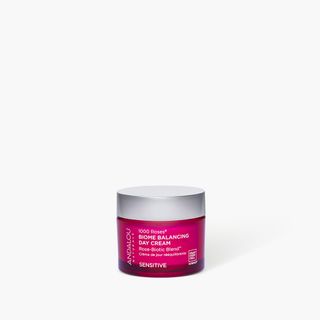
Andalou Naturals 1000 Roses Biome Balancing Day Cream
Works for
1 of 1 advertised claim delivered
MoisturizingRosa canina seed oil, Betaine + 16 moreGood evidence
“1000 Roses Biome Balancing Day Cream”
This product can help improve hydration of the skin with the two types of ingredients.
The first type is called “humectants”:
these ingredients help attract water.
When humectants are on the surface of the skin, they “pull in” the moisture from the outside environment, or from
within deeper layers of the skin. The following ingredients in this product do the job:
betaine, biosaccharide gum-1.
This product also contains ingredients called “occlusives”. They help reduce the speed with which our skin loses moisture to the outside environment. These ingredients also help soften the upper layer of the skin, so it feels less tight and nicer to the touch. The following ingredients in this product do the job: helianthus annuus seed oil, squalane.
Anti-oxidationNot advertised by the brand · Camellia sinensis extract, Lactococcus ferment lysate + 9 moreModerate evidence
This product contains antioxidants (camellia sinensis extract) that might be able to help neutralize free radicals in skin to lessen the damage it gets from the UV light (sun). There is not enough evidence to confirm their effectiveness in skin though.
Can it cause trouble?
Irritancy9 strong irritants: Rosa damascena flower water, Rosa centifolia flower extract + 7 more — patch-test recommendedHigh risk
ComedogenicClean of flagged comedogenic ingredientsNone flagged
User reviews
Be the first — your take helps the next person decide.
Ingredients
Filter by role to see what each ingredient is doing.
Aloe barbadensis leaf juice~23–35%
- Irritation risk
- Medium
Traditionally used to treat sunburns, dermatitis and inflammation, but evidence for its effectiveness is lacking. The extract can contain humectants that help attract water into the skin
More about Aloe barbadensis leaf juiceWater~11–17%
Cetearyl olivate~4.2–6.3%
Lactococcus ferment lysate~3.7–5.5%
- Irritation risk
- Low
Consists of remains of dead bacteria cells. Is likely helpful in attracting water to the upper layer of the skin. Might be helpful in reducing inflammation and neutralizing free radicals in skin
More about Lactococcus ferment lysateGlycerin~2.7–4%
- Irritation risk
- Low
One of the best moisturizing ingredients. Naturally present in skin. It attracts water to the upper layer of the skin working as a humectant
More about GlycerinBetaine~1.8–2.7%
- Irritation risk
- Low
Helps attract water to the upper layer of the skin and improves the product texture
More about BetaineSorbitan olivate~1.3–2%
Rosa damascena flower water~1.1–1.7%
- Irritation risk
- High
Used to add a nice rose smell to the product. Might help attract water to the upper layer of the skin and have some anti-oxidant effect. Can be irritating
More about Rosa damascena flower waterRosa centifolia flower extract~1–1.5%
- Irritation risk
- High
Contains essential oil. Can be irritating
More about Rosa centifolia flower extractRhododendron ferrugineum leaf cell culture extract~0.95–1.4%
- Irritation risk
- Low
Malus domestica fruit cell culture extract~0.55–1.35%
- Irritation risk
- Low
Vitis vinifera fruit cell extract~0.5–1.15%
- Irritation risk
- Low
Aronia melanocarpa fruit extract~0.45–1.05%
- Irritation risk
- Low
Euterpe oleracea fruit extract~0.45–1%
- Irritation risk
- Medium
A plant extract that can have some anti-oxidant effect in skin
More about Euterpe oleracea fruit extractLycium barbarum fruit extract~0.4–0.95%
- Irritation risk
- Medium
A plant extract that can help neutralize free radicals in skin and attract water to its upper layer
More about Lycium barbarum fruit extractCamellia sinensis extract~0.4–0.95%
- Irritation risk
- Low
Tea extract. Might be helpful in neutralizing free radicals in skin
More about Camellia sinensis extractRosa canina fruit oil~0.45–1%
- Irritation risk
- Medium
A great emollient. Contains vitamin E (tocopherol) which may give it some anti-oxidant properties. Can contain volatile compounds and can be irritating
More about Rosa canina fruit oilRosa canina seed oil~0.4–0.95%
- Irritation risk
- Medium
A plant oil that helps soften the upper layer of the skin. It might have anti-oxidant properties. Might help reduce inflammation in skin and help against blemishes
More about Rosa canina seed oilPunica granatum seed oil~0.4–0.9%
- Irritation risk
- Low
Helps soften the upper layer of the skin
More about Punica granatum seed oilGardenia taitensis flower extract~0.35–0.75%
Punica granatum fruit extract~0.3–0.75%
- Irritation risk
- High
A fruit extract that is used to add a fragrance to the product. It might have some antioxidant properties
More about Punica granatum fruit extractHydrolyzed sodium hyaluronate~0.3–0.7%
- Irritation risk
- Low
Attracts water into the upper layer of the skin
More about Hydrolyzed sodium hyaluronateSqualane~0.35–0.8%
- Irritation risk
- Low
An oil naturally present in skin. Works as an emollient to soften the skin and form a protective layer on its surface without a greasy feeling.
More about SqualaneBisabolol~0.2–0.75%
- Irritation risk
- Low
An active component of chamomile plant that historically has been used to calm down irritated skin. A recent study shows that bisabolol indeed can have some anti-inflammatory effect on skin, even though conclusive data is lacking. Bisabolol has a sweet floral scent and can be added to products for its aromatic properties
More about BisabololHelianthus annuus seed oil~0.35–0.75%
- Irritation risk
- Low
A great emollient due to its high linoleic acid content. One of the most effective plant oils in helping skin hydration and repairing skin barrier function
More about Helianthus annuus seed oilBiosaccharide gum-1~0.2–0.8%
- Irritation risk
- Low
Helps attract water to the upper layer of the skin and is claimed to provide a longer-lasting hydration because of its ability to create a water-binding film on the surface of the skin
More about Biosaccharide gum-1Lecithin~0.35–0.8%
- Irritation risk
- Low
Used mostly for creating emulsions - helping oil and water mix together. Helps soften the upper layer of the skin
More about LecithinTocopherol~0.3–0.7%
- Irritation risk
- Low
Pure form of vitamin E. Can help moisturise and protect the skin from free radicals. Often used to help stabilise other ingredients or the formula itself
More about TocopherolIsomalt~0.2–0.75%
- Irritation risk
- Low
Helps attract water to the upper layer of the skin
More about IsomaltMaltodextrin~0.3–0.75%
- Irritation risk
- Low
Used to stabilize the product formulation and can help absorb oil
More about MaltodextrinButylene glycol~0.2–0.75%
- Irritation risk
- Low
Used to create a nice product texture and help delivery of other ingredients. Might be somewhat helpful in attracting water to the upper layer of the skin
More about Butylene glycolXanthan gum~0.2–0.75%
- Irritation risk
- Low
Used to create a thicker product consistency
More about Xanthan gumPotassium sorbate~0.3–0.6%
Sodium benzoate~0.25–0.5%
Benzyl alcohol~0.15–0.65%
- Irritation risk
- High
A preservative. Can be used to mask unpleasant smell. Can be irritating
More about Benzyl alcoholDehydroacetic acid~0.3–0.6%
Citric acid~0.15–0.7%
- Irritation risk
- Medium
Can work as an exfoliant but is typically used to adjust the product pH
More about Citric acidLactic acid~0.15–0.65%
- Irritation risk
- Medium
An exfoliating and moisturizing alpha-hydroxy acid (AHA). Typically causes less irritation than other AHAs, for example, glycolic acid. At high concentrations (about 15%), lactic acid can help reduce lines and wrinkles. Recent studies show that lactic acid can support the "good" bacteria living on skin's surface (healthy skin microbiome)
More about Lactic acidSodium chloride~0.2–0.75%
- Irritation risk
- Low
Used to stabilize mixtures of oil and water, and create thicker, gel-like product textures
More about Sodium chloridePotassium hydroxide~0.15–0.65%
Parfum~0.1–0.4%
- Irritation risk
- High
An aromatic blend of unspecified and possibly irritating ingredients
More about ParfumPelargonium graveolens flower oil~0.1–0.45%
- Irritation risk
- High
An essential oil. Can be irritating. Can become an allergen with oxidation
More about Pelargonium graveolens flower oilGeraniol~0.1–0.4%
Linalool~0.1–0.4%
Limonene~0.1–0.3%
- Irritation risk
- High
A common frangrance that can easily irritate skin, especially if exposed to air, light or heat
More about LimoneneCitronellol~0.1–0.3%
Ingredient list view
Aloe barbadensis leaf juice, Water, Cetearyl olivate, Lactococcus ferment lysate, Glycerin, Betaine, Sorbitan olivate, Rosa damascena flower water, Rosa centifolia flower extract, Rhododendron ferrugineum leaf cell culture extract, Malus domestica fruit cell culture extract, Vitis vinifera fruit cell extract, Aronia melanocarpa fruit extract, Euterpe oleracea fruit extract, Lycium barbarum fruit extract, Camellia sinensis extract, Rosa canina fruit oil, Rosa canina seed oil, Punica granatum seed oil, Gardenia taitensis flower extract, Punica granatum fruit extract, Hydrolyzed sodium hyaluronate, Squalane, Bisabolol, Helianthus annuus seed oil, Biosaccharide gum-1, Lecithin, Tocopherol, Isomalt, Maltodextrin, Butylene glycol, Xanthan gum, Potassium sorbate, Sodium benzoate, Benzyl alcohol, Dehydroacetic acid, Citric acid, Lactic acid, Sodium chloride, Potassium hydroxide, Parfum, Pelargonium graveolens flower oil, Geraniol, Linalool, Limonene, Citronellol
Compare prices
Retailers ranked by price — lowest first.
.png)
Sources cited in this review
Every concentration estimate and effectiveness label is anchored to one of these 21 studies and safety reviews.
- 1
- 2
- 3
- 4
- 5
- 6

Affiliate links · As an Amazon Associate, WIMJ earns from qualifying purchases.