Works for
1 of 1 advertised claim delivered
MoisturizingCeramide ng, Ceramide np + 24 moreStrong evidence
“It protects the skin from dryness caused by UV damage.”
This product can help improve hydration of the skin with the two types of ingredients.
The first type is called “humectants”:
these ingredients help attract water.
When humectants are on the surface of the skin, they “pull in” the moisture from the outside environment, or from
within deeper layers of the skin. The following ingredients in this product do the job:
arginine, diglycerin.
This product also contains ingredients called “occlusives”. They help reduce the speed with which our skin loses moisture to the outside environment. These ingredients also help soften the upper layer of the skin, so it feels less tight and nicer to the touch. The following ingredients in this product do the job: arginine, ethyl linoleate.
The following ingredients in this product are especially good for supporting the skin barrier and helping with the hydration level: ceramide ap, ceramide ng, ceramide np
Anti-oxidationNot advertised by the brand · Ferulic acid, Ascorbyl glucoside + 7 moreStrong evidence
This product contains antioxidants (ferulic acid) that can help neutralize free radicals in skin. By doing so, they can lessen the damage the skin gets from the UV light (sun).
The following ingredients - arbutin, ascorbyl glucoside also can have an antioxidant effect, but there is less evidence to confirm their effectiveness in skin.
Anti-blemishNot advertised by the brand · Ethyl linoleateGood evidence
This product might be able to help reduce blemishes and clogged pores because it contains ethyl linoleate.
Anti-agingNot advertised by the brand · Ferulic acid, Ascorbyl glucoside + 2 moreModerate evidence
This product contains ascorbyl glucoside, ferulic acid. These ingredients might be able to help reduce and prevent fine lines and wrinkles, improve skin elasticity and firmness, but there is not enough evidence that it actually works.
Evens skin toneNot advertised by the brand · Ascorbyl glucoside, Arbutin + 4 moreModerate evidence
The following ingredient (ingredients) in this product might be helpful, but there is no evidence to confirm that it actually works: arbutin, ascorbyl glucoside, ethyl linoleate, ferulic acid.
Can it cause trouble?
Irritancy1 strong irritant: ParfumMedium risk
Comedogenic1 ingredient rated 2 or more on the 0–5 pore-clogging scale1 flagged
User reviews
Be the first — your take helps the next person decide.
Ingredients
Filter by role to see what each ingredient is doing.
Water~45–55%
Butylene glycol~6–7.3%
- Irritation risk
- Low
Used to create a nice product texture and help delivery of other ingredients. Might be somewhat helpful in attracting water to the upper layer of the skin
More about Butylene glycolGlycol~4–4.8%
- Irritation risk
- Low
Arbutin~3.1–3.8%
- Irritation risk
- Medium
Beta-arbutin. Can help to reduce hyperpigmentation and has an anti-oxidant effect when used in high enough concentration. Is less effective compared to alpha-arbutin
More about ArbutinPentylene glycol~2.3–2.8%
- Irritation risk
- Medium
Used to preserve products, dissolve other ingredients and create a nice product texture
More about Pentylene glycolAscorbyl glucoside~1.8–2.2%
- Irritation risk
- Medium
A vitamin C derivative that is more stable but less potent than pure form of vitamin C. Has a potential to boost collagen production, nutralise free radicals and reduce hyperpigmentation, but the required concentration is likely to be much higher than for the pure form of vitamin C, limiting the ingredient's effectiveness in products
More about Ascorbyl glucosideGentiana lutea root extract~1.5–1.8%
- Irritation risk
- Medium
A plant extract that can help strengthen the skin barrier function and improve skin moisture levels
More about Gentiana lutea root extractAloe barbadensis leaf extract~1.4–1.7%
- Irritation risk
- Medium
Traditionally used to treat sunburns, dermatitis and inflammation, but evidence for its effectiveness is lacking. The extract can contain humectants that help attract water into the skin
More about Aloe barbadensis leaf extractPueraria lobata root extract~1–1.2%
- Irritation risk
- Low
Chlorella vulgaris extract~0.7–1.05%
- Irritation risk
- Medium
- Comedogenicity
- 3/5
A plant extract that can help to attract water to the upper layer of the skin and might have some anti-oxidant and anti-inflammatory properties
More about Chlorella vulgaris extractArginine~0.55–0.8%
- Irritation risk
- Low
An amino acid that is naturally present in skin and helps keep it hydrated. When used together with AHAs, it can reduce their irritating effect on the skin
More about ArginineJojoba esters~0.55–0.8%
- Irritation risk
- Medium
An emollient made of jojoba oil. Helps soften the skin and support its barrier function
More about Jojoba estersSimmondsia chinensis seed oil~0.5–0.75%
- Irritation risk
- Medium
Softens the upper layer of skin and helps restore the healthy skin barrier. Has shown to help calm down inflammation in skin. It is a stable oil, meaning that it retains its properties even when exposed to air.
More about Simmondsia chinensis seed oilHydrolyzed collagen~0.45–0.7%
- Irritation risk
- Low
A typically plant-derived compound that is supposed mimic human collagen. Cannot penetrate the skin barrier so is not particularly useful in skincare products beyond attracting water to the upper layer of the skin
More about Hydrolyzed collagenCeramide np~0.4–0.6%
- Irritation risk
- Low
A type of lipid similar to ceramides naturally present in skin. Helps to soften the upper layer of the skin and supports the skin barrier function to keep it hydrated. Can help to prevent inflammation in skin
More about Ceramide npCeramide ng~0.35–0.65%
- Irritation risk
- Low
A type of lipid similar to ceramides naturally present in skin. Helps to soften the upper layer of the skin and supports the skin barrier function to keep it hydrated. Can help to prevent inflammation in skin
More about Ceramide ngCeramide ap~0.3–0.55%
- Irritation risk
- Low
A type of lipid similar to ceramides naturally present in skin. Helps to soften the upper layer of the skin and supports the skin barrier function to keep it hydrated. Can help to prevent inflammation in skin
More about Ceramide apSodium hyaluronate~0.3–0.55%
- Irritation risk
- Low
One of the best moisturizing ingredients. Attracts water into the upper layer of the skin
More about Sodium hyaluronateEthyl linoleate~0.3–0.55%
- Irritation risk
- Medium
Helps reduce acne and blemishes. Helps to soften the upper layer of the skin and reduce inflammation. Might be helpful in reducing hyperpigmentation and evening out the skin tone, but evidence of effectiveness in skin are lacking
More about Ethyl linoleateFerulic acid~0.25–0.5%
- Irritation risk
- Low
A potent anti-oxidant that has been shown to be effective in neutralizing free radicals in skin. There seem to have a synergetic effect of ferulic acid, vitamin E and C, meaning that when the ingredients are used together, they enhance each other's ability protect the skin against free radicals. Ferulic acid also helps to stabilize other ingredients - including vitamins C and E. It can help to even out the skin tone. Ferulic acid is approved for use as a sunscreen ingredient in Japan in concentrations up to 10%
More about Ferulic acidDipotassium glycyrrhizate~0.25–0.45%
- Irritation risk
- Low
A salt derived from licorice. Works as an emollient to soften the upper layer of the skin and can help calm down inflammation. Might be helpful for skin lightening
More about Dipotassium glycyrrhizateSaccharomyces lysate extract~0.25–0.45%
- Irritation risk
- Low
Helps attract water to the upper layer of the skin. Can have some anti-inflammatory effect
More about Saccharomyces lysate extractSaccharina longicruris extract~0.2–0.4%
- Irritation risk
- Low
Ascophyllum nodosum extract~0.2–0.4%
- Irritation risk
- Low
Brown seaweed extract. Can help attract water to the upper layer of the skin and might have some antioxidant effect
More about Ascophyllum nodosum extractAscorbyl tetraisopalmitate~0.25–0.45%
- Irritation risk
- Medium
A vitamin C derivative. Studies show that is might be effective in reducing hyperpigmentation, but there are no studies confirming that it is effectively converted into the bioavailable form of Vitamin C in skin. It is not clear how this derivative compares in effectiveness to the topical application of bioavailable form of vitamin C (L-ascorbic acid)
More about Ascorbyl tetraisopalmitateHydrolyzed royal jelly protein~0.2–0.4%
- Irritation risk
- High
Alteromonas ferment extract~0.2–0.4%
- Irritation risk
- Low
A marine extract that helps attract water to the upper layer of the skin. It is claimed to have anti-inflammatory properties but research is lacking
More about Alteromonas ferment extractKappaphycus alvarezii extract~0.2–0.4%
- Irritation risk
- Low
A red algae extract that can help attract water to the upper layer of the skin and might have some antioxidant properties
More about Kappaphycus alvarezii extractMyrciaria dubia fruit extract~0.2–0.4%
- Irritation risk
- Medium
A plant extract that might help neutralize free radicals in skin, but research on its effectiveness is lacking
More about Myrciaria dubia fruit extractGlucosylrutin~0.2–0.4%
- Irritation risk
- Low
Glycerin~0.25–0.5%
- Irritation risk
- Low
One of the best moisturizing ingredients. Naturally present in skin. It attracts water to the upper layer of the skin working as a humectant
More about GlycerinDiglycerin~0.2–0.4%
- Irritation risk
- Low
Helps attract water to the upper layer of the skin
More about DiglycerinTriethylhexanoin~0.2–0.35%
- Irritation risk
- Medium
Helps soften the upper layer of the skin
More about TriethylhexanoinDiphenyl dimethicone~0.25–0.5%
Phytosterols~0.25–0.5%
- Irritation risk
- Medium
Lipids that work as an emollient and can be helpful in repairing skin barrier function
More about PhytosterolsSorbitol~0.2–0.4%
- Irritation risk
- Low
Helps attract water to the upper layer of the skin and improves the product texture
More about SorbitolHydrogenated lecithin~0.25–0.4%
- Irritation risk
- Low
Helps to retain moisture by creating a protective barrier on the skin. Rich in fatty acids. Improves product texture and helps with the penetration of other ingredients.
More about Hydrogenated lecithinAcrylates/c10-30 alkyl acrylate crosspolymer~0.2–0.4%
- Irritation risk
- Medium
Maintains the texture of skincare products. Allows the product to spread evenly. Helps oil and water mix together
More about Acrylates/c10-30 alkyl acrylate crosspolymerPeg-60 hydrogenated castor oil~0.25–0.4%
- Irritation risk
- Medium
Helps oil and water mix together
More about Peg-60 hydrogenated castor oilPolyglyceryl-10 myristate~0.2–0.4%
- Irritation risk
- Low
Potassium hydroxide~0.15–0.3%
Tocopherol~0.15–0.3%
- Irritation risk
- Low
Pure form of vitamin E. Can help moisturise and protect the skin from free radicals. Often used to help stabilise other ingredients or the formula itself
More about TocopherolDisodium edta~0.15–0.25%
Potassium sorbate~0.15–0.3%
Phenoxyethanol~0.15–0.25%
- Irritation risk
- Low
A preservative. It helps prevent bacterial growth in cosmetic products
More about PhenoxyethanolParfum~0.05–0.1%
- Irritation risk
- High
An aromatic blend of unspecified and possibly irritating ingredients
More about ParfumIngredient list view
Water, Butylene glycol, Unknown, Glycol, Arbutin, Pentylene glycol, Ascorbyl glucoside, Gentiana lutea root extract, Aloe barbadensis leaf extract, Pueraria lobata root extract, Chlorella vulgaris extract, Arginine, Jojoba esters, Simmondsia chinensis seed oil, Hydrolyzed collagen, Ceramide np, Ceramide ng, Ceramide ap, Sodium hyaluronate, Ethyl linoleate, Ferulic acid, Dipotassium glycyrrhizate, Saccharomyces lysate extract, Saccharina longicruris extract, Ascophyllum nodosum extract, Ascorbyl tetraisopalmitate, Hydrolyzed royal jelly protein, Alteromonas ferment extract, Kappaphycus alvarezii extract, Myrciaria dubia fruit extract, Glucosylrutin, Glycerin, Diglycerin, Triethylhexanoin, Diphenyl dimethicone, Phytosterols, Sorbitol, Hydrogenated lecithin, Acrylates/c10-30 alkyl acrylate crosspolymer, Peg-60 hydrogenated castor oil, Polyglyceryl-10 myristate, Potassium hydroxide, Tocopherol, Disodium edta, Potassium sorbate, Phenoxyethanol, Parfum
Compare prices
Retailers ranked by price — lowest first.

Affiliate links · prices updated regularly
Product summary
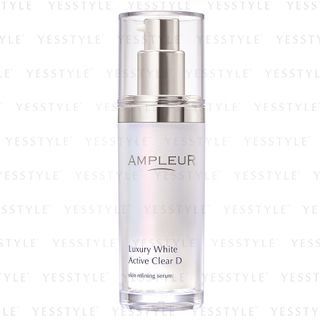
"AMPLEUR - Luxury White Active Clear D" is a well-rounded moisturizing product. The formulation is based on a combination of good humectants and emollients. Both are needed to increase the skin hydration level. Arginine, diglycerin, glycerin, hydrolyzed collagen and saccharomyces lysate extract in this product (humectants) attract water molecules to the upper layer of the skin (the water comes from the outside air or from the deeper layers of the skin if the air is dry). Emollients in this formulation (ceramide ng, ceramide np, ethyl linoleate, hydrolyzed collagen and jojoba esters) help to reduce the moisture loss from the skin. They also soften the skin surface and relieve the feeling of dryness and tightness.
Ingredient callouts
- Another benefit is that this moisturizer contain ceramides (ceramide ap 0.30% - 0.55%, ceramide ng 0.35% - 0.65% and ceramide np 0.40% - 0.60%). Ceramides are an important part of our natural skin barrier. The Ceramides used in skincare are synthetic or come from plants. They help soften the skin and can help "fill the gaps" in the skin barrier, keeping the skin hydrated and resilient for longer.
Irritation risk
There are some common irritants in this product, including ingredients that do not have benefits for the skin. We assess the overall irritancy of this moisturizer to be medium. For a detailed overview of all potential irritants: click here
You can see the detailed formula review with the breakdown of all actives in the product and the full ingredient list with estimated concentrations in the tables below.
Price
The product retails for 101.70$ in the United States.
For a detailed price comparison: click here.
Sources cited in this review
Every concentration estimate and effectiveness label is anchored to one of these 27 studies and safety reviews.
- 1Arbutin - Commentatymdedge.com
- 2TOPICAL TREATMENT OF MELASMAncbi.nlm.nih.gov
- 3The Roles of Vitamin C in Skin Healthncbi.nlm.nih.gov
- 4
- 5
- 6

Affiliate links · As an Amazon Associate, WIMJ earns from qualifying purchases.