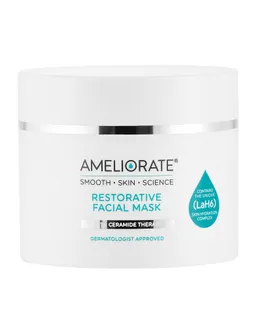
Works for
MoisturizingCeramide np, Ceramide ap + 19 moreWorks well
“The overnight mask helps to enhance skin’s natural moisture barrier to promote suppleness and elasticity.”
This product can help improve hydration of the skin with the two types of ingredients.
The first type is called “humectants”:
these ingredients help attract water.
When humectants are on the surface of the skin, they “pull in” the moisture from the outside environment, or from
within deeper layers of the skin. The following ingredients in this product do the job:
glycerin, sodium hyaluronate.
This product also contains ingredients called “occlusives”. They help reduce the speed with which our skin loses moisture to the outside environment. These ingredients also help soften the upper layer of the skin, so it feels less tight and nicer to the touch. The following ingredients in this product do the job: caprylic/capric triglyceride, squalane.
The following ingredients in this product are especially good for supporting the skin barrier and helping with the hydration level: ceramide ap, ceramide eop, ceramide np, phytosphingosine, urea
Anti-agingSide benefit · Serine, Lactococcus ferment lysate + 1 moreMay help
This product contains serine. There is some human evidence that this ingredient helps reduce and prevent fine lines and wrinkles and improve skin elasticity and firmness, though it is smaller or less consistent than the evidence for the best anti-aging ingredients.
Can it cause trouble?
Irritancy9 strong irritants: Parfum, Linalool + 7 more — patch-test recommendedHigh risk
ComedogenicClean of flagged comedogenic ingredientsNone flagged

User reviews
Be the first — your take helps the next person decide.
Ingredients
Filter by role to see what each ingredient is doing.
Water~45–55%
Glycerin~4.7–5.8%
- Irritation risk
- Low
One of the best moisturizing ingredients. Naturally present in skin. It attracts water to the upper layer of the skin working as a humectant
More about GlycerinButylene glycol~4–4.9%
- Irritation risk
- Low
Used to create a nice product texture and help delivery of other ingredients. Might be somewhat helpful in attracting water to the upper layer of the skin
More about Butylene glycolCaprylic/capric triglyceride~3.2–3.9%
- Irritation risk
- Medium
A good mix of fatty acids that forms a protective layer on the skin. Improves the shelf life of products. Derived from coconut and glycerin
More about Caprylic/capric triglycerideLactococcus ferment lysate~2.3–2.8%
- Irritation risk
- Low
Consists of remains of dead bacteria cells. Is likely helpful in attracting water to the upper layer of the skin. Might be helpful in reducing inflammation and neutralizing free radicals in skin
More about Lactococcus ferment lysateC12-15 alkyl benzoate~2–2.4%
- Irritation risk
- Low
Enhances the product texture and makes it more spreadable. Helps reduce water loss from the outer layer of skin. Extands the shelf life by preventing bacteria growth
More about C12-15 alkyl benzoateOleic/linoleic/linolenic polyglycerides~1.7–2%
- Irritation risk
- Low
Helps soften the upper layer of the skin
More about Oleic/linoleic/linolenic polyglyceridesHydroxyethyl acrylate/sodium acryloyldimethyl taurate copolymer~1.5–1.8%
- Irritation risk
- Medium
A gelling agent that thickens the product consistency and leaves the skin with a velvety finish
More about Hydroxyethyl acrylate/sodium acryloyldimethyl taurate copolymerSqualane~1.3–1.6%
- Irritation risk
- Low
An oil naturally present in skin. Works as an emollient to soften the skin and form a protective layer on its surface without a greasy feeling.
More about SqualanePhenoxyethanol~0.5–1%
- Irritation risk
- Low
A preservative. It helps prevent bacterial growth in cosmetic products
More about PhenoxyethanolCarbomer~0.7–1.05%
- Irritation risk
- Low
Helps create a thicker or gel-like product texture. It is not a surfactant but can be used in gentle cleansing formulations
More about CarbomerParfum~0.55–0.85%
- Irritation risk
- High
An aromatic blend of unspecified and possibly irritating ingredients
More about ParfumPentylene glycol~0.6–0.9%
- Irritation risk
- Medium
Used to preserve products, dissolve other ingredients and create a nice product texture
More about Pentylene glycolLactic acid~0.5–0.7%
- Irritation risk
- Medium
An exfoliating and moisturizing alpha-hydroxy acid (AHA). Typically causes less irritation than other AHAs, for example, glycolic acid. At high concentrations (about 15%), lactic acid can help reduce lines and wrinkles. Recent studies show that lactic acid can support the "good" bacteria living on skin's surface (healthy skin microbiome)
More about Lactic acidEthylhexylglycerin~0.45–0.7%
Disodium edta~0.45–0.7%
Hydrolyzed milk protein~0.45–0.65%
Sodium lauroyl lactylate~0.45–0.65%
- Irritation risk
- Medium
Helps water and oil mix together
More about Sodium lauroyl lactylateSerine~0.3–0.6%
- Irritation risk
- Low
An amino-acid that helps to attract water to the upper layer of the skin. In combination with other amino-acids, might help to reduce fine lines and wrinkles
More about SerineSodium lactate~0.3–0.6%
- Irritation risk
- Medium
Helps attract water to the upper layer of the skin. Is often used to adjust the pH level of the product
More about Sodium lactateSorbitol~0.3–0.55%
- Irritation risk
- Low
Helps attract water to the upper layer of the skin and improves the product texture
More about SorbitolUrea~0.3–0.55%
- Irritation risk
- Low
Naturally present in skin (urea makes up about 7% of natural moisturizing factors in skin). Attracts water to the upper layer of the skin. Also has a positive effect on the skin barrier beyond the humectant action. Can enhance penetration of other ingredients. Is an exfoliating ingredient when used in high concentrations
More about UreaSodium chloride~0.3–0.55%
- Irritation risk
- Low
Used to stabilize mixtures of oil and water, and create thicker, gel-like product textures
More about Sodium chlorideLinalool~0.25–0.45%
Citronellol~0.25–0.45%
Ceramide np~0.3–0.55%
- Irritation risk
- Low
A type of lipid similar to ceramides naturally present in skin. Helps to soften the upper layer of the skin and supports the skin barrier function to keep it hydrated. Can help to prevent inflammation in skin
More about Ceramide npSodium benzoate~0.25–0.5%
Citrus aurantium dulcis oil~0.25–0.5%
- Irritation risk
- High
Used as a fragrance. It can be irritating and cause photosensitivity
More about Citrus aurantium dulcis oilLimonene~0.25–0.45%
- Irritation risk
- High
A common frangrance that can easily irritate skin, especially if exposed to air, light or heat
More about LimoneneCoumarin~0.25–0.4%
Ceramide ap~0.3–0.55%
- Irritation risk
- Low
A type of lipid similar to ceramides naturally present in skin. Helps to soften the upper layer of the skin and supports the skin barrier function to keep it hydrated. Can help to prevent inflammation in skin
More about Ceramide apPhytosphingosine~0.3–0.55%
- Irritation risk
- Low
A type of lipid that is naturally present in skin. It might help in repairing skin barrier function and has anti-bacterial effect
More about PhytosphingosineCholesterol~0.3–0.55%
- Irritation risk
- Low
An emollient that is naturally found in skin
More about CholesterolJuniperus mexicana oil~0.25–0.45%
- Irritation risk
- Low
Alpha-isomethyl ionone~0.2–0.35%
- Irritation risk
- High
A fragrance. Potential allergen and can be irritating
More about Alpha-isomethyl iononeXanthan gum~0.2–0.4%
- Irritation risk
- Low
Used to create a thicker product consistency
More about Xanthan gumSodium hyaluronate~0.15–0.3%
- Irritation risk
- Low
One of the best moisturizing ingredients. Attracts water into the upper layer of the skin
More about Sodium hyaluronateAllantoin~0.1–0.25%
- Irritation risk
- Low
Helps calm down inflammation in skin and can help reduce itching. Helps to repair the skin barrier and keep skin hydrated
More about AllantoinPelargonium graveolens oil~0.15–0.25%
Geraniol~0.1–0.2%
Sodium hydroxide~0.1–0.2%
Ceramide eop~0.15–0.25%
- Irritation risk
- Low
A type of lipid similar to ceramides naturally present in skin. Helps to soften the upper layer of the skin and supports the skin barrier function to keep it hydrated. Can help to prevent inflammation in skin
More about Ceramide eopIngredient list view
Water, Glycerin, Butylene glycol, Caprylic/capric triglyceride, Lactococcus ferment lysate, C12-15 alkyl benzoate, Oleic/linoleic/linolenic polyglycerides, Hydroxyethyl acrylate/sodium acryloyldimethyl taurate copolymer, Squalane, Phenoxyethanol, Carbomer, Parfum, Pentylene glycol, Lactic acid, Ethylhexylglycerin, Disodium edta, Hydrolyzed milk protein, Sodium lauroyl lactylate, Serine, Sodium lactate, Sorbitol, Urea, Sodium chloride, Linalool, Citronellol, Ceramide np, Sodium benzoate, Citrus aurantium dulcis oil, Limonene, Coumarin, Ceramide ap, Phytosphingosine, Cholesterol, Juniperus mexicana oil, Alpha-isomethyl ionone, Xanthan gum, Sodium hyaluronate, Allantoin, Pelargonium graveolens oil, Geraniol, Sodium hydroxide, Ceramide eop
Worth comparing, line by line.
Match % combines shared ingredients, the first five ingredients, shared actives and hero ingredients, irritancy (lower counts in the alternative's favour), texture and body area. Only products in the same routine step are compared.
| AMELIORATERestorative Facial MaskYOUR PRODUCT | MIRAEEX 8 Minutes Hyaluronic Acid Moist Essence Mask | HydrinityRestorative HA+ Masque | TopicalsLike Butter Mask for Dry, Sensitive & Eczema-Prone Skin | |
|---|---|---|---|---|
| Match | — | 58% | 57% | 56% |
| Price | — | $16.50 | $120.00 | $24.20 |
| Shared key ingredients | — | 10 of 14 | 9 of 14 | 11 of 14 |
| Key difference | — | Dimethicone | Oligopeptide-1 | Madecassoside |
| Irritancy | High | Medium | Medium | Medium |
| Drying alcohol | — | — | — | — |
| View product | Shop | Shop | Shop |



More alternatives: Elizabeth Arden Superstart Probiotic Boost Skin Renewal Biocellulose Mask x4Gatineau Collagene Expert Plumping Revival Mask
Product summary
"AMELIORATE - Restorative Facial Mask" is effective for: Moisturizing
This product could be helpful for: Anti-aging, but its actives are not the most effective or are not well-studied.
Ingredient callouts
- Ceramides (phytosphingosine 0.30% - 0.55%, ceramide np 0.30% - 0.55%, ceramide eop 0.15% - 0.25% and ceramide ap 0.25% - 0.45%). Ceramides are a type of lipids that our skin produces itself. They are a building block of the skin's barrier. Ceramides used in skincare are synthetic or extracted from plants. They work well for softening the skin surface and "patch holes" in the skin's barrier.
- Humectants (sodium lactate 0.30% - 0.60%, sodium hyaluronate 0.15% - 0.30%, urea 0.30% - 0.55% and glycerin 4.70% - 5.80%). These ingredients help attract water to the upper layer of the skin and improve the skin hydration.
Price
The product retails for 28.00A$ in Australia, from 6.60£ up to 22.00£ in the United Kingdom and from 22.50$ up to 30.00$ in the United States.
For a detailed price comparison: click here.
Sources cited in this review
Every concentration estimate and effectiveness label is anchored to one of these 15 studies and safety reviews.
- 1
- 2Epidermal and dermal effects of topical lactic acidncbi.nlm.nih.gov
- 3Dual Effects of Alpha-Hydroxy Acids on the Skinpdfs.semanticscholar.org
- 4Topical palmitoyl pentapeptide provides improvement in photoaged human facial skinonlinelibrary.wiley.com
- 5Topical urea in skincare: A reviewpubmed.ncbi.nlm.nih.gov
- 6
