Works for
2 of 2 advertised claims delivered
Anti-aging7 ingredients credited for this claimModerate support
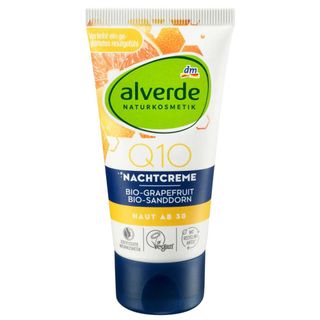
“Anti-Ageing Q10 Night Cream”
This product contains ubiquinone. This ingredient help neutralize free radicals in skin. By doing so, they might be able to prevent early signs of aging (like fine lines and wrinkles), at least to some extent. These ingredients will not be able to "reverse" signs of aging.
Moisturizing21 ingredients credited for this claimGood support
“Anti-Ageing Q10 Night Cream”
This product can help improve hydration of the skin with the two types of ingredients.
The first type is called “humectants”:
these ingredients help attract water.
When humectants are on the surface of the skin, they “pull in” the moisture from the outside environment, or from
within deeper layers of the skin. The following ingredients in this product do the job:
glycerin, sodium hyaluronate.
This product also contains ingredients called “occlusives”. They help reduce the speed with which our skin loses moisture to the outside environment. These ingredients also help soften the upper layer of the skin, so it feels less tight and nicer to the touch. The following ingredients in this product do the job: helianthus annuus seed oil, squalane.
Anti-oxidationNot advertised by the brand · 11 ingredients credited for this claimStrong support
This product contains antioxidants (ubiquinone) that can help neutralize free radicals in skin. By doing so, they can lessen the damage the skin gets from the UV light (sun).
The following ingredients - tartaric acid also can have an antioxidant effect, but there is less evidence to confirm their effectiveness in skin.
Can it cause trouble?
Irritancy9 strong irritants: Alcohol, Parfum + 7 more — patch-test recommendedHigh risk
Comedogenic3 ingredients rated 2 or more on the 0–5 pore-clogging scale3 flagged
User reviews
Be the first — your take helps the next person decide.
Ingredients
Filter by role to see what each ingredient is doing.
Water~45–55%
Olea europaea fruit oil~5.2–6.4%
- Irritation risk
- Medium
An emollient that helps soften the skin but is not effective for restoring its barrier function. Might be helpful to calm down inflammation
More about Olea europaea fruit oilGlycerin~3.8–4.7%
- Irritation risk
- Low
One of the best moisturizing ingredients. Naturally present in skin. It attracts water to the upper layer of the skin working as a humectant
More about GlycerinAlcohol~3–3.7%
- Irritation risk
- High
Can be drying and contribute to skin irritation. Used in formulars to dissolve other ingredients, create a thinner product consistency or for its antibacterial properties
More about AlcoholSqualane~2.4–2.9%
- Irritation risk
- Low
An oil naturally present in skin. Works as an emollient to soften the skin and form a protective layer on its surface without a greasy feeling.
More about SqualaneSodium lactate~1.8–2.3%
- Irritation risk
- Medium
Helps attract water to the upper layer of the skin. Is often used to adjust the pH level of the product
More about Sodium lactateGlyceryl stearate citrate~1.6–2%
- Irritation risk
- Low
Helps oil and water mix together while softening the upper layer of the skin
More about Glyceryl stearate citrateMyristyl alcohol~1.4–1.7%
- Irritation risk
- High
Helps to stabilize the product formulation while softening the upper layer of the skin. Can be irritating
More about Myristyl alcoholCetearyl alcohol~1.2–1.4%
- Irritation risk
- Low
- Comedogenicity
- 2/5
A non-drying alcohol. Works as an emollient. Helps water and oil mix together and creates a nice product texture
More about Cetearyl alcoholParfum~0.75–1.1%
- Irritation risk
- High
An aromatic blend of unspecified and possibly irritating ingredients
More about ParfumSimmondsia chinensis seed oil~0.65–1%
- Irritation risk
- Medium
Softens the upper layer of skin and helps restore the healthy skin barrier. Has shown to help calm down inflammation in skin. It is a stable oil, meaning that it retains its properties even when exposed to air.
More about Simmondsia chinensis seed oilMyristyl myristate~0.55–0.85%
- Irritation risk
- Medium
- Comedogenicity
- 3/5
An emollient. Is not recommended for acne-prone skin as it can be comedogenic
More about Myristyl myristateLycium barbarum fruit extract~0.45–0.7%
- Irritation risk
- Medium
A plant extract that can help neutralize free radicals in skin and attract water to its upper layer
More about Lycium barbarum fruit extractPrunus amygdalus dulcis oil~0.5–0.7%
- Irritation risk
- Low
An emollient that softens the skin
More about Prunus amygdalus dulcis oilButyrospermum parkii butter~0.45–0.7%
- Irritation risk
- Low
- Comedogenicity
- 3/5
A great moisturising ingredient that softens the skin and reduces water loss from its upper layer. It also can be helpful in protecting skin from free radicals
More about Butyrospermum parkii butterHippophae rhamnoides fruit extract~0.35–0.65%
- Irritation risk
- Medium
A plant extract that might help neutralize free radicals in skin, but research on its effectiveness is lacking
More about Hippophae rhamnoides fruit extractCitrus grandis fruit extract~0.3–0.55%
- Irritation risk
- High
Punica granatum fruit extract~0.3–0.55%
- Irritation risk
- High
A fruit extract that is used to add a fragrance to the product. It might have some antioxidant properties
More about Punica granatum fruit extractVitis vinifera fruit extract~0.25–0.5%
- Irritation risk
- Medium
A plant extract that helps attract water to the upper layer of the skin. It might be helpful in neutralizing free radicals in skin, but is less potent than the extract from the seeds
More about Vitis vinifera fruit extractMenyanthes trifoliata leaf extract~0.25–0.5%
- Irritation risk
- Low
Xanthan gum~0.25–0.5%
- Irritation risk
- Low
Used to create a thicker product consistency
More about Xanthan gumRhus verniciflua peel cera~0.25–0.5%
- Irritation risk
- Low
Hydrogenated palm glycerides~0.3–0.5%
- Irritation risk
- Low
An emollient that softens the skin
More about Hydrogenated palm glyceridesSodium hyaluronate~0.25–0.4%
- Irritation risk
- Low
One of the best moisturizing ingredients. Attracts water into the upper layer of the skin
More about Sodium hyaluronateUbiquinone~0.25–0.45%
- Irritation risk
- Low
Coenzyme Q10. It helps neutralize free radicals in skin, improves skin hydration and might be helpful agains fine lines and wrinkles. It can be an allergen
More about UbiquinoneHydrogenated lecithin~0.25–0.45%
- Irritation risk
- Low
Helps to retain moisture by creating a protective barrier on the skin. Rich in fatty acids. Improves product texture and helps with the penetration of other ingredients.
More about Hydrogenated lecithinBrassica campestris sterols~0.25–0.45%
- Irritation risk
- Low
Help soften the upper layer of the skin
More about Brassica campestris sterolsCitric acid~0.25–0.45%
- Irritation risk
- Medium
Can work as an exfoliant but is typically used to adjust the product pH
More about Citric acidLactic acid~0.25–0.45%
- Irritation risk
- Medium
An exfoliating and moisturizing alpha-hydroxy acid (AHA). Typically causes less irritation than other AHAs, for example, glycolic acid. At high concentrations (about 15%), lactic acid can help reduce lines and wrinkles. Recent studies show that lactic acid can support the "good" bacteria living on skin's surface (healthy skin microbiome)
More about Lactic acidTartaric acid~0.25–0.45%
- Irritation risk
- Medium
An AHA (alpha-hydroxy acid). It oxidizes quickly which makes it less effective in skincare formulations. It can support skin's barrier and moisture levels
More about Tartaric acidTocopheryl acetate~0.25–0.45%
- Irritation risk
- Medium
A more stable but less bio-available form of vitamin E compared to Tocopherol. Might help moisturize and protect the skin from free radicals, but mostly used in low concentrations to stabilize other ingredients.
More about Tocopheryl acetateTocopherol~0.2–0.4%
- Irritation risk
- Low
Pure form of vitamin E. Can help moisturise and protect the skin from free radicals. Often used to help stabilise other ingredients or the formula itself
More about TocopherolHelianthus annuus seed oil~0.25–0.4%
- Irritation risk
- Low
A great emollient due to its high linoleic acid content. One of the most effective plant oils in helping skin hydration and repairing skin barrier function
More about Helianthus annuus seed oilAscorbyl palmitate~0.15–0.3%
- Irritation risk
- Medium
Being a lipid soluble form of vitamin C, it is more stable and can penetrate the skin better than L-Ascorbic acid. It is effective in protecting the skin from free radicals, as well as evening the skin tone, but is less effective in stimulating collagen production compared to L-Ascorbic acid.
More about Ascorbyl palmitateGeraniol~0.15–0.25%
Citronellol~0.1–0.2%
Linalool~0.1–0.15%
Limonene~0.1–0.15%
- Irritation risk
- High
A common frangrance that can easily irritate skin, especially if exposed to air, light or heat
More about LimoneneCitral~0.1–0.15%
Benzyl alcohol~0.1–0.15%
- Irritation risk
- High
A preservative. Can be used to mask unpleasant smell. Can be irritating
More about Benzyl alcoholBenzyl benzoate~0.05–0.1%
- Irritation risk
- High
Fragrance with sweet balsamic smell. Help to preserve products and dissolve other ingredients. Could trigger allergic reactions and be irritating
More about Benzyl benzoateIngredient list view
Water, Olea europaea fruit oil, Glycerin, Alcohol, Squalane, Sodium lactate, Glyceryl stearate citrate, Myristyl alcohol, Cetearyl alcohol, Parfum, Simmondsia chinensis seed oil, Myristyl myristate, Lycium barbarum fruit extract, Prunus amygdalus dulcis oil, Butyrospermum parkii butter, Hippophae rhamnoides fruit extract, Citrus grandis fruit extract, Punica granatum fruit extract, Vitis vinifera fruit extract, Menyanthes trifoliata leaf extract, Xanthan gum, Rhus verniciflua peel cera, Hydrogenated palm glycerides, Sodium hyaluronate, Ubiquinone, Hydrogenated lecithin, Brassica campestris sterols, Citric acid, Lactic acid, Tartaric acid, Tocopheryl acetate, Tocopherol, Helianthus annuus seed oil, Ascorbyl palmitate, Geraniol, Citronellol, Linalool, Limonene, Citral, Benzyl alcohol, Benzyl benzoate
Compare prices
Retailers ranked by price — lowest first.

Affiliate links · prices updated regularly
Worth comparing, line by line.
Match % combines shared ingredients, the first five ingredients, shared actives and hero ingredients, irritancy (lower counts in the alternative's favour), texture and body area. Only products in the same routine step are compared.
| AlverdeAnti-Ageing Q10 Night CreamYOUR PRODUCT | Maria ÅkerbergFace Cream Sensitive | PRIORI SkincareLCA - Skin Renewal Cream | Medik8Advanced Night Restore Cream | |
|---|---|---|---|---|
| Match | — | 55% | 54% | 53% |
| Price | $5.49 | — | — | $79.32+$73.83 |
| Shared key ingredients | — | 3 of 13 | 4 of 13 | 3 of 13 |
| Key difference | — | Beeswax | Retinyl Palmitate | Ferric Hexapeptide-35 |
| Irritancy | High | Medium | Medium | High |
| Drying alcohol | Contains drying alcohol | — | — | — |
| View product | Shop | Shop | Shop |


Sources cited in this review
Every concentration estimate and effectiveness label is anchored to one of these 26 studies and safety reviews.
- 1Use of “natural” oils for moisturization: Review of olive, coconut, and sunflower seed oilonlinelibrary.wiley.com
- 2
- 3Cosmetic allergy from myristyl alcoholncbi.nlm.nih.gov
- 4
- 5Patch testing with myristyl alcoholresearchgate.net
- 6

Affiliate links · As an Amazon Associate, WIMJ earns from qualifying purchases.