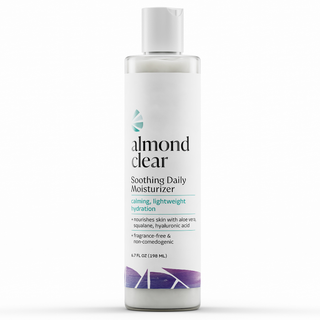
Almond Clear SOOTHING DAILY MOISTURIZER
Works for
1 of 1 advertised claim delivered
Moisturizing8 ingredients credited for this claimStrong support
“This creamy, lightweight moisturizer is seriously hydrating and soothing.”
This product can help improve hydration of the skin with the two types of ingredients.
The first type is called “humectants”:
these ingredients help attract water.
When humectants are on the surface of the skin, they “pull in” the moisture from the outside environment, or from
within deeper layers of the skin. The following ingredients in this product do the job:
glycerin, sodium hyaluronate.
This product also contains ingredients called “occlusives”. They help reduce the speed with which our skin loses moisture to the outside environment. These ingredients also help soften the upper layer of the skin, so it feels less tight and nicer to the touch. The following ingredients in this product do the job: squalane, c13-14 isoparaffin.
The following ingredients in this product are especially good for supporting the skin barrier and helping with the hydration level: panthenol
Anti-oxidationNot advertised by the brand · 4 ingredients credited for this claimStrong support
This product contains antioxidants (tocopherol, ubiquinone) that can help neutralize free radicals in skin. By doing so, they can lessen the damage the skin gets from the UV light (sun).
Anti-agingNot advertised by the brand · 4 ingredients credited for this claimModerate support
This product contains tocopherol, ubiquinone. These ingredients help neutralize free radicals in skin. By doing so, they might be able to prevent early signs of aging (like fine lines and wrinkles), at least to some extent. These ingredients will not be able to "reverse" signs of aging.
Can it cause trouble?
Irritancy6 flagged ingredientsLow risk
ComedogenicClean of flagged comedogenic ingredientsNone flagged
User reviews
Be the first — your take helps the next person decide.
Ingredients
Filter by role to see what each ingredient is doing.
Aloe barbadensis leaf juice~23–34%
- Irritation risk
- Medium
Traditionally used to treat sunburns, dermatitis and inflammation, but evidence for its effectiveness is lacking. The extract can contain humectants that help attract water into the skin
More about Aloe barbadensis leaf juiceSqualane~5.8–8.7%
- Irritation risk
- Low
An oil naturally present in skin. Works as an emollient to soften the skin and form a protective layer on its surface without a greasy feeling.
More about SqualaneGlycerin~3.9–5.8%
- Irritation risk
- Low
One of the best moisturizing ingredients. Naturally present in skin. It attracts water to the upper layer of the skin working as a humectant
More about GlycerinSodium hyaluronate~3.2–4.8%
- Irritation risk
- Low
One of the best moisturizing ingredients. Attracts water into the upper layer of the skin
More about Sodium hyaluronateSodium ascorbyl phosphate~2.5–3.8%
- Irritation risk
- Medium
A stable derivative of vitamin C. It is oil-soluble which means it is more likely to penetrate the skin compared to the pure form of vitamin C (which is water-soluble), but it is less bio-available and is way less effective in stimulating collagen and reducing wrinkles compared to the pure form of vitamin C (L-ascorbic acid) and its other derivatives (for example, magnesium ascorbyl phosphate). At the same time, this vitamin C derivative has been shown in studies to be effective in reducing acne, blemishes and clogged pores. It is less irritating then the pure form of vitamin C
More about Sodium ascorbyl phosphateTocopherol~1.7–2.6%
- Irritation risk
- Low
Pure form of vitamin E. Can help moisturise and protect the skin from free radicals. Often used to help stabilise other ingredients or the formula itself
More about TocopherolSymphytum officinale leaf extract~1.3–1.9%
- Irritation risk
- High
A plant extract that has an anti-bacterial effect
More about Symphytum officinale leaf extractDaucus carota sativa root extract~1.2–1.8%
- Irritation risk
- Low
Carrot extract. Might have anti-oxidant properties and be used to add orange color
More about Daucus carota sativa root extractChamomilla recutita flower extract~1–1.5%
- Irritation risk
- High
Plant extract that can have healing and anti-inflammatory properties. It is a potential allergen and can be irritating
More about Chamomilla recutita flower extractLonicera japonica leaf extract~0.8–1.2%
- Irritation risk
- Low
C13-14 isoparaffin~0.55–1.35%
- Irritation risk
- Low
Helps soften the upper layer of the skin, dissolve other ingredients and create a thicker product consistency
More about C13-14 isoparaffinBenzyl alcohol~0.15–0.6%
- Irritation risk
- High
A preservative. Can be used to mask unpleasant smell. Can be irritating
More about Benzyl alcoholSodium phytate~0.15–0.6%
Panthenol~0.1–0.45%
- Irritation risk
- Low
Helps attract water to the upper layer of the skin and can help improve skin barrier function
More about PanthenolUbiquinone~0.05–0.25%
- Irritation risk
- Low
Coenzyme Q10. It helps neutralize free radicals in skin, improves skin hydration and might be helpful agains fine lines and wrinkles. It can be an allergen
More about UbiquinoneEthylhexylglycerin~0.05–0.25%
Xanthan gum~0.05–0.25%
- Irritation risk
- Low
Used to create a thicker product consistency
More about Xanthan gumIngredient list view
Aloe barbadensis leaf juice, Squalane, Glycerin, Sodium hyaluronate, Sodium ascorbyl phosphate, Tocopherol, Symphytum officinale leaf extract, Daucus carota sativa root extract, Chamomilla recutita flower extract, Lonicera japonica leaf extract, C13-14 isoparaffin, Benzyl alcohol, Sodium phytate, Panthenol, Ubiquinone, Ethylhexylglycerin, Xanthan gum
Compare prices
Retailers ranked by price — lowest first.
Affiliate links · prices updated regularly · As an Amazon Associate, WIMJ earns from qualifying purchases.
Worth comparing, line by line.
Match % combines shared ingredients, the first five ingredients, shared actives and hero ingredients, irritancy (lower counts in the alternative's favour), texture and body area. Only products in the same routine step are compared.
| Almond ClearSOOTHING DAILY MOISTURIZERYOUR PRODUCT | OlayAnti-Aging Face Moisturizer Fragrance-Free | |
|---|---|---|
| Match | — | 51% |
| Price | — | $13.21 |
| Shared key ingredients | — | 3 of 7 |
| Key difference | — | Niacinamide |
| Irritancy | Low | Low |
| Drying alcohol | — | — |
| View product | Shop |
Sources cited in this review
Every concentration estimate and effectiveness label is anchored to one of these 16 studies and safety reviews.
- 1
- 2Hyaluronic acid: A key molecule in skin agingncbi.nlm.nih.gov
- 3
- 4
- 5Sodium ascorbyl phosphate in topical microemulsionssciencedirect.com
- 6

Affiliate links · As an Amazon Associate, WIMJ earns from qualifying purchases.