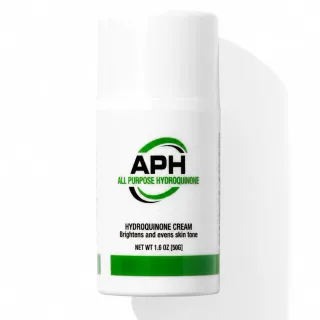
All Purpose Creams APH Hydroquinone Cream
Works for
Evens skin toneHydroquinoneWorks well
“Apply thinly: Use a small amount on dark spots (and slightly around them to avoid uneven lightening).”
This product can help reduce hypepigmentation and even out the skin tone because it contains the following effective ingredients: hydroquinone.
Keep in mind that you would need to apply any topical skincare targetted at hypigmentation consistently for a couple of months to get a result. No topical skincare product can help get rid of hyperpigmentation (including post-acne marks and age spots) instantly.
MoisturizingSide benefit the brand mentions · Paraffinum liquidum, Glycerin + 12 moreWorks well
“APH Hydroquinone Cream”
This product can help improve hydration of the skin with the two types of ingredients.
The first type is called “humectants”:
these ingredients help attract water.
When humectants are on the surface of the skin, they “pull in” the moisture from the outside environment, or from
within deeper layers of the skin. The following ingredients in this product do the job:
glycerin, sodium hyaluronate.
This product also contains ingredients called “occlusives”. They help reduce the speed with which our skin loses moisture to the outside environment. These ingredients also help soften the upper layer of the skin, so it feels less tight and nicer to the touch. The following ingredients in this product do the job: caprylic/capric triglyceride, dimethicone.
The following ingredients in this product are especially good for supporting the skin barrier and helping with the hydration level: paraffinum liquidum
Can it cause trouble?
Irritancy2 strong irritants: Hydroquinone, Diazolidinyl ureaMedium risk
Comedogenic2 ingredients rated 2 or more on the 0–5 pore-clogging scale2 flagged
User reviews
Be the first — your take helps the next person decide.
Ingredients
Filter by role to see what each ingredient is doing.
Water~40–60%
Glycerin~3.9–5.8%
- Irritation risk
- Low
One of the best moisturizing ingredients. Naturally present in skin. It attracts water to the upper layer of the skin working as a humectant
More about GlycerinPropylene glycol~3.2–4.8%
- Irritation risk
- High
Helps oil and water mix together and can enhance the penetration of other ingredients into the skin. It can be irritating
More about Propylene glycolHydroquinone~2.5–3.8%
- Irritation risk
- High
A potent anti-pigmentation active. It can have serious side-effects though and ideally is used under supervision of a doctor. It should not be used over a long period of time (over a year).
More about HydroquinoneAloe barbadensis leaf extract~2.1–3.1%
- Irritation risk
- Medium
Traditionally used to treat sunburns, dermatitis and inflammation, but evidence for its effectiveness is lacking. The extract can contain humectants that help attract water into the skin
More about Aloe barbadensis leaf extractParaffinum liquidum~1.6–2.5%
- Irritation risk
- Low
Mineral oil. One of the most effective and well studied occlusive and emollient moisturizing ingredients. Helps reduce moisture loss in skin and repair skin barrier function
More about Paraffinum liquidumCaprylic/capric triglyceride~1.4–2.1%
- Irritation risk
- Medium
A good mix of fatty acids that forms a protective layer on the skin. Improves the shelf life of products. Derived from coconut and glycerin
More about Caprylic/capric triglycerideCyclopentasiloxane~1.3–1.9%
- Irritation risk
- Low
A silicone that helps improve the product texture and spreadability. Can absorb oil creating a short-term mattifying effect on the skin
More about CyclopentasiloxaneCetearyl alcohol~1.1–1.6%
- Irritation risk
- Low
- Comedogenicity
- 2/5
A non-drying alcohol. Works as an emollient. Helps water and oil mix together and creates a nice product texture
More about Cetearyl alcoholCetearyl glucoside~0.55–1.3%
- Irritation risk
- Medium
Helps water and oil in the product mix well together and improves product texture
More about Cetearyl glucosideDimethicone~0.5–1.15%
- Irritation risk
- Low
A silicone that helps to reduce water loss from the surface of the skin. Can temporarily "fill in" lines and wrinkles, absorb oil, and create a nice product finish
More about DimethiconePolyglyceryl-2 stearate~0.35–0.8%
- Irritation risk
- Medium
Helps water and oil mix together
More about Polyglyceryl-2 stearateGlyceryl stearate~0.2–0.8%
- Irritation risk
- Low
An emollient that softens the skin and forms a protective layer on its surface. Helps water and oil mix together
More about Glyceryl stearateStearyl alcohol~0.15–0.7%
- Irritation risk
- Low
An emollient that helps soften the skin
More about Stearyl alcoholButyrospermum parkii butter~0.15–0.6%
- Irritation risk
- Low
- Comedogenicity
- 3/5
A great moisturising ingredient that softens the skin and reduces water loss from its upper layer. It also can be helpful in protecting skin from free radicals
More about Butyrospermum parkii butterPaeonol~0.1–0.45%
- Irritation risk
- Low
Methylparaben~0.15–0.3%
Xanthan gum~0.1–0.45%
- Irritation risk
- Low
Used to create a thicker product consistency
More about Xanthan gumAllantoin~0.1–0.35%
- Irritation risk
- Low
Helps calm down inflammation in skin and can help reduce itching. Helps to repair the skin barrier and keep skin hydrated
More about AllantoinTocopherol~0.1–0.3%
- Irritation risk
- Low
Pure form of vitamin E. Can help moisturise and protect the skin from free radicals. Often used to help stabilise other ingredients or the formula itself
More about TocopherolDiazolidinyl urea~0.05–0.15%
- Irritation risk
- High
A preservative. Works by releasing formaldehyde. Can be irritating
More about Diazolidinyl ureaBht~0.05–0.15%
Glucose~0.05–0.15%
- Irritation risk
- Low
Helps attract water to the upper layer of the skin. Could be helpful in restoring the skin barrier function
More about GlucoseDisodium edta~0.01–0.05%
Sodium hyaluronate~0.01–0.05%
- Irritation risk
- Low
One of the best moisturizing ingredients. Attracts water into the upper layer of the skin
More about Sodium hyaluronateIngredient list view
Water, Glycerin, Propylene glycol, Hydroquinone, Aloe barbadensis leaf extract, Paraffinum liquidum, Caprylic/capric triglyceride, Cyclopentasiloxane, Cetearyl alcohol, Cetearyl glucoside, Dimethicone, Polyglyceryl-2 stearate, Glyceryl stearate, Stearyl alcohol, Butyrospermum parkii butter, Paeonol, Methylparaben, Xanthan gum, Allantoin, Tocopherol, Diazolidinyl urea, Bht, Glucose, Disodium edta, Sodium hyaluronate
Product summary
Judging from the ingredient list, "All Purpose Creams - APH Hydroquinone Cream" works well for improving skin hydration As we expect from a proper moisturizer, the formula includes a combo of effective humectants and emollients. These are the two different types of ingredients that are essential for improving the skin hydration and supporting a healthy skin barrier. Aloe barbadensis extract and propylene glycol in this product (humectants) attract water molecules to the upper layer of the skin (the water comes from the outside air or from the deeper layers of the skin if the air is dry). Emollients in this formulation (paraffinum liquidum, dimethicone, cetyl alcohol, glyceryl stearate and stearic acid) help to reduce the moisture loss from the skin. They also soften the skin surface and relieve the feeling of dryness and tightness.
This product contains ingredients that could be beneficial, but their concentrations are too low in this formulation: allantoinIrritation risk
We assess the overall irritancy of this moisturizer to be high. For a detailed overview of all potential irritants: click here
You can see the detailed formula review with the breakdown of all actives in the product and the full ingredient list with estimated concentrations in the tables below.
Sources cited in this review
Every concentration estimate and effectiveness label is anchored to one of these 14 studies and safety reviews.
- 1
- 2Surfactants and experimental irritant contact dermatitisncbi.nlm.nih.gov
- 3Propylene Glycolpubmed.ncbi.nlm.nih.gov
- 4Skin-sensitizing and irritant properties of propylene glycolonlinelibrary.wiley.com
- 5A review on the extensive skin benefits of mineral oilncbi.nlm.nih.gov
- 6
