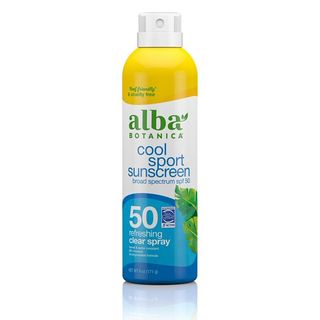
Alba Botanica Sunscreen Cool Sport Spray SPF 50
Works for
1 of 1 advertised claim delivered
Sun protectionSPF 50 · 4 UV filtersBroad spectrum
This product offers a good level of protection against both UVB and UVA rays.
This sunscreen uses organic (so-called "chemical") sunscreen filters. Organic, or "chemical" filters usually provide reliable sun protection and rarely leave a white cast. Sunscreens with organic filters can sting eyes.
This product can be considered "reef safe" because it does not contain the UV filters (oxybenzone and octinoxate) that can be harmful to coral reefs when present in the water in high concentrations.
Evens skin toneNot advertised by the brand · Camellia sinensis leaf extractStrong evidence
This product offers broad spectrum sun protection. It means that it can prevent hyperpigmentation and help keep the skin tone even (sun damage is the main factor causing age spots, darkening of post-acne marks and other discolorations).
Anti-agingNot advertised by the brand · Camellia sinensis leaf extract, Aloe barbadensis leaf juiceStrong evidence
This product can help prevent early signs of skin aging because it offers a good level of broad spectrum sun protection. Sun damage is the main cause of premature skin aging, and protecting your skin from the sun is the best anti-aging strategy.
Anti-oxidationNot advertised by the brand · Camellia sinensis leaf extract, Ginkgo biloba leaf extract + 2 moreModerate evidence
This product contains antioxidants (camellia sinensis leaf extract, ginkgo biloba leaf extract) that might be able to help neutralize free radicals in skin to lessen the damage it gets from the UV light (sun). There is not enough evidence to confirm their effectiveness in skin though.
MoisturizingNot advertised by the brand · Persea gratissima oil, Diisopropyl adipate + 2 moreGood evidence
This product can help soften the skin and reduce its moisture loss with emollients and occlusives: persea gratissima oil, diisopropyl adipate.
Keep in mind that this product does not contain effective ingredients to attract water to the upper layer of the skin. This is why an additional product with humectants like glycerin or hyaluronic acid can be helpful (apply it before this product for the best results).
Can it cause trouble?
Irritancy9 strong irritants: Alcohol denat., Citrus limon peel oil + 7 more — patch-test recommendedHigh risk
ComedogenicClean of flagged comedogenic ingredientsNone flagged
User reviews
Be the first — your take helps the next person decide.
Ingredients
Filter by role to see what each ingredient is doing.
Alcohol denat.~23–35%
- Irritation risk
- High
Produces temporary toning effect. Can help dissolve other ingredients or preserve products
More about Alcohol denat.Acrylates/octylacrylamide copolymer~5.1–7.6%
- Irritation risk
- Low
Aloe barbadensis leaf juice~4.6–6.9%
- Irritation risk
- Medium
Traditionally used to treat sunburns, dermatitis and inflammation, but evidence for its effectiveness is lacking. The extract can contain humectants that help attract water into the skin
More about Aloe barbadensis leaf juiceAmyris balsamifera bark oil~3.6–5.5%
- Irritation risk
- Low
Citrus limon peel oil~2.8–4.2%
Persea gratissima oil~2.3–3.4%
- Irritation risk
- Medium
An emollient that helps soften the skin and could be helpful in repairing its barrier function
More about Persea gratissima oilMentha piperita oil~1.6–2.3%
Camellia sinensis leaf extract~1.4–2.1%
- Irritation risk
- Low
Can contain potent anti-oxidant compounds (abbreviated ECG, GCG, EGC, and EGCG) that might help protect the skin from free radicals. Can help calm down inflammation and has some anti-bacterial properties. Unfortunately, these antioxidants are unstable and lose their effectiveness very quickly in products. The concentration of the antioxidant compounds in the extract also tends to be low to be effective in topical formulation
More about Camellia sinensis leaf extractChamomilla recutita flower extract~1.3–1.9%
- Irritation risk
- High
Plant extract that can have healing and anti-inflammatory properties. It is a potential allergen and can be irritating
More about Chamomilla recutita flower extractGinkgo biloba leaf extract~1.1–1.6%
- Irritation risk
- High
A plant extract that might help neutralize free radicals and reduce inflammation in skin. It can be irritating
More about Ginkgo biloba leaf extractPanax ginseng root extract~1–1.5%
- Irritation risk
- High
A plant extract that might have some anti-inflammatory properties, but solid evidence is lacking. It can be irritating
More about Panax ginseng root extractTocopheryl acetate~0.8–1.2%
- Irritation risk
- Medium
A more stable but less bio-available form of vitamin E compared to Tocopherol. Might help moisturize and protect the skin from free radicals, but mostly used in low concentrations to stabilize other ingredients.
More about Tocopheryl acetateDiisopropyl adipate~0.85–1.25%
- Irritation risk
- Low
Helps soften the upper layer of the skin
More about Diisopropyl adipateMenthyl lactate~0.55–1.25%
Triethyl citrate~0.5–1.15%
Benzyl salicylate~0.5–1.15%
Citral~0.5–1.1%
Citronellol~0.45–1.05%
Hexyl cinnamal~0.45–1%
Hydroxycitronellol~0.4–0.95%
- Irritation risk
- Low
Limonene~0.4–0.95%
- Irritation risk
- High
A common frangrance that can easily irritate skin, especially if exposed to air, light or heat
More about LimoneneButyl methoxydibenzoylmethane3%
- Irritation risk
- Medium
Avobenzone. An organic, or so-called "chemical" UV filter. Protects against both UVA and UVB rays. Needs to be combined with other filters in a formulation to be stable.
More about Butyl methoxydibenzoylmethaneHomosalate15%
- Irritation risk
- Medium
A weak sunscreen that offers some protection against the sun rays that cause sunburn (UVB), but does not offer meaningful protection against protect against the most aging sun rays (UVA). It loses its effectiveness quickly when exposed to sunlight. It is an organic, or so called "chemical" sunscreen. When used in low concentrations, helps to stabilize the product formulation
More about HomosalateOctocrylene8%
- Irritation risk
- Medium
A weak sunscreen that protects against the sun rays that cause sunburn (UVB) and is somewhat effective against the UVA rays. It is quite stable and can help stabilize other, more vulnerable, sunscreen ingredients like Avobenzone. It is an organic, or so called "chemical" sunscreen
More about OctocryleneEthylhexyl salicylate5%
- Irritation risk
- Low
Octisalate. A UV filter. It offers some protection against the sun rays that cause sunburn (UVB), but does not protect against the most aging sun rays (UVA). It loses its effectiveness quickly when exposed to sunlight. It is an organic, or so called "chemical" sunscreen
More about Ethylhexyl salicylateAlcohol denat.~0.4–0.95%
- Irritation risk
- High
Produces temporary toning effect. Can help dissolve other ingredients or preserve products
More about Alcohol denat.Acrylates/octylacrylamide copolymer~0.45–1.05%
- Irritation risk
- Low
Aloe barbadensis leaf juice~0.4–0.9%
- Irritation risk
- Medium
Traditionally used to treat sunburns, dermatitis and inflammation, but evidence for its effectiveness is lacking. The extract can contain humectants that help attract water into the skin
More about Aloe barbadensis leaf juiceAmyris balsamifera bark oil~0.4–0.9%
- Irritation risk
- Low
Citrus limon peel oil~0.4–0.9%
Persea gratissima oil~0.45–1.05%
- Irritation risk
- Medium
An emollient that helps soften the skin and could be helpful in repairing its barrier function
More about Persea gratissima oilMentha piperita oil~0.35–0.85%
Camellia sinensis leaf extract~0.4–0.9%
- Irritation risk
- Low
Can contain potent anti-oxidant compounds (abbreviated ECG, GCG, EGC, and EGCG) that might help protect the skin from free radicals. Can help calm down inflammation and has some anti-bacterial properties. Unfortunately, these antioxidants are unstable and lose their effectiveness very quickly in products. The concentration of the antioxidant compounds in the extract also tends to be low to be effective in topical formulation
More about Camellia sinensis leaf extractChamomilla recutita flower extract~0.4–0.9%
- Irritation risk
- High
Plant extract that can have healing and anti-inflammatory properties. It is a potential allergen and can be irritating
More about Chamomilla recutita flower extractGinkgo biloba leaf extract~0.4–0.95%
- Irritation risk
- High
A plant extract that might help neutralize free radicals and reduce inflammation in skin. It can be irritating
More about Ginkgo biloba leaf extractPanax ginseng root extract~0.45–1.05%
- Irritation risk
- High
A plant extract that might have some anti-inflammatory properties, but solid evidence is lacking. It can be irritating
More about Panax ginseng root extractTocopheryl acetate~0.4–0.9%
- Irritation risk
- Medium
A more stable but less bio-available form of vitamin E compared to Tocopherol. Might help moisturize and protect the skin from free radicals, but mostly used in low concentrations to stabilize other ingredients.
More about Tocopheryl acetateDiisopropyl adipate~0.45–1.1%
- Irritation risk
- Low
Helps soften the upper layer of the skin
More about Diisopropyl adipateMenthyl lactate~0.35–0.8%
Triethyl citrate~0.3–0.7%
Benzyl salicylate~0.15–0.7%
Citral~0.15–0.65%
Citronellol~0.15–0.65%
Hexyl cinnamal~0.15–0.65%
Hydroxycitronellol~0.15–0.6%
- Irritation risk
- Low
Limonene~0.1–0.5%
- Irritation risk
- High
A common frangrance that can easily irritate skin, especially if exposed to air, light or heat
More about LimoneneIngredient list view
Alcohol denat., Acrylates/octylacrylamide copolymer, Aloe barbadensis leaf juice, Amyris balsamifera bark oil, Citrus limon peel oil, Persea gratissima oil, Mentha piperita oil, Camellia sinensis leaf extract, Chamomilla recutita flower extract, Ginkgo biloba leaf extract, Panax ginseng root extract, Tocopheryl acetate, Diisopropyl adipate, Menthyl lactate, Triethyl citrate, Benzyl salicylate, Citral, Citronellol, Hexyl cinnamal, Hydroxycitronellol, Limonene, Butyl methoxydibenzoylmethane, Homosalate, Octocrylene, Ethylhexyl salicylate, Alcohol denat., Acrylates/octylacrylamide copolymer, Aloe barbadensis leaf juice, Amyris balsamifera bark oil, Citrus limon peel oil, Persea gratissima oil, Mentha piperita oil, Camellia sinensis leaf extract, Chamomilla recutita flower extract, Ginkgo biloba leaf extract, Panax ginseng root extract, Tocopheryl acetate, Diisopropyl adipate, Menthyl lactate, Triethyl citrate, Benzyl salicylate, Citral, Citronellol, Hexyl cinnamal, Hydroxycitronellol, Limonene
Compare prices
Retailers ranked by price — lowest first.
Affiliate links · prices updated regularly · As an Amazon Associate, WIMJ earns from qualifying purchases.
Product summary
Based on the ingredients included, we believe that "Alba Botanica - Sunscreen Cool Sport Spray SPF 50" can offer reliable sun protection. It can protect from both UVA and UVB rays. This is great news because not all sunscreens with SPF ratings give UVA protection. (UVA rays do not cause sunburn, but still damage our skin and lead to early aging).
It also works as a moisturizer, so you do not have to use an additional hydrating product. This product prevents early signs of aging by protecting against sun damage (all broad spectrum sunscreens do that).
Sunscreen filters
This sunscreen uses so-called "chemical", or organic UV filters (organic simply means that their molecules contain atoms of carbon). These filters typically give good sun protection and rarely leave a white cast, but they can be irritating for sensitive skin. The UV filters in this sunscreen are: avobenzone 3.00% (declared), octisalate 5.00% (declared), homosalate 15.00% (declared) and octocrylene 8.00% (declared).
Irritation risk
There are quite a few common irritants in this product, including ingredients without particular skin benefits. We would not recommend it for sensitive skin. We assess the overall irritancy of this sunscreen to be high. For a detailed overview of all potential irritants: click here
You can see the detailed formula review with the breakdown of all actives in the product and the full ingredient list with estimated concentrations in the tables below.
About the brand
According to Cruelty-Free Kitty "Alba Botanica" is cruelty free and so is its parent company.
Price
The product retails from 11.90$ up to 23.49$ in the United States.
For a detailed price comparison: click here.
Sources cited in this review
Every concentration estimate and effectiveness label is anchored to one of these 6 studies and safety reviews.
- 1
- 2Cosmeceutical Critique: Ginkgo Bilobamdedge.com
- 3Ginseng in Dermatology: A Reviewncbi.nlm.nih.gov
- 4
- 5
- 6

Affiliate links · As an Amazon Associate, WIMJ earns from qualifying purchases.