Works for:
based on ingredients and %- Sun protection
- Moisturizing
- Anti-aging
- Evens skin tone
Can it cause trouble?
- Irritation risk: high
- Comedogenic risk ingredients: 4
Key actives

Product Summary
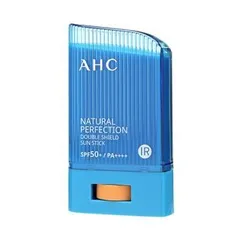
We assess that "AHC - Natural Perfection Double Shield Sun Stick" can provide reliable sun protection based on the ingredient list. We love that it can protect from both UVA and UVB rays (not all sunscreens with SPF ratings give UVA protection. UVA rays do not cause sunburn, but still damage our skin and lead to early aging).
Its formula is also hydrating, so you might not need an additional moistruizer during the day. Like all broad-spectrum sunscreens, this product helps prevent early signs of aging.
Sunscreen filters
This sunscreen uses a mixture of both mineral and organic (so-called "chemical") UV filters. Here are the organic filters this product uses: tinosorb s, butyloctyl salicylate, uvinul a plus and octinoxate. As for the mineral filters, this sunscreen uses titanium dioxide.
Irritation risk
There are quite a few common irritants in this product, including ingredients without particular skin benefits. We would not recommend it for sensitive skin. We assess the overall irritancy of this product to be high. For a detailed overview of all potential irritants: click here
You can see the detailed formula review with the breakdown of all actives in the product and the full ingredient list with estimated concentrations in the tables below.
Price
The product retails for 48.93A$ in Australia, from 9.00$ up to 14.49$ in the United States and for 17.27£ in the United Kingdom.
For a detailed price comparison: click here.
Anti-aging
This product can help prevent early signs of skin aging because it offers a good level of broad spectrum sun protection. Sun damage is the main cause of premature skin aging, and protecting your skin from the sun is the best anti-aging strategy.
These ingredients in the product might also be helpful for reducing and preventing fine lines, wrinkles, and skin elasticity, even though there is no conclusive evidence for their effectiveness: acetyl hexapeptide-8, acetyl tetrapeptide-2, aspartic acid, dipeptide diaminobutyroyl benzylamide diacetate, lysine, palmitoyl tripeptide-5, serine, tetradecyl aminobutyroylvalylaminobutyric urea trifluoroacetate, threonine.
An amino-acid that helps to attract water to the upper layer of the skin. In combination with other amino-acids, might help to reduce fine lines and wrinkles
A type of peptide. Peptides are excellent moisturizers and might be able support collagen production reducing fine lines and wrinkles
An amino-acid that helps to attract water to the upper layer of the skin. In combination with other amino-acids, might help to reduce fine lines and wrinkles
A type of peptide. Peptides are excellent moisturizers and might be able support collagen production reducing fine lines and wrinkles
An amino-acid that helps to attract water to the upper layer of the skin. In combination with other amino-acids, might help to reduce fine lines and wrinkles
A peptide. It helps attract water to the upper layer of the skin, support skin's barrier function and might have some slight anti-aging effect through stimulating skin's own production of hyaluronic acid
A type of peptide. Peptides are excellent moisturizers and might be able support collagen production reducing fine lines and wrinkles
A type of peptide. Peptides are excellent moisturizers and might be able support collagen production reducing fine lines and wrinkles
An amino-acid that helps increase skin hydration and might help to slightly improve skin firmness, potentially reducing lines and wrinkles
Might be helpful against blemishes, work as an anti-oxidant, reduce inflammation and improve skin's ability to hold on to moisture, but more research is needed to confirm its effectiveness when applied topically to human skin
Three steps removed from the active form of vitamin A - retinoic acid. To have an effect in the skin, it first needs to be converted twice to become the retinoic acid. This means it is less potent than retinol, but could also be less irritating. Once converted to the retinoic acid in the skin, it helps against all signs of aging, improves skin cell turnover and helps fight blemishes and clogged pores. However, in many cosmetic formulations, it is used in a concentration that is too low to have the full effect
A plant extract that has been shown to be able to reduce inflammation in skin, support restoration of skin barrier function, as well as support collagen production. Contains active compounds called centelloids: asiaticoside, madecasosside, asiatic acid and madecassic acid. Might be helpful in preventing stretch marks. It can be itself be irritating though.
Can contain potent anti-oxidant compounds (abbreviated ECG, GCG, EGC, and EGCG) that might help protect the skin from free radicals. Can help calm down inflammation and has some anti-bacterial properties. Unfortunately, these antioxidants are unstable and lose their effectiveness very quickly in products. The concentration of the antioxidant compounds in the extract also tends to be low to be effective in topical formulation
A great moisturising ingredient that softens the skin and reduces water loss from its upper layer. It also can be helpful in protecting skin from free radicals
A stable derivative of vitamin C. It is oil-soluble which means it is more likely to penetrate the skin compared to the pure form of vitamin C (which is water-soluble), but it is less bio-available and is way less effective in stimulating collagen and reducing wrinkles compared to the pure form of vitamin C (L-ascorbic acid) and its other derivatives (for example, magnesium ascorbyl phosphate). At the same time, this vitamin C derivative has been shown in studies to be effective in reducing acne, blemishes and clogged pores. It is less irritating then the pure form of vitamin C
Evens skin tone
This product offers broad spectrum sun protection. It means that it can prevent hyperpigmentation and help keep the skin tone even (sun damage is the main factor causing age spots, darkening of post-acne marks and other discolorations).
A plant extract that can help lighten the skin and calm down inflammation. Might be helpful in neutralizing free radicals
A plant extract that might have anti-oxidant properties and help even out skin tone, but solid evidence is lacking
A plant extract that might help neutralize free radicals and reduce hyperpigmentation, but the research on its effectiveness in skin is lacking
Might help neutralize free radicals in skin and might be helpful against hyperpigmentation
An amino-acid that helps to attract water to the upper layer of the skin and might help to lighten the skin, but solid evidence is lacking
Three steps removed from the active form of vitamin A - retinoic acid. To have an effect in the skin, it first needs to be converted twice to become the retinoic acid. This means it is less potent than retinol, but could also be less irritating. Once converted to the retinoic acid in the skin, it helps against all signs of aging, improves skin cell turnover and helps fight blemishes and clogged pores. However, in many cosmetic formulations, it is used in a concentration that is too low to have the full effect
Can contain potent anti-oxidant compounds (abbreviated ECG, GCG, EGC, and EGCG) that might help protect the skin from free radicals. Can help calm down inflammation and has some anti-bacterial properties. Unfortunately, these antioxidants are unstable and lose their effectiveness very quickly in products. The concentration of the antioxidant compounds in the extract also tends to be low to be effective in topical formulation
Moisturizing
What does the product description say?
It contains various skin care ingredients (including bamboo extract, glacier water and cotton seed extract) to soothe, smooth and hydrate skin.
Source: Yesstyle
This product can help improve hydration of the skin with the two types of ingredients.
The first type is called “humectants”:
these ingredients help attract water.
When humectants are on the surface of the skin, they “pull in” the moisture from the outside environment, or from
within deeper layers of the skin. The following ingredients in this product do the job:
alanine, anhydroxylitol.
This product also contains ingredients called “occlusives”. They help reduce the speed with which our skin loses moisture to the outside environment. These ingredients also help soften the upper layer of the skin, so it feels less tight and nicer to the touch. The following ingredients in this product do the job: arginine, cocos nucifera oil.
The following ingredients in this product are especially good for supporting the skin barrier and helping with the hydration level: acetyl hexapeptide-8, acetyl tetrapeptide-2, ceramide np, dipeptide diaminobutyroyl benzylamide diacetate, palmitoyl tripeptide-5
An amino acid that can help attract water to the upper layer of the skin and support skin's barrier function
Plant oil that due to its high content of linoleic acid can help support skin's barrier function improving its hydration
An amino-acid that helps to attract water to the upper layer of the skin. In combination with other amino-acids, might help to reduce fine lines and wrinkles
Helps attract water to the upper layer of the skin and repair the skin barrier function
A type of peptide. Peptides are excellent moisturizers and might be able support collagen production reducing fine lines and wrinkles
A type of peptide. Peptides are excellent moisturizers and might be able support collagen production reducing fine lines and wrinkles
An amino-acid that helps to attract water to the upper layer of the skin and might help to lighten the skin, but solid evidence is lacking
Helps attract water to the upper layer of the skin and repair the skin barrir function
An amino acid that is naturally present in skin and helps keep it hydrated. When used together with AHAs, it can reduce their irritating effect on the skin
An amino-acid that helps increase skin hydration and might help to slightly improve skin firmness, potentially reducing lines and wrinkles
A type of lipid similar to ceramides naturally present in skin. Helps to soften the upper layer of the skin and supports the skin barrier function to keep it hydrated. Can help to prevent inflammation in skin
An emollient. Found to be as effective as a moisturizer for dry skin as mineral oil. Could be comedogenic
Red algae extract that helps attract water to the upper layer of the skin and might contain antioxidants
Might help neutralize free radicals in skin and might be helpful against hyperpigmentation
A type of peptide. Peptides are excellent moisturizers and might be able support collagen production reducing fine lines and wrinkles
An amino-acid that helps attract water to the upper layer of the skin
One of the best moisturizing ingredients. Naturally present in skin. It attracts water to the upper layer of the skin working as a humectant
Helps to attract water to the upper layer of the skin and can help restore the skin barrier function
A great emollient due to its high linoleic acid content. One of the most effective plant oils in helping skin hydration and repairing skin barrier function
One of the best moisturizing ingredients. Attracts water into the upper layer of the skin. A version of it is naturally present in skin
An amino-acid that helps to attract water to the upper layer of the skin. In combination with other amino-acids, might help to reduce fine lines and wrinkles
An amino-acid that helps to attract water to the upper layer of the skin. In combination with other amino-acids, might help to reduce fine lines and wrinkles
A type of peptide. Peptides are excellent moisturizers and might be able support collagen production reducing fine lines and wrinkles
Lipids that work as an emollient and can be helpful in repairing skin barrier function
An oil naturally present in skin. Works as an emollient to soften the skin and form a protective layer on its surface without a greasy feeling.
A peptide. It helps attract water to the upper layer of the skin, support skin's barrier function and might have some slight anti-aging effect through stimulating skin's own production of hyaluronic acid
Helps to soften the upper layer of the skin
An emollient that helps soften the skin but is not effective for restoring its barrier function. Might be helpful to calm down inflammation
Enhances the product texture and makes it more spreadable. Helps reduce water loss from the outer layer of skin. Extands the shelf life by preventing bacteria growth
Used to improve the product consistency and soften the upper layer of the skin
A plant extract that might contain a compound baicalin that could be helpful in neutralizing free radicals and reducing inflammation in skin. The baicalin concentration in skincare products is often too low for an effective action. Can be used for its fragrant properties
Helps water and oil mix together and softens the upper layer of the skin
Helps products spread more easily and works as an emollient to soften skin
Helps oil and water mix together and can enhance the penetration of other ingredients into the skin. It can be irritating
Might have some moisturising properties. Is not effective when applied topically beyond some moisturizing effect
Used to create a nice product texture and help delivery of other ingredients. Might be somewhat helpful in attracting water to the upper layer of the skin
Helps preserve products and creates a nice product texture
A type of silicone that helps to soften the upper layer of the skin and create a nice product finish on the skin
A plant extract that has been shown to be able to reduce inflammation in skin, support restoration of skin barrier function, as well as support collagen production. Contains active compounds called centelloids: asiaticoside, madecasosside, asiatic acid and madecassic acid. Might be helpful in preventing stretch marks. It can be itself be irritating though.
Softens the upper layer of skin and helps restore the healthy skin barrier. Has shown to help calm down inflammation in skin. It is a stable oil, meaning that it retains its properties even when exposed to air.
A great moisturising ingredient that softens the skin and reduces water loss from its upper layer. It also can be helpful in protecting skin from free radicals
An emollient that helps soften the upper layer of the skin. Might have some weak anti-oxidant properties
A good mix of fatty acids that forms a protective layer on the skin. Improves the shelf life of products. Derived from coconut and glycerin
Helps attract water to the upper layer of the skin and can help improve skin barrier function
Might be helpful against blemishes, work as an anti-oxidant, reduce inflammation and improve skin's ability to hold on to moisture, but more research is needed to confirm its effectiveness when applied topically to human skin
Helps oil and water mix together and works as an emollient
Used mostly for creating emulsions - helping oil and water mix together. Helps soften the upper layer of the skin
Can contain potent anti-oxidant compounds (abbreviated ECG, GCG, EGC, and EGCG) that might help protect the skin from free radicals. Can help calm down inflammation and has some anti-bacterial properties. Unfortunately, these antioxidants are unstable and lose their effectiveness very quickly in products. The concentration of the antioxidant compounds in the extract also tends to be low to be effective in topical formulation
Sun protection
This product offers a good level of protection against both UVB and UVA rays.
This sunscreen uses organic (so-called "chemical") sunscreen filters. Organic, or "chemical" filters usually provide reliable sun protection and rarely leave a white cast. Sunscreens with organic filters can sting eyes.
Tinosorb S. One of the most effective broad spectrum sunscreen ingredients. Protects from both UVA and UVB rays. It is photostable. Unfortunately, not approved by FDA (US) yet.
Works as a UV filter when used in high concentrations. It is photostable and is effective mostly against the UVB light, with some protection in the UVA range. In small concentrations, used for its ability to improve the color of cosmetic products. Is usually well tolerated by the skin
Uvinul A Plus. A new generation broad spectrum sunscreen that offers an effective protection especially in the UVA range. It is stable in formulations. Unfortunately, is not approved by the FDA (US) yet
Octinoxate. When used in higher concentrations, works as a sunscreen protecting the skin from UVB rays. When used in lower concentration, helps to preserve the product formulation. Is shown to be harmful to coral reefs - consider avoiding bathing in coral reef areas when wearing a product with this ingredient. It can be irritating
A synthetic ester of salicylic acid that is used to help disperse pigments and boost effectiveness of sunscreen ingredients. It is able to absorb UV light (working as an organic, or chemical filter), but is not approved as a sunscreen ingredient on its own
A broad spectrum sunblock (protects from both UVA and UVB rays). Is suitable for most sensitive skins. In small concentrations, can be used as a colorant
Anti-oxidation
This product contains antioxidants (camellia japonica flower extract, cysteine) that might be able to help neutralize free radicals in skin to lessen the damage it gets from the UV light (sun). There is not enough evidence to confirm their effectiveness in skin though.
A plant extract that might help neutralize free radicals in skin
Might help neutralize free radicals in skin and might be helpful against hyperpigmentation
A plant extract that might have some anti-oxidant effect
A plant extract that might have some anti-oxidant properties
Eggplant fruit extract. Might have some anti-oxidant effect
A more stable but less bio-available form of vitamin E compared to Tocopherol. Might help moisturize and protect the skin from free radicals, but mostly used in low concentrations to stabilize other ingredients.
A plant extract that can help lighten the skin and calm down inflammation. Might be helpful in neutralizing free radicals
A plant extract that might have some anti-oxidant effect helping neutralize free radicals in skin
Red algae extract that helps attract water to the upper layer of the skin and might contain antioxidants
A bark extract that might help clam down inflammation and neutralize free radicals , but evidence of effectiveness in skin is lacking
A plant extract that might help neutralize free radicals in skin. Can be used for its fragrance
A plant extract that might be helpful to neutralize free radicals in skin
A plant extract that might have anti-oxidant properties and help even out skin tone, but solid evidence is lacking
A plant extract that is rich in a fragrance compound eugenol that is a frequent allergen and can be irritating. It might also contain anti-oxidants to help neutralize free radicals
A plant extract that might help neutralize free radicals and reduce hyperpigmentation, but the research on its effectiveness in skin is lacking
A berry extract that might help neutralize free radicals on the surface of the skin
A plant extract that might contain a compound baicalin that could be helpful in neutralizing free radicals and reducing inflammation in skin. The baicalin concentration in skincare products is often too low for an effective action. Can be used for its fragrant properties
A fruit extract that is used to add a fragrance to the product. It might have some antioxidant properties
An essential oil. Can be irritating. Can become an allergen with oxidation
A plant extract that has been shown to be able to reduce inflammation in skin, support restoration of skin barrier function, as well as support collagen production. Contains active compounds called centelloids: asiaticoside, madecasosside, asiatic acid and madecassic acid. Might be helpful in preventing stretch marks. It can be itself be irritating though.
Might be helpful against blemishes, work as an anti-oxidant, reduce inflammation and improve skin's ability to hold on to moisture, but more research is needed to confirm its effectiveness when applied topically to human skin
A stable derivative of vitamin C. It is oil-soluble which means it is more likely to penetrate the skin compared to the pure form of vitamin C (which is water-soluble), but it is less bio-available and is way less effective in stimulating collagen and reducing wrinkles compared to the pure form of vitamin C (L-ascorbic acid) and its other derivatives (for example, magnesium ascorbyl phosphate). At the same time, this vitamin C derivative has been shown in studies to be effective in reducing acne, blemishes and clogged pores. It is less irritating then the pure form of vitamin C
Can contain potent anti-oxidant compounds (abbreviated ECG, GCG, EGC, and EGCG) that might help protect the skin from free radicals. Can help calm down inflammation and has some anti-bacterial properties. Unfortunately, these antioxidants are unstable and lose their effectiveness very quickly in products. The concentration of the antioxidant compounds in the extract also tends to be low to be effective in topical formulation
Can be helpful in reducing inflammation in skin, including inflamed acne. It can be irritating
An active component of chamomile plant that historically has been used to calm down irritated skin. A recent study shows that bisabolol indeed can have some anti-inflammatory effect on skin, even though conclusive data is lacking. Bisabolol has a sweet floral scent and can be added to products for its aromatic properties
A great moisturising ingredient that softens the skin and reduces water loss from its upper layer. It also can be helpful in protecting skin from free radicals
A plant extract that can contain resveratrol, an antioxidant that can help neutralize free radicals in skin. The effectiveness depends on the extract quality and concentration in the product
A plant extract that might have some anti-inflammatory properties, but solid evidence is lacking. It can be irritating
An emollient that helps soften the upper layer of the skin. Might have some weak anti-oxidant properties
How honest is this product?
| Promise | Can it deliver? |
|---|---|
| Sun protection | |
| Moisturizing |
Total Promises Fulfilled score: 90/100.
We receive a small commission for purchases made through these links at no cost for you. Thank you for your support! Learn more
Potential irritants
Comedogenic ingredients
User reviews (0)
Averages from community submissions.
No reviews yet for this product.
Be the first to share your experience!
Tried this product?
Help capture what the ingredient list can't—texture, finish, pilling, scent, and more. Answer what you can, skip the rest.
Takes ~30 seconds.
Reviews are shown in aggregate. No personal details.
Key Actives
A plant extract that has been shown to be able to reduce inflammation in skin, support restoration of skin barrier function, as well as support collagen production. Contains active compounds called centelloids: asiaticoside, madecasosside, asiatic acid and madecassic acid. Might be helpful in preventing stretch marks. It can be itself be irritating though.
Can contain potent anti-oxidant compounds (abbreviated ECG, GCG, EGC, and EGCG) that might help protect the skin from free radicals. Can help calm down inflammation and has some anti-bacterial properties. Unfortunately, these antioxidants are unstable and lose their effectiveness very quickly in products. The concentration of the antioxidant compounds in the extract also tends to be low to be effective in topical formulation
Might be helpful against blemishes, work as an anti-oxidant, reduce inflammation and improve skin's ability to hold on to moisture, but more research is needed to confirm its effectiveness when applied topically to human skin
Three steps removed from the active form of vitamin A - retinoic acid. To have an effect in the skin, it first needs to be converted twice to become the retinoic acid. This means it is less potent than retinol, but could also be less irritating. Once converted to the retinoic acid in the skin, it helps against all signs of aging, improves skin cell turnover and helps fight blemishes and clogged pores. However, in many cosmetic formulations, it is used in a concentration that is too low to have the full effect
An active component of chamomile plant that historically has been used to calm down irritated skin. A recent study shows that bisabolol indeed can have some anti-inflammatory effect on skin, even though conclusive data is lacking. Bisabolol has a sweet floral scent and can be added to products for its aromatic properties
Helps attract water to the upper layer of the skin and can help improve skin barrier function
Can be helpful in reducing inflammation in skin, including inflamed acne. It can be irritating
A type of lipid similar to ceramides naturally present in skin. Helps to soften the upper layer of the skin and supports the skin barrier function to keep it hydrated. Can help to prevent inflammation in skin
A great moisturising ingredient that softens the skin and reduces water loss from its upper layer. It also can be helpful in protecting skin from free radicals
Might help neutralize free radicals in skin and might be helpful against hyperpigmentation
An emollient that helps soften the upper layer of the skin. Might have some weak anti-oxidant properties
A type of peptide. Peptides are excellent moisturizers and might be able support collagen production reducing fine lines and wrinkles
A peptide. It helps attract water to the upper layer of the skin, support skin's barrier function and might have some slight anti-aging effect through stimulating skin's own production of hyaluronic acid
A type of peptide. Peptides are excellent moisturizers and might be able support collagen production reducing fine lines and wrinkles
A type of peptide. Peptides are excellent moisturizers and might be able support collagen production reducing fine lines and wrinkles
A type of peptide. Peptides are excellent moisturizers and might be able support collagen production reducing fine lines and wrinkles
Red algae extract that helps attract water to the upper layer of the skin and might contain antioxidants
A plant extract that has anti-bacterial properties. Can be used to preserve the product. Can be irritating
An amino-acid that helps to attract water to the upper layer of the skin. In combination with other amino-acids, might help to reduce fine lines and wrinkles
An amino-acid that helps increase skin hydration and might help to slightly improve skin firmness, potentially reducing lines and wrinkles
An amino-acid that helps to attract water to the upper layer of the skin and might help to lighten the skin, but solid evidence is lacking
An amino-acid that helps to attract water to the upper layer of the skin. In combination with other amino-acids, might help to reduce fine lines and wrinkles
An amino-acid that helps to attract water to the upper layer of the skin. In combination with other amino-acids, might help to reduce fine lines and wrinkles
Octinoxate. When used in higher concentrations, works as a sunscreen protecting the skin from UVB rays. When used in lower concentration, helps to preserve the product formulation. Is shown to be harmful to coral reefs - consider avoiding bathing in coral reef areas when wearing a product with this ingredient. It can be irritating
Works as a UV filter when used in high concentrations. It is photostable and is effective mostly against the UVB light, with some protection in the UVA range. In small concentrations, used for its ability to improve the color of cosmetic products. Is usually well tolerated by the skin
Uvinul A Plus. A new generation broad spectrum sunscreen that offers an effective protection especially in the UVA range. It is stable in formulations. Unfortunately, is not approved by the FDA (US) yet
A synthetic ester of salicylic acid that is used to help disperse pigments and boost effectiveness of sunscreen ingredients. It is able to absorb UV light (working as an organic, or chemical filter), but is not approved as a sunscreen ingredient on its own
Tinosorb S. One of the most effective broad spectrum sunscreen ingredients. Protects from both UVA and UVB rays. It is photostable. Unfortunately, not approved by FDA (US) yet.
A great emollient due to its high linoleic acid content. One of the most effective plant oils in helping skin hydration and repairing skin barrier function
A broad spectrum sunblock (protects from both UVA and UVB rays). Is suitable for most sensitive skins. In small concentrations, can be used as a colorant
One of the best moisturizing ingredients. Naturally present in skin. It attracts water to the upper layer of the skin working as a humectant
A good mix of fatty acids that forms a protective layer on the skin. Improves the shelf life of products. Derived from coconut and glycerin
An oil naturally present in skin. Works as an emollient to soften the skin and form a protective layer on its surface without a greasy feeling.
Helps attract water to the upper layer of the skin and repair the skin barrier function
Helps attract water to the upper layer of the skin and repair the skin barrir function
One of the best moisturizing ingredients. Attracts water into the upper layer of the skin. A version of it is naturally present in skin
Lipids that work as an emollient and can be helpful in repairing skin barrier function
A plant extract that might help neutralize free radicals in skin
An emollient. Found to be as effective as a moisturizer for dry skin as mineral oil. Could be comedogenic
Softens the upper layer of skin and helps restore the healthy skin barrier. Has shown to help calm down inflammation in skin. It is a stable oil, meaning that it retains its properties even when exposed to air.
Helps to attract water to the upper layer of the skin and can help restore the skin barrier function
An amino-acid that helps attract water to the upper layer of the skin
An amino acid that is naturally present in skin and helps keep it hydrated. When used together with AHAs, it can reduce their irritating effect on the skin
An amino acid that can help attract water to the upper layer of the skin and support skin's barrier function
Plant oil that due to its high content of linoleic acid can help support skin's barrier function improving its hydration
Potential irritants
Octinoxate. When used in higher concentrations, works as a sunscreen protecting the skin from UVB rays. When used in lower concentration, helps to preserve the product formulation. Is shown to be harmful to coral reefs - consider avoiding bathing in coral reef areas when wearing a product with this ingredient. It can be irritating
An essential oil with a lemon-like smell that is extracted from a fruit grown in Asia. Used as a fragrance
An essential oil. Can be irritating. Can become an allergen with oxidation
Helps oil and water mix together and can enhance the penetration of other ingredients into the skin. It can be irritating
A plant extract that one one hand, can contain compounds that can help calm down skin irritation, but, on the other hand, its other compounds (especially fragrant ones) can themselves be irritating
A bark extract that might help clam down inflammation and neutralize free radicals , but evidence of effectiveness in skin is lacking
A plant extract that might help neutralize free radicals in skin
A plant extract that might have some anti-inflammatory properties, but solid evidence is lacking. It can be irritating
A plant extract that might contain a compound baicalin that could be helpful in neutralizing free radicals and reducing inflammation in skin. The baicalin concentration in skincare products is often too low for an effective action. Can be used for its fragrant properties
Can be helpful in reducing inflammation in skin, including inflamed acne. It can be irritating
Used as a fragrance and can be irritating
Plant extract that has some anti-bacterial properties. Can be used as a fragrance. Can be irritating
Three steps removed from the active form of vitamin A - retinoic acid. To have an effect in the skin, it first needs to be converted twice to become the retinoic acid. This means it is less potent than retinol, but could also be less irritating. Once converted to the retinoic acid in the skin, it helps against all signs of aging, improves skin cell turnover and helps fight blemishes and clogged pores. However, in many cosmetic formulations, it is used in a concentration that is too low to have the full effect
A plant extract that might have some anti-oxidant effect
A plant extract that is rich in a fragrance compound eugenol that is a frequent allergen and can be irritating. It might also contain anti-oxidants to help neutralize free radicals
A plant extract that can contain an active compound curcumin, that may have some anti-inflammatory properties when applied to the skin, but solid research is lacking and the typical concentration used in skincare products is too low. Can be an irritant
A plant extract that has anti-bacterial properties. Can be used to preserve the product. Can be irritating
A fruit extract that is used to add a fragrance to the product. It might have some antioxidant properties
A plant extract that might help neutralize free radicals in skin. Can be used for its fragrance
A plant extract that might have anti-oxidant properties and help even out skin tone, but solid evidence is lacking
A more stable but less bio-available form of vitamin E compared to Tocopherol. Might help moisturize and protect the skin from free radicals, but mostly used in low concentrations to stabilize other ingredients.
Uvinul A Plus. A new generation broad spectrum sunscreen that offers an effective protection especially in the UVA range. It is stable in formulations. Unfortunately, is not approved by the FDA (US) yet
A synthetic ester of salicylic acid that is used to help disperse pigments and boost effectiveness of sunscreen ingredients. It is able to absorb UV light (working as an organic, or chemical filter), but is not approved as a sunscreen ingredient on its own
Tinosorb S. One of the most effective broad spectrum sunscreen ingredients. Protects from both UVA and UVB rays. It is photostable. Unfortunately, not approved by FDA (US) yet.
Used to create a thicker product consistency and stabilize the formulation
Helps preserve products and creates a nice product texture
A good mix of fatty acids that forms a protective layer on the skin. Improves the shelf life of products. Derived from coconut and glycerin
An emollient that helps soften the upper layer of the skin. Might have some weak anti-oxidant properties
A berry extract that might help neutralize free radicals on the surface of the skin
A plant extract that has been shown to be able to reduce inflammation in skin, support restoration of skin barrier function, as well as support collagen production. Contains active compounds called centelloids: asiaticoside, madecasosside, asiatic acid and madecassic acid. Might be helpful in preventing stretch marks. It can be itself be irritating though.
A plant extract that can help lighten the skin and calm down inflammation. Might be helpful in neutralizing free radicals
Lipids that work as an emollient and can be helpful in repairing skin barrier function
Helps water and oil mix together and softens the upper layer of the skin
A plant extract that can contain resveratrol, an antioxidant that can help neutralize free radicals in skin. The effectiveness depends on the extract quality and concentration in the product
A stable derivative of vitamin C. It is oil-soluble which means it is more likely to penetrate the skin compared to the pure form of vitamin C (which is water-soluble), but it is less bio-available and is way less effective in stimulating collagen and reducing wrinkles compared to the pure form of vitamin C (L-ascorbic acid) and its other derivatives (for example, magnesium ascorbyl phosphate). At the same time, this vitamin C derivative has been shown in studies to be effective in reducing acne, blemishes and clogged pores. It is less irritating then the pure form of vitamin C
An emollient that helps soften the skin but is not effective for restoring its barrier function. Might be helpful to calm down inflammation
Can work as an exfoliant but is typically used to adjust the product pH
Eggplant fruit extract. Might have some anti-oxidant effect
Softens the upper layer of skin and helps restore the healthy skin barrier. Has shown to help calm down inflammation in skin. It is a stable oil, meaning that it retains its properties even when exposed to air.
A plant extract that might be helpful to neutralize free radicals in skin
A plant extract that might have some anti-oxidant effect helping neutralize free radicals in skin
A plant extract that might help neutralize free radicals and reduce hyperpigmentation, but the research on its effectiveness in skin is lacking
Comedogenic ingredients
A great moisturising ingredient that softens the skin and reduces water loss from its upper layer. It also can be helpful in protecting skin from free radicals
An emollient. Found to be as effective as a moisturizer for dry skin as mineral oil. Could be comedogenic
Red algae extract that helps attract water to the upper layer of the skin and might contain antioxidants
All ingredients
A type of silicone that create a smooth product finish and can create an optical soft-focus effect on the skin. Helps to thicken the product consistency
Octinoxate. When used in higher concentrations, works as a sunscreen protecting the skin from UVB rays. When used in lower concentration, helps to preserve the product formulation. Is shown to be harmful to coral reefs - consider avoiding bathing in coral reef areas when wearing a product with this ingredient. It can be irritating
A more stable but less bio-available form of vitamin E compared to Tocopherol. Might help moisturize and protect the skin from free radicals, but mostly used in low concentrations to stabilize other ingredients.
Works as a UV filter when used in high concentrations. It is photostable and is effective mostly against the UVB light, with some protection in the UVA range. In small concentrations, used for its ability to improve the color of cosmetic products. Is usually well tolerated by the skin
Helps products spread more easily and works as an emollient to soften skin
Uvinul A Plus. A new generation broad spectrum sunscreen that offers an effective protection especially in the UVA range. It is stable in formulations. Unfortunately, is not approved by the FDA (US) yet
A synthetic ester of salicylic acid that is used to help disperse pigments and boost effectiveness of sunscreen ingredients. It is able to absorb UV light (working as an organic, or chemical filter), but is not approved as a sunscreen ingredient on its own
Tinosorb S. One of the most effective broad spectrum sunscreen ingredients. Protects from both UVA and UVB rays. It is photostable. Unfortunately, not approved by FDA (US) yet.
A type of silicone that helps to soften the upper layer of the skin and create a nice product finish on the skin
Enhances the product texture and makes it more spreadable. Helps reduce water loss from the outer layer of skin. Extands the shelf life by preventing bacteria growth
An active component of chamomile plant that historically has been used to calm down irritated skin. A recent study shows that bisabolol indeed can have some anti-inflammatory effect on skin, even though conclusive data is lacking. Bisabolol has a sweet floral scent and can be added to products for its aromatic properties
A great emollient due to its high linoleic acid content. One of the most effective plant oils in helping skin hydration and repairing skin barrier function
Is used to add opaque (non-transparent) appearance to formulations. Can be used to coat other ingredients for even dispersion. This is a different ingredient compared to the ones used in antipersperants (aluminium chloride and aluminium chlorohydrate)
Acts as a solvent for other ingredients. Speeds up the absorption of other ingredients into the skin
Used to create a thicker product consistency and stabilize the formulation
Helps preserve products and creates a nice product texture
A broad spectrum sunblock (protects from both UVA and UVB rays). Is suitable for most sensitive skins. In small concentrations, can be used as a colorant
An essential oil with a lemon-like smell that is extracted from a fruit grown in Asia. Used as a fragrance
An essential oil. Can be irritating. Can become an allergen with oxidation
One of the best moisturizing ingredients. Naturally present in skin. It attracts water to the upper layer of the skin working as a humectant
Used to create a nice product texture and help delivery of other ingredients. Might be somewhat helpful in attracting water to the upper layer of the skin
A good mix of fatty acids that forms a protective layer on the skin. Improves the shelf life of products. Derived from coconut and glycerin
An oil naturally present in skin. Works as an emollient to soften the skin and form a protective layer on its surface without a greasy feeling.
An emollient that helps soften the upper layer of the skin. Might have some weak anti-oxidant properties
Helps oil and water mix together and can enhance the penetration of other ingredients into the skin. It can be irritating
Helps attract water to the upper layer of the skin and repair the skin barrier function
Helps attract water to the upper layer of the skin and repair the skin barrir function
A berry extract that might help neutralize free radicals on the surface of the skin
A plant extract that has been shown to be able to reduce inflammation in skin, support restoration of skin barrier function, as well as support collagen production. Contains active compounds called centelloids: asiaticoside, madecasosside, asiatic acid and madecassic acid. Might be helpful in preventing stretch marks. It can be itself be irritating though.
Helps attract water to the upper layer of the skin and repair the skin barrier function
One of the best moisturizing ingredients. Attracts water into the upper layer of the skin. A version of it is naturally present in skin
A plant extract that can help lighten the skin and calm down inflammation. Might be helpful in neutralizing free radicals
A plant extract that one one hand, can contain compounds that can help calm down skin irritation, but, on the other hand, its other compounds (especially fragrant ones) can themselves be irritating
Lipids that work as an emollient and can be helpful in repairing skin barrier function
A bark extract that might help clam down inflammation and neutralize free radicals , but evidence of effectiveness in skin is lacking
Used mostly for creating emulsions - helping oil and water mix together. Helps soften the upper layer of the skin
Helps to retain moisture by creating a protective barrier on the skin. Rich in fatty acids. Improves product texture and helps with the penetration of other ingredients.
Helps adjust the product pH and stabilize the formulation
A plant extract that might help neutralize free radicals in skin
A plant extract that might have some anti-inflammatory properties, but solid evidence is lacking. It can be irritating
Helps water and oil mix together and softens the upper layer of the skin
A plant extract that can contain resveratrol, an antioxidant that can help neutralize free radicals in skin. The effectiveness depends on the extract quality and concentration in the product
A plant extract that might contain a compound baicalin that could be helpful in neutralizing free radicals and reducing inflammation in skin. The baicalin concentration in skincare products is often too low for an effective action. Can be used for its fragrant properties
Can contain potent anti-oxidant compounds (abbreviated ECG, GCG, EGC, and EGCG) that might help protect the skin from free radicals. Can help calm down inflammation and has some anti-bacterial properties. Unfortunately, these antioxidants are unstable and lose their effectiveness very quickly in products. The concentration of the antioxidant compounds in the extract also tends to be low to be effective in topical formulation
Helps attract water to the upper layer of the skin and can help improve skin barrier function
A type of peptide. Peptides are excellent moisturizers and might be able support collagen production reducing fine lines and wrinkles
Can be helpful in reducing inflammation in skin, including inflamed acne. It can be irritating
A stable derivative of vitamin C. It is oil-soluble which means it is more likely to penetrate the skin compared to the pure form of vitamin C (which is water-soluble), but it is less bio-available and is way less effective in stimulating collagen and reducing wrinkles compared to the pure form of vitamin C (L-ascorbic acid) and its other derivatives (for example, magnesium ascorbyl phosphate). At the same time, this vitamin C derivative has been shown in studies to be effective in reducing acne, blemishes and clogged pores. It is less irritating then the pure form of vitamin C
Used as a fragrance and can be irritating
Plant extract that has some anti-bacterial properties. Can be used as a fragrance. Can be irritating
A peptide. It helps attract water to the upper layer of the skin, support skin's barrier function and might have some slight anti-aging effect through stimulating skin's own production of hyaluronic acid
An emollient that helps soften the skin but is not effective for restoring its barrier function. Might be helpful to calm down inflammation
Dissolves other ingredients. It does not have additional skin benefits compared to plain water
A type of peptide. Peptides are excellent moisturizers and might be able support collagen production reducing fine lines and wrinkles
A type of lipid similar to ceramides naturally present in skin. Helps to soften the upper layer of the skin and supports the skin barrier function to keep it hydrated. Can help to prevent inflammation in skin
A great moisturising ingredient that softens the skin and reduces water loss from its upper layer. It also can be helpful in protecting skin from free radicals
A type of peptide. Peptides are excellent moisturizers and might be able support collagen production reducing fine lines and wrinkles
A type of peptide. Peptides are excellent moisturizers and might be able support collagen production reducing fine lines and wrinkles
Might be helpful against blemishes, work as an anti-oxidant, reduce inflammation and improve skin's ability to hold on to moisture, but more research is needed to confirm its effectiveness when applied topically to human skin
Three steps removed from the active form of vitamin A - retinoic acid. To have an effect in the skin, it first needs to be converted twice to become the retinoic acid. This means it is less potent than retinol, but could also be less irritating. Once converted to the retinoic acid in the skin, it helps against all signs of aging, improves skin cell turnover and helps fight blemishes and clogged pores. However, in many cosmetic formulations, it is used in a concentration that is too low to have the full effect
Might have some moisturising properties. Is not effective when applied topically beyond some moisturizing effect
Oxygen molecules that are abundant in normal air. In cosmetic formulas typically comes as a perfluorohexane oxygen emulsion. There is no evidence for benefits of the oxygen emulsion in topical creams, lotions or serums. There is a study available confirming a positive impact of oxygen therapy for skin wound healing, but it used an emulsion stored under high pressure using special equipment
Helps water and oil mix together and preserve the product formulation
An emollient. Found to be as effective as a moisturizer for dry skin as mineral oil. Could be comedogenic
Can work as an exfoliant but is typically used to adjust the product pH
Eggplant fruit extract. Might have some anti-oxidant effect
A plant extract that might have some anti-oxidant effect
Softens the upper layer of skin and helps restore the healthy skin barrier. Has shown to help calm down inflammation in skin. It is a stable oil, meaning that it retains its properties even when exposed to air.
A plant extract that is rich in a fragrance compound eugenol that is a frequent allergen and can be irritating. It might also contain anti-oxidants to help neutralize free radicals
A plant extract that can contain an active compound curcumin, that may have some anti-inflammatory properties when applied to the skin, but solid research is lacking and the typical concentration used in skincare products is too low. Can be an irritant
Red algae extract that helps attract water to the upper layer of the skin and might contain antioxidants
A plant extract that might be helpful to neutralize free radicals in skin
A plant extract that has anti-bacterial properties. Can be used to preserve the product. Can be irritating
A plant extract that might have some anti-oxidant effect helping neutralize free radicals in skin
A fruit extract that is used to add a fragrance to the product. It might have some antioxidant properties
A plant extract that might help neutralize free radicals in skin. Can be used for its fragrance
Helps to attract water to the upper layer of the skin and can help restore the skin barrier function
An amino-acid that helps to attract water to the upper layer of the skin. In combination with other amino-acids, might help to reduce fine lines and wrinkles
An amino-acid that helps attract water to the upper layer of the skin
An amino-acid that helps increase skin hydration and might help to slightly improve skin firmness, potentially reducing lines and wrinkles
An amino-acid that helps to attract water to the upper layer of the skin and might help to lighten the skin, but solid evidence is lacking
An amino-acid that helps to attract water to the upper layer of the skin. In combination with other amino-acids, might help to reduce fine lines and wrinkles
An amino acid that is naturally present in skin and helps keep it hydrated. When used together with AHAs, it can reduce their irritating effect on the skin
An amino-acid that helps to attract water to the upper layer of the skin. In combination with other amino-acids, might help to reduce fine lines and wrinkles
An amino acid that can help attract water to the upper layer of the skin and support skin's barrier function
Might help neutralize free radicals in skin and might be helpful against hyperpigmentation
A plant extract that might help neutralize free radicals and reduce hyperpigmentation, but the research on its effectiveness in skin is lacking
A plant extract that might have anti-oxidant properties and help even out skin tone, but solid evidence is lacking
Plant oil that due to its high content of linoleic acid can help support skin's barrier function improving its hydration
Used to improve the product consistency and soften the upper layer of the skin
A plant extract that might have some anti-oxidant properties
Ingredient list view
Propylene glycol dicaprylate/dicaprate, Polyethylene, Vinyl dimethicone/methicone silsesquioxane crosspolymer, Ethylhexyl methoxycinnamate, Tocopheryl acetate, Titanium dioxide, Ci 77891, Dicaprylyl carbonate, Diethylamino hydroxybenzoyl hexyl benzoate, Butyloctyl salicylate, Bis-ethylhexyloxyphenol methoxyphenyl triazine, Caprylyl methicone, C12-15 alkyl benzoate, Diisostearyl malate, Bisabolol, Euphorbia cerifera wax, Helianthus annuus seed oil, Aluminum hydroxide, Propanediol, Citrus paradisi peel oil, Polyhydroxystearic acid, Stearic acid, Caprylyl glycol, Ethylhexylglycerin, Zinc oxide, Ci 77947, Litsea cubeba fruit oil, Pelargonium graveolens flower oil, Salvia officinalis oil, Water, Glycerin, Butylene glycol, Caprylic/capric triglyceride, Squalane, Argania spinosa kernel oil, Mallotus japonicus bark extract, Magnolia sieboldii extract, Bletilla striata root extract, Propylene glycol, Bambusa vulgaris extract, Xylitylglucoside, Anhydroxylitol, Schisandra chinensis fruit extract, Centella asiatica extract, Xylitol, Hydrolyzed hyaluronic acid, 1,2-hexanediol, Nymphaea caerulea flower extract, Leontopodium alpinum extract, Glycyrrhiza inflata root extract, Anthemis nobilis flower extract, Phytosterols, Enantia chlorantha bark extract, Fructan, Lecithin, Hydrogenated lecithin, Buddleja davidii extract, Thymus vulgaris extract, Sparassis crispa extract, Disodium phosphate, Glycine soja sprout extract, Camellia japonica flower extract, Aralia elata root extract, Magnolia kobus bark extract, Panax ginseng root extract, Andrographis paniculata extract, Polyglyceryl-10 stearate, Polygonum cuspidatum root extract, Scutellaria baicalensis root extract, Citrus unshiu peel extract, Camellia sinensis leaf extract, Forsythia suspensa fruit extract, Panthenol, Sodium phosphate, Dipeptide diaminobutyroyl benzylamide diacetate, Rosmarinus officinalis leaf extract, Sodium ascorbyl phosphate, Veronica officinalis extract, Mentha rotundifolia leaf extract, Sanguisorba officinalis root extract, Xanthan gum, Thymus vulgaris leaf extract, Tetradecyl aminobutyroylvalylaminobutyric urea trifluoroacetate, Hydrolyzed pea protein, Olea europaea fruit oil, Sea water, Palmitoyl tripeptide-5, Magnesium chloride, Ceramide np, Butyrospermum parkii butter, Acetyl tetrapeptide-2, Acetyl hexapeptide-8, Glyceryl linoleate, Glyceryl arachidonate, Oleanolic acid, Retinyl palmitate, Biotin, Oxygen, Candida bombicola/glucose/methyl rapeseedate ferment, Oryza sativa germ oil, Cocos nucifera oil, Glycolipids, Hydroxyacetophenone, Gossypium herbaceum seed extract, Disodium edta, Opuntia ficus-indica stem extract, Citric acid, Solanum melongena fruit extract, Aloe barbadensis flower extract, Simmondsia chinensis seed oil, Ocimum sanctum leaf extract, Curcuma longa root extract, Corallina officinalis extract, Melia azadirachta flower extract, Melia azadirachta leaf extract, Coccinia indica fruit extract, Punica granatum fruit extract, Papaver rhoeas petal extract, Ziziphus jujuba fruit extract, Trifolium pratense leaf extract, Cimicifuga racemosa root extract, Lithospermum erythrorhizon root extract, Dioscorea japonica root extract, Chaenomeles sinensis fruit extract, Diospyros kaki leaf extract, Cinnamomum cassia bark extract, Artemisia princeps leaf extract, Chrysanthellum indicum extract, Glycine, Serine, Glutamic acid, Aspartic acid, Leucine, Alanine, Lysine, Arginine, Tyrosine, Phenylalanine, Threonine, Proline, Valine, Isoleucine, Histidine, Methionine, Cysteine, Paeonia lactiflora root extract, Paeonia albiflora root extract, Polygonum multiflorum root extract, Phellinus linteus extract, Morus alba bark extract, Sophora flavescens root extract, Sesamum indicum seed extract, Angelica gigas root extract, Hydrogenated polyisobutene, Anemarrhena asphodeloides root extract, Water
- Safety assessment of Salicylic Acid, Butyloctyl Salicylate, Calcium Salicylate, C12-15 Alkyl Salicylate, Capryloyl Salicylic Acid, Hexyldodecyl Salicylate, Isocetyl Salicylate, Isodecyl Salicylate, Magnesium Salicylate, MEA-Salicylate, Ethylhexyl Salicylate, Potassium Salicylate, Methyl Salicylate, Myristyl Salicylate, Sodium Salicylate, TEA-Salicylate, and Tridecyl Salicylate
- α-(-)-Bisabolol Reduces Pro-Inflammatory Cytokine Production and Ameliorates Skin Inflammation
- Effect of Olive and Sunflower Seed Oil on the Adult Skin Barrier: Implications for Neonatal Skin Care
- Topically Applied Sunflower Seed Oil Prevents Invasive Bacterial Infections in Preterm Infants in Egypt
- Effect of topically applied lipids on surfactant-irritated skin
- Impact of topical oils on the skin barrier: possible implications for neonatal health in developing countries
- Safety Assessment of Alumina and Aluminum Hydroxide as Used in Cosmetics
- A review of inorganic UV filters zinc oxide and titanium dioxide
- Risk assessment of zinc oxide, a cosmetic ingredient used as a UV filter of sunscreens
- Characterization of the UVA protection provided by avobenzone, zinc oxide, and titanium dioxide in broad-spectrum sunscreen products
- Ultraviolet Protection Properties of Commercial Sunscreens and Sunscreens Containing Zno Nanorods
- ZnO nanoparticles and organic chemical UV-filters are equally well tolerated by human immune cells
- Ethnopharmacological Properties and Medicinal Uses of Litsea cubeba
- Fragrance Compound Geraniol Forms Contact Allergens on Air Exposure. Identification and Quantification of Oxidation Products and Effect on Skin Sensitization
- Glycerol and the skin: holistic approach to its origin and functions
- Natural vegetable fats in the prevention of irritant contact dermatitis
- Surfactants and experimental irritant contact dermatitis
- Propylene Glycol
- Skin-sensitizing and irritant properties of propylene glycol
- Anti-Inflammatory Effect of Titrated Extract of Centella asiatica in Phthalic Anhydride-Induced Allergic Dermatitis Animal Model
- Centella asiatica in cosmetology
- Triterpene Composition and Bioactivities of Centella asiatica
- Asiaticoside induction for cell-cycle progression, proliferation and collagen synthesis in human dermal fibroblasts
- Assessment report on Centella asiatica (L.) Urban, herba
- Contact dermatitis due to Madecassol
- The Effects of a Standardized Extract of Centella asiatica on Postlaser Resurfacing Wound Healing on the Face: A Split-Face, Double-Blind, Randomized, Placebo-Controlled Trial
- Efficacy of a New Topical Nano-hyaluronic Acid in Humans
- Physiochemical properties and application of hyaluronic acid: a systematic review
- The influence of alkane chain length on the skin irritation potential of 1,2-alkanediols
- Anti-oxidant, Histopathology and LD50 Evaluation of Ethanol Stem Bark Extract of Enantia chlorantha in Rodents
- Ginseng in Dermatology: A Review
- Antiaging effects of the mixture of Panax ginseng and Crataegus pinnatifida in human dermal fibroblasts and healthy human skin
- Safety Assessment of Polyglyceryl Fatty Acid Esters as Used in Cosmetics
- Nuclear Factor Kappa B Inhibition as a Therapeutic Target of Nutraceuticals in Arthritis, Osteoarthritis, and Related Inflammation
- Resveratrol as an active ingredient for cosmetic and dermatological applications: a review
- Scutellaria baicalensis, the golden herb from the garden of Chinese medicinal plants
- Flavonoids in Treating Psoriasis
- Improvement of skin barrier dysfunction by Scutellaria baicalensis GEOGI extracts through lactic acid fermentation
- Safety Assessment of Scutellaria baicalensis-Derived Ingredients as Used in Cosmetics
- Skin moisturizing effects of panthenol-based formulations
- Safety Assessment of Panthenol, Pantothenic Acid, and Derivatives as Used in Cosmetics
- Allergic contact dermatitis induced by rosemary leaf extract in a cleansing gel
- Safety Assessment of Rosmarinus officinalis (Rosemary)-Derived Ingredients as Used in Cosmetics
- Rosmarinus officinalis Extract Suppresses Propionibacterium acnes–Induced Inflammatory Responses
- Sodium ascorbyl phosphate shows in vitro and in vivo efficacy in the prevention and treatment of acne vulgaris
- Sodium ascorbyl phosphate in topical microemulsions
- Final report of the safety assessment of L-Ascorbic Acid, Calcium Ascorbate, Magnesium Ascorbate, Magnesium Ascorbyl Phosphate, Sodium Ascorbate, and Sodium Ascorbyl Phosphate as used in cosmetics
- Regulation of collagen synthesis in human dermal fibroblasts by the sodium and magnesium salts of ascorbyl-2-phosphate
- Comparison of clinical efficacies of sodium ascorbyl phosphate, retinol and their combination in acne treatment
- Application of l-ascorbic acid and its derivatives (sodium ascorbyl phosphate and magnesium ascorbyl phosphate) in topical cosmetic formulations: stability studies
- Sodium L-ascorbyl-2-phosphate 5% lotion for the treatment of acne vulgaris: a randomized, double-blind, controlled trial
- Use of “natural” oils for moisturization: Review of olive, coconut, and sunflower seed oil
- Skin hydration is significantly increased by a cream formulated to mimic the skin’s own natural moisturizing systems
- Topically Applied Ceramides Interact with the Stratum Corneum Lipid Matrix in Compromised Ex Vivo Skin
- Effectiveness of the formulation that containing oleanolic acid 3% on inhibition of 5-α reductase activity on skin of patients with acne
- The effect of ursolic and oleanolic acids on human skin fibroblast cells
- Topical Oxygen Emulsion A Novel Wound Therapy
- In Vitro antioxidative and anti-inflammatory activities of the ethanol extract of eggplant (Solanum melongena) stalks in macrophage RAW 264.7 cells
- Vaughn, A. R., Branum, A., & Sivamani, R. K. (2016). Effects of Turmeric (Curcuma longa) on Skin Health: A Systematic Review of the Clinical Evidence. Phytotherapy Research, 30(8), 1243–1264. doi:10.1002/ptr.5640
- Melia azedarach
- Preliminary and Pharmacological Profile of Melia azedarach L.: An Overview
- Volatile Aroma Composition of Chrysanthemum indicum L. Flower Oil
- Effect of Topical Application of Glycine and Proline on Recalcitrant Leg Ulcers of Prolidase Deficiency
- Functional glycine receptor in cultured human keratinocytes
- Topical palmitoyl pentapeptide provides improvement in photoaged human facial skin
- Acetyl aspartic acid, a novel active ingredient, demonstrates potential to improve signs of skin ageing: from consumer need to clinical proof
- In vivo topical application of acetyl aspartic acid increases fibrillin-1 and collagen IV deposition leading to a significant improvement of skin firmness
- Combination of amino acids reduces pigmentation in B16F0 melanoma cells
- Local rhamnosoft, ceramides and L‐isoleucine in atopic eczema: a randomized, placebo controlled trial
- Histidine and/or Histidine Derivative for the Treatment of Inflammatory Skin Diseases
- Safety Assessment of α-Amino Acids as Used in Cosmetics
- The Potential Uses of N-acetylcysteine in Dermatology: A Review
- The skin-depigmenting potential of Paeonia lactiflora root extract and paeoniflorin: in vitro evaluation using reconstructed pigmented human epidermis
- Mulberroside F Isolated from the Leaves of Morus alba Inhibits Melanin Biosynthesis
- Morus alba L. nature's functional tonic
- Seed oil content and fatty acid composition in East African sesame (Sesamum indicum L.) accessions evaluated over 3 years
- Final report of the cosmetic ingredient review expert panel on the safety assessment of Polyisobutene and Hydrogenated Polyisobutene as used in cosmetics