Works for:
based on ingredients and %- Cleansing
Doesn't work for:
based on ingredients and %- Anti-blemish
- Exfoliation
Can it cause trouble?
- Irritation risk: high
- Comedogenic risk ingredients: 3
Key actives

Cleansing
What does the product description say?
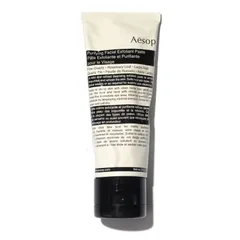
Aesop Purifying Facial Exfoliant is a deep-cleansing wash that removes dead skin cells while unblocking clogged pores that make skin appear dull to help skin look radiant but feel silken and soft.
Source: SpaceNK
This product works by removing dirt and oil from the surface of the skin. It uses a combination of mild cleansing agents (ceteareth-20, cetearyl alcohol, coconut alcohol, glyceryl stearate se, sodium cocoyl isethionate) and should be able to cleanse the skin gently. Still keep in mind that any cleansing can disrupt the skin barrier, and most people do not need to cleanse their skin more than once per day.
A non-drying alcohol. Works as an emollient. Helps water and oil mix together and creates a nice product texture
Used to stabilize the product formulations and works as an emollient
Helps water and oil mix together. Can be used as a cleansing agent
Helps oil and water mix together. Has some emollient properties
Anti-blemish
What does the product description say?
Aesop Purifying Facial Exfoliant is a deep-cleansing wash that removes dead skin cells while unblocking clogged pores that make skin appear dull to help skin look radiant but feel silken and soft.
Source: SpaceNK
Effective ingredients missing or their concentration is too low.
Helps soften the upper layer of the skin and can support skin barrier function
Exfoliation
What does the product description say?
Purifying Facial Exfoliant Paste
Source: From product name
This product does not contain effective exfoliating ingredients. It might be able to deliver physical exfoliation, that is scrub off some of the dead cells on the surface of the skin. We do not recommend physical exfoliation, because it is not uniform (some bits of skin can get exfoliated too much while others not at all). It can also traumatize the skin and aggrevate acne and other skin conditions.
An exfoliating and moisturizing alpha-hydroxy acid (AHA). Typically causes less irritation than other AHAs, for example, glycolic acid. At high concentrations (about 15%), lactic acid can help reduce lines and wrinkles. Recent studies show that lactic acid can support the "good" bacteria living on skin's surface (healthy skin microbiome)
How honest is this product?
| Promise | Can it deliver? |
|---|---|
| Cleansing | |
| Exfoliation | |
| Anti-blemish |
Total Promises Fulfilled score: 33/100.
We receive a small commission for purchases made through these links at no cost for you. Thank you for your support! Learn more
Potential irritants
Comedogenic ingredients
User reviews (0)
Averages from community submissions.
No reviews yet for this product.
Be the first to share your experience!
Tried this product?
Help capture what the ingredient list can't—texture, finish, pilling, scent, and more. Answer what you can, skip the rest.
Takes ~30 seconds.
Reviews are shown in aggregate. No personal details.
| Product | Similarity | Price | Irritancy |
|---|---|---|---|
 Aesop Purifying Facial Exfoliant Paste | Current | $57.00 | |
 Skincare Company Daily Cleanser | 51% | - | |
 Gallinée Prebiotic Soothing Cleansing Cream | 50% | ≈ $30.67 |
Key Actives
Helps soften the upper layer of the skin and can support skin barrier function
An exfoliating and moisturizing alpha-hydroxy acid (AHA). Typically causes less irritation than other AHAs, for example, glycolic acid. At high concentrations (about 15%), lactic acid can help reduce lines and wrinkles. Recent studies show that lactic acid can support the "good" bacteria living on skin's surface (healthy skin microbiome)
Used to stabilize the product formulations and works as an emollient
A non-drying alcohol. Works as an emollient. Helps water and oil mix together and creates a nice product texture
A great emollient. Contains vitamin E (tocopherol) which may give it some anti-oxidant properties. Can contain volatile compounds and can be irritating
Helps oil and water mix together. Has some emollient properties
One of the best moisturizing ingredients. Naturally present in skin. It attracts water to the upper layer of the skin working as a humectant
Helps water and oil mix together. Can be used as a cleansing agent
Potential irritants
An essential oil. Potential allergen and can be irritating. It has some anti-bacterial properties
A plant oil with high content of volatile compounds that can irritate the skin. Can be used as a fragrance. Has anti-bacterial properties and might help neutralize free radicals on the surface of the skin
A preservative. Is a frequent allergen in cosmetics
A common frangrance that can easily irritate skin, especially if exposed to air, light or heat
A great emollient. Contains vitamin E (tocopherol) which may give it some anti-oxidant properties. Can contain volatile compounds and can be irritating
Helps oil and water mix together. Has some emollient properties
Helps soften the upper layer of the skin and can support skin barrier function
Helps water and oil mix together. Can be used as a cleansing agent
An exfoliating and moisturizing alpha-hydroxy acid (AHA). Typically causes less irritation than other AHAs, for example, glycolic acid. At high concentrations (about 15%), lactic acid can help reduce lines and wrinkles. Recent studies show that lactic acid can support the "good" bacteria living on skin's surface (healthy skin microbiome)
Comedogenic ingredients
Used to stabilize the product formulations and works as an emollient
A non-drying alcohol. Works as an emollient. Helps water and oil mix together and creates a nice product texture
Helps oil and water mix together. Has some emollient properties
All ingredients
Used to stabilize the product formulations and works as an emollient
A non-drying alcohol. Works as an emollient. Helps water and oil mix together and creates a nice product texture
A great emollient. Contains vitamin E (tocopherol) which may give it some anti-oxidant properties. Can contain volatile compounds and can be irritating
Helps oil and water mix together. Has some emollient properties
One of the best moisturizing ingredients. Naturally present in skin. It attracts water to the upper layer of the skin working as a humectant
Helps soften the upper layer of the skin and can support skin barrier function
Helps water and oil mix together. Can be used as a cleansing agent
An exfoliating and moisturizing alpha-hydroxy acid (AHA). Typically causes less irritation than other AHAs, for example, glycolic acid. At high concentrations (about 15%), lactic acid can help reduce lines and wrinkles. Recent studies show that lactic acid can support the "good" bacteria living on skin's surface (healthy skin microbiome)
A preservative. It helps prevent bacterial growth in cosmetic products
An essential oil. Potential allergen and can be irritating. It has some anti-bacterial properties
A plant oil with high content of volatile compounds that can irritate the skin. Can be used as a fragrance. Has anti-bacterial properties and might help neutralize free radicals on the surface of the skin
A preservative. Is a frequent allergen in cosmetics
A common frangrance that can easily irritate skin, especially if exposed to air, light or heat
Ingredient list view
Water, Quartz, Glyceryl stearate se, Cetearyl alcohol, Rosa canina fruit oil, Ceteareth-20, Glycerin, Oenothera biennis oil, Sodium cocoyl isethionate, Lactic acid, Coconut alcohol, Ormenis multicaulis oil, Phenoxyethanol, Sodium hydroxide, Lavandula angustifolia oil, Rosmarinus officinalis leaf oil, Disodium edta, Methylchloroisothiazolinone, Methylisothiazolinone, Linalool, Limonene
- Glycerol and the skin: holistic approach to its origin and functions
- Final Report on the Safety Assessment of Sodium Cocoyl Isethionate
- Epidermal and dermal effects of topical lactic acid
- Dual Effects of Alpha-Hydroxy Acids on the Skin
- Assessment report on Rosmarinus officinalis L., aetheroleum and Rosmarinus officinalis L., folium
- Screening of plant extracts for antimicrobial activity against bacteria and yeasts with dermatological relevance
- Occupational contact dermatitis due to essential oils
- The in vitro antimicrobial activity and chemometric modelling of 59 commercial essential oils against pathogens of dermatological relevance
- Antimicrobial and Antioxidant Properties of Rosemary and Sage (Rosmarinus officinalis L. and Salvia officinalis L., Lamiaceae) Essential Oils
- Chemical Composition, Plant Genetic Differences, Antimicrobial and Antifungal Activity Investigation of the Essential Oil of Rosmarinus officinalis L.
- Methylisothiazolinone contact allergy: a review