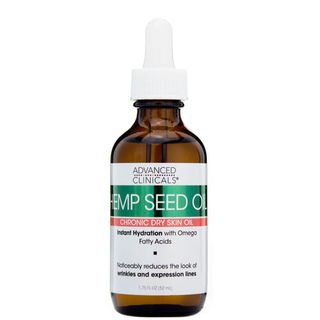
ADVANCED CLINICALS Hemp Seed Oil
Works for
1 of 3 advertised claims delivered
Moisturizing7 ingredients credited for this claimGood support
“Quantity DescriptionThe perfect anti-aging, soothing moisturizer, and it comes straight from nature.”
This product can help soften the skin and reduce its moisture loss with emollients and occlusives: caprylic/capric triglyceride, squalene.
Keep in mind that this product does not contain effective ingredients to attract water to the upper layer of the skin. This is why an additional product with humectants like glycerin or hyaluronic acid can be helpful (apply it before this product for the best results).
Anti-aging3 ingredients credited for this claimLimited support
“Quantity DescriptionThe perfect anti-aging, soothing moisturizer, and it comes straight from nature.”
This product does not contain ingredients that are able to reduce fine lines and wrinkles or help with skin elasticity, but it can improve the look of the skin temporarily through moisturization. Well-moisturized skin might also be able to repair the sun damage better.
This ingredient squalene might be able to help neutralize free radicals in skin and help it fight off some of the sun damage.
Anti-blemish3 ingredients credited for this claimLimited support
“Provides long lasting moisture while balancing oily skin to ensure your pores won’t get clogged.”
This product contains ingredients (rosmarinus officinalis leaf extract) that could help reduce blemishes and clogged pores in theory, but there is not enough evidence that they actually work.
Anti-oxidationNot advertised by the brand · 5 ingredients credited for this claimModerate support
This product contains antioxidants (squalene) that might be able to help neutralize free radicals in skin to lessen the damage it gets from the UV light (sun). There is not enough evidence to confirm their effectiveness in skin though.
Can it cause trouble?
Irritancy4 strong irritants: Rosmarinus officinalis leaf extract, Rosa damascena flower extract + 2 more — patch-test recommendedHigh risk
Comedogenic1 ingredient rated 2 or more on the 0–5 pore-clogging scale1 flagged
User reviews
Be the first — your take helps the next person decide.
Ingredients
Filter by role to see what each ingredient is doing.
Caprylic/capric triglyceride~23–34%
- Irritation risk
- Medium
A good mix of fatty acids that forms a protective layer on the skin. Improves the shelf life of products. Derived from coconut and glycerin
More about Caprylic/capric triglycerideCannabis sativa seed oil~5.5–8.2%
- Irritation risk
- Medium
A plant oil that due to its high linoleic acid content can help strengthen skin's barrier function and soften its upper layer
More about Cannabis sativa seed oilSqualene~4.8–7.2%
- Irritation risk
- Low
- Comedogenicity
- 2/5
An oil that is naturally part of skin sebum that helps to soften its upper layer, reduce water loss and neutralize free radicals. It might be comedogenic. Avoid applying large concentrations (or pure oil) before sun exposure as oxidized squalene can clog pores and lead to skin irritation. Today squalene is mostly derived from vegetable oils or synthetized by yeast
More about SqualeneOryza sativa bran extract~3.8–5.7%
Rosmarinus officinalis leaf extract~2.3–3.5%
- Irritation risk
- High
Can be helpful in reducing inflammation in skin, including inflamed acne. It can be irritating
More about Rosmarinus officinalis leaf extractHelianthus annuus extract~2.3–3.4%
- Irritation risk
- Low
Helps soften the upper layer of the skin
More about Helianthus annuus extractTocopherol~1.2–1.8%
- Irritation risk
- Low
Pure form of vitamin E. Can help moisturise and protect the skin from free radicals. Often used to help stabilise other ingredients or the formula itself
More about TocopherolRosa damascena flower extract~0.95–1.4%
Arnica montana flower extract~0.55–1.3%
- Irritation risk
- High
A plant extract that can be irritating. It can have some anti-bacterial properties, but there are no evidence of a beneficial effect for skin
More about Arnica montana flower extractCamellia sinensis leaf extract~0.4–0.9%
- Irritation risk
- Low
Can contain potent anti-oxidant compounds (abbreviated ECG, GCG, EGC, and EGCG) that might help protect the skin from free radicals. Can help calm down inflammation and has some anti-bacterial properties. Unfortunately, these antioxidants are unstable and lose their effectiveness very quickly in products. The concentration of the antioxidant compounds in the extract also tends to be low to be effective in topical formulation
More about Camellia sinensis leaf extractCentella asiatica extract~0.15–0.7%
- Irritation risk
- Medium
A plant extract that has been shown to be able to reduce inflammation in skin, support restoration of skin barrier function, as well as support collagen production. Contains active compounds called centelloids: asiaticoside, madecasosside, asiatic acid and madecassic acid. Might be helpful in preventing stretch marks. It can be itself be irritating though.
More about Centella asiatica extractSilica dimethyl silylate~0.3–0.75%
Silica~0.2–0.75%
Parfum~0.05–0.2%
- Irritation risk
- High
An aromatic blend of unspecified and possibly irritating ingredients
More about ParfumIngredient list view
Caprylic/capric triglyceride, Cannabis sativa seed oil, Squalene, Oryza sativa bran extract, Rosmarinus officinalis leaf extract, Helianthus annuus extract, Tocopherol, Rosa damascena flower extract, Arnica montana flower extract, Camellia sinensis leaf extract, Centella asiatica extract, Silica dimethyl silylate, Silica, Parfum
Compare prices
Retailers ranked by price — lowest first.

Sources cited in this review
Every concentration estimate and effectiveness label is anchored to one of these 21 studies and safety reviews.
- 1
- 2Hemp (Cannabis sativa L.) as a Resource for Green Cosmeticstandfonline.com
- 3Squalene and its potential clinical useseuropepmc.org
- 4
- 5Enhanced comedo formation in rabbit ear skin by squalene and oleic acid peroxidesonlinelibrary.wiley.com
- 6Allergic contact dermatitis induced by rosemary leaf extract in a cleansing gelpubmed.ncbi.nlm.nih.gov

Affiliate links · As an Amazon Associate, WIMJ earns from qualifying purchases.