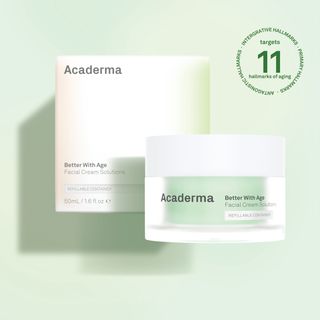
Acaderma Better With Age Revival Light Cream Pod
Works for
2 of 2 advertised claims delivered
Moisturizing25 ingredients credited for this claimStrong support
“An anti-aging and multi-tasking moisturizer that enhances skin longevity.”
This product can help improve hydration of the skin with the two types of ingredients.
The first type is called “humectants”:
these ingredients help attract water.
When humectants are on the surface of the skin, they “pull in” the moisture from the outside environment, or from
within deeper layers of the skin. The following ingredients in this product do the job:
arginine, fructose.
This product also contains ingredients called “occlusives”. They help reduce the speed with which our skin loses moisture to the outside environment. These ingredients also help soften the upper layer of the skin, so it feels less tight and nicer to the touch. The following ingredients in this product do the job: arginine, carthamus tinctorius seed oil.
The following ingredients in this product are especially good for supporting the skin barrier and helping with the hydration level: acetyl tetrapeptide-9, ceramide ap, ceramide eop, ceramide np, madecassoside, panthenol, phytosphingosine
Anti-aging7 ingredients credited for this claimModerate support
“An anti-aging and multi-tasking moisturizer that enhances skin longevity.”
This product contains acetyl tetrapeptide-9, asiaticoside, astaxanthin, centella asiatica extract, madecassoside. These ingredients might be able to help reduce and prevent fine lines and wrinkles, improve skin elasticity and firmness, but there is not enough evidence that it actually works.
Anti-oxidationNot advertised by the brand · 11 ingredients credited for this claimStrong support
This product contains antioxidants (asiaticoside, astaxanthin, madecassoside) that can help neutralize free radicals in skin. By doing so, they can lessen the damage the skin gets from the UV light (sun).
The following ingredients - centella asiatica extract also can have an antioxidant effect, but there is less evidence to confirm their effectiveness in skin.
Can it cause trouble?
Irritancy13 flagged ingredientsMedium risk
ComedogenicClean of flagged comedogenic ingredientsNone flagged

User reviews
Be the first — your take helps the next person decide.
Ingredients
Filter by role to see what each ingredient is doing.
Water~45–55%
Isododecane~5.8–7.1%
- Irritation risk
- Low
An emollient that helps soften the skin and can decrease moisture loss. Helps create a nice product texture
More about IsododecaneGlycerin~4–4.9%
- Irritation risk
- Low
One of the best moisturizing ingredients. Naturally present in skin. It attracts water to the upper layer of the skin working as a humectant
More about GlycerinLimnanthes alba seed oil~3.1–3.8%
- Irritation risk
- Low
This oil's cmposition is closest to rapeseed oil. It is a very stable oil and serves as an emoillient
More about Limnanthes alba seed oilOctyldodecanol~2.3–2.8%
- Irritation risk
- Low
An emollient that helps to soften the skin and create a pleasant product texture and stabilize the formulation
More about OctyldodecanolCetearyl olivate~1.9–2.4%
Sorbitan olivate~1.6–2%
Fructose~1.4–1.7%
- Irritation risk
- Low
Helps attract water to the upper layer of the skin
More about FructosePanthenol~1.2–1.4%
- Irritation risk
- Low
Helps attract water to the upper layer of the skin and can help improve skin barrier function
More about Panthenol1,2-hexanediol~0.7–1.05%
Alpha-glucan oligosaccharide~0.7–1.05%
- Irritation risk
- Low
Helps attract water to the upper layer of the skin
More about Alpha-glucan oligosaccharideOlea europaea leaf extract~0.5–0.8%
- Irritation risk
- Medium
A plant extract that might have some anti-oxidant and anti-inflammatory properties but evidence for effectiveness in skin is missing
More about Olea europaea leaf extractArginine~0.5–0.7%
- Irritation risk
- Low
An amino acid that is naturally present in skin and helps keep it hydrated. When used together with AHAs, it can reduce their irritating effect on the skin
More about ArgininePropanediol~0.5–0.7%
- Irritation risk
- Low
Acts as a solvent for other ingredients. Speeds up the absorption of other ingredients into the skin
More about PropanediolAcrylates/c10-30 alkyl acrylate crosspolymer~0.45–0.65%
- Irritation risk
- Medium
Maintains the texture of skincare products. Allows the product to spread evenly. Helps oil and water mix together
More about Acrylates/c10-30 alkyl acrylate crosspolymerTocopheryl acetate~0.45–0.65%
- Irritation risk
- Medium
A more stable but less bio-available form of vitamin E compared to Tocopherol. Might help moisturize and protect the skin from free radicals, but mostly used in low concentrations to stabilize other ingredients.
More about Tocopheryl acetateButylene glycol~0.4–0.6%
- Irritation risk
- Low
Used to create a nice product texture and help delivery of other ingredients. Might be somewhat helpful in attracting water to the upper layer of the skin
More about Butylene glycolMaltodextrin~0.35–0.65%
- Irritation risk
- Low
Used to stabilize the product formulation and can help absorb oil
More about MaltodextrinSilica~0.45–0.7%
Phenoxyethanol~0.3–0.55%
- Irritation risk
- Low
A preservative. It helps prevent bacterial growth in cosmetic products
More about PhenoxyethanolCombretum micranthum leaf extract~0.25–0.5%
- Irritation risk
- High
A plant extract that might have some anti-oxidant properties
More about Combretum micranthum leaf extractAcetyl tetrapeptide-9~0.25–0.45%
- Irritation risk
- Low
A type of peptide. Peptides are excellent moisturizers and might be able support collagen production reducing fine lines and wrinkles
More about Acetyl tetrapeptide-9Helianthus annuus sprout extract~0.25–0.45%
- Irritation risk
- Low
Helps soften the upper layer of the skin and can help support the skin barrier
More about Helianthus annuus sprout extractCentella asiatica extract~0.3–0.55%
- Irritation risk
- Medium
A plant extract that has been shown to be able to reduce inflammation in skin, support restoration of skin barrier function, as well as support collagen production. Contains active compounds called centelloids: asiaticoside, madecasosside, asiatic acid and madecassic acid. Might be helpful in preventing stretch marks. It can be itself be irritating though.
More about Centella asiatica extractErgothioneine~0.25–0.45%
- Irritation risk
- Low
Can help neutralize free radicals in skin. Preliminary studies show that it can be more effective than coenzyme Q10 but studies on effective concentration for topical applications are lacking
More about ErgothioneineMadecassoside~0.25–0.45%
- Irritation risk
- Medium
An antioxidant that is typically derived from plant Centella Asiatica. It can help neutralize free radicals in skin and support skin barrier function. It could, however, itself be irritating. It is often unstable in formulations
More about MadecassosideAsiaticoside~0.2–0.4%
- Irritation risk
- Medium
An active compound of Centella Asiatica plant extract. In combination with other active compounds of Centella Asiatica extract (madecasosside, asiatic acid and madecassic acid), asiaticoside has been shown to be helpful in wound-healing, restoring skin barrier function and supporting collagen production in skin. It can, however, itself be irritating
More about AsiaticosideCeramide np~0.3–0.5%
- Irritation risk
- Low
A type of lipid similar to ceramides naturally present in skin. Helps to soften the upper layer of the skin and supports the skin barrier function to keep it hydrated. Can help to prevent inflammation in skin
More about Ceramide npCeramide ap~0.25–0.5%
- Irritation risk
- Low
A type of lipid similar to ceramides naturally present in skin. Helps to soften the upper layer of the skin and supports the skin barrier function to keep it hydrated. Can help to prevent inflammation in skin
More about Ceramide apCeramide eop~0.25–0.5%
- Irritation risk
- Low
A type of lipid similar to ceramides naturally present in skin. Helps to soften the upper layer of the skin and supports the skin barrier function to keep it hydrated. Can help to prevent inflammation in skin
More about Ceramide eopAstaxanthin~0.25–0.45%
- Irritation risk
- Medium
Helps neutralize free radicals in skin and might help to calm down inflammation
More about AstaxanthinLeucojum aestivum bulb extract~0.25–0.45%
- Irritation risk
- Low
Sodium hyaluronate~0.25–0.45%
- Irritation risk
- Low
One of the best moisturizing ingredients. Attracts water into the upper layer of the skin
More about Sodium hyaluronateSodium lauroyl lactylate~0.25–0.45%
- Irritation risk
- Medium
Helps water and oil mix together
More about Sodium lauroyl lactylatePhytosphingosine~0.25–0.5%
- Irritation risk
- Low
A type of lipid that is naturally present in skin. It might help in repairing skin barrier function and has anti-bacterial effect
More about PhytosphingosineCholesterol~0.25–0.5%
- Irritation risk
- Low
An emollient that is naturally found in skin
More about CholesterolLecithin~0.25–0.5%
- Irritation risk
- Low
Used mostly for creating emulsions - helping oil and water mix together. Helps soften the upper layer of the skin
More about LecithinCarthamus tinctorius seed oil~0.25–0.45%
- Irritation risk
- Low
An emollient that helps soften the skin and might help calm down inflammation
More about Carthamus tinctorius seed oilCarbomer~0.2–0.35%
- Irritation risk
- Low
Helps create a thicker or gel-like product texture. It is not a surfactant but can be used in gentle cleansing formulations
More about CarbomerPentylene glycol~0.2–0.4%
- Irritation risk
- Medium
Used to preserve products, dissolve other ingredients and create a nice product texture
More about Pentylene glycolMannitol~0.15–0.25%
- Irritation risk
- Low
Helps to attract water to the upper layer of the skin
More about MannitolXanthan gum~0.15–0.3%
- Irritation risk
- Low
Used to create a thicker product consistency
More about Xanthan gumEthylhexylglycerin~0.15–0.25%
Tocopherol~0.1–0.2%
- Irritation risk
- Low
Pure form of vitamin E. Can help moisturise and protect the skin from free radicals. Often used to help stabilise other ingredients or the formula itself
More about TocopherolTrisodium ethylenediamine disuccinate~0.05–0.1%
- Irritation risk
- Medium
Used to improve stability of the formulation
More about Trisodium ethylenediamine disuccinateIngredient list view
Water, Isododecane, Glycerin, Limnanthes alba seed oil, Octyldodecanol, Cetearyl olivate, Sorbitan olivate, Fructose, Panthenol, 1,2-hexanediol, Alpha-glucan oligosaccharide, Unknown, Olea europaea leaf extract, Arginine, Propanediol, Acrylates/c10-30 alkyl acrylate crosspolymer, Tocopheryl acetate, Butylene glycol, Maltodextrin, Silica, Phenoxyethanol, Combretum micranthum leaf extract, Acetyl tetrapeptide-9, Helianthus annuus sprout extract, Centella asiatica extract, Ergothioneine, Madecassoside, Asiaticoside, Ceramide np, Ceramide ap, Ceramide eop, Astaxanthin, Leucojum aestivum bulb extract, Sodium hyaluronate, Sodium lauroyl lactylate, Phytosphingosine, Cholesterol, Lecithin, Carthamus tinctorius seed oil, Carbomer, Pentylene glycol, Mannitol, Xanthan gum, Ethylhexylglycerin, Tocopherol, Trisodium ethylenediamine disuccinate
Compare prices
Retailers ranked by price — lowest first.

Affiliate links · prices updated regularly
Worth comparing, line by line.
Match % combines shared ingredients, the first five ingredients, shared actives and hero ingredients, irritancy (lower counts in the alternative's favour), texture and body area. Only products in the same routine step are compared.
| AcadermaBetter With Age Revival Light Cream PodYOUR PRODUCT | YUMUCica Exosome Blemish Relief Cream | RilastilAcnestil Attiva Cream | AgencyCloud Care Weightless Whipped Moisturizer | |
|---|---|---|---|---|
| Match | — | 53% | 53% | 53% |
| Price | $72.00 | $23.99−$48.01 | $24.44−$47.56 | — |
| Shared key ingredients | — | 12 of 21 | 8 of 21 | 8 of 21 |
| Key difference | — | Niacinamide | Niacinamide | Niacinamide |
| Irritancy | Medium | Medium | Low | Low |
| Drying alcohol | — | — | — | — |
| View product | Shop | Shop | Shop |
Sources cited in this review
Every concentration estimate and effectiveness label is anchored to one of these 32 studies and safety reviews.
- 1
- 2Skin moisturizing effects of panthenol-based formulationspdfs.semanticscholar.org
- 3
- 4
- 5
- 6

Affiliate links · As an Amazon Associate, WIMJ earns from qualifying purchases.