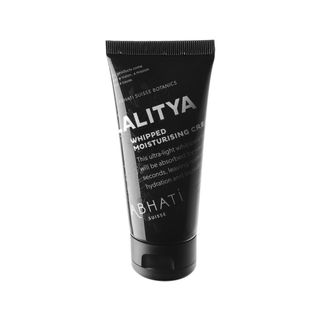
Abhati Suisse Lalitya Whipped Face Cream
Works for
1 of 3 advertised claims delivered
Moisturizing18 ingredients credited for this claimGood support
“ Abhati Suisse Lalitya Whipped Face Cream is a rich yet lightweight moisturizer that leaves your skin hydrated and dewy.”
This product can help improve hydration of the skin with the two types of ingredients.
The first type is called “humectants”:
these ingredients help attract water.
When humectants are on the surface of the skin, they “pull in” the moisture from the outside environment, or from
within deeper layers of the skin. The following ingredients in this product do the job:
glycerin, saccharide isomerate.
This product also contains ingredients called “occlusives”. They help reduce the speed with which our skin loses moisture to the outside environment. These ingredients also help soften the upper layer of the skin, so it feels less tight and nicer to the touch. The following ingredients in this product do the job: butyrospermum parkii butter, caprylic/capric triglyceride.
Anti-aging4 ingredients credited for this claimLimited support
“Wild Cherry Oil is similar to a natural form of retinol which helps to improve the appearance of fine lines and uneven skin tone.”
This product does not contain ingredients that are able to reduce fine lines and wrinkles or help with skin elasticity, but it can improve the look of the skin temporarily through moisturization. Well-moisturized skin might also be able to repair the sun damage better.This ingredient - butyrospermum parkii butter - could be helpful for preventing or repairing signs of aging in theory, but there is no evidence that it actually works.
Evens skin tone2 ingredients credited for this claimWeak support
“Wild Cherry Oil is similar to a natural form of retinol which helps to improve the appearance of fine lines and uneven skin tone.”
Effective ingredients missing or their concentration is too low
Can it cause trouble?
Irritancy6 strong irritants: Limonene, Linalool + 4 more — patch-test recommendedHigh risk
Comedogenic5 ingredients rated 2 or more on the 0–5 pore-clogging scale5 flagged
User reviews
Be the first — your take helps the next person decide.
Ingredients
Filter by role to see what each ingredient is doing.
Water~45–55%
Pentylene glycol~5.6–6.8%
- Irritation risk
- Medium
Used to preserve products, dissolve other ingredients and create a nice product texture
More about Pentylene glycolGlycerin~4–4.8%
- Irritation risk
- Low
One of the best moisturizing ingredients. Naturally present in skin. It attracts water to the upper layer of the skin working as a humectant
More about GlycerinCaprylic/capric triglyceride~3.2–3.9%
- Irritation risk
- Medium
A good mix of fatty acids that forms a protective layer on the skin. Improves the shelf life of products. Derived from coconut and glycerin
More about Caprylic/capric triglycerideJojoba esters~2.4–2.9%
- Irritation risk
- Medium
An emollient made of jojoba oil. Helps soften the skin and support its barrier function
More about Jojoba estersButyrospermum parkii butter~2–2.5%
- Irritation risk
- Low
- Comedogenicity
- 3/5
A great moisturising ingredient that softens the skin and reduces water loss from its upper layer. It also can be helpful in protecting skin from free radicals
More about Butyrospermum parkii butterCetyl alcohol~1.7–2%
- Irritation risk
- Low
A non-drying alcohol that works to soften the skin and stabilize product formulations helping oil and water mix together
More about Cetyl alcoholCocos nucifera oil~1.5–1.8%
- Irritation risk
- Low
- Comedogenicity
- 3/5
An emollient. Found to be as effective as a moisturizer for dry skin as mineral oil. Could be comedogenic
More about Cocos nucifera oilMoringa oleifera seed oil~1.2–1.5%
- Irritation risk
- Medium
A plant oil that helps soften the upper layer of the skin. Is unlikely to be helpful in restoring skin barrier function due to the low content of linoleic acid
More about Moringa oleifera seed oilMyristyl myristate~1.1–1.3%
- Irritation risk
- Medium
- Comedogenicity
- 3/5
An emollient. Is not recommended for acne-prone skin as it can be comedogenic
More about Myristyl myristateSaccharide isomerate~0.7–1.05%
- Irritation risk
- Low
Helps attract water to the upper layer of the skin
More about Saccharide isomerateStearyl alcohol~0.7–1.05%
- Irritation risk
- Low
An emollient that helps soften the skin
More about Stearyl alcoholOlea europaea leaf extract~0.5–0.75%
- Irritation risk
- Medium
A plant extract that might have some anti-oxidant and anti-inflammatory properties but evidence for effectiveness in skin is missing
More about Olea europaea leaf extractPrinsepia utilis seed oil~0.55–0.85%
- Irritation risk
- Low
Dioscorea villosa root extract~0.45–0.7%
- Irritation risk
- Low
Chondrus crispus powder~0.6–0.95%
- Irritation risk
- Low
- Comedogenicity
- 3/5
A powder from red algae extract that helps attract water to the upper layer of the skin and create a nicer product consistency
More about Chondrus crispus powderLeontopodium alpinum extract~0.45–0.65%
- Irritation risk
- Low
Phyllanthus emblica fruit extract~0.4–0.65%
- Irritation risk
- Medium
A plant extract that might be helpful in neutralizing free radicals and have a skin lightening effect if used in high enough concentrations
More about Phyllanthus emblica fruit extractCurcuma longa root extract~0.35–0.6%
- Irritation risk
- High
A plant extract that can contain an active compound curcumin, that may have some anti-inflammatory properties when applied to the skin, but solid research is lacking and the typical concentration used in skincare products is too low. Can be an irritant
More about Curcuma longa root extractHelianthus annuus seed oil~0.4–0.6%
- Irritation risk
- Low
A great emollient due to its high linoleic acid content. One of the most effective plant oils in helping skin hydration and repairing skin barrier function
More about Helianthus annuus seed oilTocopheryl acetate~0.3–0.6%
- Irritation risk
- Medium
A more stable but less bio-available form of vitamin E compared to Tocopherol. Might help moisturize and protect the skin from free radicals, but mostly used in low concentrations to stabilize other ingredients.
More about Tocopheryl acetateBisabolol~0.25–0.5%
- Irritation risk
- Low
An active component of chamomile plant that historically has been used to calm down irritated skin. A recent study shows that bisabolol indeed can have some anti-inflammatory effect on skin, even though conclusive data is lacking. Bisabolol has a sweet floral scent and can be added to products for its aromatic properties
More about BisabololTocopherol~0.3–0.55%
- Irritation risk
- Low
Pure form of vitamin E. Can help moisturise and protect the skin from free radicals. Often used to help stabilise other ingredients or the formula itself
More about TocopherolGlycine soja oil~0.3–0.55%
- Irritation risk
- Medium
- Comedogenicity
- 2/5
A good emollient that helps soften the skin and helps repair its barrier function. It can clog pores if used in high concentrations.
More about Glycine soja oilXanthan gum~0.3–0.55%
- Irritation risk
- Low
Used to create a thicker product consistency
More about Xanthan gumPalmitic acid~0.35–0.6%
- Irritation risk
- Low
An emollient that is naturally present in skin and helps soften it
More about Palmitic acidLactic acid~0.25–0.5%
- Irritation risk
- Medium
An exfoliating and moisturizing alpha-hydroxy acid (AHA). Typically causes less irritation than other AHAs, for example, glycolic acid. At high concentrations (about 15%), lactic acid can help reduce lines and wrinkles. Recent studies show that lactic acid can support the "good" bacteria living on skin's surface (healthy skin microbiome)
More about Lactic acidStearic acid~0.4–0.65%
- Irritation risk
- Low
Helps oil and water mix together and works as an emollient
More about Stearic acidGlycine soja sterols~0.3–0.55%
- Irritation risk
- Low
An emollient that helps soften the skin
More about Glycine soja sterolsCitric acid~0.25–0.45%
- Irritation risk
- Medium
Can work as an exfoliant but is typically used to adjust the product pH
More about Citric acidLimonene~0.2–0.4%
- Irritation risk
- High
A common frangrance that can easily irritate skin, especially if exposed to air, light or heat
More about LimoneneLinalool~0.2–0.35%
Sodium citrate~0.2–0.35%
- Irritation risk
- Medium
Helps to control the skin's pH level. Maintains the skin's natural film of amino-lactic acids and oils. Helps to preserve products
More about Sodium citrateCitronellol~0.15–0.25%
Geraniol~0.1–0.2%
Parfum~0.1–0.2%
- Irritation risk
- High
An aromatic blend of unspecified and possibly irritating ingredients
More about ParfumSodium benzoate~0.1–0.2%
Citral~0.05–0.15%
Potassium sorbate~0.1–0.2%
Ingredient list view
Water, Pentylene glycol, Glycerin, Caprylic/capric triglyceride, Jojoba esters, Butyrospermum parkii butter, Cetyl alcohol, Cocos nucifera oil, Moringa oleifera seed oil, Myristyl myristate, Saccharide isomerate, Stearyl alcohol, Olea europaea leaf extract, Prinsepia utilis seed oil, Dioscorea villosa root extract, Chondrus crispus powder, Leontopodium alpinum extract, Phyllanthus emblica fruit extract, Curcuma longa root extract, Helianthus annuus seed oil, Tocopheryl acetate, Bisabolol, Tocopherol, Glycine soja oil, Xanthan gum, Palmitic acid, Lactic acid, Stearic acid, Glycine soja sterols, Citric acid, Limonene, Linalool, Sodium citrate, Citronellol, Geraniol, Parfum, Sodium benzoate, Citral, Potassium sorbate
Compare prices
Retailers ranked by price — lowest first.
Affiliate links · prices updated regularly · As an Amazon Associate, WIMJ earns from qualifying purchases.
Worth comparing, line by line.
Match % combines shared ingredients, the first five ingredients, shared actives and hero ingredients, irritancy (lower counts in the alternative's favour), texture and body area. Only products in the same routine step are compared.
| Abhati SuisseLalitya Whipped Face CreamYOUR PRODUCT | Maria ÅkerbergFace Cream Sensitive | January LabsRetexturizing Night Cream | Medik8Advanced Night Restore Cream | |
|---|---|---|---|---|
| Match | — | 55% | 55% | 53% |
| Price | $39.90 | — | $86.00+$46.10 | — |
| Shared key ingredients | — | 3 of 14 | 4 of 14 | 3 of 14 |
| Key difference | — | Beeswax | Niacinamide | Ferric Hexapeptide-35 |
| Irritancy | High | Medium | Medium | High |
| Drying alcohol | — | — | — | — |
| View product | Shop | Shop | Shop |


Sources cited in this review
Every concentration estimate and effectiveness label is anchored to one of these 18 studies and safety reviews.
- 1
- 2
- 3
- 4
- 5Emblicamdedge.com
- 6

Affiliate links · As an Amazon Associate, WIMJ earns from qualifying purchases.