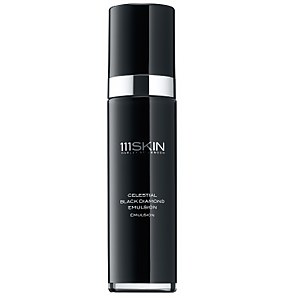
111SKIN Celestial Black Diamond Emulsion
Works for
1 of 3 advertised claims delivered
Moisturizing12 ingredients credited for this claimStrong support
“Hyaluronic Acid equips the skin with a nurturing burst of hydration, promoting a smooth and supple finish in its wake.”
This product can help improve hydration of the skin with the two types of ingredients.
The first type is called “humectants”:
these ingredients help attract water.
When humectants are on the surface of the skin, they “pull in” the moisture from the outside environment, or from
within deeper layers of the skin. The following ingredients in this product do the job:
glycerin, sodium hyaluronate.
This product also contains ingredients called “occlusives”. They help reduce the speed with which our skin loses moisture to the outside environment. These ingredients also help soften the upper layer of the skin, so it feels less tight and nicer to the touch. The following ingredients in this product do the job: isopropyl myristate, prunus armeniaca kernel oil.
The following ingredients in this product are especially good for supporting the skin barrier and helping with the hydration level: linoleic acid
Evens skin tone2 ingredients credited for this claimLimited support
“Liquorice Root targets pigmentation issues, helping to balance areas of discolouration for a more unified complexion.”
This product contains ingredients (glycyrrhiza glabra root extract) that could help reduce hyperpigmentation (for example, post-acne marks or age spots) in theory, but there is not enough evidence that they actually work.
Anti-aging4 ingredients credited for this claimLimited support
“Designed for oilier skin types, or those who prefer a lightweight day moisturiser, this face cream works to reduce the appearance of fine lines and wrinkles while enhancing resilience in the skin.”
This product does not contain ingredients that are able to reduce fine lines and wrinkles or help with skin elasticity, but it can improve the look of the skin temporarily through moisturization. Well-moisturized skin might also be able to repair the sun damage better.
Can it cause trouble?
Irritancy2 strong irritants: Retinyl palmitate, ParfumMedium risk
Comedogenic1 ingredient rated 2 or more on the 0–5 pore-clogging scale1 flagged


User reviews
Be the first — your take helps the next person decide.
Ingredients
Filter by role to see what each ingredient is doing.
Water~40–60%
Isopropyl myristate~4.9–7.3%
- Irritation risk
- Low
- Comedogenicity
- 3/5
An emollient that helps soften the skin. Could be comedogenic
More about Isopropyl myristateHydrogenated palm oil~3.4–5.2%
- Irritation risk
- Low
Helps soften the upper layer of the skin
More about Hydrogenated palm oilStearic acid~2.5–3.8%
- Irritation risk
- Low
Helps oil and water mix together and works as an emollient
More about Stearic acidGlycerin~2.1–3.2%
- Irritation risk
- Low
One of the best moisturizing ingredients. Naturally present in skin. It attracts water to the upper layer of the skin working as a humectant
More about GlycerinAesculus hippocastanum extract~1.8–2.6%
- Irritation risk
- High
A plant extract. Benefits of topical application are not confirmed
More about Aesculus hippocastanum extractGlyceryl stearate~1.4–2.2%
- Irritation risk
- Low
An emollient that softens the skin and forms a protective layer on its surface. Helps water and oil mix together
More about Glyceryl stearateAloe barbadensis extract~1.2–1.8%
- Irritation risk
- Medium
Traditionally used to treat sunburns, dermatitis and inflammation, but evidence for its effectiveness is lacking. The extract can contain humectants that help attract water into the skin
More about Aloe barbadensis extractSodium hyaluronate~1–1.5%
- Irritation risk
- Low
One of the best moisturizing ingredients. Attracts water into the upper layer of the skin
More about Sodium hyaluronateBenzyl alcohol~0.5–1%
- Irritation risk
- High
A preservative. Can be used to mask unpleasant smell. Can be irritating
More about Benzyl alcoholGlycyrrhiza glabra root extract~0.4–0.9%
- Irritation risk
- Medium
A plant extract that can help lighten the skin and calm down inflammation. Might be helpful in neutralizing free radicals
More about Glycyrrhiza glabra root extractPrunus armeniaca kernel oil~0.45–1%
- Irritation risk
- Medium
An emollient that helps soften the skin
More about Prunus armeniaca kernel oilPolysorbate 20~0.35–0.85%
Sodium hydroxide~0.35–0.75%
Xanthan gum~0.2–0.75%
- Irritation risk
- Low
Used to create a thicker product consistency
More about Xanthan gumSodium ascorbyl phosphate~0.15–0.65%
- Irritation risk
- Medium
A stable derivative of vitamin C. It is oil-soluble which means it is more likely to penetrate the skin compared to the pure form of vitamin C (which is water-soluble), but it is less bio-available and is way less effective in stimulating collagen and reducing wrinkles compared to the pure form of vitamin C (L-ascorbic acid) and its other derivatives (for example, magnesium ascorbyl phosphate). At the same time, this vitamin C derivative has been shown in studies to be effective in reducing acne, blemishes and clogged pores. It is less irritating then the pure form of vitamin C
More about Sodium ascorbyl phosphateVitis vinifera seed oil~0.15–0.65%
- Irritation risk
- Medium
A great emollient that can also have anti-oxidant properties
More about Vitis vinifera seed oilRetinyl palmitate~0.1–0.4%
- Irritation risk
- High
Three steps removed from the active form of vitamin A - retinoic acid. To have an effect in the skin, it first needs to be converted twice to become the retinoic acid. This means it is less potent than retinol, but could also be less irritating. Once converted to the retinoic acid in the skin, it helps against all signs of aging, improves skin cell turnover and helps fight blemishes and clogged pores. However, in many cosmetic formulations, it is used in a concentration that is too low to have the full effect
More about Retinyl palmitateTocopherol~0.1–0.4%
- Irritation risk
- Low
Pure form of vitamin E. Can help moisturise and protect the skin from free radicals. Often used to help stabilise other ingredients or the formula itself
More about TocopherolLinoleic acid~0.15–0.6%
- Irritation risk
- Low
An excellent emollient. Helps soften the skin, restore its barrier function, and can help to calm down inflammation. It can be helpful to prevent blemishes and clogged pores
More about Linoleic acidCentella asiatica extract~0.1–0.45%
- Irritation risk
- Medium
A plant extract that has been shown to be able to reduce inflammation in skin, support restoration of skin barrier function, as well as support collagen production. Contains active compounds called centelloids: asiaticoside, madecasosside, asiatic acid and madecassic acid. Might be helpful in preventing stretch marks. It can be itself be irritating though.
More about Centella asiatica extractAcetyl cysteine~0.05–0.2%
- Irritation risk
- Low
Diamond powder~0.1–0.35%
- Irritation risk
- Low
Does not have known skin benefits. Might help create an optical illusion of smoother skin
More about Diamond powderParfum~0.01–0.05%
- Irritation risk
- High
An aromatic blend of unspecified and possibly irritating ingredients
More about ParfumIngredient list view
Water, Isopropyl myristate, Hydrogenated palm oil, Stearic acid, Glycerin, Aesculus hippocastanum extract, Glyceryl stearate, Aloe barbadensis extract, Sodium hyaluronate, Benzyl alcohol, Glycyrrhiza glabra root extract, Prunus armeniaca kernel oil, Polysorbate 20, Sodium hydroxide, Xanthan gum, Sodium ascorbyl phosphate, Vitis vinifera seed oil, Retinyl palmitate, Tocopherol, Linoleic acid, Centella asiatica extract, Acetyl cysteine, Diamond powder, Parfum
Compare prices
Retailers ranked by price — lowest first.


Worth comparing, line by line.
Match % combines shared ingredients, the first five ingredients, shared actives and hero ingredients, irritancy (lower counts in the alternative's favour), texture and body area. Only products in the same routine step are compared.
| 111SKINCelestial Black Diamond EmulsionYOUR PRODUCT | UltraceuticalsLIMITED EDITION SIZE Ultra Moisturiser Cream | PanOxylPM Balancing Repair Moisturizer | BeautyStatUniversal Pro-Bio Moisture Boost Cream | |
|---|---|---|---|---|
| Match | — | 53% | 52% | 52% |
| Price | $549.99 | $144.00−$405.99 | $9.44−$540.55 | $50.00−$499.99 |
| Shared key ingredients | — | 3 of 8 | 3 of 8 | 3 of 8 |
| Key difference | — | Urea | Niacinamide | Ceramide 2 |
| Irritancy | Medium | Low | Low | Low |
| Drying alcohol | — | — | — | — |
| View product | Shop | Shop | Shop |


Sources cited in this review
Every concentration estimate and effectiveness label is anchored to one of these 22 studies and safety reviews.
- 1
- 2Contact dermatitis to extract of horse chestnut (esculin)pubmed.ncbi.nlm.nih.gov
- 3Hyaluronic acid: A key molecule in skin agingncbi.nlm.nih.gov
- 4
- 5
- 6Sodium ascorbyl phosphate in topical microemulsionssciencedirect.com

Affiliate links · As an Amazon Associate, WIMJ earns from qualifying purchases.