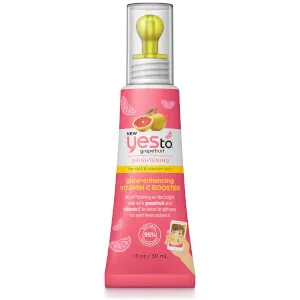
Yes to Grapefruit Glow Enhancing Vitamin C Booster

Yes to Grapefruit Glow Enhancing Vitamin C Booster

Efficacy0/100IrritancyHigh

Works for

Evens skin tone
No ingredient credited for this claim
Not delivered
What the product description says
“Infused with Grapefruit and Vitamin C, the antioxidant-rich booster combats dullness and uneven skin tone to promote a brighter, smoother visage with a health glow.”
Source: Mankind

Effective ingredients missing or their concentration is too low

Anti-oxidation
Side benefit · Sodium ascorbyl phosphate, Ficus carica fruit extract + 2 more
May help

This product contains antioxidants (ficus carica fruit extract, sodium ascorbyl phosphate) that can help neutralize free radicals in skin to lessen the damage it gets from the UV light (sun). There is some human evidence for this effect in skin, though it is smaller or less consistent than the evidence for the best antioxidants.

Sodium ascorbyl phosphateKey activeEffect: MediumA stable derivative of vitamin C. It is oil-soluble which means it is more likely to penetrate the skin compared to the pure form of vitamin C (which is water-soluble), but it is less bio-available and is way less effective in stimulating collagen and reducing wrinkles compared to the pure form of vitamin C (L-ascorbic acid) and its other derivatives (for example, magnesium ascorbyl phosphate). At the same time, this vitamin C derivative has been shown in studies to be effective in reducing acne, blemishes and clogged pores. It is less irritating then the pure form of vitamin C~7.5–11.3%
Ficus carica fruit extractKey activeEffect: MediumA plant extract that can help neutralize free radicals. The concentrations typically used in cosmetics are too small to have an effect~0.95–1.45%
Punica granatum fruit extractEffect: LowA fruit extract that is used to add a fragrance to the product. It might have some antioxidant properties~0.4–0.9%
Tocopheryl acetateEffect: Low, below effective doseA more stable but less bio-available form of vitamin E compared to Tocopherol. Might help moisturize and protect the skin from free radicals, but mostly used in low concentrations to stabilize other ingredients.~0.35–0.8%
Moisturizing
Side benefit · Glycerin, Aloe barbadensis leaf juice
Works

This product contains good ingredients to attract water to the upper layer of the skin. These ingredients are called "humectants": glycerin, aloe barbadensis leaf juice.

When humectants are on the surface of the skin, they “pull in” the moisture from the outside environment, or from within deeper layers of the skin. If the air is dry, humectants can speed up the moisture loss from the skin. This is why it is a good idea to use another product on top of this one to help "seal in" the moisture (look for ingredients like dimethicone, squalane, oils and butters).

GlycerinKey active· HumectantEffect: HighOne of the best moisturizing ingredients. Naturally present in skin. It attracts water to the upper layer of the skin working as a humectant~2.8–4.2%
Aloe barbadensis leaf juice· HumectantEffect: LowTraditionally used to treat sunburns, dermatitis and inflammation, but evidence for its effectiveness is lacking. The extract can contain humectants that help attract water into the skin~4.1–6.1%
Anti-blemish
Side benefit · Sodium ascorbyl phosphate, Aloe barbadensis leaf juice
May help

This product might be able to help reduce blemishes and clogged pores because it contains sodium ascorbyl phosphate.

Sodium ascorbyl phosphateKey activeEffect: HighA stable derivative of vitamin C. It is oil-soluble which means it is more likely to penetrate the skin compared to the pure form of vitamin C (which is water-soluble), but it is less bio-available and is way less effective in stimulating collagen and reducing wrinkles compared to the pure form of vitamin C (L-ascorbic acid) and its other derivatives (for example, magnesium ascorbyl phosphate). At the same time, this vitamin C derivative has been shown in studies to be effective in reducing acne, blemishes and clogged pores. It is less irritating then the pure form of vitamin C~7.5–11.3%
Aloe barbadensis leaf juiceEffect: LowTraditionally used to treat sunburns, dermatitis and inflammation, but evidence for its effectiveness is lacking. The extract can contain humectants that help attract water into the skin~4.1–6.1%

Can it cause trouble?

Irritancy
4 strong irritants: Citrus grandis seed extract, Parfum + 2 more — patch-test recommended
High risk
We flagged 12 ingredients with irritancy potential. Severity depends on your sensitivity threshold; the table lists the worst offenders first.
IngredientFunctionIrritationEst. amount
Decyl glucosideHelps oil and water mix together. Can be irritatingHigh~1.9–2.8%est.
Citrus grandis seed extract—High~1.2–1.8%est.
Punica granatum fruit extractA fruit extract that is used to add a fragrance to the product. It might have some antioxidant propertiesHigh~0.4–0.9%est.
ParfumAn aromatic blend of unspecified and possibly irritating ingredientsHigh~0.05–0.25%est.
CitralA fragrance with a lemon scent. A likely irritantHigh~0.05–0.15%est.
LimoneneA common frangrance that can easily irritate skin, especially if exposed to air, light or heatHigh~0.05–0.1%est.
Sodium ascorbyl phosphateA stable derivative of vitamin C. It is oil-soluble which means it is more likely to penetrate the skin compared to the pure form of vitamin C (which is water-soluble), but it is less bio-available and is way less effective in stimulating collagen and reducing wrinkles compared to the pure form of vitamin C (L-ascorbic acid) and its other derivatives (for example, magnesium ascorbyl phosphate). At the same time, this vitamin C derivative has been shown in studies to be effective in reducing acne, blemishes and clogged pores. It is less irritating then the pure form of vitamin CMedium~7.5–11.3%est.
Aloe barbadensis leaf juiceTraditionally used to treat sunburns, dermatitis and inflammation, but evidence for its effectiveness is lacking. The extract can contain humectants that help attract water into the skinMedium~4.1–6.1%est.
Ficus carica fruit extractA plant extract that can help neutralize free radicals. The concentrations typically used in cosmetics are too small to have an effectMedium~0.95–1.45%est.
Tocopheryl acetateA more stable but less bio-available form of vitamin E compared to Tocopherol. Might help moisturize and protect the skin from free radicals, but mostly used in low concentrations to stabilize other ingredients.Medium~0.35–0.8%est.
Ceratonia siliqua gumUsed to stabilize product formulations and create thicker consistencyMedium~0.35–0.8%est.
Caprylhydroxamic acidA preservativeMedium~0.1–0.4%est.
Comedogenic
Clean of flagged comedogenic ingredients
None flagged

User reviews

Would you recommend?
No community reviews yet.

Be the first — your take helps the next person decide.

Ingredients

Filter by role to see what each ingredient is doing.

Water~40–60%
Formula
Irritation risk
Low

Plain old water

More about Water
Sodium ascorbyl phosphate~7.5–11.3%
Key activeIrritant · medium
Irritation risk
Medium
Works for
Anti-blemishAnti-oxidationAnti-aging

A stable derivative of vitamin C. It is oil-soluble which means it is more likely to penetrate the skin compared to the pure form of vitamin C (which is water-soluble), but it is less bio-available and is way less effective in stimulating collagen and reducing wrinkles compared to the pure form of vitamin C (L-ascorbic acid) and its other derivatives (for example, magnesium ascorbyl phosphate). At the same time, this vitamin C derivative has been shown in studies to be effective in reducing acne, blemishes and clogged pores. It is less irritating then the pure form of vitamin C

More about Sodium ascorbyl phosphate
Aloe barbadensis leaf juice~4.1–6.1%
Irritant · medium
Irritation risk
Medium
Works for
MoisturizingReduces rednessAntibacterialReduces irritationAnti-inflammatoryAnti-blemishAnti-aging

Traditionally used to treat sunburns, dermatitis and inflammation, but evidence for its effectiveness is lacking. The extract can contain humectants that help attract water into the skin

More about Aloe barbadensis leaf juice
Glycerin~2.8–4.2%
Key active
Irritation risk
Low
Works for
Moisturizing

One of the best moisturizing ingredients. Naturally present in skin. It attracts water to the upper layer of the skin working as a humectant

More about Glycerin
Propanediol~2–3.1%
Formula
Irritation risk
Low

Acts as a solvent for other ingredients. Speeds up the absorption of other ingredients into the skin

More about Propanediol
Decyl glucoside~1.9–2.8%
Irritant · high
Irritation risk
High
Works for
Cleansing

Helps oil and water mix together. Can be irritating

More about Decyl glucoside
Citrus grandis seed extract~1.2–1.8%
Irritant · high
Maltodextrin~1.1–1.7%
Formula
Irritation risk
Low
Works for
Mattifying

Used to stabilize the product formulation and can help absorb oil

More about Maltodextrin
Ficus carica fruit extract~0.95–1.45%
Key activeIrritant · medium
Irritation risk
Medium
Works for
Anti-oxidation

A plant extract that can help neutralize free radicals. The concentrations typically used in cosmetics are too small to have an effect

More about Ficus carica fruit extract
Ginkgo biloba nut extract~0.8–1.2%
Formula
Morus alba fruit extract~0.5–1.15%
Formula
Punica granatum fruit extract~0.4–0.9%
Irritant · high
Irritation risk
High
Works for
Anti-oxidation

A fruit extract that is used to add a fragrance to the product. It might have some antioxidant properties

More about Punica granatum fruit extract
Tocopheryl acetate~0.35–0.8%
Irritant · medium
Irritation risk
Medium
Works for
Anti-oxidation

A more stable but less bio-available form of vitamin E compared to Tocopherol. Might help moisturize and protect the skin from free radicals, but mostly used in low concentrations to stabilize other ingredients.

More about Tocopheryl acetate
Ceratonia siliqua gum~0.35–0.8%
Irritant · medium
Irritation risk
Medium

Used to stabilize product formulations and create thicker consistency

More about Ceratonia siliqua gum
Xanthan gum~0.15–0.6%
Formula
Irritation risk
Low
Works for
Cleansing

Used to create a thicker product consistency

More about Xanthan gum
Caprylhydroxamic acid~0.1–0.4%
Irritant · medium
Irritation risk
Medium

A preservative

More about Caprylhydroxamic acid
Parfum~0.05–0.25%
Irritant · high
Irritation risk
High

An aromatic blend of unspecified and possibly irritating ingredients

More about Parfum
Citral~0.05–0.15%
Irritant · high
Irritation risk
High

A fragrance with a lemon scent. A likely irritant

More about Citral
Limonene~0.05–0.1%
Irritant · high
Irritation risk
High

A common frangrance that can easily irritate skin, especially if exposed to air, light or heat

More about Limonene
Vitamin c
Not recognized
Ingredient list view

Water, Sodium ascorbyl phosphate, Aloe barbadensis leaf juice, Glycerin, Propanediol, Decyl glucoside, Citrus grandis seed extract, Maltodextrin, Ficus carica fruit extract, Ginkgo biloba nut extract, Morus alba fruit extract, Punica granatum fruit extract, Tocopheryl acetate, Ceratonia siliqua gum, Xanthan gum, Caprylhydroxamic acid, Parfum, Citral, Limonene, Unknown

Compare prices

Retailers ranked by price — lowest first.

🇬🇧 Lookfantastic (UK)30 ml
≈ $13.21
Buy
🇬🇧 Mankind (UK)30 ml
≈ $13.21
Buy
🇬🇧 Beauty Bay (UK)
Price unavailable
Check

Affiliate links · As an Amazon Associate, WIMJ earns from qualifying purchases.

Cheaper alternatives? See how this stacks up against similar formulas.
We compare ingredient profiles across our catalog — pick the closest match for your budget.
Open dupe finder
Yes to Grapefruit Glow Enhancing Vitamin C Booster
Yes toGrapefruit Glow Enhancing Vitamin C Booster

Affiliate links · As an Amazon Associate, WIMJ earns from qualifying purchases.

As an Amazon Associate, WIMJ earns from qualifying purchases.