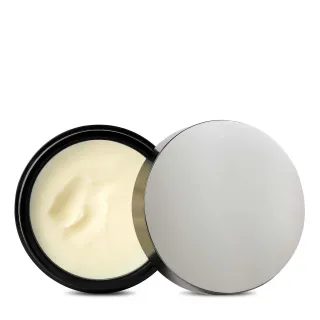
Perricone MD Cold Plasma Plus + The Intensive Hydrating Body Balm
Works for
1 of 1 advertised claim delivered
Moisturizing16 ingredients credited for this claimStrong support
“This multi-tasking powerhouse intensely moisturizes and conditions dry, damaged skin using a proprietary liquid crystal delivery system for faster and effective absorption of key ingredients into skin's surface.”
This product can help soften the skin and reduce its moisture loss with emollients and occlusives: butyrospermum parkii butter, helianthus annuus seed oil.
Keep in mind that this product does not contain effective ingredients to attract water to the upper layer of the skin. This is why an additional product with humectants like glycerin or hyaluronic acid can be helpful (apply it before this product for the best results).
The following ingredients in this product are especially good for supporting the skin barrier and helping with the hydration level: ceramide np, copper tripeptide-1
Anti-agingNot advertised by the brand · 4 ingredients credited for this claimModerate support
This product contains copper tripeptide-1. This ingredient might be able to help reduce and prevent fine lines and wrinkles, improve skin elasticity and firmness, but there is not enough evidence that it actually works.
Can it cause trouble?
Irritancy6 strong irritants: Parfum, Rosmarinus officinalis leaf extract + 4 more — patch-test recommendedHigh risk
Comedogenic2 ingredients rated 2 or more on the 0–5 pore-clogging scale2 flagged
User reviews
Be the first — your take helps the next person decide.
Ingredients
Filter by role to see what each ingredient is doing.
Butyrospermum parkii butter~22–34%
- Irritation risk
- Low
- Comedogenicity
- 3/5
A great moisturising ingredient that softens the skin and reduces water loss from its upper layer. It also can be helpful in protecting skin from free radicals
More about Butyrospermum parkii butterShea butter ethyl esters~4.8–7.2%
- Irritation risk
- Low
Helps soften the upper layer of the skin
More about Shea butter ethyl estersHelianthus annuus seed wax~4.4–6.7%
- Irritation risk
- Low
Helps soften the upper layer of the skin and support skin's barrier function while creating a thicker product consistency
More about Helianthus annuus seed waxGarcinia indica seed butter~3.7–5.5%
- Irritation risk
- Low
Helps soften the upper layer of the skin. It mostly contains oleic acid which is not the most effective emollient to prevent water loss, but might have an anti-inflammatory effect
More about Garcinia indica seed butterCucurbita pepo seed oil~2.9–4.3%
- Irritation risk
- Low
Helps soften the upper layer of the skin
More about Cucurbita pepo seed oilLinum usitatissimum seed oil~1.9–2.9%
Mangifera indica seed butter~1.6–2.3%
- Irritation risk
- Low
Helps to soften the upper layer of the skin and might have some anti-oxidant effect
More about Mangifera indica seed butterMoringa oleifera seed oil~1.4–2.1%
- Irritation risk
- Medium
A plant oil that helps soften the upper layer of the skin. Is unlikely to be helpful in restoring skin barrier function due to the low content of linoleic acid
More about Moringa oleifera seed oilSalvia hispanica seed oil~1.2–1.8%
- Irritation risk
- Low
Chia seed oil. Helps to soften the upper layer of the skin and might be helpful in repairing skin barrier
More about Salvia hispanica seed oilHelianthus annuus seed oil~1–1.5%
- Irritation risk
- Low
A great emollient due to its high linoleic acid content. One of the most effective plant oils in helping skin hydration and repairing skin barrier function
More about Helianthus annuus seed oilGlyceryl caprate~0.9–1.3%
- Irritation risk
- Low
Tocopherol~0.5–1.2%
- Irritation risk
- Low
Pure form of vitamin E. Can help moisturise and protect the skin from free radicals. Often used to help stabilise other ingredients or the formula itself
More about TocopherolCeramide np~0.55–1.25%
- Irritation risk
- Low
A type of lipid similar to ceramides naturally present in skin. Helps to soften the upper layer of the skin and supports the skin barrier function to keep it hydrated. Can help to prevent inflammation in skin
More about Ceramide npParfum~0.45–1%
- Irritation risk
- High
An aromatic blend of unspecified and possibly irritating ingredients
More about ParfumGlyceryl undecylenate~0.5–1.15%
- Irritation risk
- Medium
Helps oil and water mix together and helps preserve the product formulation
More about Glyceryl undecylenatePhosphatidylcholine~0.45–1.05%
- Irritation risk
- Medium
Used to enhance the delivery of other ingredients
More about PhosphatidylcholineRosmarinus officinalis leaf extract~0.4–0.9%
- Irritation risk
- High
Can be helpful in reducing inflammation in skin, including inflamed acne. It can be irritating
More about Rosmarinus officinalis leaf extractGlycine soja oil~0.4–0.95%
- Irritation risk
- Medium
- Comedogenicity
- 2/5
A good emollient that helps soften the skin and helps repair its barrier function. It can clog pores if used in high concentrations.
More about Glycine soja oilTheobroma grandiflorum seed butter~0.35–0.8%
- Irritation risk
- Medium
Helps soften the upper layer of the skin and might as well help to attract moisture to its upper layer
More about Theobroma grandiflorum seed butterCopper tripeptide-1~0.3–0.7%
- Irritation risk
- Low
A naturally occurring peptide. One of the most studied peptides in dermatology. It is sometimes abbreviated GHK-Cu. Belongs to the class of carrier peptides. It stimulates both synthesis and breakdown of collagen in skin. It is released in skin wounds and inflammation to support healing. It accelerates wound-healing of the skin and can stimulate hair growth. There are preliminary studies that confirm that copper tripeptide can help support collagen production reducing fine lines and wrinkles and decrease inflammation in skin.
More about Copper tripeptide-1Triethoxycaprylylsilane~0.2–0.75%
- Irritation risk
- Low
A type of silicone that helps oil and water mix well together. Helps to disperse other ingredients, e.g. pigments, evenly in a formulation
More about TriethoxycaprylylsilaneCitric acid~0.15–0.7%
- Irritation risk
- Medium
Can work as an exfoliant but is typically used to adjust the product pH
More about Citric acidWater~0.15–0.65%
Ascorbyl palmitate~0.15–0.55%
- Irritation risk
- Medium
Being a lipid soluble form of vitamin C, it is more stable and can penetrate the skin better than L-Ascorbic acid. It is effective in protecting the skin from free radicals, as well as evening the skin tone, but is less effective in stimulating collagen production compared to L-Ascorbic acid.
More about Ascorbyl palmitateCitronellol~0.1–0.45%
Geraniol~0.1–0.45%
Limonene~0.1–0.4%
- Irritation risk
- High
A common frangrance that can easily irritate skin, especially if exposed to air, light or heat
More about LimoneneLinalool~0.1–0.35%
Ci 42090~0.1–0.35%
Ingredient list view
Butyrospermum parkii butter, Shea butter ethyl esters, Helianthus annuus seed wax, Garcinia indica seed butter, Cucurbita pepo seed oil, Linum usitatissimum seed oil, Mangifera indica seed butter, Moringa oleifera seed oil, Salvia hispanica seed oil, Helianthus annuus seed oil, Glyceryl caprate, Tocopherol, Ceramide np, Parfum, Glyceryl undecylenate, Phosphatidylcholine, Rosmarinus officinalis leaf extract, Glycine soja oil, Theobroma grandiflorum seed butter, Copper tripeptide-1, Triethoxycaprylylsilane, Citric acid, Water, Ascorbyl palmitate, Citronellol, Geraniol, Limonene, Linalool, Ci 42090
Compare prices
Retailers ranked by price — lowest first.

Sources cited in this review
Every concentration estimate and effectiveness label is anchored to one of these 23 studies and safety reviews.
- 1
- 2TECHNICAL DATA SHEET KOKUM FAT 2.imimg.com
- 3Extraction and Characteristics of Seed Kernel Oil from Mangopdfs.semanticscholar.org
- 4
- 5
- 6

Affiliate links · As an Amazon Associate, WIMJ earns from qualifying purchases.