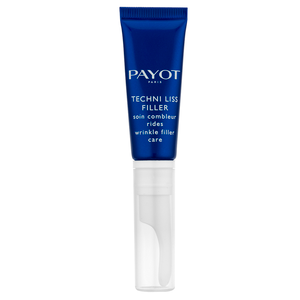
Works for
1 of 2 advertised claims delivered
Moisturizing7 ingredients credited for this claimGood support
“With a thick cream texture and precision tip delivery, the product melts effortlessly into skin, delivering hyaluronic acid spheres and antioxidant vitamins to reinforce and correct the surface, reducing the severity of lines and wrinkles for a rejuvenated, plumper-looking facial contour.”
This product contains good ingredients to attract water to the upper layer of the skin. These ingredients are called "humectants": sodium hyaluronate crosspolymer.
When humectants are on the surface of the skin, they “pull in” the moisture from the outside environment, or from within deeper layers of the skin. If the air is dry, humectants can speed up the moisture loss from the skin. This is why it is a good idea to use another product on top of this one to help "seal in" the moisture (look for ingredients like dimethicone, squalane, oils and butters).
Anti-aging2 ingredients credited for this claimWeak support
“Acting on the formation of wrinkles, the innovative filler helps correct and smooth, and its subtle, natural tint and soft focus powders even out the complexion for a perfected canvas.”
Effective ingredients missing or their concentration is too low.
Can it cause trouble?
Irritancy4 flagged ingredientsLow risk
Comedogenic1 ingredient rated 2 or more on the 0–5 pore-clogging scale1 flagged
User reviews
Be the first — your take helps the next person decide.
Ingredients
Filter by role to see what each ingredient is doing.
Isododecane~23–35%
- Irritation risk
- Low
An emollient that helps soften the skin and can decrease moisture loss. Helps create a nice product texture
More about IsododecaneIsohexadecane~7.5–11.3%
- Irritation risk
- Low
Improves the texture of the product and helps soften the skin. Helps oil and water mix together and can be used as a cleansing agent
More about IsohexadecaneDimethicone/bis-isobutyl ppg-20 crosspolymer~4.7–7.1%
- Irritation risk
- Low
Helps to create a nice product texture
More about Dimethicone/bis-isobutyl ppg-20 crosspolymerBenzimidazole diamond amidoethyl urea carbamoyl propyl polymethylsilsesquioxane~3.8–5.6%
Hibiscus sabdariffa seed oil~2.9–4.3%
- Irritation risk
- Low
Water~1.9–2.9%
Hydrogenated vegetable oil~1.7–2.6%
- Irritation risk
- Low
- Comedogenicity
- 2/5
An oil from a mixture of different vegetables. Helps soften the upper layer of the skin
More about Hydrogenated vegetable oilCi 77891~1.2–1.9%
- Irritation risk
- Low
Titanium dioxide~1.4–2.1%
- Irritation risk
- Low
Works as a UV filter when used in high concentrations. It is photostable and is effective mostly against the UVB light, with some protection in the UVA range. In small concentrations, used for its ability to improve the color of cosmetic products. Is usually well tolerated by the skin
More about Titanium dioxideAscorbyl tetraisopalmitate~0.95–1.45%
- Irritation risk
- Medium
A vitamin C derivative. Studies show that is might be effective in reducing hyperpigmentation, but there are no studies confirming that it is effectively converted into the bioavailable form of Vitamin C in skin. It is not clear how this derivative compares in effectiveness to the topical application of bioavailable form of vitamin C (L-ascorbic acid)
More about Ascorbyl tetraisopalmitateTocopheryl acetate~0.5–1.2%
- Irritation risk
- Medium
A more stable but less bio-available form of vitamin E compared to Tocopherol. Might help moisturize and protect the skin from free radicals, but mostly used in low concentrations to stabilize other ingredients.
More about Tocopheryl acetateEthylhexyl stearate~0.55–1.25%
- Irritation risk
- Low
Helps soften the upper layer of the skin
More about Ethylhexyl stearateMica~0.5–1.2%
- Irritation risk
- Low
Creates an illusion of smoother and more radiant skin tone. Adds shimmer to the skin by reflecting light
More about MicaPolyglyceryl-4 diisostearate/polyhydroxystearate/sebacate~0.3–0.75%
- Irritation risk
- Medium
Helps water and oil mix together
More about Polyglyceryl-4 diisostearate/polyhydroxystearate/sebacateSodium hyaluronate crosspolymer~0.15–0.6%
- Irritation risk
- Medium
Attracts water into the upper layer of the skin
More about Sodium hyaluronate crosspolymerSodium isostearate~0.2–0.75%
Tocopherol~0.1–0.4%
- Irritation risk
- Low
Pure form of vitamin E. Can help moisturise and protect the skin from free radicals. Often used to help stabilise other ingredients or the formula itself
More about TocopherolCi 77491~0.1–0.3%
- Irritation risk
- Low
A red colorant made of iron oxide. Typically is not irritating
More about Ci 77491Iron oxides~0.05–0.3%
- Irritation risk
- Low
An umbrella term for the following three colorants: CI 77491, CI 77492, CI 77499. They might be able to offer some protection against visible light, but the degree of the protection is not clear
More about Iron oxidesIngredient list view
Isododecane, Isohexadecane, Dimethicone/bis-isobutyl ppg-20 crosspolymer, Benzimidazole diamond amidoethyl urea carbamoyl propyl polymethylsilsesquioxane, Hibiscus sabdariffa seed oil, Water, Hydrogenated vegetable oil, Ci 77891, Titanium dioxide, Ascorbyl tetraisopalmitate, Tocopheryl acetate, Ethylhexyl stearate, Mica, Polyglyceryl-4 diisostearate/polyhydroxystearate/sebacate, Sodium hyaluronate crosspolymer, Sodium isostearate, Tocopherol, Ci 77491, Iron oxides
Compare prices
Retailers ranked by price — lowest first.

Affiliate links · prices updated regularly
Sources cited in this review
Every concentration estimate and effectiveness label is anchored to one of these 6 studies and safety reviews.
- 1
- 2
- 3
- 4
- 5Vitamin E in dermatologyncbi.nlm.nih.gov
- 6Vitamin E and Skin Healthlpi.oregonstate.edu

Affiliate links · As an Amazon Associate, WIMJ earns from qualifying purchases.