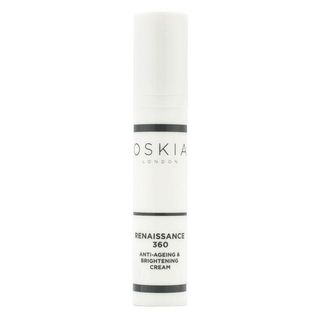
OSKIA Renaissance 360 Anti-Ageing and Brightening Supreme Cream Travel
Works for
3 of 3 advertised claims delivered
Evens skin tone4 ingredients credited for this claimStrong support
“It has glutathione to brighten the skin and improve the appearance of discolouration and stimulates melanin production, in the form of Oskia’s own liposome Nanobright.”
This product can help reduce hypepigmentation and even out the skin tone because it contains the following effective ingredients: glutathione
The following ingredient (ingredients) in this product might be helpful, but there is no evidence to confirm that it actually can help even out the skin tone: arbutin.
Keep in mind that you would need to apply any topical skincare targetted at hypigmentation consistently for a couple of months to get a result. No topical skincare product can help get rid of hyperpigmentation (including post-acne marks and age spots) instantly.
Moisturizing24 ingredients credited for this claimGood support
“It is light in texture but incredibly hydrating and contains powerful vitamins and nutrients to nourish the skin.”
This product can help improve hydration of the skin with the two types of ingredients.
The first type is called “humectants”:
these ingredients help attract water.
When humectants are on the surface of the skin, they “pull in” the moisture from the outside environment, or from
within deeper layers of the skin. The following ingredients in this product do the job:
galactoarabinan, glycerin.
This product also contains ingredients called “occlusives”. They help reduce the speed with which our skin loses moisture to the outside environment. These ingredients also help soften the upper layer of the skin, so it feels less tight and nicer to the touch. The following ingredients in this product do the job: helianthus annuus seed oil, simmondsia chinensis seed oil.
Anti-aging5 ingredients credited for this claimModerate support
“Renaissance 360 Anti-Ageing and Brightening Supreme Cream Travel”
This product contains glutathione. This ingredient help neutralize free radicals in skin. By doing so, they might be able to prevent early signs of aging (like fine lines and wrinkles), at least to some extent. These ingredients will not be able to "reverse" signs of aging.
Anti-oxidationNot advertised by the brand · 9 ingredients credited for this claimStrong support
This product contains antioxidants (glutathione) that can help neutralize free radicals in skin. By doing so, they can lessen the damage the skin gets from the UV light (sun).
The following ingredients - arbutin also can have an antioxidant effect, but there is less evidence to confirm their effectiveness in skin.
Can it cause trouble?
Irritancy11 strong irritants: Retinyl palmitate, Rosa damascena flower oil + 9 more — patch-test recommendedHigh risk
Comedogenic3 ingredients rated 2 or more on the 0–5 pore-clogging scale3 flagged
User reviews
Be the first — your take helps the next person decide.
Ingredients
Filter by role to see what each ingredient is doing.
Water~45–55%
Caprylyl caprylate/caprate~5.5–6.7%
- Irritation risk
- Low
Helps soften the upper layer of the skin
More about Caprylyl caprylate/caprateGlycerin~4.5–5.5%
- Irritation risk
- Low
One of the best moisturizing ingredients. Naturally present in skin. It attracts water to the upper layer of the skin working as a humectant
More about GlycerinZinc oxide~4.2–5.2%
- Irritation risk
- Low
A broad spectrum sunblock (protects from both UVA and UVB rays). Is suitable for most sensitive skins. In small concentrations, can be used as a colorant
More about Zinc oxideSimmondsia chinensis seed oil~2.8–3.4%
- Irritation risk
- Medium
Softens the upper layer of skin and helps restore the healthy skin barrier. Has shown to help calm down inflammation in skin. It is a stable oil, meaning that it retains its properties even when exposed to air.
More about Simmondsia chinensis seed oilArgania spinosa kernel oil~2.3–2.8%
- Irritation risk
- Medium
An emollient that helps soften the upper layer of the skin. Might have some weak anti-oxidant properties
More about Argania spinosa kernel oilCetearyl olivate~2–2.4%
Cetearyl alcohol~1.7–2.1%
- Irritation risk
- Low
- Comedogenicity
- 2/5
A non-drying alcohol. Works as an emollient. Helps water and oil mix together and creates a nice product texture
More about Cetearyl alcoholSorbitan olivate~1.4–1.7%
Inulin lauryl carbamate~0.95–1.15%
Tocopheryl acetate~0.7–1.05%
- Irritation risk
- Medium
A more stable but less bio-available form of vitamin E compared to Tocopherol. Might help moisturize and protect the skin from free radicals, but mostly used in low concentrations to stabilize other ingredients.
More about Tocopheryl acetateDimethyl sulfone~0.6–0.85%
Butyrospermum parkii butter extract~0.55–0.8%
- Irritation risk
- Low
- Comedogenicity
- 3/5
A great moisturising ingredient that softens the skin and reduces water loss from its upper layer. It also can be helpful in protecting skin from free radicals
More about Butyrospermum parkii butter extractHelianthus annuus seed oil unsaponifiables~0.5–0.8%
- Irritation risk
- Low
A great emollient due to its high linoleic acid content. One of the most effective plant oils in helping skin hydration and repairing skin barrier function
More about Helianthus annuus seed oil unsaponifiablesMyristyl myristate~0.45–0.7%
- Irritation risk
- Medium
- Comedogenicity
- 3/5
An emollient. Is not recommended for acne-prone skin as it can be comedogenic
More about Myristyl myristateOpuntia ficus-indica stem extract~0.45–0.65%
- Irritation risk
- Low
Sodium hyaluronate~0.45–0.65%
- Irritation risk
- Low
One of the best moisturizing ingredients. Attracts water into the upper layer of the skin
More about Sodium hyaluronateLepidium sativum sprout extract~0.35–0.6%
- Irritation risk
- Low
Helianthus annuus seed oil~0.35–0.65%
- Irritation risk
- Low
A great emollient due to its high linoleic acid content. One of the most effective plant oils in helping skin hydration and repairing skin barrier function
More about Helianthus annuus seed oilLupinus albus seed extract~0.3–0.55%
- Irritation risk
- Medium
A plant extract that helps soften the upper layer of the skin
More about Lupinus albus seed extractBisabolol~0.25–0.5%
- Irritation risk
- Low
An active component of chamomile plant that historically has been used to calm down irritated skin. A recent study shows that bisabolol indeed can have some anti-inflammatory effect on skin, even though conclusive data is lacking. Bisabolol has a sweet floral scent and can be added to products for its aromatic properties
More about BisabololGalactoarabinan~0.35–0.6%
- Irritation risk
- Medium
Helps attract water to the upper layer of the skin
More about GalactoarabinanSodium ascorbyl phosphate~0.3–0.55%
- Irritation risk
- Medium
A stable derivative of vitamin C. It is oil-soluble which means it is more likely to penetrate the skin compared to the pure form of vitamin C (which is water-soluble), but it is less bio-available and is way less effective in stimulating collagen and reducing wrinkles compared to the pure form of vitamin C (L-ascorbic acid) and its other derivatives (for example, magnesium ascorbyl phosphate). At the same time, this vitamin C derivative has been shown in studies to be effective in reducing acne, blemishes and clogged pores. It is less irritating then the pure form of vitamin C
More about Sodium ascorbyl phosphateRetinyl palmitate~0.25–0.5%
- Irritation risk
- High
Three steps removed from the active form of vitamin A - retinoic acid. To have an effect in the skin, it first needs to be converted twice to become the retinoic acid. This means it is less potent than retinol, but could also be less irritating. Once converted to the retinoic acid in the skin, it helps against all signs of aging, improves skin cell turnover and helps fight blemishes and clogged pores. However, in many cosmetic formulations, it is used in a concentration that is too low to have the full effect
More about Retinyl palmitateTocopherol~0.3–0.55%
- Irritation risk
- Low
Pure form of vitamin E. Can help moisturise and protect the skin from free radicals. Often used to help stabilise other ingredients or the formula itself
More about TocopherolAscorbyl palmitate~0.3–0.55%
- Irritation risk
- Medium
Being a lipid soluble form of vitamin C, it is more stable and can penetrate the skin better than L-Ascorbic acid. It is effective in protecting the skin from free radicals, as well as evening the skin tone, but is less effective in stimulating collagen production compared to L-Ascorbic acid.
More about Ascorbyl palmitateArbutin~0.25–0.5%
- Irritation risk
- Medium
Beta-arbutin. Can help to reduce hyperpigmentation and has an anti-oxidant effect when used in high enough concentration. Is less effective compared to alpha-arbutin
More about ArbutinGlutathione~0.3–0.55%
- Irritation risk
- Medium
A peptide that can help neutralize free radicals in skin and reduce melanin production resulting in skin lightening effect and reduction in hyperpigmentation. It can also help attract moisture to the upper layer of the skin
More about GlutathioneGlyceryl linoleate~0.35–0.65%
- Irritation risk
- Medium
Helps oil and water mix together
More about Glyceryl linoleateGlyceryl linolenate~0.35–0.6%
- Irritation risk
- Low
Helps soften the upper layer of the skin
More about Glyceryl linolenateLinoleic acid~0.45–0.7%
- Irritation risk
- Low
An excellent emollient. Helps soften the skin, restore its barrier function, and can help to calm down inflammation. It can be helpful to prevent blemishes and clogged pores
More about Linoleic acidLinolenic acid~0.4–0.6%
- Irritation risk
- Medium
An emollient that helps soften the skin and calm down inflammation
More about Linolenic acidRosa damascena flower oil~0.25–0.5%
- Irritation risk
- High
Used as a fragrance. Can be irritating
More about Rosa damascena flower oilPhytic acid~0.3–0.55%
- Irritation risk
- Medium
An alpha-hydroxy acid (AHA), but is mostly used to stabilize product formulations in cosmetics
More about Phytic acidCetyl palmitate~0.35–0.6%
- Irritation risk
- Low
An emollient that helps soften the skin and is used to improve product texture and stability
More about Cetyl palmitateSorbitan palmitate~0.3–0.55%
- Irritation risk
- Medium
Helps water and oil mix together and stabilize the product formulation
More about Sorbitan palmitateAnthemis nobilis flower oil~0.25–0.45%
- Irritation risk
- High
An essential oil that is used as a fragrance and can be irritating. It might have some anti-oxidant effect in skin
More about Anthemis nobilis flower oilPhenethyl alcohol~0.3–0.55%
Silica~0.45–0.7%
Benzyl alcohol~0.25–0.5%
- Irritation risk
- High
A preservative. Can be used to mask unpleasant smell. Can be irritating
More about Benzyl alcoholCaprylyl glycol~0.3–0.6%
- Irritation risk
- Medium
Helps preserve products and creates a nice product texture
More about Caprylyl glycolLactic acid~0.3–0.5%
- Irritation risk
- Medium
An exfoliating and moisturizing alpha-hydroxy acid (AHA). Typically causes less irritation than other AHAs, for example, glycolic acid. At high concentrations (about 15%), lactic acid can help reduce lines and wrinkles. Recent studies show that lactic acid can support the "good" bacteria living on skin's surface (healthy skin microbiome)
More about Lactic acidSclerotium gum~0.25–0.5%
- Irritation risk
- Low
Used to create gel-like formulas and stabilize emulsions
More about Sclerotium gumEthylhexylglycerin~0.3–0.55%
Titanium dioxide~0.4–0.6%
- Irritation risk
- Low
Works as a UV filter when used in high concentrations. It is photostable and is effective mostly against the UVB light, with some protection in the UVA range. In small concentrations, used for its ability to improve the color of cosmetic products. Is usually well tolerated by the skin
More about Titanium dioxideAlcohol~0.3–0.55%
- Irritation risk
- High
Can be drying and contribute to skin irritation. Used in formulars to dissolve other ingredients, create a thinner product consistency or for its antibacterial properties
More about AlcoholRhodinols~0.25–0.5%
- Irritation risk
- Low
Juniperus mexicana wood oil~0.25–0.5%
- Irritation risk
- Low
Cymbopogon martini oil~0.3–0.5%
- Irritation risk
- High
Aromatic plant oil used in cosmetics as a fragrance. A likely irritant
More about Cymbopogon martini oilCinnamomum camphora linalooliferum wood oil~0.25–0.5%
- Irritation risk
- High
Pelargonium graveolens oil~0.3–0.5%
Eugenia caryophyllus bud oil~0.25–0.5%
Lecithin~0.3–0.6%
- Irritation risk
- Low
Used mostly for creating emulsions - helping oil and water mix together. Helps soften the upper layer of the skin
More about LecithinSorbitol~0.25–0.5%
- Irritation risk
- Low
Helps attract water to the upper layer of the skin and improves the product texture
More about SorbitolXanthan gum~0.25–0.5%
- Irritation risk
- Low
Used to create a thicker product consistency
More about Xanthan gumDisodium edta~0.25–0.45%
Glyceryl caprylate~0.25–0.5%
- Irritation risk
- Low
An emollient that can also help water and oil mix together, as well as prevent bacteria growth in products
More about Glyceryl caprylatePhenoxyethanol~0.2–0.35%
- Irritation risk
- Low
A preservative. It helps prevent bacterial growth in cosmetic products
More about PhenoxyethanolCitronellol~0.15–0.3%
Geraniol~0.15–0.25%
Linalool~0.1–0.15%
Eugenol~0.05–0.15%
Ingredient list view
Water, Caprylyl caprylate/caprate, Glycerin, Zinc oxide, Simmondsia chinensis seed oil, Argania spinosa kernel oil, Cetearyl olivate, Cetearyl alcohol, Sorbitan olivate, Inulin lauryl carbamate, Tocopheryl acetate, Dimethyl sulfone, Butyrospermum parkii butter extract, Helianthus annuus seed oil unsaponifiables, Myristyl myristate, Opuntia ficus-indica stem extract, Sodium hyaluronate, Lepidium sativum sprout extract, Helianthus annuus seed oil, Lupinus albus seed extract, Bisabolol, Galactoarabinan, Sodium ascorbyl phosphate, Retinyl palmitate, Tocopherol, Ascorbyl palmitate, Arbutin, Glutathione, Glyceryl linoleate, Glyceryl linolenate, Linoleic acid, Linolenic acid, Rosa damascena flower oil, Phytic acid, Cetyl palmitate, Sorbitan palmitate, Anthemis nobilis flower oil, Phenethyl alcohol, Silica, Benzyl alcohol, Caprylyl glycol, Lactic acid, Sclerotium gum, Ethylhexylglycerin, Titanium dioxide, Alcohol, Rhodinols, Juniperus mexicana wood oil, Cymbopogon martini oil, Cinnamomum camphora linalooliferum wood oil, Pelargonium graveolens oil, Eugenia caryophyllus bud oil, Lecithin, Sorbitol, Xanthan gum, Disodium edta, Glyceryl caprylate, Phenoxyethanol, Citronellol, Geraniol, Linalool, Eugenol
Compare prices
Retailers ranked by price — lowest first.

Affiliate links · prices updated regularly
Sources cited in this review
Every concentration estimate and effectiveness label is anchored to one of these 37 studies and safety reviews.
- 1
- 2A review of inorganic UV filters zinc oxide and titanium dioxideonlinelibrary.wiley.com
- 3
- 4
- 5
- 6

Affiliate links · As an Amazon Associate, WIMJ earns from qualifying purchases.