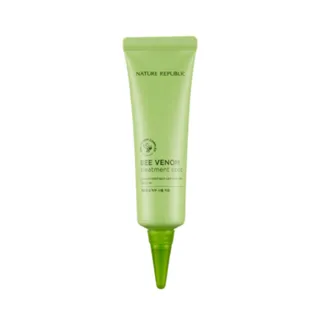
NATURE REPUBLIC Bee Venom Treatment Spot

NATURE REPUBLIC Bee Venom Treatment Spot

Efficacy0/100IrritancyHigh

Works for

Anti-blemish
Salicylic acid ~0.2–0.4%, below the ~0.5% it needs
Under-dosed
What the product description says
“The spot treatment controls sebum, fosters healing of acne and soothes troubled areas with its 77% bee venom complex.”
Source: Yesstyle

Effective ingredients missing or their concentration is too low.

Centella asiatica extractEffect: LowA plant extract that has been shown to be able to reduce inflammation in skin, support restoration of skin barrier function, as well as support collagen production. Contains active compounds called centelloids: asiaticoside, madecasosside, asiatic acid and madecassic acid. Might be helpful in preventing stretch marks. It can be itself be irritating though.~1.1–1.4%
Salix alba bark extractEffect: LowA plant extract that can help neutralize free radicals in skin. It contains a compound salicin that can theoretically be converted into salicylic acid that, in turn, helps reduce inflammation in skin, but the evidence of effectiveness in skin is lacking and the extract is usually not used in a concentration that would enable an exfoliating effect~0.25–0.5%
Salicylic acidUnder-dosedUsed for skin exfoliation. It has an anti-inflammatory and anti-bacterial effect, helps to unclog pores, prevent blemishes and speed up healing of the existing ones. Sometimes referred to as a BHA (beta-hydroxy acid)~0.2–0.4%
Anti-aging
Side benefit · Centella asiatica extract, Tocopherol
May help

This product contains centella asiatica extract. There is some human evidence that this ingredient helps reduce and prevent fine lines and wrinkles and improve skin elasticity and firmness, though it is smaller or less consistent than the evidence for the best anti-aging ingredients.

Centella asiatica extractKey activeEffect: MediumA plant extract that has been shown to be able to reduce inflammation in skin, support restoration of skin barrier function, as well as support collagen production. Contains active compounds called centelloids: asiaticoside, madecasosside, asiatic acid and madecassic acid. Might be helpful in preventing stretch marks. It can be itself be irritating though.~1.1–1.4%
TocopherolEffect: Low, below effective dosePure form of vitamin E. Can help moisturise and protect the skin from free radicals. Often used to help stabilise other ingredients or the formula itself~0.2–0.4%
Moisturizing
Side benefit · Glycerin, Caprylic/capric triglyceride + 15 more
Works

This product can help improve hydration of the skin with the two types of ingredients.

The first type is called “humectants”:
these ingredients help attract water. When humectants are on the surface of the skin, they “pull in” the moisture from the outside environment, or from within deeper layers of the skin. The following ingredients in this product do the job: arginine, glycerin.

This product also contains ingredients called “occlusives”. They help reduce the speed with which our skin loses moisture to the outside environment. These ingredients also help soften the upper layer of the skin, so it feels less tight and nicer to the touch. The following ingredients in this product do the job: arginine, caprylic/capric triglyceride.

GlycerinKey active· HumectantEffect: HighOne of the best moisturizing ingredients. Naturally present in skin. It attracts water to the upper layer of the skin working as a humectant~4.1–5%
Caprylic/capric triglycerideKey active· Emollient, OcclusiveEffect: HighA good mix of fatty acids that forms a protective layer on the skin. Improves the shelf life of products. Derived from coconut and glycerin~3.2–3.9%
Simmondsia chinensis seed oilKey active· Emollient, OcclusiveEffect: HighSoftens the upper layer of skin and helps restore the healthy skin barrier. Has shown to help calm down inflammation in skin. It is a stable oil, meaning that it retains its properties even when exposed to air.~2.4–2.9%
Olea europaea fruit oilKey active· EmollientEffect: MediumAn emollient that helps soften the skin but is not effective for restoring its barrier function. Might be helpful to calm down inflammation~1.5–1.8%
Centella asiatica extractKey activeEffect: HighA plant extract that has been shown to be able to reduce inflammation in skin, support restoration of skin barrier function, as well as support collagen production. Contains active compounds called centelloids: asiaticoside, madecasosside, asiatic acid and madecassic acid. Might be helpful in preventing stretch marks. It can be itself be irritating though.~1.1–1.4%
Macadamia ternifolia seed oilKey active· EmollientEffect: MediumPlant oil from nuts that helps soften the upper layer of the skin. Contains a high concentration of oleic acid that can weaken skin's barrier function and increase water-loss while enhancing penetration of other ingredients~0.45–0.7%
Beta-sitosterolKey active· EmollientEffect: HighA phytosterol that can support skin's barrier function and help the skin stay hydrated~0.25–0.45%
CholesterolKey active· EmollientEffect: HighAn emollient that is naturally found in skin~0.25–0.5%
ArginineKey active· Humectant, OcclusiveEffect: HighAn amino acid that is naturally present in skin and helps keep it hydrated. When used together with AHAs, it can reduce their irritating effect on the skin~0.2–0.4%
Lactobacillus/soybean ferment extractKey activeEffect: MediumA fermentation product created by bacteria Lactobacillus out of soybean. The fermented product helps to attract water to the upper layer of the skin and has anti-bacterial properties. It might be helpful in calming down inflammation and could be helpful in evening out skin tone, but studies are lacking~0.2–0.35%
Butylene glycol· HumectantEffect: LowUsed to create a nice product texture and help delivery of other ingredients. Might be somewhat helpful in attracting water to the upper layer of the skin~5.9–7.2%
Glyceryl stearate· EmollientEffect: LowAn emollient that softens the skin and forms a protective layer on its surface. Helps water and oil mix together~0.25–0.5%
Portulaca oleracea extract· HumectantEffect: LowA plant extract that has some anti-oxidant activity, but solid research is lacking. Can help attract water to the upper layer of the skin~0.2–0.4%
Scutellaria baicalensis root extract· HumectantEffect: LowA plant extract that might contain a compound baicalin that could be helpful in neutralizing free radicals and reducing inflammation in skin. The baicalin concentration in skincare products is often too low for an effective action. Can be used for its fragrant properties~0.2–0.35%
Propylene glycol· HumectantEffect: LowHelps oil and water mix together and can enhance the penetration of other ingredients into the skin. It can be irritating~0.2–0.4%
TocopherolEffect: Low, below effective dosePure form of vitamin E. Can help moisturise and protect the skin from free radicals. Often used to help stabilise other ingredients or the formula itself~0.2–0.4%
LecithinEffect: Low, below effective doseUsed mostly for creating emulsions - helping oil and water mix together. Helps soften the upper layer of the skin~0.2–0.4%
Anti-oxidation
Side benefit · Centella asiatica extract, Camellia japonica flower extract + 7 more
May help

This product contains antioxidants (camellia japonica flower extract, centella asiatica extract) that can help neutralize free radicals in skin to lessen the damage it gets from the UV light (sun). There is some human evidence for this effect in skin, though it is smaller or less consistent than the evidence for the best antioxidants.

Centella asiatica extractKey activeEffect: MediumA plant extract that has been shown to be able to reduce inflammation in skin, support restoration of skin barrier function, as well as support collagen production. Contains active compounds called centelloids: asiaticoside, madecasosside, asiatic acid and madecassic acid. Might be helpful in preventing stretch marks. It can be itself be irritating though.~1.1–1.4%
Camellia japonica flower extractKey activeEffect: MediumA plant extract that might help neutralize free radicals in skin~0.25–0.45%
Origanum vulgare leaf extractEffect: LowA plant extract. Can have an anti-oxidant effect, but can also contain irritants~0.3–0.55%
Rosmarinus officinalis leaf oilEffect: LowA plant oil with high content of volatile compounds that can irritate the skin. Can be used as a fragrance. Has anti-bacterial properties and might help neutralize free radicals on the surface of the skin~0.3–0.6%
Salix alba bark extractEffect: LowA plant extract that can help neutralize free radicals in skin. It contains a compound salicin that can theoretically be converted into salicylic acid that, in turn, helps reduce inflammation in skin, but the evidence of effectiveness in skin is lacking and the extract is usually not used in a concentration that would enable an exfoliating effect~0.25–0.5%
Pelargonium graveolens flower oilEffect: LowAn essential oil. Can be irritating. Can become an allergen with oxidation~0.25–0.5%
Portulaca oleracea extractEffect: LowA plant extract that has some anti-oxidant activity, but solid research is lacking. Can help attract water to the upper layer of the skin~0.2–0.4%
Scutellaria baicalensis root extractEffect: LowA plant extract that might contain a compound baicalin that could be helpful in neutralizing free radicals and reducing inflammation in skin. The baicalin concentration in skincare products is often too low for an effective action. Can be used for its fragrant properties~0.2–0.35%
TocopherolUnder-dosedPure form of vitamin E. Can help moisturise and protect the skin from free radicals. Often used to help stabilise other ingredients or the formula itself~0.2–0.4%

Can it cause trouble?

Irritancy
11 strong irritants: Lavandula angustifolia oil, Pinus sylvestris leaf oil + 9 more — patch-test recommended
High risk
We flagged 28 ingredients with irritancy potential. Severity depends on your sensitivity threshold; the table lists the worst offenders first.
IngredientFunctionIrritationEst. amount
Lavandula angustifolia oilAn essential oil. Potential allergen and can be irritating. It has some anti-bacterial propertiesHigh~0.95–1.2%est.
Pinus sylvestris leaf oilAn essential oil from pine tree. Can be irritatingHigh~0.75–1.1%est.
Cananga odorata flower oilAn essential oil. Can be irritatingHigh~0.55–0.8%est.
Rosmarinus officinalis leaf oilA plant oil with high content of volatile compounds that can irritate the skin. Can be used as a fragrance. Has anti-bacterial properties and might help neutralize free radicals on the surface of the skinHigh~0.3–0.6%est.
Origanum vulgare leaf extractA plant extract. Can have an anti-oxidant effect, but can also contain irritantsHigh~0.3–0.55%est.
Salix alba bark extractA plant extract that can help neutralize free radicals in skin. It contains a compound salicin that can theoretically be converted into salicylic acid that, in turn, helps reduce inflammation in skin, but the evidence of effectiveness in skin is lacking and the extract is usually not used in a concentration that would enable an exfoliating effectHigh~0.25–0.5%est.
Chamaecyparis obtusa leaf extractUsed as a fragranceHigh~0.3–0.5%est.
Pelargonium graveolens flower oilAn essential oil. Can be irritating. Can become an allergen with oxidationHigh~0.25–0.5%est.
Melaleuca alternifolia leaf oilAn essential oil that can be irritating. Has some anti-bacterial propertiesHigh~0.25–0.45%est.
Camellia japonica flower extractA plant extract that might help neutralize free radicals in skinHigh~0.25–0.45%est.
Scutellaria baicalensis root extractA plant extract that might contain a compound baicalin that could be helpful in neutralizing free radicals and reducing inflammation in skin. The baicalin concentration in skincare products is often too low for an effective action. Can be used for its fragrant propertiesHigh~0.2–0.35%est.
Cinnamomum cassia bark extractUsed as a fragrance. Can be irritatingHigh~0.25–0.45%est.
Propylene glycolHelps oil and water mix together and can enhance the penetration of other ingredients into the skin. It can be irritatingHigh~0.2–0.4%est.
Salicylic acidUsed for skin exfoliation. It has an anti-inflammatory and anti-bacterial effect, helps to unclog pores, prevent blemishes and speed up healing of the existing ones. Sometimes referred to as a BHA (beta-hydroxy acid)High~0.2–0.4%est.
Alcohol denat.Produces temporary toning effect. Can help dissolve other ingredients or preserve productsHigh~0.15–0.25%est.
AlcoholCan be drying and contribute to skin irritation. Used in formulars to dissolve other ingredients, create a thinner product consistency or for its antibacterial propertiesHigh~0.15–0.25%est.
Caprylic/capric triglycerideA good mix of fatty acids that forms a protective layer on the skin. Improves the shelf life of products. Derived from coconut and glycerinMedium~3.2–3.9%est.
Simmondsia chinensis seed oilSoftens the upper layer of skin and helps restore the healthy skin barrier. Has shown to help calm down inflammation in skin. It is a stable oil, meaning that it retains its properties even when exposed to air.Medium~2.4–2.9%est.
Olea europaea fruit oilAn emollient that helps soften the skin but is not effective for restoring its barrier function. Might be helpful to calm down inflammationMedium~1.5–1.8%est.
Centella asiatica extractA plant extract that has been shown to be able to reduce inflammation in skin, support restoration of skin barrier function, as well as support collagen production. Contains active compounds called centelloids: asiaticoside, madecasosside, asiatic acid and madecassic acid. Might be helpful in preventing stretch marks. It can be itself be irritating though.Medium~1.1–1.4%est.
Macadamia ternifolia seed oilPlant oil from nuts that helps soften the upper layer of the skin. Contains a high concentration of oleic acid that can weaken skin's barrier function and increase water-loss while enhancing penetration of other ingredientsMedium~0.45–0.7%est.
Portulaca oleracea extractA plant extract that has some anti-oxidant activity, but solid research is lacking. Can help attract water to the upper layer of the skinMedium~0.2–0.4%est.
1,2-hexanediolA preservativeMedium~0.2–0.4%est.
Polyglyceryl-3 methylglucose distearateHelps water and oil mix togetherMedium~0.25–0.45%est.
Hydroxyethyl acrylate/sodium acryloyldimethyl taurate copolymerA gelling agent that thickens the product consistency and leaves the skin with a velvety finishMedium~0.2–0.4%est.
Acrylates/c10-30 alkyl acrylate crosspolymerMaintains the texture of skincare products. Allows the product to spread evenly. Helps oil and water mix togetherMedium~0.25–0.45%est.
Potassium cetyl phosphateHelps oil and water mix togetherMedium~0.25–0.45%est.
Disodium edtaStabilizes the product formulationMedium~0.1–0.25%est.
Comedogenic
Clean of flagged comedogenic ingredients
None flagged

User reviews

Would you recommend?
No community reviews yet.

Be the first — your take helps the next person decide.

Ingredients

Filter by role to see what each ingredient is doing.

Water~45–55%
Formula
Irritation risk
Low

Plain old water

More about Water
Butylene glycol~5.9–7.2%
Formula
Irritation risk
Low
Works for
Moisturizing

Used to create a nice product texture and help delivery of other ingredients. Might be somewhat helpful in attracting water to the upper layer of the skin

More about Butylene glycol
Glycerin~4.1–5%
Key active
Irritation risk
Low
Works for
Moisturizing

One of the best moisturizing ingredients. Naturally present in skin. It attracts water to the upper layer of the skin working as a humectant

More about Glycerin
Caprylic/capric triglyceride~3.2–3.9%
Key activeIrritant · medium
Irritation risk
Medium
Works for
Moisturizing

A good mix of fatty acids that forms a protective layer on the skin. Improves the shelf life of products. Derived from coconut and glycerin

More about Caprylic/capric triglyceride
Simmondsia chinensis seed oil~2.4–2.9%
Key activeIrritant · medium
Irritation risk
Medium
Works for
Moisturizing

Softens the upper layer of skin and helps restore the healthy skin barrier. Has shown to help calm down inflammation in skin. It is a stable oil, meaning that it retains its properties even when exposed to air.

More about Simmondsia chinensis seed oil
Xylitol~1.8–2.2%
Formula
Irritation risk
Low

Helps attract water to the upper layer of the skin and repair the skin barrier function

More about Xylitol
Olea europaea fruit oil~1.5–1.8%
Key activeIrritant · medium
Irritation risk
Medium
Works for
Moisturizing

An emollient that helps soften the skin but is not effective for restoring its barrier function. Might be helpful to calm down inflammation

More about Olea europaea fruit oil
Centella asiatica extract~1.1–1.4%
Key activeIrritant · medium
Irritation risk
Medium
Works for
Reduces rednessAnti-inflammatoryMoisturizingReduces irritationAnti-agingAnti-oxidationAnti-blemish

A plant extract that has been shown to be able to reduce inflammation in skin, support restoration of skin barrier function, as well as support collagen production. Contains active compounds called centelloids: asiaticoside, madecasosside, asiatic acid and madecassic acid. Might be helpful in preventing stretch marks. It can be itself be irritating though.

More about Centella asiatica extract
Lavandula angustifolia oil~0.95–1.2%
Irritant · high
Irritation risk
High

An essential oil. Potential allergen and can be irritating. It has some anti-bacterial properties

More about Lavandula angustifolia oil
Pinus sylvestris leaf oil~0.75–1.1%
Irritant · high
Irritation risk
High

An essential oil from pine tree. Can be irritating

More about Pinus sylvestris leaf oil
Cananga odorata flower oil~0.55–0.8%
Irritant · high
Irritation risk
High

An essential oil. Can be irritating

More about Cananga odorata flower oil
Pollen extract~0.55–0.8%
Formula
Irritation risk
Low
More about Pollen extract
Macadamia ternifolia seed oil~0.45–0.7%
Key activeIrritant · medium
Irritation risk
Medium
Works for
Moisturizing

Plant oil from nuts that helps soften the upper layer of the skin. Contains a high concentration of oleic acid that can weaken skin's barrier function and increase water-loss while enhancing penetration of other ingredients

More about Macadamia ternifolia seed oil
Rosmarinus officinalis leaf oil~0.3–0.6%
Irritant · high
Irritation risk
High
Works for
AntibacterialAnti-oxidation

A plant oil with high content of volatile compounds that can irritate the skin. Can be used as a fragrance. Has anti-bacterial properties and might help neutralize free radicals on the surface of the skin

More about Rosmarinus officinalis leaf oil
Origanum vulgare leaf extract~0.3–0.55%
Irritant · high
Irritation risk
High
Works for
Anti-oxidation

A plant extract. Can have an anti-oxidant effect, but can also contain irritants

More about Origanum vulgare leaf extract
Salix alba bark extract~0.25–0.5%
Irritant · high
Irritation risk
High
Works for
Anti-oxidationAnti-inflammatoryExfoliationAnti-blemish

A plant extract that can help neutralize free radicals in skin. It contains a compound salicin that can theoretically be converted into salicylic acid that, in turn, helps reduce inflammation in skin, but the evidence of effectiveness in skin is lacking and the extract is usually not used in a concentration that would enable an exfoliating effect

More about Salix alba bark extract
Chamaecyparis obtusa leaf extract~0.3–0.5%
Irritant · high
Irritation risk
High

Used as a fragrance

More about Chamaecyparis obtusa leaf extract
Pelargonium graveolens flower oil~0.25–0.5%
Irritant · high
Irritation risk
High
Works for
Anti-oxidation

An essential oil. Can be irritating. Can become an allergen with oxidation

More about Pelargonium graveolens flower oil
Melaleuca alternifolia leaf oil~0.25–0.45%
Irritant · high
Irritation risk
High
Works for
Antibacterial

An essential oil that can be irritating. Has some anti-bacterial properties

More about Melaleuca alternifolia leaf oil
Camellia japonica flower extract~0.25–0.45%
Key activeIrritant · high
Irritation risk
High
Works for
Anti-oxidation

A plant extract that might help neutralize free radicals in skin

More about Camellia japonica flower extract
Portulaca oleracea extract~0.2–0.4%
Irritant · medium
Irritation risk
Medium
Works for
MoisturizingAnti-oxidation

A plant extract that has some anti-oxidant activity, but solid research is lacking. Can help attract water to the upper layer of the skin

More about Portulaca oleracea extract
Scutellaria baicalensis root extract~0.2–0.35%
Irritant · high
Irritation risk
High
Works for
Reduces irritationAnti-inflammatoryAntibacterialMoisturizingAnti-oxidation

A plant extract that might contain a compound baicalin that could be helpful in neutralizing free radicals and reducing inflammation in skin. The baicalin concentration in skincare products is often too low for an effective action. Can be used for its fragrant properties

More about Scutellaria baicalensis root extract
Lactobacillus/soybean ferment extract~0.2–0.35%
Key active
Irritation risk
Low
Works for
Moisturizing

A fermentation product created by bacteria Lactobacillus out of soybean. The fermented product helps to attract water to the upper layer of the skin and has anti-bacterial properties. It might be helpful in calming down inflammation and could be helpful in evening out skin tone, but studies are lacking

More about Lactobacillus/soybean ferment extract
Cinnamomum cassia bark extract~0.25–0.45%
Irritant · high
Irritation risk
High

Used as a fragrance. Can be irritating

More about Cinnamomum cassia bark extract
Water~0.2–0.4%
Formula
Irritation risk
Low

Plain old water

More about Water
Terminalia chebula fruit extract~0.2–0.4%
Formula
Caesalpinia sappan bark extract~0.2–0.4%
Formula
Magnolia officinalis bark extract~0.2–0.4%
Formula
Bee venom~0.2–0.4%
Formula
Irritation risk
Low
More about Bee venom
1,2-hexanediol~0.2–0.4%
Irritant · medium
Irritation risk
Medium

A preservative

More about 1,2-hexanediol
Sodium polyacrylate~0.25–0.5%
Formula
Irritation risk
Low
Works for
Mattifying

Used to create a gel-like product texture, as well as to stabilize emulsions

More about Sodium polyacrylate
Polyglyceryl-3 methylglucose distearate~0.25–0.45%
Irritant · medium
Irritation risk
Medium
Works for
Cleansing

Helps water and oil mix together

More about Polyglyceryl-3 methylglucose distearate
Hydroxyethyl acrylate/sodium acryloyldimethyl taurate copolymer~0.2–0.4%
Irritant · medium
Irritation risk
Medium

A gelling agent that thickens the product consistency and leaves the skin with a velvety finish

More about Hydroxyethyl acrylate/sodium acryloyldimethyl taurate copolymer
Glyceryl stearate~0.25–0.5%
Formula
Irritation risk
Low
Works for
CleansingMoisturizing

An emollient that softens the skin and forms a protective layer on its surface. Helps water and oil mix together

More about Glyceryl stearate
Peg-100 stearate~0.3–0.55%
Formula
Irritation risk
Low
Works for
Cleansing

Helps oil and water mix togehter and creates a nice product texture

More about Peg-100 stearate
Acrylates/c10-30 alkyl acrylate crosspolymer~0.25–0.45%
Irritant · medium
Irritation risk
Medium

Maintains the texture of skincare products. Allows the product to spread evenly. Helps oil and water mix together

More about Acrylates/c10-30 alkyl acrylate crosspolymer
Arginine~0.2–0.4%
Key active
Irritation risk
Low
Works for
Moisturizing

An amino acid that is naturally present in skin and helps keep it hydrated. When used together with AHAs, it can reduce their irritating effect on the skin

More about Arginine
Beta-sitosterol~0.25–0.45%
Key active
Irritation risk
Low
Works for
Moisturizing

A phytosterol that can support skin's barrier function and help the skin stay hydrated

More about Beta-sitosterol
Steareth-4~0.25–0.45%
Formula
Irritation risk
Low
Works for
Cleansing
More about Steareth-4
Cholesterol~0.25–0.5%
Key active
Irritation risk
Low
Works for
CleansingMoisturizing

An emollient that is naturally found in skin

More about Cholesterol
Potassium cetyl phosphate~0.25–0.45%
Irritant · medium
Irritation risk
Medium
Works for
Cleansing

Helps oil and water mix together

More about Potassium cetyl phosphate
Propylene glycol~0.2–0.4%
Irritant · high
Irritation risk
High
Works for
Moisturizing

Helps oil and water mix together and can enhance the penetration of other ingredients into the skin. It can be irritating

More about Propylene glycol
Salicylic acid~0.2–0.4%
Under-dosedIrritant · high
Irritation risk
High
Works for
ExfoliationAnti-inflammatoryAnti-blemishAntibacterialEvens skin tone

Used for skin exfoliation. It has an anti-inflammatory and anti-bacterial effect, helps to unclog pores, prevent blemishes and speed up healing of the existing ones. Sometimes referred to as a BHA (beta-hydroxy acid)

More about Salicylic acid
Tocopherol~0.2–0.4%
Under-dosed
Irritation risk
Low
Works for
Anti-oxidationMoisturizingAnti-inflammatoryAnti-aging

Pure form of vitamin E. Can help moisturise and protect the skin from free radicals. Often used to help stabilise other ingredients or the formula itself

More about Tocopherol
Cholesteryl/behenyl/octyldodecyl lauroyl glutamate~0.2–0.35%
Formula
Palmeth-2 phosphate~0.25–0.5%
Formula
Irritation risk
Low
Works for
Cleansing
More about Palmeth-2 phosphate
Lecithin~0.2–0.4%
Formula
Irritation risk
Low
Works for
CleansingMoisturizing

Used mostly for creating emulsions - helping oil and water mix together. Helps soften the upper layer of the skin

More about Lecithin
Alcohol denat.~0.15–0.25%
Irritant · high
Irritation risk
High

Produces temporary toning effect. Can help dissolve other ingredients or preserve products

More about Alcohol denat.
Alcohol~0.15–0.25%
Irritant · high
Irritation risk
High
Works for
Antibacterial

Can be drying and contribute to skin irritation. Used in formulars to dissolve other ingredients, create a thinner product consistency or for its antibacterial properties

More about Alcohol
Disodium edta~0.1–0.25%
Irritant · medium
Irritation risk
Medium

Stabilizes the product formulation

More about Disodium edta
Phenoxyethanol~0.15–0.25%
Formula
Irritation risk
Low

A preservative. It helps prevent bacterial growth in cosmetic products

More about Phenoxyethanol
Ingredient list view

Water, Butylene glycol, Glycerin, Caprylic/capric triglyceride, Simmondsia chinensis seed oil, Xylitol, Olea europaea fruit oil, Centella asiatica extract, Lavandula angustifolia oil, Pinus sylvestris leaf oil, Cananga odorata flower oil, Pollen extract, Macadamia ternifolia seed oil, Rosmarinus officinalis leaf oil, Origanum vulgare leaf extract, Salix alba bark extract, Chamaecyparis obtusa leaf extract, Pelargonium graveolens flower oil, Melaleuca alternifolia leaf oil, Camellia japonica flower extract, Portulaca oleracea extract, Scutellaria baicalensis root extract, Lactobacillus/soybean ferment extract, Cinnamomum cassia bark extract, Water, Terminalia chebula fruit extract, Caesalpinia sappan bark extract, Magnolia officinalis bark extract, Bee venom, 1,2-hexanediol, Sodium polyacrylate, Polyglyceryl-3 methylglucose distearate, Hydroxyethyl acrylate/sodium acryloyldimethyl taurate copolymer, Glyceryl stearate, Peg-100 stearate, Acrylates/c10-30 alkyl acrylate crosspolymer, Arginine, Beta-sitosterol, Steareth-4, Cholesterol, Potassium cetyl phosphate, Propylene glycol, Salicylic acid, Tocopherol, Cholesteryl/behenyl/octyldodecyl lauroyl glutamate, Palmeth-2 phosphate, Lecithin, Alcohol denat., Alcohol, Disodium edta, Phenoxyethanol

Compare prices

Retailers ranked by price — lowest first.

Yesstyle30 ml
$10.50 Out of stock
Check

Affiliate links · As an Amazon Associate, WIMJ earns from qualifying purchases.

Cheaper alternatives? See how this stacks up against similar formulas.
We compare ingredient profiles across our catalog — pick the closest match for your budget.
Open dupe finder

Sources cited in this review

Every concentration estimate and effectiveness label is anchored to one of these 36 studies and safety reviews.

  1. 1
  2. 2
  3. 3
  4. 4
  5. 5
  6. 6
NATURE REPUBLIC Bee Venom Treatment Spot
NATURE REPUBLICBee Venom Treatment Spot

Affiliate links · As an Amazon Associate, WIMJ earns from qualifying purchases.

As an Amazon Associate, WIMJ earns from qualifying purchases.