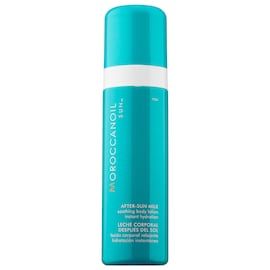
Moroccanoil After-Sun Milk Soothing Body Lotion
Works for
1 of 2 advertised claims delivered
Moisturizing15 ingredients credited for this claimGood support
“A lightweight, soothing body lotion that enhances and extends your sunkissed glow while nourishing and hydrating skin.”
This product can help improve hydration of the skin with the two types of ingredients.
The first type is called “humectants”:
these ingredients help attract water.
When humectants are on the surface of the skin, they “pull in” the moisture from the outside environment, or from
within deeper layers of the skin. The following ingredients in this product do the job:
glycerin, caprylyl glycol.
This product also contains ingredients called “occlusives”. They help reduce the speed with which our skin loses moisture to the outside environment. These ingredients also help soften the upper layer of the skin, so it feels less tight and nicer to the touch. The following ingredients in this product do the job: caprylic/capric triglyceride, cocos nucifera oil.
Evens skin toneNo ingredient credited for this claimNo support
“Dullness and uneven texture If you want to know more.”
Effective ingredients missing or their concentration is too low
Can it cause trouble?
Irritancy4 strong irritants: Passiflora incarnata seed oil, Gardenia taitensis flower extract + 2 more — patch-test recommendedHigh risk
Comedogenic2 ingredients rated 2 or more on the 0–5 pore-clogging scale2 flagged
User reviews
Be the first — your take helps the next person decide.
Ingredients
Filter by role to see what each ingredient is doing.
Water~45–55%
Caprylic/capric triglyceride~6.5–8%
- Irritation risk
- Medium
A good mix of fatty acids that forms a protective layer on the skin. Improves the shelf life of products. Derived from coconut and glycerin
More about Caprylic/capric triglycerideGlycerin~4.1–5%
- Irritation risk
- Low
One of the best moisturizing ingredients. Naturally present in skin. It attracts water to the upper layer of the skin working as a humectant
More about GlycerinCyclopentasiloxane~3.3–4%
- Irritation risk
- Low
A silicone that helps improve the product texture and spreadability. Can absorb oil creating a short-term mattifying effect on the skin
More about CyclopentasiloxaneCetearyl alcohol~2.4–3%
- Irritation risk
- Low
- Comedogenicity
- 2/5
A non-drying alcohol. Works as an emollient. Helps water and oil mix together and creates a nice product texture
More about Cetearyl alcoholDicaprylyl carbonate~2–2.5%
- Irritation risk
- Low
Helps products spread more easily and works as an emollient to soften skin
More about Dicaprylyl carbonateSorbitol~1.7–2.1%
- Irritation risk
- Low
Helps attract water to the upper layer of the skin and improves the product texture
More about SorbitolPeg-8~1.5–1.8%
- Irritation risk
- Medium
Used to create a nice product consistency
More about Peg-8Cocos nucifera oil~1.3–1.6%
- Irritation risk
- Low
- Comedogenicity
- 3/5
An emollient. Found to be as effective as a moisturizer for dry skin as mineral oil. Could be comedogenic
More about Cocos nucifera oilArgania spinosa kernel oil~1–1.2%
- Irritation risk
- Medium
An emollient that helps soften the upper layer of the skin. Might have some weak anti-oxidant properties
More about Argania spinosa kernel oilTocopherol~0.7–1.05%
- Irritation risk
- Low
Pure form of vitamin E. Can help moisturise and protect the skin from free radicals. Often used to help stabilise other ingredients or the formula itself
More about TocopherolTocopheryl acetate~0.6–0.9%
- Irritation risk
- Medium
A more stable but less bio-available form of vitamin E compared to Tocopherol. Might help moisturize and protect the skin from free radicals, but mostly used in low concentrations to stabilize other ingredients.
More about Tocopheryl acetateAloe barbadensis leaf juice powder~0.5–0.8%
- Irritation risk
- Medium
Traditionally used to treat sunburns, dermatitis and inflammation, but evidence for its effectiveness is lacking. The extract can contain humectants that help attract water into the skin
More about Aloe barbadensis leaf juice powderPassiflora incarnata seed oil~0.5–0.7%
- Irritation risk
- High
A plant oil that can help soften the upper layer of the skin. Contains essential oil that can be irritating
More about Passiflora incarnata seed oilGardenia taitensis flower extract~0.45–0.65%
Microcrystalline cellulose~0.5–0.7%
Tyrosine~0.4–0.6%
Ornithine hcl~0.35–0.65%
- Irritation risk
- Low
Arginine hcl~0.3–0.55%
- Irritation risk
- Low
An amino acid that is naturally present in skin and helps keep it hydrated. When used together with AHAs, it can reduce their irritating effect on the skin
More about Arginine hclCellulose gum~0.3–0.55%
- Irritation risk
- Low
Used to create thicker product consistency and stabilize emulsions
More about Cellulose gumParfum~0.25–0.45%
- Irritation risk
- High
An aromatic blend of unspecified and possibly irritating ingredients
More about ParfumMenthyl lactate~0.25–0.45%
Inulin lauryl carbamate~0.2–0.4%
Caprylyl glycol~0.25–0.45%
- Irritation risk
- Medium
Helps preserve products and creates a nice product texture
More about Caprylyl glycolSodium polyacrylate~0.25–0.45%
- Irritation risk
- Low
Used to create a gel-like product texture, as well as to stabilize emulsions
More about Sodium polyacrylateSodium bicarbonate~0.25–0.5%
Ethylhexylglycerin~0.15–0.3%
C30-45 alkyl cetearyl dimethicone crosspolymer~0.2–0.35%
- Irritation risk
- Low
Helps to create a nice silky product texture
More about C30-45 alkyl cetearyl dimethicone crosspolymerSilica~0.2–0.4%
Triethanolamine~0.1–0.2%
- Irritation risk
- Medium
Used to adjust pH of the product and can help improve the product's smell
More about TriethanolaminePhenoxyethanol~0.1–0.2%
- Irritation risk
- Low
A preservative. It helps prevent bacterial growth in cosmetic products
More about PhenoxyethanolIngredient list view
Water, Caprylic/capric triglyceride, Glycerin, Cyclopentasiloxane, Cetearyl alcohol, Dicaprylyl carbonate, Sorbitol, Peg-8, Cocos nucifera oil, Argania spinosa kernel oil, Tocopherol, Tocopheryl acetate, Aloe barbadensis leaf juice powder, Passiflora incarnata seed oil, Gardenia taitensis flower extract, Microcrystalline cellulose, Tyrosine, Ornithine hcl, Arginine hcl, Cellulose gum, Parfum, Menthyl lactate, Inulin lauryl carbamate, Caprylyl glycol, Sodium polyacrylate, Sodium bicarbonate, Ethylhexylglycerin, C30-45 alkyl cetearyl dimethicone crosspolymer, Silica, Triethanolamine, Phenoxyethanol
Compare prices
Retailers ranked by price — lowest first.
Sources cited in this review
Every concentration estimate and effectiveness label is anchored to one of these 5 studies and safety reviews.
- 1
- 2
- 3Vitamin E in dermatologyncbi.nlm.nih.gov
- 4Vitamin E and Skin Healthlpi.oregonstate.edu
- 5

Affiliate links · As an Amazon Associate, WIMJ earns from qualifying purchases.