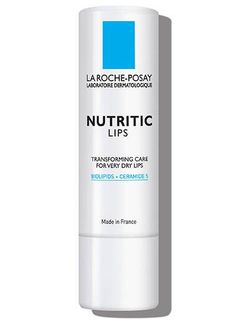
La Roche-Posay Nutritic Lip Balm
Works for
1 of 1 advertised claim delivered
MoisturizingHydroxypalmitoyl sphinganine, Bis-diglyceryl polyacyladipate-2 + 15 moreStrong evidence
“Moisturizes very dry lips”
This product can help improve hydration of the skin with the two types of ingredients.
The first type is called “humectants”:
these ingredients help attract water.
When humectants are on the surface of the skin, they “pull in” the moisture from the outside environment, or from
within deeper layers of the skin. The following ingredients in this product do the job:
glycerin.
This product also contains ingredients called “occlusives”. They help reduce the speed with which our skin loses moisture to the outside environment. These ingredients also help soften the upper layer of the skin, so it feels less tight and nicer to the touch. The following ingredients in this product do the job: bis-diglyceryl polyacyladipate-2, butyrospermum parkii butter.
The following ingredients in this product are especially good for supporting the skin barrier and helping with the hydration level: hydroxypalmitoyl sphinganine
Can it cause trouble?
Irritancy1 strong irritant: Coriandrum sativum fruit oilMedium risk
Comedogenic3 ingredients rated 2 or more on the 0–5 pore-clogging scale3 flagged
User reviews
Be the first — your take helps the next person decide.
Ingredients
Filter by role to see what each ingredient is doing.
Polyethylene~23–34%
Polybutene~4.9–7.4%
Bis-diglyceryl polyacyladipate-2~4.8–7.1%
- Irritation risk
- Low
Helps soften the upper layer of the skin and reduce water loss from its surface
More about Bis-diglyceryl polyacyladipate-2Butyrospermum parkii butter~3.7–5.6%
- Irritation risk
- Low
- Comedogenicity
- 3/5
A great moisturising ingredient that softens the skin and reduces water loss from its upper layer. It also can be helpful in protecting skin from free radicals
More about Butyrospermum parkii butterHydrogenated polyisobutene~2.8–4.2%
- Irritation risk
- Low
Used to improve the product consistency and soften the upper layer of the skin
More about Hydrogenated polyisobuteneMyristyl myristate~2.3–3.4%
- Irritation risk
- Medium
- Comedogenicity
- 3/5
An emollient. Is not recommended for acne-prone skin as it can be comedogenic
More about Myristyl myristateCera alba~2.1–3.2%
- Irritation risk
- Medium
Forms a protective barrier that holds water and keeps dry skin hydrated. Keeps an emulsion from separating into its oil and liquid components, and increases the thickness of a product. Can be an allergen
More about Cera albaOctyldodecanol~1.4–2%
- Irritation risk
- Low
An emollient that helps to soften the skin and create a pleasant product texture and stabilize the formulation
More about OctyldodecanolRicinus communis seed oil~1.3–2%
- Irritation risk
- Medium
A plant oil that can help soften the skin. It might be helpful in calming down inflammation, but solid research is lacking. Is often used in lip products to create the needed product consistency
More about Ricinus communis seed oilCetyl alcohol~1.1–1.6%
- Irritation risk
- Low
A non-drying alcohol that works to soften the skin and stabilize product formulations helping oil and water mix together
More about Cetyl alcoholLimnanthes alba seed oil~0.85–1.25%
- Irritation risk
- Low
This oil's cmposition is closest to rapeseed oil. It is a very stable oil and serves as an emoillient
More about Limnanthes alba seed oilCetyl palmitate~0.55–1.3%
- Irritation risk
- Low
An emollient that helps soften the skin and is used to improve product texture and stability
More about Cetyl palmitateGlycerin~0.5–1.1%
- Irritation risk
- Low
One of the best moisturizing ingredients. Naturally present in skin. It attracts water to the upper layer of the skin working as a humectant
More about GlycerinRibes nigrum seed oil~0.45–1.1%
- Irritation risk
- Medium
An emollient. Can be helpful for restoring skin barrier function.
More about Ribes nigrum seed oilEchium lycopsis fruit oil~0.4–0.9%
- Irritation risk
- Low
Coriandrum sativum fruit oil~0.35–0.85%
- Irritation risk
- High
A plant oil that is used as a fragrance. Can be irritating
More about Coriandrum sativum fruit oilPrunus armeniaca kernel oil~0.4–0.95%
- Irritation risk
- Medium
An emollient that helps soften the skin
More about Prunus armeniaca kernel oilTocopheryl acetate~0.2–0.75%
- Irritation risk
- Medium
A more stable but less bio-available form of vitamin E compared to Tocopherol. Might help moisturize and protect the skin from free radicals, but mostly used in low concentrations to stabilize other ingredients.
More about Tocopheryl acetateHydroxypalmitoyl sphinganine~0.15–0.7%
- Irritation risk
- Low
A type of lipid similar to ceramides naturally present in skin. Helps to soften the upper layer of the skin and supports the skin barrier function to keep it hydrated. Can help to prevent inflammation in skin
More about Hydroxypalmitoyl sphinganinePentaerythrityl tetra-di-t-butyl hydroxyhydrocinnamate~0.1–0.5%
- Irritation risk
- Low
Used to increase stability of product formulations
More about Pentaerythrityl tetra-di-t-butyl hydroxyhydrocinnamateTitanium dioxide~0.2–0.7%
- Irritation risk
- Low
Works as a UV filter when used in high concentrations. It is photostable and is effective mostly against the UVB light, with some protection in the UVA range. In small concentrations, used for its ability to improve the color of cosmetic products. Is usually well tolerated by the skin
More about Titanium dioxideStearyl alcohol~0.15–0.6%
- Irritation risk
- Low
An emollient that helps soften the skin
More about Stearyl alcoholGlycine soja oil~0.1–0.4%
- Irritation risk
- Medium
- Comedogenicity
- 2/5
A good emollient that helps soften the skin and helps repair its barrier function. It can clog pores if used in high concentrations.
More about Glycine soja oilMyristyl alcohol~0.1–0.45%
- Irritation risk
- High
Helps to stabilize the product formulation while softening the upper layer of the skin. Can be irritating
More about Myristyl alcoholCitric acid~0.05–0.1%
- Irritation risk
- Medium
Can work as an exfoliant but is typically used to adjust the product pH
More about Citric acidTocopherol~0.01–0.1%
- Irritation risk
- Low
Pure form of vitamin E. Can help moisturise and protect the skin from free radicals. Often used to help stabilise other ingredients or the formula itself
More about TocopherolAscorbyl palmitate~0.01–0.05%
- Irritation risk
- Medium
Being a lipid soluble form of vitamin C, it is more stable and can penetrate the skin better than L-Ascorbic acid. It is effective in protecting the skin from free radicals, as well as evening the skin tone, but is less effective in stimulating collagen production compared to L-Ascorbic acid.
More about Ascorbyl palmitateIngredient list view
Polyethylene, Polybutene, Bis-diglyceryl polyacyladipate-2, Butyrospermum parkii butter, Hydrogenated polyisobutene, Myristyl myristate, Cera alba, Octyldodecanol, Ricinus communis seed oil, Cetyl alcohol, Limnanthes alba seed oil, Cetyl palmitate, Glycerin, Ribes nigrum seed oil, Echium lycopsis fruit oil, Coriandrum sativum fruit oil, Prunus armeniaca kernel oil, Tocopheryl acetate, Hydroxypalmitoyl sphinganine, Pentaerythrityl tetra-di-t-butyl hydroxyhydrocinnamate, Titanium dioxide, Stearyl alcohol, Glycine soja oil, Myristyl alcohol, Citric acid, Tocopherol, Ascorbyl palmitate
Compare prices
Retailers ranked by price — lowest first.

Sources cited in this review
Every concentration estimate and effectiveness label is anchored to one of these 17 studies and safety reviews.
- 1
- 2
- 3
- 4
- 5
- 6

Affiliate links · As an Amazon Associate, WIMJ earns from qualifying purchases.