Works for
1 of 3 advertised claims delivered
Moisturizing17 ingredients credited for this claimStrong support
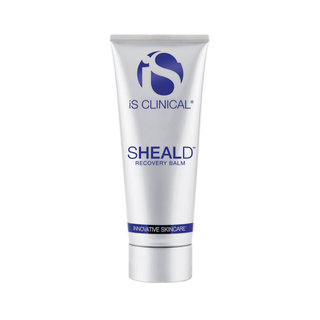
“Formulated for sensitive, compromised and dry skin types, iS Clinical Sheald Recovery Balm contains a high concentration of barrier repairing ceramides that help to rebuild skin function and is therefore ideal for skin irritations caused by in-clinic procedures such as laser, microdermabrasion and chemical peel treatments.”
This product can help improve hydration of the skin with the two types of ingredients.
The first type is called “humectants”:
these ingredients help attract water.
When humectants are on the surface of the skin, they “pull in” the moisture from the outside environment, or from
within deeper layers of the skin. The following ingredients in this product do the job:
ahnfeltia concinna extract, glycerin.
This product also contains ingredients called “occlusives”. They help reduce the speed with which our skin loses moisture to the outside environment. These ingredients also help soften the upper layer of the skin, so it feels less tight and nicer to the touch. The following ingredients in this product do the job: cholesterol, cetearyl alcohol.
The following ingredients in this product are especially good for supporting the skin barrier and helping with the hydration level: ceramide 1, ceramide 3, ceramide 6 ii, petrolatum, phytosphingosine
Evens skin tone1 ingredient credited for this claimWeak support
“The thick, moisture-rich balm eases irritation whilst also helping to stimulate collagen production within skin’s lower layers, to encourage faster healing and prevent the development of scarring.”
Effective ingredients missing or their concentration is too low
Exfoliation1 ingredient credited for this claimWeak support
“Sheald Recovery Balm can be used following abrasive in-clinic procedures such as laser, microdermabrasion and chemical treatments.”
This product does not contain effective exfoliating ingredients. It might be able to deliver physical exfoliation, that is scrub off some of the dead cells on the surface of the skin. We do not recommend physical exfoliation, because it is not uniform (some bits of skin can get exfoliated too much while others not at all). It can also traumatize the skin and aggrevate acne and other skin conditions.
Anti-oxidationNot advertised by the brand · 2 ingredients credited for this claimStrong support
This product contains antioxidants (tocopherol) that can help neutralize free radicals in skin. By doing so, they can lessen the damage the skin gets from the UV light (sun).
Anti-agingNot advertised by the brand · 2 ingredients credited for this claimModerate support
This product contains tocopherol. This ingredient help neutralize free radicals in skin. By doing so, they might be able to prevent early signs of aging (like fine lines and wrinkles), at least to some extent. These ingredients will not be able to "reverse" signs of aging.
Can it cause trouble?
Irritancy1 strong irritant: Retinyl palmitateMedium risk
Comedogenic3 ingredients rated 2 or more on the 0–5 pore-clogging scale3 flagged
User reviews
Be the first — your take helps the next person decide.
Ingredients
Filter by role to see what each ingredient is doing.
Water~45–55%
Sodium hyaluronate~7.4–9%
- Irritation risk
- Low
One of the best moisturizing ingredients. Attracts water into the upper layer of the skin
More about Sodium hyaluronateGlycerin~4.2–5.1%
- Irritation risk
- Low
One of the best moisturizing ingredients. Naturally present in skin. It attracts water to the upper layer of the skin working as a humectant
More about GlycerinC12-15 pareth-3 benzoate~3.2–3.9%
- Irritation risk
- Low
Petrolatum~2.4–2.9%
- Irritation risk
- Low
One of the most effective and the most studied occlusive ingredients that creates a protective layer on top of the skin preventing moisture loss
More about PetrolatumTocopherol~1.8–2.2%
- Irritation risk
- Low
Pure form of vitamin E. Can help moisturise and protect the skin from free radicals. Often used to help stabilise other ingredients or the formula itself
More about TocopherolCetearyl alcohol~1.6–2%
- Irritation risk
- Low
- Comedogenicity
- 2/5
A non-drying alcohol. Works as an emollient. Helps water and oil mix together and creates a nice product texture
More about Cetearyl alcoholCeteareth-20~1.5–1.8%
- Irritation risk
- Medium
- Comedogenicity
- 2/5
Helps oil and water mix together. Has some emollient properties
More about Ceteareth-20Glyceryl stearate~1.2–1.5%
- Irritation risk
- Low
An emollient that softens the skin and forms a protective layer on its surface. Helps water and oil mix together
More about Glyceryl stearatePeg-100 stearate~1–1.3%
- Irritation risk
- Low
Helps oil and water mix togehter and creates a nice product texture
More about Peg-100 stearateZea mays kernel extract~0.75–1.15%
- Irritation risk
- Low
- Comedogenicity
- 3/5
Avena sativa kernel extract~0.6–0.95%
- Irritation risk
- Low
An effective moisturizing and skin barrier repair ingredient. Helps calm down inflammation and has some anti-oxidant properties
More about Avena sativa kernel extractSorbitan stearate~0.55–0.85%
Ahnfeltia concinna extract~0.5–0.75%
- Irritation risk
- Low
An algae extract that helps attract water to the upper layer of the skin. Also used to create a thicker product texture
More about Ahnfeltia concinna extractCeramide 3~0.5–0.8%
- Irritation risk
- Low
A type of lipid similar to ceramides naturally present in skin. Helps to soften the upper layer of the skin and supports the skin barrier function to keep it hydrated. Can help to prevent inflammation in skin
More about Ceramide 3Sodium lauroyl lactylate~0.5–0.75%
- Irritation risk
- Medium
Helps water and oil mix together
More about Sodium lauroyl lactylateCeramide 6 ii~0.5–0.75%
- Irritation risk
- Low
A type of lipid similar to ceramides naturally present in skin. Helps to soften the upper layer of the skin and supports the skin barrier function to keep it hydrated. Can help to prevent inflammation in skin
More about Ceramide 6 iiCeramide 1~0.45–0.7%
- Irritation risk
- Low
A type of lipid similar to ceramides naturally present in skin. Helps to soften the upper layer of the skin and supports the skin barrier function to keep it hydrated. Can help to prevent inflammation in skin
More about Ceramide 1Cholesterol~0.45–0.65%
- Irritation risk
- Low
An emollient that is naturally found in skin
More about CholesterolPhytosphingosine~0.4–0.6%
- Irritation risk
- Low
A type of lipid that is naturally present in skin. It might help in repairing skin barrier function and has anti-bacterial effect
More about PhytosphingosinePeg-8~0.3–0.55%
- Irritation risk
- Medium
Used to create a nice product consistency
More about Peg-8Peg-8/smdi copolymer~0.3–0.55%
- Irritation risk
- Low
Piper methysticum leaf/root/stem extract~0.25–0.45%
- Irritation risk
- Low
Panthenol~0.25–0.45%
- Irritation risk
- Low
Helps attract water to the upper layer of the skin and can help improve skin barrier function
More about PanthenolButylene glycol~0.2–0.4%
- Irritation risk
- Low
Used to create a nice product texture and help delivery of other ingredients. Might be somewhat helpful in attracting water to the upper layer of the skin
More about Butylene glycolPolysorbate 20~0.25–0.4%
Xanthan gum~0.2–0.35%
- Irritation risk
- Low
Used to create a thicker product consistency
More about Xanthan gumCarbomer~0.15–0.25%
- Irritation risk
- Low
Helps create a thicker or gel-like product texture. It is not a surfactant but can be used in gentle cleansing formulations
More about CarbomerRetinyl palmitate~0.1–0.2%
- Irritation risk
- High
Three steps removed from the active form of vitamin A - retinoic acid. To have an effect in the skin, it first needs to be converted twice to become the retinoic acid. This means it is less potent than retinol, but could also be less irritating. Once converted to the retinoic acid in the skin, it helps against all signs of aging, improves skin cell turnover and helps fight blemishes and clogged pores. However, in many cosmetic formulations, it is used in a concentration that is too low to have the full effect
More about Retinyl palmitateTriethanolamine~0.1–0.2%
- Irritation risk
- Medium
Used to adjust pH of the product and can help improve the product's smell
More about TriethanolamineCaprylyl glycol~0.1–0.2%
- Irritation risk
- Medium
Helps preserve products and creates a nice product texture
More about Caprylyl glycol1,2-hexanediol~0.05–0.15%
Disodium edta~0.01–0.05%
Ingredient list view
Water, Sodium hyaluronate, Glycerin, C12-15 pareth-3 benzoate, Petrolatum, Tocopherol, Cetearyl alcohol, Ceteareth-20, Glyceryl stearate, Peg-100 stearate, Zea mays kernel extract, Avena sativa kernel extract, Sorbitan stearate, Ahnfeltia concinna extract, Ceramide 3, Sodium lauroyl lactylate, Ceramide 6 ii, Ceramide 1, Cholesterol, Phytosphingosine, Peg-8, Peg-8/smdi copolymer, Piper methysticum leaf/root/stem extract, Panthenol, Butylene glycol, Polysorbate 20, Xanthan gum, Carbomer, Retinyl palmitate, Triethanolamine, Caprylyl glycol, 1,2-hexanediol, Disodium edta
Compare prices
Retailers ranked by price — lowest first.

Product summary
Based on the ingredient list, "iS Clinical - SHEALD™ Recovery Balm" can work well for skin moisturization. As we expect from a proper moisturizer, the formula includes a combo of effective humectants and emollients. These are the two different types of ingredients that are essential for improving the skin hydration and supporting a healthy skin barrier. Ahnfeltia concinna extract, glycerin, sodium hyaluronate, butylene glycol and caprylyl glycol in this product (humectants) attract water molecules to the upper layer of the skin (the water comes from the outside air or from the deeper layers of the skin if the air is dry). Ceramide 1, ceramide 3, ceramide 6 ii, phytosphingosine and petrolatum in this product help decrease the water evoporation from the skin, so that it stays hydrated for longer. These ingredients also soften the skin and take away the feeling of tightness and dryness.
Ingredient callouts
- this moisturizer includes a form of retinoids (vitamin A) - retinyl palmitate 0.10% - 0.20%, but this type of vitamin A is not very effective. It could in theory help with fine lines and wrinkles, but the effect is most likely minimal.
- Another benefit is that this moisturizer contain ceramides (phytosphingosine 0.40% - 0.60%, ceramide 6 ii 0.50% - 0.75%, ceramide 3 0.50% - 0.80% and ceramide 1 0.45% - 0.70%). Ceramides are an important part of our natural skin barrier. The ceramides used in skincare are synthetic or come from plants. They help soften the skin and can help "fill the gaps" in the skin barrier, keeping the skin hydrated and resilient for longer.
Irritation risk
This moisturizer contains actives that can be irritating. We assess the overall irritancy of this moisturizer to be medium. For a detailed overview of all potential irritants: click here
You can see the detailed formula review with the breakdown of all actives in the product and the full ingredient list with estimated concentrations in the tables below.
Price
The product retails for 75.00$ in the United States, from 92.50CA$ up to 96.95CA$ in Canada, for 87.40A$ in Australia and from 26.00£ up to 60.00£ in the United Kingdom.
For a detailed price comparison: click here.
Sources cited in this review
Every concentration estimate and effectiveness label is anchored to one of these 9 studies and safety reviews.
- 1Hyaluronic acid: A key molecule in skin agingncbi.nlm.nih.gov
- 2
- 3
- 4Vitamin E in dermatologyncbi.nlm.nih.gov
- 5Vitamin E and Skin Healthlpi.oregonstate.edu
- 6

Affiliate links · As an Amazon Associate, WIMJ earns from qualifying purchases.