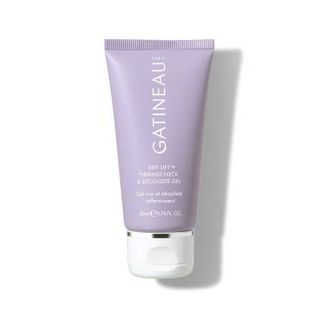
Gatineau DEFILIFT 3D™ Firming Neck Decollete Gel
Works for
1 of 1 advertised claim delivered
Anti-aging2 ingredients credited for this claimModerate support
“With a complex of powerful Vitamins, this vulnerable area is intensively regenerated and protected for a smoother, more youthful appearance.”
This product contains threonine. This ingredient might be able to help reduce and prevent fine lines and wrinkles, improve skin elasticity and firmness, but there is not enough evidence that it actually works.
MoisturizingNot advertised by the brand · 12 ingredients credited for this claimGood support
This product can help improve hydration of the skin with the two types of ingredients.
The first type is called “humectants”:
these ingredients help attract water.
When humectants are on the surface of the skin, they “pull in” the moisture from the outside environment, or from
within deeper layers of the skin. The following ingredients in this product do the job:
glutamic acid, glycerin.
This product also contains ingredients called “occlusives”. They help reduce the speed with which our skin loses moisture to the outside environment. These ingredients also help soften the upper layer of the skin, so it feels less tight and nicer to the touch. The following ingredients in this product do the job: helianthus annuus seed oil, ethyl linoleate.
Anti-blemishNot advertised by the brand · 1 ingredient credited for this claimGood support
This product might be able to help reduce blemishes and clogged pores because it contains ethyl linoleate.
Can it cause trouble?
Irritancy2 strong irritants: Menthol, ParfumMedium risk
Comedogenic1 ingredient rated 2 or more on the 0–5 pore-clogging scale1 flagged
User reviews
Be the first — your take helps the next person decide.
Ingredients
Filter by role to see what each ingredient is doing.
Water~45–55%
Tromethamine~9.1–11.1%
Helianthus annuus seed oil~4.6–5.6%
- Irritation risk
- Low
A great emollient due to its high linoleic acid content. One of the most effective plant oils in helping skin hydration and repairing skin barrier function
More about Helianthus annuus seed oilButylene glycol~3.2–3.9%
- Irritation risk
- Low
Used to create a nice product texture and help delivery of other ingredients. Might be somewhat helpful in attracting water to the upper layer of the skin
More about Butylene glycolNylon-12~2.4–3%
Acrylates/vinyl isodecanoate crosspolymer~2.1–2.5%
- Irritation risk
- Medium
Used to stabilize product formulation, help create an even product layer over skin (for example, in sunscreen), evenly disperse pigements and create a nice product consistency
More about Acrylates/vinyl isodecanoate crosspolymerCaesalpinia spinosa fruit extract~1.7–2.1%
- Irritation risk
- Low
Caprylyl glycol~1.6–2%
- Irritation risk
- Medium
Helps preserve products and creates a nice product texture
More about Caprylyl glycolDisodium succinate~1.4–1.7%
Ethyl linoleate~1.2–1.4%
- Irritation risk
- Medium
Helps reduce acne and blemishes. Helps to soften the upper layer of the skin and reduce inflammation. Might be helpful in reducing hyperpigmentation and evening out the skin tone, but evidence of effectiveness in skin are lacking
More about Ethyl linoleateEthyl linolenate~1–1.2%
- Irritation risk
- Low
Ethyl oleate~0.75–1.1%
- Irritation risk
- Medium
Ethyl oleate is a long-chain fatty acid ethyl ester resulting from the formal condensation of the carboxy group of oleic acid with the hydroxy group of ethanol. It derives from an oleic acid. In skincare, it is used to soften the upper layer of the skin, improve the product texture and smell
More about Ethyl oleateEthylhexylglycerin~0.65–1%
Glutamic acid~0.65–0.95%
- Irritation risk
- Low
An amino-acid that helps attract water to the upper layer of the skin
More about Glutamic acidGlycerin~0.65–0.95%
- Irritation risk
- Low
One of the best moisturizing ingredients. Naturally present in skin. It attracts water to the upper layer of the skin working as a humectant
More about GlycerinGlycine~0.6–0.85%
- Irritation risk
- Low
Helps to attract water to the upper layer of the skin and can help restore the skin barrier function
More about GlycineKappaphycus alvarezii extract~0.55–0.85%
- Irritation risk
- Low
A red algae extract that can help attract water to the upper layer of the skin and might have some antioxidant properties
More about Kappaphycus alvarezii extractLaureth-4~0.55–0.85%
- Irritation risk
- Medium
- Comedogenicity
- 2/5
Helps water and oil mix together
More about Laureth-4Menthol~0.5–0.75%
- Irritation risk
- High
Polyvinyl alcohol~0.5–0.75%
Propylene glycol~0.45–0.65%
- Irritation risk
- High
Helps oil and water mix together and can enhance the penetration of other ingredients into the skin. It can be irritating
More about Propylene glycolSaccharide isomerate~0.45–0.65%
- Irritation risk
- Low
Helps attract water to the upper layer of the skin
More about Saccharide isomerateSaccharomyces lysate~0.4–0.6%
- Irritation risk
- Low
Sodium citrate~0.4–0.6%
- Irritation risk
- Medium
Helps to control the skin's pH level. Maintains the skin's natural film of amino-lactic acids and oils. Helps to preserve products
More about Sodium citrateSodium polystyrene sulfonate~0.4–0.6%
Sorghum bicolor stalk juice~0.35–0.65%
- Irritation risk
- Low
Threonine~0.35–0.6%
- Irritation risk
- Low
An amino-acid that helps to attract water to the upper layer of the skin. In combination with other amino-acids, might help to reduce fine lines and wrinkles
More about ThreonineTocopherol~0.3–0.6%
- Irritation risk
- Low
Pure form of vitamin E. Can help moisturise and protect the skin from free radicals. Often used to help stabilise other ingredients or the formula itself
More about TocopherolTocopheryl acetate~0.3–0.6%
- Irritation risk
- Medium
A more stable but less bio-available form of vitamin E compared to Tocopherol. Might help moisturize and protect the skin from free radicals, but mostly used in low concentrations to stabilize other ingredients.
More about Tocopheryl acetateValine~0.3–0.55%
- Irritation risk
- Low
Parfum~0.2–0.4%
- Irritation risk
- High
An aromatic blend of unspecified and possibly irritating ingredients
More about ParfumChlorphenesin~0.15–0.3%
Citric acid~0.15–0.3%
- Irritation risk
- Medium
Can work as an exfoliant but is typically used to adjust the product pH
More about Citric acidMethylparaben~0.15–0.25%
Phenoxyethanol~0.15–0.25%
- Irritation risk
- Low
A preservative. It helps prevent bacterial growth in cosmetic products
More about PhenoxyethanolCi 15985~0.1–0.2%
Ingredient list view
Water, Tromethamine, Helianthus annuus seed oil, Butylene glycol, Nylon-12, Acrylates/vinyl isodecanoate crosspolymer, Caesalpinia spinosa fruit extract, Caprylyl glycol, Disodium succinate, Ethyl linoleate, Ethyl linolenate, Ethyl oleate, Ethylhexylglycerin, Glutamic acid, Glycerin, Glycine, Kappaphycus alvarezii extract, Laureth-4, Menthol, Polyvinyl alcohol, Propylene glycol, Saccharide isomerate, Saccharomyces lysate, Sodium citrate, Sodium polystyrene sulfonate, Sorghum bicolor stalk juice, Threonine, Tocopherol, Tocopheryl acetate, Valine, Parfum, Chlorphenesin, Citric acid, Methylparaben, Phenoxyethanol, Ci 15985
Compare prices
Retailers ranked by price — lowest first.
Sources cited in this review
Every concentration estimate and effectiveness label is anchored to one of these 18 studies and safety reviews.
- 1Safety Assessment of Tromethamine as Used in Cosmeticscir-safety.org
- 2
- 3
- 4Effect of topically applied lipids on surfactant-irritated skinonlinelibrary.wiley.com
- 5
- 6Safety Assessment of Cross-Linked Alkyl Acrylates as Used in Cosmeticsjournals.sagepub.com

Affiliate links · As an Amazon Associate, WIMJ earns from qualifying purchases.