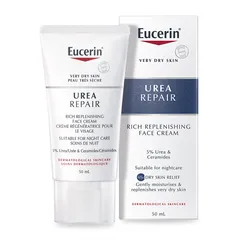
Works for:
based on ingredients and %- Moisturizing
Doesn't work for:
based on ingredients and %- Anti-aging
Can it cause trouble?
- Irritation risk: low
- Comedogenic risk ingredients: 0
Key actives

Product Summary
Based on the ingredients included, "Eucerin - Dry Skin Replenishing Face Cream Night 5% Urea" works well for moisturizing the skin. As we expect from a proper moisturizer, the formula includes a combo of effective humectants and emollients. These are the two different types of ingredients that are essential for improving the skin hydration and supporting a healthy skin barrier. Urea, biosaccharide gum-1, cyclomethicone, glycerin and sodium lactate in this product (humectants) attract water molecules to the upper layer of the skin (the water comes from the outside air or from the deeper layers of the skin if the air is dry). Ceramide 3, cyclomethicone, caprylic/capric triglyceride, dimethicone and cetyl alcohol in this product help decrease the water evoporation from the skin, so that it stays hydrated for longer. These ingredients also soften the skin and take away the feeling of tightness and dryness.
Ingredient callouts
- Another benefit is that this moisturizer contain ceramides (ceramide 3 0.15% - 0.25%). Ceramides are an important part of our natural skin barrier. The Ceramides used in skincare are synthetic or come from plants. They help soften the skin and can help "fill the gaps" in the skin barrier, keeping the skin hydrated and resilient for longer.
Irritation risk
This moisturizer contains some common irritants, including those without a benefit for the skin. We assess the overall irritancy of this moisturizer to be low. For a detailed overview of all potential irritants: click here
You can see the detailed formula review with the breakdown of all actives in the product and the full ingredient list with estimated concentrations in the tables below.
Price
The product retails from 8.80£ up to 20.00£ in the United Kingdom and for 11.00$ in the United States.
For a detailed price comparison: click here.
Moisturizing
What does the product description say?
Powered by 5% Urea, the moisturiser improves the appearance of rough skin while conditioning the skin’s surface with intense moisture.
Source: Mankind
This product can help improve hydration of the skin with the two types of ingredients.
The first type is called “humectants”:
these ingredients help attract water.
When humectants are on the surface of the skin, they “pull in” the moisture from the outside environment, or from
within deeper layers of the skin. The following ingredients in this product do the job:
alanine, glycerin.
This product also contains ingredients called “occlusives”. They help reduce the speed with which our skin loses moisture to the outside environment. These ingredients also help soften the upper layer of the skin, so it feels less tight and nicer to the touch. The following ingredients in this product do the job: caprylic/capric triglyceride, cholesterol.
The following ingredients in this product are especially good for supporting the skin barrier and helping with the hydration level: ceramide np, phytosphingosine, urea
A good mix of fatty acids that forms a protective layer on the skin. Improves the shelf life of products. Derived from coconut and glycerin
A type of lipid that is naturally present in skin. It might help in repairing skin barrier function and has anti-bacterial effect
Helps attract water to the upper layer of the skin. Is often used to adjust the pH level of the product
Naturally present in skin and helps to attract water to its upper layer
Naturally present in skin (urea makes up about 7% of natural moisturizing factors in skin). Attracts water to the upper layer of the skin. Also has a positive effect on the skin barrier beyond the humectant action. Can enhance penetration of other ingredients. Is an exfoliating ingredient when used in high concentrations
Helps to attract water to the upper layer of the skin and can help restore the skin barrier function
An amino acid that is naturally present in skin and helps keep it hydrated. When used together with AHAs, it can reduce their irritating effect on the skin
A type of lipid similar to ceramides naturally present in skin. Helps to soften the upper layer of the skin and supports the skin barrier function to keep it hydrated. Can help to prevent inflammation in skin
An emollient that is naturally found in skin
One of the best moisturizing ingredients. Naturally present in skin. It attracts water to the upper layer of the skin working as a humectant
An amino-acid that helps to attract water to the upper layer of the skin and might help to lighten the skin, but solid evidence is lacking
A non-drying alcohol that works to soften the skin and stabilize product formulations helping oil and water mix together
Helps soften the upper layer of the skin. At the same time, it can weaken the skin's barrier enhancing penetration of other ingredients and increasing the risk of skin dryness
An emollient that softens the skin and forms a protective layer on its surface. Helps water and oil mix together
An exfoliating and moisturizing alpha-hydroxy acid (AHA). Typically causes less irritation than other AHAs, for example, glycolic acid. At high concentrations (about 15%), lactic acid can help reduce lines and wrinkles. Recent studies show that lactic acid can support the "good" bacteria living on skin's surface (healthy skin microbiome)
Pure form of vitamin E. Can help moisturise and protect the skin from free radicals. Often used to help stabilise other ingredients or the formula itself
Anti-aging
What does the product description say?
Dry skin was reduced, along with scaling, fine lines and redness.
Source: Boots
This product does not contain ingredients that are able to reduce fine lines and wrinkles or help with skin elasticity, but it can improve the look of the skin temporarily through moisturization. Well-moisturized skin might also be able to repair the sun damage better.
An exfoliating and moisturizing alpha-hydroxy acid (AHA). Typically causes less irritation than other AHAs, for example, glycolic acid. At high concentrations (about 15%), lactic acid can help reduce lines and wrinkles. Recent studies show that lactic acid can support the "good" bacteria living on skin's surface (healthy skin microbiome)
Pure form of vitamin E. Can help moisturise and protect the skin from free radicals. Often used to help stabilise other ingredients or the formula itself
How honest is this product?
| Promise | Can it deliver? |
|---|---|
| Moisturizing | |
| Anti-aging |
Total Promises Fulfilled score: 75/100.
We receive a small commission for purchases made through these links at no cost for you. Thank you for your support! Learn more
Potential irritants
Comedogenic ingredients
No comedogenic ingredients detected
User reviews (0)
Averages from community submissions.
No reviews yet for this product.
Be the first to share your experience!
Tried this product?
Help capture what the ingredient list can't—texture, finish, pilling, scent, and more. Answer what you can, skip the rest.
Takes ~30 seconds.
Reviews are shown in aggregate. No personal details.
| Product | Similarity | Price | Irritancy |
|---|---|---|---|
 Eucerin Dry Skin Replenishing Face Cream Night 5% Urea | Current | ≈ $14.00 | |
 Neogenisis Barrier Renewal Cream | 52% | $197.50 | |
 CeraVe Psoriasis Moisturizing Cream | 50% | - |
Key Actives
An exfoliating and moisturizing alpha-hydroxy acid (AHA). Typically causes less irritation than other AHAs, for example, glycolic acid. At high concentrations (about 15%), lactic acid can help reduce lines and wrinkles. Recent studies show that lactic acid can support the "good" bacteria living on skin's surface (healthy skin microbiome)
Pure form of vitamin E. Can help moisturise and protect the skin from free radicals. Often used to help stabilise other ingredients or the formula itself
A type of lipid similar to ceramides naturally present in skin. Helps to soften the upper layer of the skin and supports the skin barrier function to keep it hydrated. Can help to prevent inflammation in skin
A type of lipid that is naturally present in skin. It might help in repairing skin barrier function and has anti-bacterial effect
Naturally present in skin (urea makes up about 7% of natural moisturizing factors in skin). Attracts water to the upper layer of the skin. Also has a positive effect on the skin barrier beyond the humectant action. Can enhance penetration of other ingredients. Is an exfoliating ingredient when used in high concentrations
An emollient that is naturally found in skin
An amino-acid that helps to attract water to the upper layer of the skin and might help to lighten the skin, but solid evidence is lacking
An amino acid that is naturally present in skin and helps keep it hydrated. When used together with AHAs, it can reduce their irritating effect on the skin
One of the best moisturizing ingredients. Naturally present in skin. It attracts water to the upper layer of the skin working as a humectant
A good mix of fatty acids that forms a protective layer on the skin. Improves the shelf life of products. Derived from coconut and glycerin
Helps attract water to the upper layer of the skin. Is often used to adjust the pH level of the product
Helps to attract water to the upper layer of the skin and can help restore the skin barrier function
Naturally present in skin and helps to attract water to its upper layer
Potential irritants
A good mix of fatty acids that forms a protective layer on the skin. Improves the shelf life of products. Derived from coconut and glycerin
Used to create a thicker product consistency
Helps attract water to the upper layer of the skin. Is often used to adjust the pH level of the product
Helps oil and water mix together and used to stabilize product formulations
An exfoliating and moisturizing alpha-hydroxy acid (AHA). Typically causes less irritation than other AHAs, for example, glycolic acid. At high concentrations (about 15%), lactic acid can help reduce lines and wrinkles. Recent studies show that lactic acid can support the "good" bacteria living on skin's surface (healthy skin microbiome)
Helps soften the upper layer of the skin. At the same time, it can weaken the skin's barrier enhancing penetration of other ingredients and increasing the risk of skin dryness
Comedogenic ingredients
We couldn't find any comedogenic ingredients in this product
All ingredients
One of the best moisturizing ingredients. Naturally present in skin. It attracts water to the upper layer of the skin working as a humectant
Naturally present in skin (urea makes up about 7% of natural moisturizing factors in skin). Attracts water to the upper layer of the skin. Also has a positive effect on the skin barrier beyond the humectant action. Can enhance penetration of other ingredients. Is an exfoliating ingredient when used in high concentrations
A good mix of fatty acids that forms a protective layer on the skin. Improves the shelf life of products. Derived from coconut and glycerin
Used to create a thicker product consistency
A non-drying alcohol that works to soften the skin and stabilize product formulations helping oil and water mix together
An emollient that softens the skin and forms a protective layer on its surface. Helps water and oil mix together
Helps attract water to the upper layer of the skin. Is often used to adjust the pH level of the product
Helps oil and water mix together and used to stabilize product formulations
A type of lipid similar to ceramides naturally present in skin. Helps to soften the upper layer of the skin and supports the skin barrier function to keep it hydrated. Can help to prevent inflammation in skin
An exfoliating and moisturizing alpha-hydroxy acid (AHA). Typically causes less irritation than other AHAs, for example, glycolic acid. At high concentrations (about 15%), lactic acid can help reduce lines and wrinkles. Recent studies show that lactic acid can support the "good" bacteria living on skin's surface (healthy skin microbiome)
Pure form of vitamin E. Can help moisturise and protect the skin from free radicals. Often used to help stabilise other ingredients or the formula itself
An amino-acid that helps to attract water to the upper layer of the skin and might help to lighten the skin, but solid evidence is lacking
Helps to attract water to the upper layer of the skin and can help restore the skin barrier function
Naturally present in skin and helps to attract water to its upper layer
An amino acid that is naturally present in skin and helps keep it hydrated. When used together with AHAs, it can reduce their irritating effect on the skin
A type of lipid that is naturally present in skin. It might help in repairing skin barrier function and has anti-bacterial effect
Helps soften the upper layer of the skin. At the same time, it can weaken the skin's barrier enhancing penetration of other ingredients and increasing the risk of skin dryness
A preservative. It helps prevent bacterial growth in cosmetic products
Used to stabilize mixtures of oil and water, and create thicker, gel-like product textures
Ingredient list view
Water, Glycerin, Urea, Caprylic/capric triglyceride, Pentaerythrityl tetraisostearate, Cetyl alcohol, Glyceryl stearate, Sodium lactate, Hydroxypropyl starch phosphate, Ceramide np, Lactic acid, Tocopherol, Cholesterol, Alanine, Carnitine, Glycine, Sodium pca, Arginine hcl, Phytosphingosine, Potassium cetyl phosphate, Oleic acid, Xanthan gum, 1,2-hexanediol, Phenoxyethanol, Sodium chloride
- Glycerol and the skin: holistic approach to its origin and functions
- Topical urea in skincare: A review
- Safety Assessment of Pentaerythrityl Tetraesters as Used in Cosmetics
- Skin hydration is significantly increased by a cream formulated to mimic the skin’s own natural moisturizing systems
- Topically Applied Ceramides Interact with the Stratum Corneum Lipid Matrix in Compromised Ex Vivo Skin
- Epidermal and dermal effects of topical lactic acid
- Dual Effects of Alpha-Hydroxy Acids on the Skin
- Vitamin E in dermatology
- Vitamin E and Skin Health
- Combination of amino acids reduces pigmentation in B16F0 melanoma cells
- Effect of Topical Application of Glycine and Proline on Recalcitrant Leg Ulcers of Prolidase Deficiency
- Functional glycine receptor in cultured human keratinocytes
- Anti-Inflammatory and Skin Barrier Repair Effects of Topical Application of Some Plant Oils
- https://www.sciencedirect.com/science/article/pii/0168365995000887
- The influence of alkane chain length on the skin irritation potential of 1,2-alkanediols