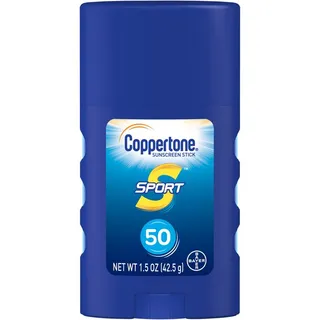
Coppertone Sport Sunscreen Stick SPF 50
Works for
Sun protectionSPF 50 · 4 UV filtersBroad spectrum
This product offers a good level of protection against both UVB and UVA rays.
This sunscreen uses organic (so-called "chemical") sunscreen filters. Organic, or "chemical" filters usually provide reliable sun protection and rarely leave a white cast. Sunscreens with organic filters can sting eyes.
This product can be considered "reef safe" because it does not contain the UV filters (oxybenzone and octinoxate) that can be harmful to coral reefs when present in the water in high concentrations.
Evens skin toneSide benefit · No ingredient credited for this claimWorks well
This product offers broad spectrum sun protection. It means that it can prevent hyperpigmentation and help keep the skin tone even (sun damage is the main factor causing age spots, darkening of post-acne marks and other discolorations).
Anti-agingSide benefit · Sodium ascorbyl phosphate, TocopherolWorks well
This product can help prevent early signs of skin aging because it offers a good level of broad spectrum sun protection. Sun damage is the main cause of premature skin aging, and protecting your skin from the sun is the best anti-aging strategy.
MoisturizingSide benefit · C12-15 alkyl benzoate, Isopropyl myristate + 8 moreWorks
This product can help soften the skin and reduce its moisture loss with emollients and occlusives: caprylic/capric triglyceride, helianthus annuus seed oil.
Keep in mind that this product does not contain effective ingredients to attract water to the upper layer of the skin. This is why an additional product with humectants like glycerin or hyaluronic acid can be helpful (apply it before this product for the best results).
Can it cause trouble?
Irritancy9 flagged ingredientsLow risk
Comedogenic2 ingredients rated 2 or more on the 0–5 pore-clogging scale2 flagged
User reviews
Be the first — your take helps the next person decide.
Ingredients
Filter by role to see what each ingredient is doing.
Ozokerite~23–35%
Caprylic/capric triglyceride~5.7–8.6%
- Irritation risk
- Medium
A good mix of fatty acids that forms a protective layer on the skin. Improves the shelf life of products. Derived from coconut and glycerin
More about Caprylic/capric triglycerideC12-15 alkyl benzoate~3.8–5.7%
- Irritation risk
- Low
Enhances the product texture and makes it more spreadable. Helps reduce water loss from the outer layer of skin. Extands the shelf life by preventing bacteria growth
More about C12-15 alkyl benzoateLauryl laurate~2.8–4.2%
- Irritation risk
- Medium
Helps soften the upper layer of the skin
More about Lauryl laurateBehenyl alcohol~2.2–3.3%
- Irritation risk
- Low
Non-drying alcohol that helps water and oil mix together. Also serves as an emollient
More about Behenyl alcoholBis-peg-12 dimethicone beeswax~1.8–2.7%
- Irritation risk
- Low
Isopropyl myristate~1.5–2.3%
- Irritation risk
- Low
- Comedogenicity
- 3/5
An emollient that helps soften the skin. Could be comedogenic
More about Isopropyl myristateC20-40 alkyl stearate~1.3–2%
- Irritation risk
- Low
Synthetic beeswax~1.1–1.6%
- Irritation risk
- Low
Helps soften the upper layer of the skin
More about Synthetic beeswaxTocopherol~0.9–1.35%
- Irritation risk
- Low
Pure form of vitamin E. Can help moisturise and protect the skin from free radicals. Often used to help stabilise other ingredients or the formula itself
More about TocopherolPolyethylene~0.95–1.45%
Sorbitan oleate~0.5–1.15%
- Irritation risk
- Medium
- Comedogenicity
- 2/5
Helps oil and water mix together
More about Sorbitan oleateVp/hexadecene copolymer~0.45–1.1%
- Irritation risk
- Low
Creates a nice product texture and can support water-resistance of sunscreens
More about Vp/hexadecene copolymerAloe barbadensis leaf extract~0.45–1.1%
- Irritation risk
- Medium
Traditionally used to treat sunburns, dermatitis and inflammation, but evidence for its effectiveness is lacking. The extract can contain humectants that help attract water into the skin
More about Aloe barbadensis leaf extractStearoxy dimethicone~0.4–0.95%
- Irritation risk
- Low
Helianthus annuus seed oil~0.4–0.95%
- Irritation risk
- Low
A great emollient due to its high linoleic acid content. One of the most effective plant oils in helping skin hydration and repairing skin barrier function
More about Helianthus annuus seed oilButyl methoxydibenzoylmethane3%
- Irritation risk
- Medium
Avobenzone. An organic, or so-called "chemical" UV filter. Protects against both UVA and UVB rays. Needs to be combined with other filters in a formulation to be stable.
More about Butyl methoxydibenzoylmethaneHomosalate15%
- Irritation risk
- Medium
A weak sunscreen that offers some protection against the sun rays that cause sunburn (UVB), but does not offer meaningful protection against protect against the most aging sun rays (UVA). It loses its effectiveness quickly when exposed to sunlight. It is an organic, or so called "chemical" sunscreen. When used in low concentrations, helps to stabilize the product formulation
More about HomosalateEthylhexyl salicylate5%
- Irritation risk
- Low
Octisalate. A UV filter. It offers some protection against the sun rays that cause sunburn (UVB), but does not protect against the most aging sun rays (UVA). It loses its effectiveness quickly when exposed to sunlight. It is an organic, or so called "chemical" sunscreen
More about Ethylhexyl salicylateOctocrylene10%
- Irritation risk
- Medium
A weak sunscreen that protects against the sun rays that cause sunburn (UVB) and is somewhat effective against the UVA rays. It is quite stable and can help stabilize other, more vulnerable, sunscreen ingredients like Avobenzone. It is an organic, or so called "chemical" sunscreen
More about OctocryleneC13-15 alkane~0.4–0.9%
Ozokerite~0.35–0.85%
Tapioca starch~0.35–0.8%
Stearyl alcohol~0.35–0.85%
- Irritation risk
- Low
An emollient that helps soften the skin
More about Stearyl alcoholCetyl alcohol~0.35–0.8%
- Irritation risk
- Low
A non-drying alcohol that works to soften the skin and stabilize product formulations helping oil and water mix together
More about Cetyl alcoholCaprylic/capric triglyceride~0.35–0.8%
- Irritation risk
- Medium
A good mix of fatty acids that forms a protective layer on the skin. Improves the shelf life of products. Derived from coconut and glycerin
More about Caprylic/capric triglycerideSynthetic beeswax~0.2–0.75%
- Irritation risk
- Low
Helps soften the upper layer of the skin
More about Synthetic beeswaxBehenyl behenate~0.2–0.75%
- Irritation risk
- Low
Trimethoxybenzylidene pentanedione~0.2–0.7%
- Irritation risk
- Low
Styrene/acrylates copolymer~0.15–0.65%
- Irritation risk
- Low
Used to create an even product consistency. Can help boost efficiency of sunscreen filters
More about Styrene/acrylates copolymerTocopherol~0.15–0.65%
- Irritation risk
- Low
Pure form of vitamin E. Can help moisturise and protect the skin from free radicals. Often used to help stabilise other ingredients or the formula itself
More about TocopherolAloe barbadensis leaf extract~0.2–0.75%
- Irritation risk
- Medium
Traditionally used to treat sunburns, dermatitis and inflammation, but evidence for its effectiveness is lacking. The extract can contain humectants that help attract water into the skin
More about Aloe barbadensis leaf extractSodium ascorbyl phosphate~0.15–0.55%
- Irritation risk
- Medium
A stable derivative of vitamin C. It is oil-soluble which means it is more likely to penetrate the skin compared to the pure form of vitamin C (which is water-soluble), but it is less bio-available and is way less effective in stimulating collagen and reducing wrinkles compared to the pure form of vitamin C (L-ascorbic acid) and its other derivatives (for example, magnesium ascorbyl phosphate). At the same time, this vitamin C derivative has been shown in studies to be effective in reducing acne, blemishes and clogged pores. It is less irritating then the pure form of vitamin C
More about Sodium ascorbyl phosphateIngredient list view
Ozokerite, Caprylic/capric triglyceride, C12-15 alkyl benzoate, Lauryl laurate, Behenyl alcohol, Bis-peg-12 dimethicone beeswax, Isopropyl myristate, C20-40 alkyl stearate, Synthetic beeswax, Tocopherol, Polyethylene, Sorbitan oleate, Vp/hexadecene copolymer, Aloe barbadensis leaf extract, Stearoxy dimethicone, Helianthus annuus seed oil, Butyl methoxydibenzoylmethane, Homosalate, Ethylhexyl salicylate, Octocrylene, C13-15 alkane, Ozokerite, Tapioca starch, Stearyl alcohol, Cetyl alcohol, Caprylic/capric triglyceride, Synthetic beeswax, Behenyl behenate, Trimethoxybenzylidene pentanedione, Styrene/acrylates copolymer, Tocopherol, Aloe barbadensis leaf extract, Sodium ascorbyl phosphate
Compare prices
Retailers ranked by price — lowest first.

Sources cited in this review
Every concentration estimate and effectiveness label is anchored to one of these 16 studies and safety reviews.
- 1Vitamin E in dermatologyncbi.nlm.nih.gov
- 2Vitamin E and Skin Healthlpi.oregonstate.edu
- 3Surfactants and experimental irritant contact dermatitisncbi.nlm.nih.gov
- 4
- 5
- 6Effect of topically applied lipids on surfactant-irritated skinonlinelibrary.wiley.com

Affiliate links · As an Amazon Associate, WIMJ earns from qualifying purchases.