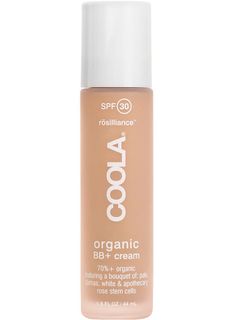
Coola Mineral Face SPF 30 Rosiliance BB+ Cream
Works for
0 of 1 advertised claim delivered
Sun protectionSPF 30 · 1 UV filter · Partial spectrumWeak protectionLow filter dose
This product does not offer good protection against UVA rays.
This product can be considered "reef safe" because it does not contain the UV filters (oxybenzone and octinoxate) that can be harmful to coral reefs when present in the water in high concentrations.
MoisturizingNot advertised by the brand · 10 ingredients credited for this claimGood support
This product can help improve hydration of the skin with the two types of ingredients.
The first type is called “humectants”:
these ingredients help attract water.
When humectants are on the surface of the skin, they “pull in” the moisture from the outside environment, or from
within deeper layers of the skin. The following ingredients in this product do the job:
glycerin, caprylyl glycol.
This product also contains ingredients called “occlusives”. They help reduce the speed with which our skin loses moisture to the outside environment. These ingredients also help soften the upper layer of the skin, so it feels less tight and nicer to the touch. The following ingredients in this product do the job: helianthus annuus seed oil, carthamus tinctorius seed oil.
Can it cause trouble?
Irritancy6 strong irritants: Citrus aurantium dulcis peel oil, Citrus aurantium dulcis fruit water + 4 more — patch-test recommendedHigh risk
Comedogenic3 ingredients rated 2 or more on the 0–5 pore-clogging scale3 flagged
User reviews
Be the first — your take helps the next person decide.
Ingredients
Filter by role to see what each ingredient is doing.
Titanium dioxide5.6%
- Irritation risk
- Low
Works as a UV filter when used in high concentrations. It is photostable and is effective mostly against the UVB light, with some protection in the UVA range. In small concentrations, used for its ability to improve the color of cosmetic products. Is usually well tolerated by the skin
More about Titanium dioxideGold~26–32%
Aluminum hydroxide~6.1–7.5%
- Irritation risk
- Low
Is used to add opaque (non-transparent) appearance to formulations. Can be used to coat other ingredients for even dispersion. This is a different ingredient compared to the ones used in antipersperants (aluminium chloride and aluminium chlorohydrate)
More about Aluminum hydroxideCaprylhydroxamic acid~5–6.1%
Caprylyl glycol~3.5–4.2%
- Irritation risk
- Medium
Helps preserve products and creates a nice product texture
More about Caprylyl glycolCarthamus tinctorius extract~2.7–3.3%
- Irritation risk
- Low
Carthamus tinctorius seed oil~2.3–2.8%
- Irritation risk
- Low
An emollient that helps soften the skin and might help calm down inflammation
More about Carthamus tinctorius seed oilCitrus aurantium dulcis peel oil~1.8–2.2%
- Irritation risk
- High
An essentil oil from orange peel. Potential allergen and can be irritating
More about Citrus aurantium dulcis peel oilCitrus aurantium dulcis fruit water~1.5–1.9%
- Irritation risk
- High
Cocoglycerides~1.4–1.7%
- Irritation risk
- High
Help soften the upper layer of the skin and make it easier for oil and water mix together. Recently, a rising number of allergic reactions to cocoglycerides and other coconut-derived surfactants has been reported. As there is a significant overlap between frequent irritants and allergens, we flag this ingredient for attention of those with very sensitive, reactive skin
More about CocoglyceridesCommiphora myrrha leaf cell extract~1–1.2%
- Irritation risk
- Low
Cucumis sativus fruit~0.75–1.1%
- Irritation risk
- Low
Cucumis sativus fruit extract~0.6–0.9%
- Irritation risk
- Medium
Might be somewhat helpful in reducing hyperpigmentation and neutralizing free radicals but its typical concentration in a product is too low for having an effect
More about Cucumis sativus fruit extractDicaprylyl carbonate~0.65–0.95%
- Irritation risk
- Low
Helps products spread more easily and works as an emollient to soften skin
More about Dicaprylyl carbonateEuterpe oleracea fruit oil~0.5–0.75%
- Irritation risk
- Medium
A plant oil that might help neutralize free radicals, but evidence of effectiveness in skin is lacking
More about Euterpe oleracea fruit oilParfum~0.45–0.7%
- Irritation risk
- High
An aromatic blend of unspecified and possibly irritating ingredients
More about ParfumGlycerin~0.5–0.75%
- Irritation risk
- Low
One of the best moisturizing ingredients. Naturally present in skin. It attracts water to the upper layer of the skin working as a humectant
More about GlycerinHelianthus annuus extract~0.5–0.8%
- Irritation risk
- Low
Helps soften the upper layer of the skin
More about Helianthus annuus extractHelianthus annuus seed extract~0.4–0.6%
- Irritation risk
- Low
Helianthus annuus seed oil~0.45–0.7%
- Irritation risk
- Low
A great emollient due to its high linoleic acid content. One of the most effective plant oils in helping skin hydration and repairing skin barrier function
More about Helianthus annuus seed oilHydrogen dimethicone~0.4–0.6%
- Irritation risk
- Low
Helps the function of sunscreen and pigment ingredients in the formulation
More about Hydrogen dimethiconeHydrolyzed wheat protein/pvp crosspolymer~0.35–0.65%
- Irritation risk
- Low
Hydroxyethyl acrylate/sodium acryloyldimethyl taurate copolymer~0.3–0.55%
- Irritation risk
- Medium
A gelling agent that thickens the product consistency and leaves the skin with a velvety finish
More about Hydroxyethyl acrylate/sodium acryloyldimethyl taurate copolymerIron oxides~0.25–0.5%
- Irritation risk
- Low
An umbrella term for the following three colorants: CI 77491, CI 77492, CI 77499. They might be able to offer some protection against visible light, but the degree of the protection is not clear
More about Iron oxidesOctyldodecyl oleate~0.35–0.65%
- Irritation risk
- Low
Oryza sativa~0.25–0.5%
- Irritation risk
- Low
Oryza sativa bran oil~0.35–0.6%
- Irritation risk
- Low
Helps soften the upper layer of the skin and might have some anti-oxidant properties
More about Oryza sativa bran oilPlankton extract~0.3–0.5%
- Irritation risk
- Medium
- Comedogenicity
- 3/5
Can help attract water to the upper layer of the skin
More about Plankton extractPropanediol~0.3–0.55%
- Irritation risk
- Low
Acts as a solvent for other ingredients. Speeds up the absorption of other ingredients into the skin
More about PropanediolRosa alba leaf cell extract~0.25–0.5%
- Irritation risk
- High
Rosa centifolia leaf cell extract~0.25–0.5%
- Irritation risk
- Low
Rosa damascena leaf cell extract~0.25–0.5%
- Irritation risk
- High
Rosa alba leaf cell extract~0.25–0.5%
- Irritation risk
- High
Rosmarinus officinalis leaf extract~0.25–0.45%
- Irritation risk
- High
Can be helpful in reducing inflammation in skin, including inflamed acne. It can be irritating
More about Rosmarinus officinalis leaf extractSodium citrate~0.25–0.5%
- Irritation risk
- Medium
Helps to control the skin's pH level. Maintains the skin's natural film of amino-lactic acids and oils. Helps to preserve products
More about Sodium citrateTrisodium ethylenediamine disuccinate~0.25–0.5%
- Irritation risk
- Medium
Used to improve stability of the formulation
More about Trisodium ethylenediamine disuccinateWater~0.25–0.5%
Xanthan gum~0.3–0.5%
- Irritation risk
- Low
Used to create a thicker product consistency
More about Xanthan gumAluminum hydroxide~0.35–0.6%
- Irritation risk
- Low
Is used to add opaque (non-transparent) appearance to formulations. Can be used to coat other ingredients for even dispersion. This is a different ingredient compared to the ones used in antipersperants (aluminium chloride and aluminium chlorohydrate)
More about Aluminum hydroxideCaprylhydroxamic acid~0.25–0.5%
Caprylyl glycol~0.3–0.6%
- Irritation risk
- Medium
Helps preserve products and creates a nice product texture
More about Caprylyl glycolCarthamus tinctorius extract~0.35–0.6%
- Irritation risk
- Low
Carthamus tinctorius seed oil~0.35–0.65%
- Irritation risk
- Low
An emollient that helps soften the skin and might help calm down inflammation
More about Carthamus tinctorius seed oilCitrus aurantium dulcis peel oil~0.25–0.5%
- Irritation risk
- High
An essentil oil from orange peel. Potential allergen and can be irritating
More about Citrus aurantium dulcis peel oilCitrus aurantium dulcis fruit water~0.25–0.5%
- Irritation risk
- High
Cocoglycerides~0.35–0.65%
- Irritation risk
- High
Help soften the upper layer of the skin and make it easier for oil and water mix together. Recently, a rising number of allergic reactions to cocoglycerides and other coconut-derived surfactants has been reported. As there is a significant overlap between frequent irritants and allergens, we flag this ingredient for attention of those with very sensitive, reactive skin
More about CocoglyceridesCommiphora myrrha leaf cell extract~0.25–0.5%
- Irritation risk
- Low
Cucumis sativus extract~0.25–0.5%
- Irritation risk
- Medium
Cucumis sativus fruit extract~0.25–0.5%
- Irritation risk
- Medium
Might be somewhat helpful in reducing hyperpigmentation and neutralizing free radicals but its typical concentration in a product is too low for having an effect
More about Cucumis sativus fruit extractDicaprylyl carbonate~0.35–0.6%
- Irritation risk
- Low
Helps products spread more easily and works as an emollient to soften skin
More about Dicaprylyl carbonateEuterpe oleracea fruit extract~0.25–0.5%
- Irritation risk
- Medium
A plant extract that can have some anti-oxidant effect in skin
More about Euterpe oleracea fruit extractEuterpe oleracea fruit oil~0.25–0.5%
- Irritation risk
- Medium
A plant oil that might help neutralize free radicals, but evidence of effectiveness in skin is lacking
More about Euterpe oleracea fruit oilParfum~0.25–0.45%
- Irritation risk
- High
An aromatic blend of unspecified and possibly irritating ingredients
More about ParfumGlycerin~0.3–0.55%
- Irritation risk
- Low
One of the best moisturizing ingredients. Naturally present in skin. It attracts water to the upper layer of the skin working as a humectant
More about GlycerinHelianthus annuus extract~0.35–0.6%
- Irritation risk
- Low
Helps soften the upper layer of the skin
More about Helianthus annuus extractHelianthus annuus seed extract~0.25–0.5%
- Irritation risk
- Low
Helianthus annuus seed oil~0.35–0.6%
- Irritation risk
- Low
A great emollient due to its high linoleic acid content. One of the most effective plant oils in helping skin hydration and repairing skin barrier function
More about Helianthus annuus seed oilHydrogen dimethicone~0.3–0.55%
- Irritation risk
- Low
Helps the function of sunscreen and pigment ingredients in the formulation
More about Hydrogen dimethiconeHydrolyzed wheat protein/pvp crosspolymer~0.3–0.55%
- Irritation risk
- Low
Hydroxyethyl acrylate/sodium acryloyldimethyl taurate copolymer~0.25–0.5%
- Irritation risk
- Medium
A gelling agent that thickens the product consistency and leaves the skin with a velvety finish
More about Hydroxyethyl acrylate/sodium acryloyldimethyl taurate copolymerIron oxides~0.25–0.5%
- Irritation risk
- Low
An umbrella term for the following three colorants: CI 77491, CI 77492, CI 77499. They might be able to offer some protection against visible light, but the degree of the protection is not clear
More about Iron oxidesMica~0.3–0.6%
- Irritation risk
- Low
Creates an illusion of smoother and more radiant skin tone. Adds shimmer to the skin by reflecting light
More about MicaOctyldodecyl oleate~0.35–0.65%
- Irritation risk
- Low
Oryza sativa~0.25–0.5%
- Irritation risk
- Low
Oryza sativa bran oil~0.35–0.6%
- Irritation risk
- Low
Helps soften the upper layer of the skin and might have some anti-oxidant properties
More about Oryza sativa bran oilPlankton extract~0.3–0.55%
- Irritation risk
- Medium
- Comedogenicity
- 3/5
Can help attract water to the upper layer of the skin
More about Plankton extractPropanediol~0.3–0.6%
- Irritation risk
- Low
Acts as a solvent for other ingredients. Speeds up the absorption of other ingredients into the skin
More about PropanediolRosa alba leaf cell extract~0.3–0.55%
- Irritation risk
- High
Rosa centifolia leaf cell extract~0.3–0.55%
- Irritation risk
- Low
Rosa damascena leaf cell extract~0.3–0.55%
- Irritation risk
- High
Rosa alba leaf cell extract~0.3–0.55%
- Irritation risk
- High
Rosmarinus officinalis leaf extract~0.3–0.5%
- Irritation risk
- High
Can be helpful in reducing inflammation in skin, including inflamed acne. It can be irritating
More about Rosmarinus officinalis leaf extractSodium citrate~0.3–0.55%
- Irritation risk
- Medium
Helps to control the skin's pH level. Maintains the skin's natural film of amino-lactic acids and oils. Helps to preserve products
More about Sodium citrateTrisodium ethylenediamine disuccinate~0.3–0.55%
- Irritation risk
- Medium
Used to improve stability of the formulation
More about Trisodium ethylenediamine disuccinateWater~0.3–0.55%
Xanthan gum~0.3–0.6%
- Irritation risk
- Low
Used to create a thicker product consistency
More about Xanthan gumAluminum hydroxide~0.4–0.65%
- Irritation risk
- Low
Is used to add opaque (non-transparent) appearance to formulations. Can be used to coat other ingredients for even dispersion. This is a different ingredient compared to the ones used in antipersperants (aluminium chloride and aluminium chlorohydrate)
More about Aluminum hydroxideCaprylhydroxamic acid~0.3–0.55%
Caprylyl glycol~0.4–0.6%
- Irritation risk
- Medium
Helps preserve products and creates a nice product texture
More about Caprylyl glycolCarthamus tinctorius extract~0.4–0.6%
- Irritation risk
- Low
Carthamus tinctorius seed oil~0.4–0.65%
- Irritation risk
- Low
An emollient that helps soften the skin and might help calm down inflammation
More about Carthamus tinctorius seed oilCitrus aurantium dulcis peel oil~0.3–0.55%
- Irritation risk
- High
An essentil oil from orange peel. Potential allergen and can be irritating
More about Citrus aurantium dulcis peel oilCitrus aurantium dulcis fruit water~0.3–0.55%
- Irritation risk
- High
Cocoglycerides~0.45–0.65%
- Irritation risk
- High
Help soften the upper layer of the skin and make it easier for oil and water mix together. Recently, a rising number of allergic reactions to cocoglycerides and other coconut-derived surfactants has been reported. As there is a significant overlap between frequent irritants and allergens, we flag this ingredient for attention of those with very sensitive, reactive skin
More about CocoglyceridesCommiphora myrrha leaf cell extract~0.3–0.55%
- Irritation risk
- Low
Cucumis sativus fruit~0.3–0.55%
- Irritation risk
- Low
Cucumis sativus fruit extract~0.3–0.55%
- Irritation risk
- Medium
Might be somewhat helpful in reducing hyperpigmentation and neutralizing free radicals but its typical concentration in a product is too low for having an effect
More about Cucumis sativus fruit extractDicaprylyl carbonate~0.4–0.6%
- Irritation risk
- Low
Helps products spread more easily and works as an emollient to soften skin
More about Dicaprylyl carbonateEuterpe oleracea fruit extract~0.3–0.55%
- Irritation risk
- Medium
A plant extract that can have some anti-oxidant effect in skin
More about Euterpe oleracea fruit extractEuterpe oleracea fruit oil~0.3–0.55%
- Irritation risk
- Medium
A plant oil that might help neutralize free radicals, but evidence of effectiveness in skin is lacking
More about Euterpe oleracea fruit oilParfum~0.3–0.55%
- Irritation risk
- High
An aromatic blend of unspecified and possibly irritating ingredients
More about ParfumGlycerin~0.35–0.6%
- Irritation risk
- Low
One of the best moisturizing ingredients. Naturally present in skin. It attracts water to the upper layer of the skin working as a humectant
More about GlycerinHelianthus annuus extract~0.4–0.6%
- Irritation risk
- Low
Helps soften the upper layer of the skin
More about Helianthus annuus extractHelianthus annuus seed extract~0.3–0.55%
- Irritation risk
- Low
Helianthus annuus seed oil~0.4–0.6%
- Irritation risk
- Low
A great emollient due to its high linoleic acid content. One of the most effective plant oils in helping skin hydration and repairing skin barrier function
More about Helianthus annuus seed oilHydrogen dimethicone~0.35–0.6%
- Irritation risk
- Low
Helps the function of sunscreen and pigment ingredients in the formulation
More about Hydrogen dimethiconeHydrolyzed wheat protein/pvp crosspolymer~0.35–0.6%
- Irritation risk
- Low
Hydroxyethyl acrylate/sodium acryloyldimethyl taurate copolymer~0.3–0.55%
- Irritation risk
- Medium
A gelling agent that thickens the product consistency and leaves the skin with a velvety finish
More about Hydroxyethyl acrylate/sodium acryloyldimethyl taurate copolymerIron oxides~0.3–0.55%
- Irritation risk
- Low
An umbrella term for the following three colorants: CI 77491, CI 77492, CI 77499. They might be able to offer some protection against visible light, but the degree of the protection is not clear
More about Iron oxidesOctyldodecyl oleate~0.4–0.65%
- Irritation risk
- Low
Oryza sativa~0.3–0.55%
- Irritation risk
- Low
Oryza sativa bran oil~0.4–0.6%
- Irritation risk
- Low
Helps soften the upper layer of the skin and might have some anti-oxidant properties
More about Oryza sativa bran oilPlankton extract~0.3–0.55%
- Irritation risk
- Medium
- Comedogenicity
- 3/5
Can help attract water to the upper layer of the skin
More about Plankton extractPropanediol~0.3–0.55%
- Irritation risk
- Low
Acts as a solvent for other ingredients. Speeds up the absorption of other ingredients into the skin
More about PropanediolRosa alba leaf cell extract~0.3–0.55%
- Irritation risk
- High
Rosa centifolia leaf cell extract~0.3–0.55%
- Irritation risk
- Low
Rosa damascena leaf cell extract~0.2–0.4%
- Irritation risk
- High
Rosa alba leaf cell extract~0.2–0.4%
- Irritation risk
- High
Rosmarinus officinalis leaf extract~0.15–0.3%
- Irritation risk
- High
Can be helpful in reducing inflammation in skin, including inflamed acne. It can be irritating
More about Rosmarinus officinalis leaf extractSodium citrate~0.2–0.35%
- Irritation risk
- Medium
Helps to control the skin's pH level. Maintains the skin's natural film of amino-lactic acids and oils. Helps to preserve products
More about Sodium citrateTrisodium ethylenediamine disuccinate~0.2–0.35%
- Irritation risk
- Medium
Used to improve stability of the formulation
More about Trisodium ethylenediamine disuccinateWater~0.2–0.35%
Xanthan gum~0.15–0.25%
- Irritation risk
- Low
Used to create a thicker product consistency
More about Xanthan gumIngredient list view
Titanium dioxide, Gold, Unknown, Aluminum hydroxide, Caprylhydroxamic acid, Caprylyl glycol, Carthamus tinctorius extract, Carthamus tinctorius seed oil, Citrus aurantium dulcis peel oil, Citrus aurantium dulcis fruit water, Cocoglycerides, Commiphora myrrha leaf cell extract, Cucumis sativus fruit, Cucumis sativus fruit extract, Dicaprylyl carbonate, Euterpe oleracea fruit oil, Parfum, Glycerin, Helianthus annuus extract, Helianthus annuus seed extract, Helianthus annuus seed oil, Hydrogen dimethicone, Hydrolyzed wheat protein/pvp crosspolymer, Hydroxyethyl acrylate/sodium acryloyldimethyl taurate copolymer, Iron oxides, Octyldodecyl oleate, Oryza sativa, Oryza sativa bran oil, Plankton extract, Propanediol, Rosa alba leaf cell extract, Rosa centifolia leaf cell extract, Rosa damascena leaf cell extract, Rosa alba leaf cell extract, Rosmarinus officinalis leaf extract, Sodium citrate, Trisodium ethylenediamine disuccinate, Water, Xanthan gum, Aluminum hydroxide, Caprylhydroxamic acid, Caprylyl glycol, Carthamus tinctorius extract, Carthamus tinctorius seed oil, Citrus aurantium dulcis peel oil, Citrus aurantium dulcis fruit water, Cocoglycerides, Commiphora myrrha leaf cell extract, Cucumis sativus extract, Cucumis sativus fruit extract, Dicaprylyl carbonate, Euterpe oleracea fruit extract, Unknown, Euterpe oleracea fruit oil, Parfum, Glycerin, Helianthus annuus extract, Helianthus annuus seed extract, Helianthus annuus seed oil, Hydrogen dimethicone, Hydrolyzed wheat protein/pvp crosspolymer, Hydroxyethyl acrylate/sodium acryloyldimethyl taurate copolymer, Iron oxides, Mica, Octyldodecyl oleate, Oryza sativa, Oryza sativa bran oil, Plankton extract, Propanediol, Rosa alba leaf cell extract, Rosa centifolia leaf cell extract, Rosa damascena leaf cell extract, Rosa alba leaf cell extract, Rosmarinus officinalis leaf extract, Sodium citrate, Trisodium ethylenediamine disuccinate, Water, Xanthan gum, Aluminum hydroxide, Caprylhydroxamic acid, Caprylyl glycol, Carthamus tinctorius extract, Carthamus tinctorius seed oil, Citrus aurantium dulcis peel oil, Citrus aurantium dulcis fruit water, Cocoglycerides, Commiphora myrrha leaf cell extract, Cucumis sativus fruit, Cucumis sativus fruit extract, Dicaprylyl carbonate, Euterpe oleracea fruit extract, Unknown, Euterpe oleracea fruit oil, Parfum, Glycerin, Helianthus annuus extract, Helianthus annuus seed extract, Helianthus annuus seed oil, Hydrogen dimethicone, Hydrolyzed wheat protein/pvp crosspolymer, Hydroxyethyl acrylate/sodium acryloyldimethyl taurate copolymer, Iron oxides, Octyldodecyl oleate, Oryza sativa, Oryza sativa bran oil, Plankton extract, Propanediol, Rosa alba leaf cell extract, Rosa centifolia leaf cell extract, Rosa damascena leaf cell extract, Rosa alba leaf cell extract, Rosmarinus officinalis leaf extract, Sodium citrate, Trisodium ethylenediamine disuccinate, Water, Xanthan gum
Compare prices
Retailers ranked by price — lowest first.

Affiliate links · prices updated regularly
Product summary
We do not recommend "Coola - Mineral Face SPF 30 Rosiliance BB+ Cream" because it does not provide good UVA protection. UVA sun rays don't burn the skin, but they still lead to photoaging and hyperpigmentation.
Its formula is also hydrating, so you might not need an additional moistruizer during the day.
Sunscreen filters
This moisturizer is a mineral sunscreen. It uses titanium dioxide for sun protection. Titanium dioxide almost never irritates the skin or stings eyes, but it can leave a white cast.
Irritation risk
This moisturizer contains a bunch of common irritants, including ingredients that do not provide any known benefit for the skin. It might not be the best choice if your skin is sensitive. We assess the overall irritancy of this moisturizer to be high. For a detailed overview of all potential irritants: click here
You can see the detailed formula review with the breakdown of all actives in the product and the full ingredient list with estimated concentrations in the tables below.
About the brand
According to Cruelty-Free Kitty "Coola" is cruelty free, but its parent company is not.
Price
The product retails for 55.00£ in the United Kingdom.
For a detailed price comparison: click here.
Sources cited in this review
Every concentration estimate and effectiveness label is anchored to one of these 13 studies and safety reviews.
- 1
- 2
- 3
- 4
- 5
- 6Effect of topically applied lipids on surfactant-irritated skinonlinelibrary.wiley.com

Affiliate links · As an Amazon Associate, WIMJ earns from qualifying purchases.