Works for
1 of 1 advertised claim delivered
Moisturizing19 ingredients credited for this claimStrong support
“This limited edition formulation calls upon jojoba oil for its moisturising and softening qualities, nutrient-rich watermelon butter and vitamin E to encourage nourished lips. The results?”
This product can help improve hydration of the skin with the two types of ingredients.
The first type is called “humectants”:
these ingredients help attract water.
When humectants are on the surface of the skin, they “pull in” the moisture from the outside environment, or from
within deeper layers of the skin. The following ingredients in this product do the job:
sodium hyaluronate, caprylyl glycol.
This product also contains ingredients called “occlusives”. They help reduce the speed with which our skin loses moisture to the outside environment. These ingredients also help soften the upper layer of the skin, so it feels less tight and nicer to the touch. The following ingredients in this product do the job: cera microcristallina, ricinus communis seed oil.
The following ingredients in this product are especially good for supporting the skin barrier and helping with the hydration level: palmitoyl tripeptide-1
Anti-agingNot advertised by the brand · 4 ingredients credited for this claimModerate support
This product contains palmitoyl tripeptide-1. This ingredient might be able to help reduce and prevent fine lines and wrinkles, improve skin elasticity and firmness, but there is not enough evidence that it actually works.
Can it cause trouble?
Irritancy2 strong irritants: Parfum, Aroma — patch-test recommendedHigh risk
Comedogenic8 ingredients rated 2 or more on the 0–5 pore-clogging scale8 flagged
User reviews
Be the first — your take helps the next person decide.
Ingredients
Filter by role to see what each ingredient is doing.
Diisostearyl malate~25–31%
- Irritation risk
- Medium
Helps to soften the upper layer of the skin
More about Diisostearyl malateHydrogenated polyisobutene~4.5–5.5%
- Irritation risk
- Low
Used to improve the product consistency and soften the upper layer of the skin
More about Hydrogenated polyisobutenePolyglyceryl-2 triisostearate~3.8–4.6%
- Irritation risk
- Low
Helps to soften the upper layer of the skin and create a nice product texture
More about Polyglyceryl-2 triisostearateSimmondsia chinensis seed extract~4.2–5.2%
- Irritation risk
- Low
Plant oil that helps soften the upper layer of the skin
More about Simmondsia chinensis seed extractMicrocrystalline wax~2.9–3.6%
Cera microcristallina~2.5–3.1%
- Irritation risk
- Low
Helps to soften the upper layer of the skin, reduce water loss from its surface and create a thicker product consistency
More about Cera microcristallinaPolyethylene~2–2.4%
Dipentaerythrityl hexahydroxystearate/hexastearate/hexarosinate~1.5–1.8%
- Irritation risk
- Low
Jojoba esters~1.3–1.5%
- Irritation risk
- Medium
An emollient made of jojoba oil. Helps soften the skin and support its barrier function
More about Jojoba estersIsostearyl isostearate~1.1–1.3%
- Irritation risk
- Medium
- Comedogenicity
- 3/5
Helps soften the upper layer of the skin and improve the product texture. It can be comedogenic
More about Isostearyl isostearateHydrogenated vegetable oil~0.75–1.15%
- Irritation risk
- Low
- Comedogenicity
- 2/5
An oil from a mixture of different vegetables. Helps soften the upper layer of the skin
More about Hydrogenated vegetable oilCalcium aluminum borosilicate~0.65–1%
Isostearyl alcohol~0.6–0.9%
- Irritation risk
- Low
Helps soften the upper layer of the skin
More about Isostearyl alcoholEthylene/propylene/styrene copolymer~0.5–0.75%
- Irritation risk
- Low
Used to create a thicker product consistency
More about Ethylene/propylene/styrene copolymerButylene/ethylene/styrene copolymer~0.45–0.7%
- Irritation risk
- Low
Used to create a gel-like product texture
More about Butylene/ethylene/styrene copolymerButyrospermum parkii nut extract~0.55–0.8%
- Irritation risk
- Low
Citrullus lanatus seed oil~0.55–0.8%
- Irritation risk
- Low
Ethylhexyl palmitate~0.5–0.75%
- Irritation risk
- Low
- Comedogenicity
- 3/5
An emollient that helps soften the skin and create a nice product texture
More about Ethylhexyl palmitateRicinus communis seed oil~0.45–0.7%
- Irritation risk
- Medium
A plant oil that can help soften the skin. It might be helpful in calming down inflammation, but solid research is lacking. Is often used in lip products to create the needed product consistency
More about Ricinus communis seed oilTrihydroxystearin~0.35–0.6%
- Irritation risk
- Low
Helps soften the upper layer of the skin and improve the product texture
More about TrihydroxystearinVp/hexadecene copolymer~0.45–0.65%
- Irritation risk
- Low
Creates a nice product texture and can support water-resistance of sunscreens
More about Vp/hexadecene copolymerCaprylyl glycol~0.4–0.65%
- Irritation risk
- Medium
Helps preserve products and creates a nice product texture
More about Caprylyl glycolSilica~0.5–0.7%
Sodium hyaluronate~0.3–0.55%
- Irritation risk
- Low
One of the best moisturizing ingredients. Attracts water into the upper layer of the skin
More about Sodium hyaluronateTribehenin~0.4–0.6%
- Irritation risk
- Low
Used to create a thicker product consistency and soften the upper layer of the skin
More about TribeheninMalic acid~0.3–0.55%
Hydrogenated castor oil~0.45–0.65%
- Irritation risk
- Medium
A plant oil that can help soften the skin. It might be helpful in calming down inflammation, but solid research is lacking. Is often used in lip products to create the needed product consistency
More about Hydrogenated castor oilTocopherol~0.3–0.55%
- Irritation risk
- Low
Pure form of vitamin E. Can help moisturise and protect the skin from free radicals. Often used to help stabilise other ingredients or the formula itself
More about TocopherolTocopheryl acetate~0.3–0.6%
- Irritation risk
- Medium
A more stable but less bio-available form of vitamin E compared to Tocopherol. Might help moisturize and protect the skin from free radicals, but mostly used in low concentrations to stabilize other ingredients.
More about Tocopheryl acetateSorbitan isostearate~0.3–0.6%
- Irritation risk
- Low
Helps oil and water mix together
More about Sorbitan isostearateSaccharin~0.3–0.6%
- Irritation risk
- Low
Tin oxide~0.5–0.7%
- Irritation risk
- Low
A colorant that can add a pearl-like appearance to the formulation
More about Tin oxideRuby powder~0.3–0.55%
- Irritation risk
- Low
Lactic acid~0.3–0.55%
- Irritation risk
- Medium
An exfoliating and moisturizing alpha-hydroxy acid (AHA). Typically causes less irritation than other AHAs, for example, glycolic acid. At high concentrations (about 15%), lactic acid can help reduce lines and wrinkles. Recent studies show that lactic acid can support the "good" bacteria living on skin's surface (healthy skin microbiome)
More about Lactic acidLecithin~0.45–0.65%
- Irritation risk
- Low
Used mostly for creating emulsions - helping oil and water mix together. Helps soften the upper layer of the skin
More about LecithinPalmitoyl tripeptide-1~0.4–0.65%
- Irritation risk
- Low
A type of peptide. Peptides are excellent moisturizers and might be able support collagen production reducing fine lines and wrinkles
More about Palmitoyl tripeptide-1Calcium sodium borosilicate~0.35–0.65%
Synthetic fluorphlogopite~0.35–0.6%
- Irritation risk
- Low
A mineral that is used as an optical filter (makes the skin looks nicer through light reflection) and to improve the texture of cosmetic products
More about Synthetic fluorphlogopiteCitric acid~0.3–0.55%
- Irritation risk
- Medium
Can work as an exfoliant but is typically used to adjust the product pH
More about Citric acidParfum~0.3–0.5%
- Irritation risk
- High
An aromatic blend of unspecified and possibly irritating ingredients
More about ParfumAroma~0.3–0.55%
Bht~0.3–0.55%
Pentaerythrityl tetra-di-t-butyl hydroxyhydrocinnamate~0.3–0.6%
- Irritation risk
- Low
Used to increase stability of product formulations
More about Pentaerythrityl tetra-di-t-butyl hydroxyhydrocinnamateAscorbyl palmitate~0.3–0.55%
- Irritation risk
- Medium
Being a lipid soluble form of vitamin C, it is more stable and can penetrate the skin better than L-Ascorbic acid. It is effective in protecting the skin from free radicals, as well as evening the skin tone, but is less effective in stimulating collagen production compared to L-Ascorbic acid.
More about Ascorbyl palmitateTitanium dioxide~0.45–0.7%
- Irritation risk
- Low
Works as a UV filter when used in high concentrations. It is photostable and is effective mostly against the UVB light, with some protection in the UVA range. In small concentrations, used for its ability to improve the color of cosmetic products. Is usually well tolerated by the skin
More about Titanium dioxideCi 77891~0.3–0.5%
- Irritation risk
- Low
Mica~0.4–0.6%
- Irritation risk
- Low
Creates an illusion of smoother and more radiant skin tone. Adds shimmer to the skin by reflecting light
More about MicaCi 19140~0.3–0.55%
Ci 14700~0.3–0.55%
Ci 45380~0.3–0.55%
Ci 15850~0.3–0.55%
Iron oxides~0.3–0.5%
- Irritation risk
- Low
An umbrella term for the following three colorants: CI 77491, CI 77492, CI 77499. They might be able to offer some protection against visible light, but the degree of the protection is not clear
More about Iron oxidesCi 77491~0.3–0.55%
- Irritation risk
- Low
A red colorant made of iron oxide. Typically is not irritating
More about Ci 77491Ci 75470~0.3–0.55%
Copper powder~0.3–0.55%
- Irritation risk
- Low
Ci 77400~0.3–0.55%
- Irritation risk
- Low
Ci 17200~0.3–0.55%
Ci 73360~0.3–0.55%
Ci 15850~0.3–0.55%
Ci 19140~0.3–0.55%
Ci 15985~0.3–0.55%
Blue 1 lake~0.3–0.55%
Ci 42090~0.3–0.55%
Ci 77163~0.3–0.55%
Bronzite powder~0.3–0.6%
- Irritation risk
- Low
Ci 77400~0.3–0.5%
- Irritation risk
- Low
Iron oxides~0.25–0.45%
- Irritation risk
- Low
An umbrella term for the following three colorants: CI 77491, CI 77492, CI 77499. They might be able to offer some protection against visible light, but the degree of the protection is not clear
More about Iron oxidesCi 77499~0.25–0.5%
Iron oxides~0.25–0.45%
- Irritation risk
- Low
An umbrella term for the following three colorants: CI 77491, CI 77492, CI 77499. They might be able to offer some protection against visible light, but the degree of the protection is not clear
More about Iron oxidesCi 77492~0.2–0.4%
Ci 45410~0.2–0.35%
Ci 77742~0.2–0.35%
Ci 45410~0.2–0.35%
Ci 45380~0.15–0.25%
Ci 17200~0.15–0.25%
Ingredient list view
Diisostearyl malate, Hydrogenated polyisobutene, Polyglyceryl-2 triisostearate, Simmondsia chinensis seed extract, Microcrystalline wax, Cera microcristallina, Polyethylene, Dipentaerythrityl hexahydroxystearate/hexastearate/hexarosinate, Jojoba esters, Isostearyl isostearate, Hydrogenated vegetable oil, Calcium aluminum borosilicate, Isostearyl alcohol, Ethylene/propylene/styrene copolymer, Butylene/ethylene/styrene copolymer, Butyrospermum parkii nut extract, Citrullus lanatus seed oil, Ethylhexyl palmitate, Ricinus communis seed oil, Trihydroxystearin, Vp/hexadecene copolymer, Caprylyl glycol, Silica, Sodium hyaluronate, Tribehenin, Malic acid, Hydrogenated castor oil, Tocopherol, Tocopheryl acetate, Sorbitan isostearate, Saccharin, Tin oxide, Ruby powder, Lactic acid, Lecithin, Palmitoyl tripeptide-1, Calcium sodium borosilicate, Synthetic fluorphlogopite, Citric acid, Parfum, Aroma, Bht, Pentaerythrityl tetra-di-t-butyl hydroxyhydrocinnamate, Ascorbyl palmitate, Titanium dioxide, Ci 77891, Mica, Ci 19140, Ci 14700, Unknown, Ci 45380, Ci 15850, Iron oxides, Ci 77491, Ci 75470, Copper powder, Ci 77400, Ci 17200, Ci 73360, Ci 15850, Ci 19140, Ci 15985, Blue 1 lake, Ci 42090, Ci 77163, Bronzite powder, Ci 77400, Iron oxides, Ci 77499, Iron oxides, Ci 77492, Ci 45410, Ci 77742, Ci 45410, Ci 45380, Ci 17200
Compare prices
Retailers ranked by price — lowest first.
Product summary
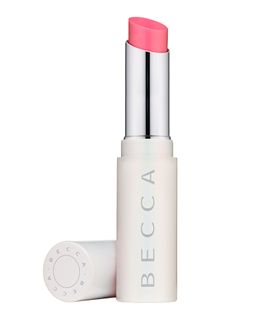
"BECCA - Pearl Glow Lip Tint Rose" is effective for: Moisturizing
This lip product could be helpful for: Anti-aging, but its actives are not the most effective or are not well-studied.
Ingredient callouts
- This moisturizer also contains Peptides (palmitoyl tripeptide-1 0.40% - 0.65%). Peptides are a very big group of ingredients. They all consist of a different combination of aminoacids. Our skin produces Peptides naturally. Some of them work as natural antibiotics, promote wound-healing and production of collagen. The scientists are still studying how effective the topical application of Peptides is, but it is very likely that they are helpful. Peptides might be able to support skin barrier restoration and even have an anti-aging benefit. At the very least, they certainly help attract water to the skin and support the hydration in this way.
About the brand
According to Cruelty-Free Kitty "BECCA" is cruelty free, but its parent company is not.
Price
The product retails for 30.40$ in the United States.
For a detailed price comparison: click here.
Sources cited in this review
Every concentration estimate and effectiveness label is anchored to one of these 17 studies and safety reviews.
- 1
- 2
- 3
- 4
- 5
- 6

Affiliate links · As an Amazon Associate, WIMJ earns from qualifying purchases.