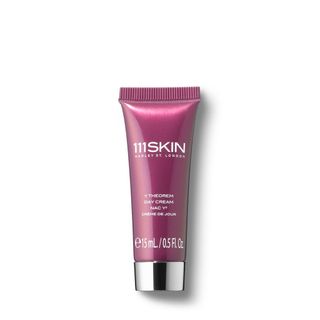
111SKIN Complimentary Y Theorem Day Cream NAC Y2 DELUXE
Works for
0 of 2 advertised claims delivered
Evens skin tone1 ingredient credited for this claimWeak support
“An advanced brightening treatment that works to eliminate pigmentation and dark spots to reveal a bright and even skin tone.”
Effective ingredients missing or their concentration is too low
Exfoliation1 ingredient credited for this claimWeak support
“An advanced brightening treatment that works to eliminate pigmentation and dark spots to reveal a bright and even skin tone.”
This product does not contain effective exfoliating ingredients. It might be able to deliver physical exfoliation, that is scrub off some of the dead cells on the surface of the skin. We do not recommend physical exfoliation, because it is not uniform (some bits of skin can get exfoliated too much while others not at all). It can also traumatize the skin and aggrevate acne and other skin conditions.
MoisturizingNot advertised by the brand · 9 ingredients credited for this claimGood support
This product can help improve hydration of the skin with the two types of ingredients.
The first type is called “humectants”:
these ingredients help attract water.
When humectants are on the surface of the skin, they “pull in” the moisture from the outside environment, or from
within deeper layers of the skin. The following ingredients in this product do the job:
glycerin, sodium hyaluronate.
This product also contains ingredients called “occlusives”. They help reduce the speed with which our skin loses moisture to the outside environment. These ingredients also help soften the upper layer of the skin, so it feels less tight and nicer to the touch. The following ingredients in this product do the job: caprylic/capric triglyceride, isopropyl myristate.
Can it cause trouble?
Irritancy2 strong irritants: Retinyl palmitate, ParfumMedium risk
Comedogenic1 ingredient rated 2 or more on the 0–5 pore-clogging scale1 flagged


User reviews
Be the first — your take helps the next person decide.
Ingredients
Filter by role to see what each ingredient is doing.
Water~40–60%
Isopropyl myristate~5.2–7.7%
- Irritation risk
- Low
- Comedogenicity
- 3/5
An emollient that helps soften the skin. Could be comedogenic
More about Isopropyl myristatePeg-40 hydrogenated castor oil~3.2–4.8%
- Irritation risk
- Medium
Helps oil and water mix together
More about Peg-40 hydrogenated castor oilCaprylic/capric triglyceride~2.8–4.1%
- Irritation risk
- Medium
A good mix of fatty acids that forms a protective layer on the skin. Improves the shelf life of products. Derived from coconut and glycerin
More about Caprylic/capric triglyceridePeg-100 stearate~2.1–3.1%
- Irritation risk
- Low
Helps oil and water mix togehter and creates a nice product texture
More about Peg-100 stearateGlycerin~1.7–2.5%
- Irritation risk
- Low
One of the best moisturizing ingredients. Naturally present in skin. It attracts water to the upper layer of the skin working as a humectant
More about GlycerinBenzyl alcohol~0.45–1%
- Irritation risk
- High
A preservative. Can be used to mask unpleasant smell. Can be irritating
More about Benzyl alcoholOryza sativa bran oil~1.2–1.7%
- Irritation risk
- Low
Helps soften the upper layer of the skin and might have some anti-oxidant properties
More about Oryza sativa bran oilOlea europaea fruit oil~0.9–1.35%
- Irritation risk
- Medium
An emollient that helps soften the skin but is not effective for restoring its barrier function. Might be helpful to calm down inflammation
More about Olea europaea fruit oilSodium hyaluronate~0.55–1.35%
- Irritation risk
- Low
One of the best moisturizing ingredients. Attracts water into the upper layer of the skin
More about Sodium hyaluronateCarbomer~0.45–1.1%
- Irritation risk
- Low
Helps create a thicker or gel-like product texture. It is not a surfactant but can be used in gentle cleansing formulations
More about CarbomerPeg-7 hydrogenated castor oil~0.4–1%
Sodium hydroxide~0.35–0.75%
Polysorbate 20~0.2–0.8%
Retinyl palmitate~0.15–0.6%
- Irritation risk
- High
Three steps removed from the active form of vitamin A - retinoic acid. To have an effect in the skin, it first needs to be converted twice to become the retinoic acid. This means it is less potent than retinol, but could also be less irritating. Once converted to the retinoic acid in the skin, it helps against all signs of aging, improves skin cell turnover and helps fight blemishes and clogged pores. However, in many cosmetic formulations, it is used in a concentration that is too low to have the full effect
More about Retinyl palmitateTocopherol~0.15–0.55%
- Irritation risk
- Low
Pure form of vitamin E. Can help moisturise and protect the skin from free radicals. Often used to help stabilise other ingredients or the formula itself
More about TocopherolLinoleic acid~0.2–0.75%
- Irritation risk
- Low
An excellent emollient. Helps soften the skin, restore its barrier function, and can help to calm down inflammation. It can be helpful to prevent blemishes and clogged pores
More about Linoleic acidStearic acid~0.15–0.55%
- Irritation risk
- Low
Helps oil and water mix together and works as an emollient
More about Stearic acidSodium ascorbyl phosphate~0.05–0.25%
- Irritation risk
- Medium
A stable derivative of vitamin C. It is oil-soluble which means it is more likely to penetrate the skin compared to the pure form of vitamin C (which is water-soluble), but it is less bio-available and is way less effective in stimulating collagen and reducing wrinkles compared to the pure form of vitamin C (L-ascorbic acid) and its other derivatives (for example, magnesium ascorbyl phosphate). At the same time, this vitamin C derivative has been shown in studies to be effective in reducing acne, blemishes and clogged pores. It is less irritating then the pure form of vitamin C
More about Sodium ascorbyl phosphateAesculus hippocastanum extract~0.05–0.25%
- Irritation risk
- High
A plant extract. Benefits of topical application are not confirmed
More about Aesculus hippocastanum extractAcetyl cysteine~0.01–0.1%
- Irritation risk
- Low
Parfum~0.01–0.05%
- Irritation risk
- High
An aromatic blend of unspecified and possibly irritating ingredients
More about ParfumIngredient list view
Water, Isopropyl myristate, Peg-40 hydrogenated castor oil, Caprylic/capric triglyceride, Peg-100 stearate, Glycerin, Benzyl alcohol, Oryza sativa bran oil, Olea europaea fruit oil, Sodium hyaluronate, Carbomer, Peg-7 hydrogenated castor oil, Sodium hydroxide, Polysorbate 20, Retinyl palmitate, Tocopherol, Linoleic acid, Stearic acid, Sodium ascorbyl phosphate, Aesculus hippocastanum extract, Acetyl cysteine, Parfum
Compare prices
Retailers ranked by price — lowest first.
Worth comparing, line by line.
Match % combines shared ingredients, the first five ingredients, shared actives and hero ingredients, irritancy (lower counts in the alternative's favour), texture and body area. Only products in the same routine step are compared.
| 111SKINComplimentary Y Theorem Day Cream NAC Y2 DELUXEYOUR PRODUCT | BiossanceSqualane + Omega Repair Cream | NaturiumRetinol Cream 2.5% | Dieux SkinInstant Angel | |
|---|---|---|---|---|
| Match | — | 61% | 59% | 56% |
| Price | $270.00 | $14.00−$256.00 | $15.99−$254.01 | $8.98−$261.02 |
| Shared key ingredients | — | 4 of 7 | 5 of 7 | 4 of 7 |
| Key difference | — | Ceramide Np | Retinol | Palmitoyl Hexapeptide-12 |
| Irritancy | Medium | Low | Medium | Medium |
| Drying alcohol | — | — | — | — |
| View product | Shop | Shop | Shop |


Sources cited in this review
Every concentration estimate and effectiveness label is anchored to one of these 18 studies and safety reviews.
- 1
- 2
- 3
- 4Use of “natural” oils for moisturization: Review of olive, coconut, and sunflower seed oilonlinelibrary.wiley.com
- 5Hyaluronic acid: A key molecule in skin agingncbi.nlm.nih.gov
- 6

Affiliate links · As an Amazon Associate, WIMJ earns from qualifying purchases.